


BigCommerce Vs. Squarespace: Comparison and Expert Reviews for 2026


If you’re weighing between BigCommerce and Squarespace, you’re likely deciding between deep customization and operational power versus ease of use and creative control. BigCommerce offers your team advanced ecommerce platform tools for scaling complex catalogs and multi-channel sales, while Squarespace offers a design-driven ecommerce platform that makes launching a visually polished store simple, even if you aren’t a tech expert. This article covers how each ecommerce platform handles product management, integrations, payments, and growth; so you can confidently choose the right fit for your business goals, team skills, and customer experience ambitions.
BigCommerce vs. Squarespace: An Overview
BigCommerce



Squarespace




Why Trust Our Software Reviews
We’ve been testing and reviewing retail and ecommerce software and services since 2021.
As retail experts ourselves, we know how critical and difficult it is to make the right decision when selecting software. We invest in deep research to help our audience make better software purchasing decisions.
We’ve tested more than 2,000 tools for different finance and accounting use cases and written over 1,000 comprehensive software reviews. Learn how we stay transparent and our review methodology.
BigCommerce vs. Squarespace Pricing Comparison
| BigCommerce | Squarespace | |
|---|---|---|
| Free Trial | Free demo available | Free trial available |
| Pricing | Pricing upon request | From $16/month (billed annually) |
BigCommerce Vs. Squarespace Pricing & Hidden Costs
BigCommerce uses a tiered subscription model based on your store’s annual sales volume, with higher tiers unlocking more advanced features and support. You might also encounter extra costs for premium apps, payment processing, and third-party integrations. Squarespace offers flat-rate plans with ecommerce features included, but some advanced selling tools, transaction fees, and add-ons can increase your total spend as your store grows.
To choose the right pricing model, look beyond the monthly subscription and consider your projected sales, the features you’ll actually use, and any third-party tools you’ll need to connect. Review each platform’s upgrade triggers, transaction fees, and integration costs to avoid surprises. It helps to map out your growth plans and estimate total costs over time, and not just at launch.
BigCommerce vs. Squarespace Feature Comparison
BigCommerce supports your daily operations with advanced product catalog management and built-in multi-channel selling, making it easier to handle large inventories and sync sales across platforms. Squarespace focuses on intuitive drag-and-drop design and built-in marketing tools, helping you quickly update your storefront and launch campaigns without technical hurdles.
| BigCommerce | Squarespace | |
|---|---|---|
| A/B Testing | ||
| API | ||
| Data Export | ||
| Data Import | ||
| External Integrations | ||
| Multi-User | ||
| Third-Party Plugins/Add-Ons |
BigCommerce Vs. Squarespace Integrations
| Factor | BigCommerce | Squarespace |
|---|---|---|
| PayPal | ✅ | ✅ |
| Stripe | ✅ | ✅ |
| Amazon Pay | ✅ | ❌ |
| eBay | ❌ | ❌ |
| Mailchimp | ✅ | ✅ |
| QuickBooks Online | ✅ | ✅ |
| ShipStation | ✅ | ✅ |
| Instagram Shopping | ❌ | ❌ |
| API | ✅ | ✅ |
| Zapier | ✅ | ✅ |
BigCommerce offers a broader range of direct integrations, especially for payment options and accounting features, while Squarespace covers the basics and relies more on its API for advanced connections. If your business depends on marketplace selling or accounting integrations, BigCommerce is likely to meet more of your needs out of the box, but both platforms support flexible workflows through API and Zapier.
BigCommerce Vs. Squarespace Security, Compliance & Reliability
| Factor | BigCommerce | Squarespace |
|---|---|---|
| PCI Compliance | PCI DSS 4.0 Level 1 certified, supporting secure payment processing out of the box. | PCI compliant for online payments, with secure checkout for customers. |
| SSL Encryption | Provides free SSL certificates for all stores, ensuring encrypted data transfer. | Includes SSL certificates on all plans for secure browsing and checkout. |
| Uptime Guarantee | 99.99% uptime real-time monitoring and incident response, although they don’t have an official SLA. | 99.9% uptime with automated monitoring and regular infrastructure updates, though they lack an SLA. |
| Data Privacy | Offers GDPR tools, privacy policy templates, and data export features. | Supports GDPR compliance with privacy controls and data request tools. |
| Fraud Protection | Integrates with third-party fraud detection tools and offers built-in controls. | Includes basic fraud protection and integrates with select payment providers. |
BigCommerce and Squarespace are fairly similar in security and reliability, with both covering essential protections for online stores. BigCommerce leans slightly more toward enterprise-grade features, while Squarespace focuses on delivering straightforward, secure ecommerce built for simplicity.
BigCommerce Vs. Squarespace Ease of Use
| Factor | BigCommerce | Squarespace |
|---|---|---|
| User Interface | Dashboard is feature-rich but can feel complex for new users managing large catalogs. | Clean, intuitive interface with drag-and-drop editing for quick site changes. |
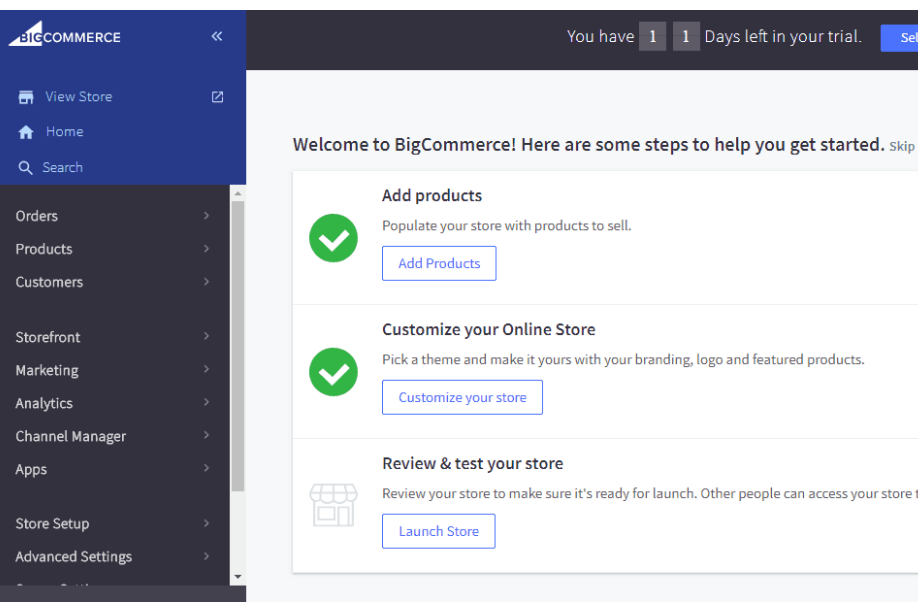
| Onboarding | Guided setup walks users through key steps, but advanced options may require extra learning. | Simple onboarding with step-by-step prompts and helpful tooltips. |
| Store Setup | Offers detailed product and channel setup, which can be time-consuming for small teams. | Fast store launch with pre-built templates and minimal configuration. |
| Support | 24/7 support via chat, email, and phone, plus a large help center. | Email and live chat support, paid access to a Squarespace Expert, with a searchable knowledge base. |
| Customization | Extensive customization through code and integrations, best for users with technical skills. | Visual customization is easy, but advanced changes are more limited. |
Squarespace is easier for most users to pick up and run with, while BigCommerce offers more depth for those willing to navigate a steeper learning curve. Squarespace shines for its approachable design and quick setup, while BigCommerce’s usability strength is in its flexibility and control for experienced users.
BigCommerce vs Squarespace: Pros & Cons
BigCommerce
- You can easily customize your store with its flexible design tools.
- Your team benefits from strong SEO features that boost visibility.
- You get reliable performance with fast loading times.
- Your team might find the learning curve a bit steep.
- You could encounter limitations with multi-language support.
- You might need more advanced reporting tools for detailed insights.
Squarespace
- You can create stunning websites with its beautiful design templates.
- It's easy to use, even if you're not tech-savvy.
- The drag-and-drop interface makes site customization simple.
- Your site customization options are limited compared to some competitors.
- The customer support can be slow and less responsive.
- You might find the onboarding process a bit challenging if you're new to ecommerce.
Best Use Cases for BigCommerce and Squarespace
BigCommerce
- Fashion Retailers BigCommerce’s flexible design tools let you create visually appealing stores that attract fashion-savvy customers.
- Electronics Stores Its strong SEO features help your tech products reach a wider audience, boosting your online presence.
- Mid-Sized Businesses BigCommerce supports scalability, allowing your business to grow without hitting platform limitations.
- Marketing Teams The SEO capabilities enable your team to enhance your brand’s visibility and drive more traffic.
- Home Goods Retailers You can benefit from reliable performance and fast loading times, ensuring a smooth shopping experience for your customers.
- Digital Agencies BigCommerce’s customizable design options let your agency craft unique, branded experiences for clients.
Squarespace
- Creative professionals Show portfolios with visually appealing templates.
- Small business owners Set up an online store quickly with user-friendly tools.
- Photographers Present work beautifully using built-in gallery options.
- Artists Create a sleek online gallery to sell artwork.
- Designers Build a professional site with modern, clean aesthetics.
- Bloggers Easily craft and manage content with built-in blogging features.
Who Should Use BigCommerce, And Who Should Use Squarespace?
BigCommerce is best for established retailers, fast-growing brands, and teams managing complex catalogs or multi-channel sales who need advanced integrations and customization. Squarespace is a fit for creative entrepreneurs, small businesses, and teams that value design, simplicity, and a quick launch over deep operational control. If your business relies on marketplace selling, custom workflows, or scaling up, BigCommerce is the stronger choice. If you want to get online fast with an aesthetically pleasing storefront and minimal technical overhead, Squarespace is the way to go.
Differences Between BigCommerce and Squarespace
| BigCommerce | Squarespace | |
|---|---|---|
| Catalog Complexity | Handles large, complex product catalogs with advanced filtering and variants. | Best for smaller catalogs with straightforward product options. |
| Customization | Extensive code access and developer tools for deep customization. | Visual editor with limited backend customization options. |
| Multi-Channel Sales | Built-in integrations for direct marketplaces and sales channels. | Limited direct marketplace integrations; focuses on website sales. |
| Pricing Model | Tiered pricing based on sales volume and feature access. | Flat-rate plans with features bundled by plan type. |
| Read BigCommerce ReviewOpens new window | Read Squarespace ReviewOpens new window |
Similarities Between BigCommerce and Squarespace
| Built-In Analytics | Both provide built-in analytics dashboards to track sales, traffic, and customer behavior, though BigCommerce’s reporting is more advanced. |
|---|---|
| Hosted Platform | Both are fully hosted solutions, so you don’t need to manage servers or security updates; each handles maintenance and uptime for your storefront. |
| Mobile Responsiveness | Both offer mobile-optimized templates and storefronts, so your site looks and works well on any device. |
| Payment Gateways | Both support major payment processors like PayPal and Stripe, letting you accept credit cards and digital wallets at checkout. |
| SSL Security | Both include SSL certificates on all plans, ensuring secure browsing and checkout for your customers. |
| Read BigCommerce ReviewOpens new window Read Squarespace ReviewOpens new window | |