

Mailchimp Review: Pros, Cons, Features, and Pricing


Mailchimp is an e-commerce email marketing software that helps businesses create and manage email campaigns to engage customers and drive sales. It's particularly beneficial for small to medium-sized businesses (SMBs), marketing teams, and e-commerce retailers looking to simplify their email marketing and customer relationship management (CRM) efforts, such as independent online stores or niche product sellers. Mailchimp's user-friendly interface and extensive automation make it a valuable tool for reaching your audience effectively.
Mailchimp addresses common pain points, such as managing large email lists and tailoring content, making it ideal for marketing and sales teams. This article covers Mailchimp's features, pros and cons, use cases, and pricing so you can decide if it aligns with your marketing needs and goals.
Mailchimp Evaluation Summary
- From $13/month
- Free plan available and 14-day free trial
Why Trust Our Software Reviews
Mailchimp Overview
In my opinion, Mailchimp stands out as a solid choice for small to medium-sized e-commerce businesses looking for accessible email marketing solutions. Its user-friendly interface makes onboarding relatively smooth, although some users might find the customer support lacking without a premium plan. The software excels with its automation features and integrations, making it ideal for teams eager to improve their email marketing without complex setups. However, for large enterprises requiring extensive customization and dedicated support, other tools might offer better options. Mailchimp's pricing is competitive, especially for those just starting with an email marketing platform, providing good value with essential features.
pros
-
Over 100 templates help you design professional emails quickly.
-
Automation features save you time on repetitive tasks.
-
The user-friendly interface lets your team create campaigns efficiently.
cons
-
A learning curve exists before you can use all features effectively.
-
Advanced customization options might not meet all your needs.
-
Customer support can be limited without a premium plan.
-

GoBolt
Visit WebsiteThis is an aggregated rating for this tool including ratings from Crozdesk users and ratings from other sites.4.2 -
4ALLPORTAL
Visit WebsiteThis is an aggregated rating for this tool including ratings from Crozdesk users and ratings from other sites.4.7 -
Mouseflow
Visit WebsiteThis is an aggregated rating for this tool including ratings from Crozdesk users and ratings from other sites.4.7



Our Review Methodology
How We Test & Score Tools
We’ve spent years building, refining, and improving our software testing and scoring system. The rubric is designed to capture the nuances of software selection and what makes a tool effective, focusing on critical aspects of the decision-making process.
Below, you can see exactly how our testing and scoring works across seven criteria. It allows us to provide an unbiased evaluation of the software based on core functionality, standout features, ease of use, onboarding, customer support, integrations, customer reviews, and value for money.
Core Functionality (25% of final scoring)
The starting point of our evaluation is always the core functionality of the tool. Does it have the basic features and functions that a user would expect to see? Are any of those core features locked to higher-tiered pricing plans? At its core, we expect a tool to stand up against the baseline capabilities of its competitors.
Standout Features (25% of final scoring)
Next, we evaluate uncommon standout features that go above and beyond the core functionality typically found in tools of its kind. A high score reflects specialized or unique features that make the product faster, more efficient, or offer additional value to the user.
We also evaluate how easy it is to integrate with other tools typically found in the tech stack to expand the functionality and utility of the software. Tools offering plentiful native integrations, 3rd party connections, and API access to build custom integrations score best.
Ease of Use (10% of final scoring)
We consider how quick and easy it is to execute the tasks defined in the core functionality using the tool. High scoring software is well designed, intuitive to use, offers mobile apps, provides templates, and makes relatively complex tasks seem simple.
Onboarding (10% of final scoring)
We know how important rapid team adoption is for a new platform, so we evaluate how easy it is to learn and use a tool with minimal training. We evaluate how quickly a team member can get set up and start using the tool with no experience. High scoring solutions indicate little or no support is required.
Customer Support (10% of final scoring)
We review how quick and easy it is to get unstuck and find help by phone, live chat, or knowledge base. Tools and companies that provide real-time support score best, while chatbots score worst.
Customer Reviews (10% of final scoring)
Beyond our own testing and evaluation, we consider the net promoter score from current and past customers. We review their likelihood, given the option, to choose the tool again for the core functionality. A high scoring software reflects a high net promoter score from current or past customers.
Value for Money (10% of final scoring)
Lastly, in consideration of all the other criteria, we review the average price of entry level plans against the core features and consider the value of the other evaluation criteria. Software that delivers more, for less, will score higher.
Core Features
Email Campaigns: Mailchimp lets your team create and send engaging email campaigns with ease. Its drag-and-drop editor helps you design HTML emails that look professional without coding.
Automation: This feature allows you to set up automated emails based on customer actions. It saves time by handling repetitive tasks such as welcome emails or abandoned cart reminders.
Segmentation: Segment your audience to send targeted emails based on demographics or behavior. This helps you personalize communication and improve engagement rates.
A/B Testing: Mailchimp's A/B testing lets you experiment with different email versions, including varied subject lines, to see what works best. It helps you optimize your campaigns for better results.
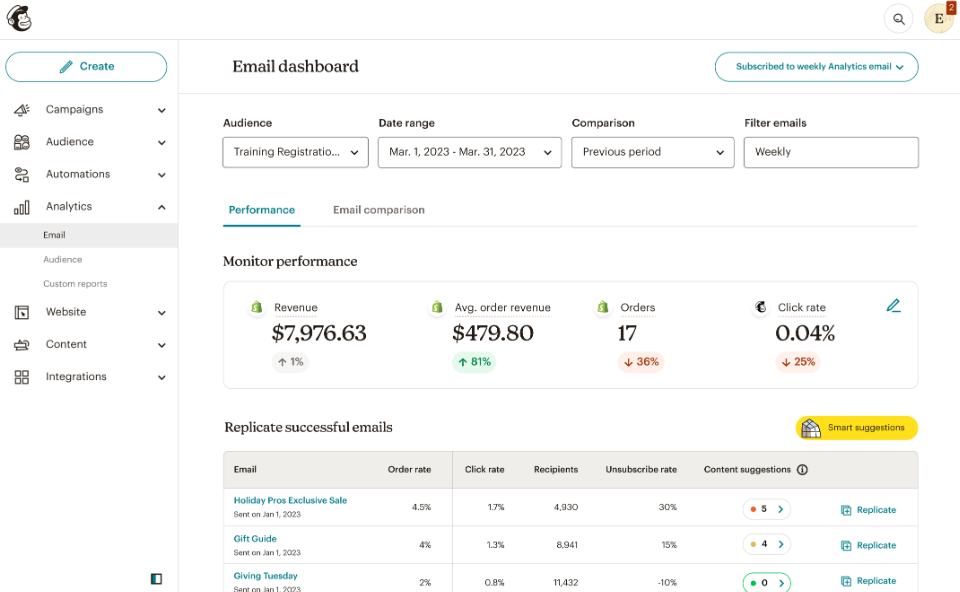
Analytics and Reporting: The platform offers detailed insights into your email campaign's performance. You can track open rates, clicks, unsubscribes, and other metrics to refine your marketing strategies.
Templates: Mailchimp provides a wide range of customizable templates. These templates, including a website builder, help you quickly create visually appealing emails or pages that align with your brand.
Ease of Use
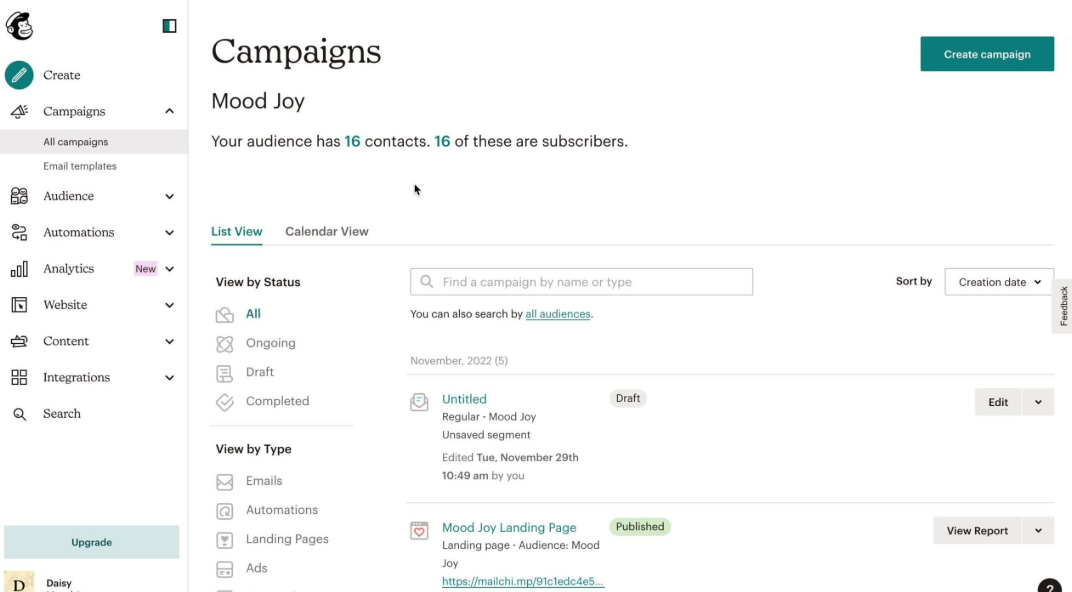
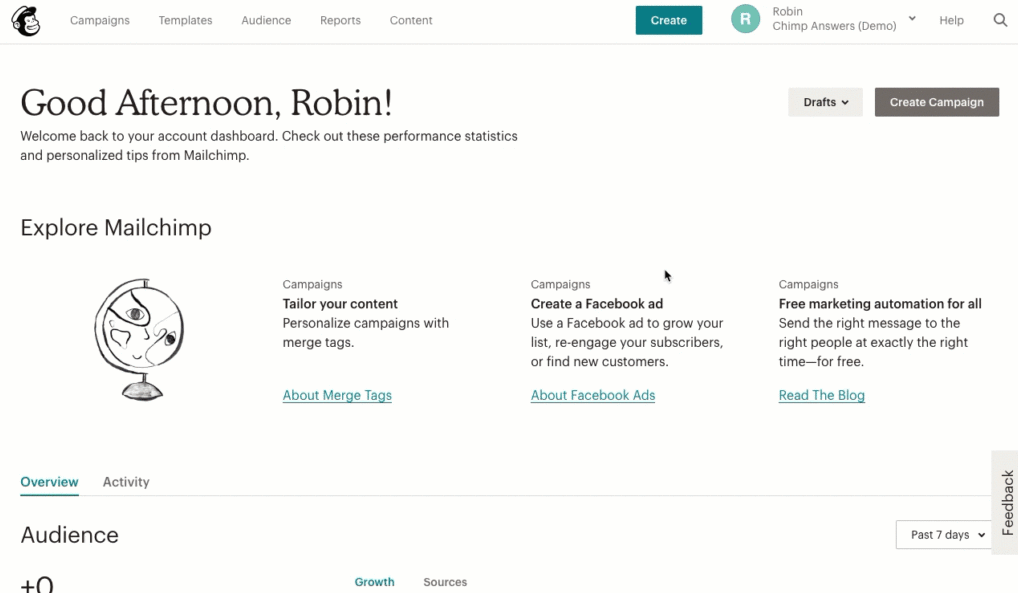
Mailchimp's intuitive interface makes it a breeze for your team to create and manage email campaigns. The drag-and-drop editor simplifies designing professional emails, even if you don't have technical skills. Automation features are straightforward to set up and save you time on routine tasks. Compared to Mailchimp alternatives, the user-friendly design and helpful guides ensure that you quickly get up to speed. This accessibility makes it a preferred choice for SMBs looking for effective email marketing solutions.
Integrations
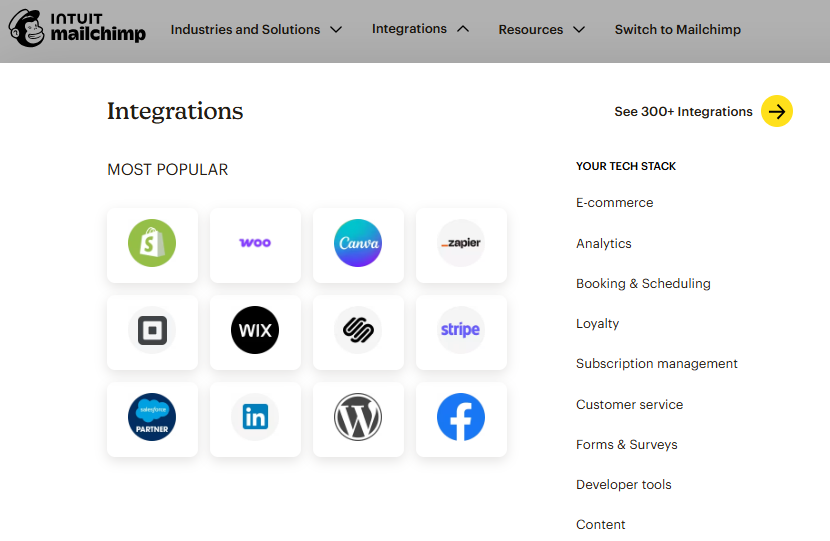
Mailchimp integrates with Shopify, WooCommerce, Squarespace, Zapier, Canva, Google Analytics, Typeform, Vimeo, and HubSpot.
Mailchimp also offers an application programming interface (API) for custom integrations and connects with third-party integration tools.
Mailchimp Specs
- Access Management
- API
- Asset Tagging
- Automatic Transcription
- Batch Permissions & Access
- Brand Asset Creation
- Brand Management
- Dashboards
- Database Search
- Document Comparison
- Document Sharing
- Downloading
- External Integrations
- File Format Conversion
- File Sharing
- File Transfer
- History/Version Control
- Keyword Tracking
- Materials Library
- Metadata Management
- Multi-User
- Product Catalog
- Reports
- Review Monitoring
- Template Designer