
27 Best Order Processing Services for 2026

The Top 10 Order Processing Services to Consider
Let’s see the top picks before we go any further. These are the best order processing service providers and what they do best:


Order processing services handle the operational work of fulfilling customer orders—inventory management, picking and packing, shipping, and returns.
Most ecommerce operators outsource to cut operational costs, speed up delivery, and avoid the hassle of scaling warehouse staff during peak seasons.
I managed retail logistics for over a decade, from warehouse operations to international shipping coordination. For this review, I evaluated top providers on core services, industry specialties, pricing structures, and integration capabilities with tools like QuickBooks and order management systems.
Some excel at heavy goods logistics. Others specialize in subscription boxes or cost-effective multichannel fulfillment.
This guide breaks down what each provider does best, so you can match your order volume, customer expectations, and growth plan to the right service provider.
Why Trust Our Software Reviews
Comparing the Best Order Processing Services, Side-by-Side
This chart summarizes pricing and specialties across the top providers, so you can narrow your shortlist before diving into the detailed reviews.
| Service | Best For | Trial Info | Price | ||
|---|---|---|---|---|---|
| 1 | Best for subscription box services | Free demo | Pricing upon request | Website | |
| 2 | Best for Amazon sellers | Free consultation available for new clients | Pricing upon request | Website | |
| 3 | Best for flexible warehousing | Free consultation available | Pricing upon request | Website | |
| 4 | Best for heavy goods | 30-day risk-free trial—no long-term contract | Pricing upon request | Website | |
| 5 | Best for large-scale operations | Demo available upon request | Pricing upon request | Website | |
| 6 | Best for omnichannel logistics | Free discovery call available | Pricing available upon request | Website | |
| 7 | Best for global ecommerce reach | Consultation available upon request | Pricing available upon request | Website | |
| 8 | Best for cloud supply chain | Free consultation available for new clients | Pricing upon request | Website | |
| 9 | Best for fast shipping needs | Trial information not available | Pricing available upon request | Website | |
| 10 | Best for tech-driven solutions | Free consultation available upon request | Pricing available upon request | Website |
The 10 Best Order Processing Services, Reviewed
The summaries below break down what each provider does well, which industries they serve, and what makes them worth considering. Use these reviews to match your order volume, shipping requirements, and budget to the right service provider.


ShipMonk offers ecommerce fulfillment services tailored for businesses that need inventory management, order processing, and shipping solutions. They primarily serve small to medium-sized businesses across various industries, with a focus on subscription box services.
Why I picked ShipMonk: ShipMonk caters specifically to subscription box services with its flexible and scalable solutions, which adapt to your needs as you grow. Their technology platform integrates with popular ecommerce systems, making it easy for your team to manage orders and inventory. This focus on scalability and integration makes them ideal for businesses looking to expand their reach.
Standout Services: They offer custom packaging that enables you to create a unique brand experience for your customers, thereby enhancing loyalty and satisfaction. Their warehouse management system provides real-time insights into your inventory, enabling you to make informed decisions and minimize stockouts.
Target industries: Fashion, beauty, health and wellness, technology, and consumer goods.
Specialties: Subscription box services, custom packaging, inventory management, technology integration, and real-time analytics.
Pros and Cons
Pros:
- Real-time inventory insights
- Offers custom packaging options
- Flexible and scalable solutions
Cons:
- Requires integration with existing systems
- May not suit very large businesses
Amazon Multi-Channel Fulfillment (MCF) offers order fulfillment services that utilize Amazon's extensive logistics network to support ecommerce businesses. They primarily cater to sellers who want to fulfill orders from multiple sales channels using Amazon's infrastructure.
Why I chose Amazon Multi-Channel Fulfillment (MCF): Amazon MCF offers extensive reach by utilizing Amazon's logistics network, enabling your team to efficiently fulfill orders across multiple platforms. Their integration with Amazon's systems enables smooth inventory and shipping management. This makes them an excellent choice for sellers who want to utilize Amazon's capabilities to enhance their order fulfillment process.
Standout Services: They offer multichannel inventory management, helping you keep track of stock across different platforms and reducing the risk of overselling. Their fast shipping options ensure your customers receive their orders quickly, improving satisfaction and loyalty.
Target industries: Retail, ecommerce, consumer electronics, apparel, and home goods.
Specialties: Multichannel fulfillment, inventory management, fast shipping, integration with Amazon, and logistics network.
Pros and Cons
Pros:
- Uses Amazon's infrastructure
- Extensive reach and scalability
- Integrates with multiple sales channels
Cons:
- Requires integration with Amazon systems
- May not suit non-Amazon sellers

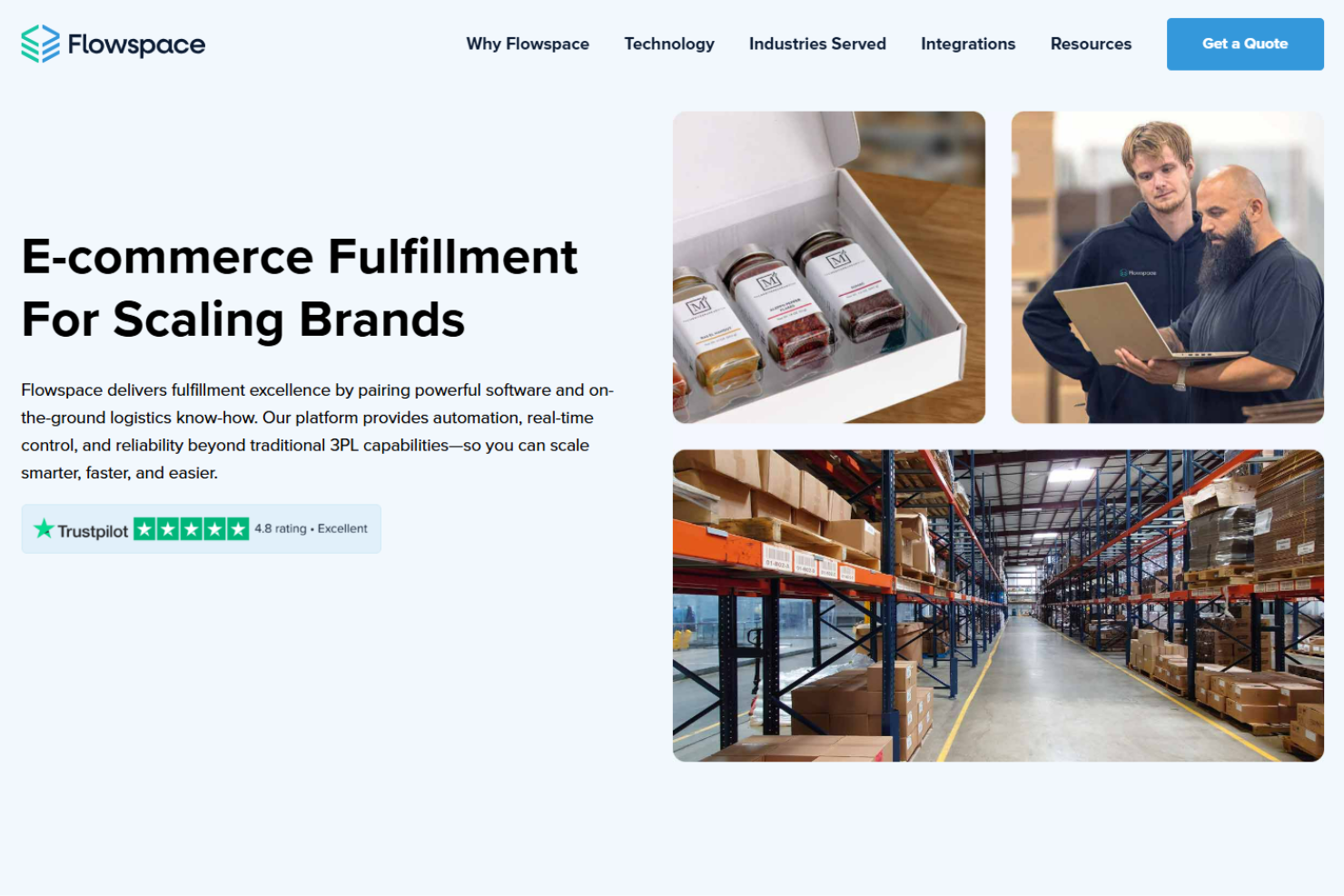
Flowspace offers on-demand warehousing and fulfillment services designed to meet the needs of ecommerce businesses. They provide flexible solutions for inventory management and distribution, serving a diverse range of clients from various industries.
Why I picked Flowspace: Flowspace excels in offering flexible warehousing solutions that adapt to your business needs, whether you're scaling up or down. Their platform integrates with major ecommerce systems, providing valuable insights and control over your inventory. This adaptability makes them a strong choice for those seeking scalable logistics options.
Standout Services: They offer on-demand warehousing, allowing you to adjust your storage space as needed, helping you manage costs effectively. Their distributed fulfillment network ensures faster delivery times by storing products closer to your customers.
Target industries: Retail, consumer goods, electronics, apparel, and health and beauty.
Specialties: On-demand warehousing, distributed fulfillment, inventory management, ecommerce integration, and data analytics.
Pros and Cons
Pros:
- Scalable logistics for growing businesses
- Fast delivery with distributed network
- Provides on-demand storage options
Cons:
- Focused on flexible warehousing
- Services limited to ecommerce


Red Stag Fulfillment provides specialized ecommerce fulfillment services, specializing in handling heavy, large, and high-value products. They cater primarily to businesses that require careful and reliable logistics solutions for oversized items.
Why I picked Red Stag Fulfillment: Red Stag Fulfillment's expertise in handling heavy goods makes them ideal for businesses dealing with oversized and high-value products. With a focus on accuracy and reliability, they offer services such as secure storage and careful handling. This specialization ensures your team can trust them with products that require extra care and attention.
Standout Services: They offer customized kitting and packaging solutions that let you create unique product bundles, enhancing customer satisfaction and reducing shipping costs. Their real-time inventory tracking provides you with up-to-date insights, allowing you to manage stock levels efficiently and avoid stockouts.
Target industries: Furniture, electronics, home appliances, fitness equipment, and industrial goods.
Specialties: Heavy goods handling, secure storage, customized packaging, real-time tracking, and high-value item logistics.
Pros and Cons
Pros:
- Real-time inventory tracking available
- Offers customized packaging solutions
- Provides accurate and reliable logistics
Cons:
- Requires tech integration
- May not suit small, lightweight items

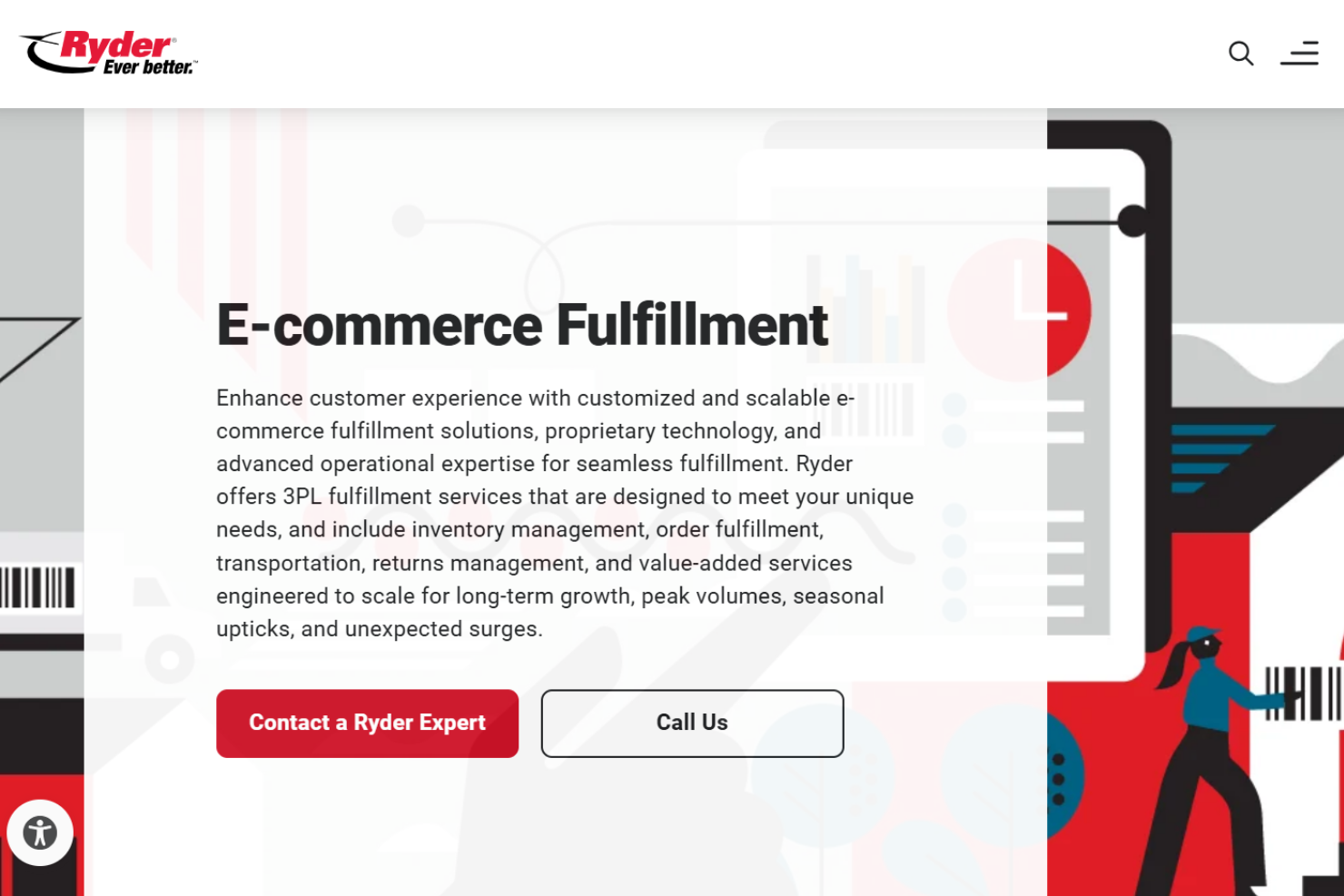
Ryder provides ecommerce fulfillment services that include inventory management, order fulfillment, and shipping. They primarily serve industries like automotive, healthcare, and retail, offering scalable solutions tailored to large-scale operations.
Why I picked Ryder: Ryder specializes in handling large-scale operations with their scalable solutions that adapt to business growth and seasonal demands. Their RyderShip™ technology integrates with major ecommerce platforms, enhancing fulfillment accuracy and speed. This makes them a great choice for managing high-volume orders efficiently.
Standout Services: They offer real-time tracking, allowing customers to monitor their orders and improve transparency and satisfaction. Their value-added services, such as gift wrapping and kitting, offer customization options to enhance the customer experience.
Target industries: Automotive, healthcare, retail, technology, and consumer packaged goods.
Specialties: Inventory management, order fulfillment, returns management, RyderShip™ technology, and value-added services.
Pros and Cons
Pros:
- Real-time order tracking
- Offers value-added services
- Integrates with ecommerce platforms
Cons:
- Requires advanced tech integration
- Limited to certain industries

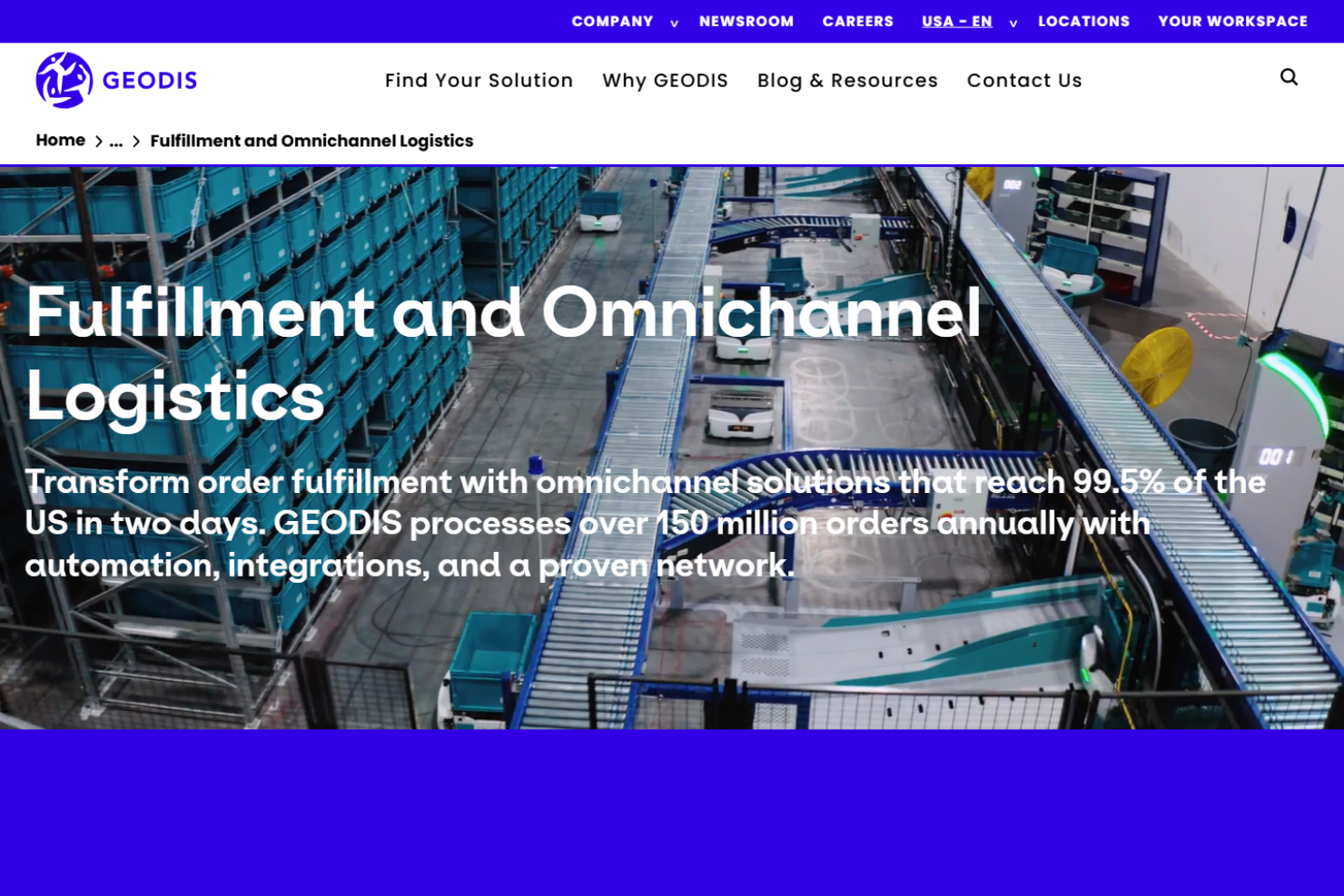
GEODIS eLogistics offers fulfillment and logistics services with a focus on omnichannel solutions. They serve retailers and ecommerce businesses looking for integrated logistics across multiple sales channels.
Why I picked GEODIS eLogistics: GEODIS eLogistics' strength lies in providing omnichannel logistics solutions that unify your sales channels, enhancing customer experience. They offer integrated inventory management and fulfillment services that adapt to your business's changing needs. This makes them a great choice if you're looking to optimize logistics across various platforms and improve operational efficiency.
Standout Services: They provide returns management services that help you handle product returns efficiently, reducing operational headaches. Their end-to-end visibility gives you comprehensive insights into your supply chain, allowing you to make informed decisions quickly.
Target industries: Retail, ecommerce, consumer goods, fashion, and electronics.
Specialties: Omnichannel logistics, inventory management, integrated fulfillment, returns management, and supply chain visibility.
Pros and Cons
Pros:
- Adapts to changing business needs
- End-to-end supply chain visibility
- Offers returns management
Cons:
- Limited to ecommerce and retail
- Focused on specific industries

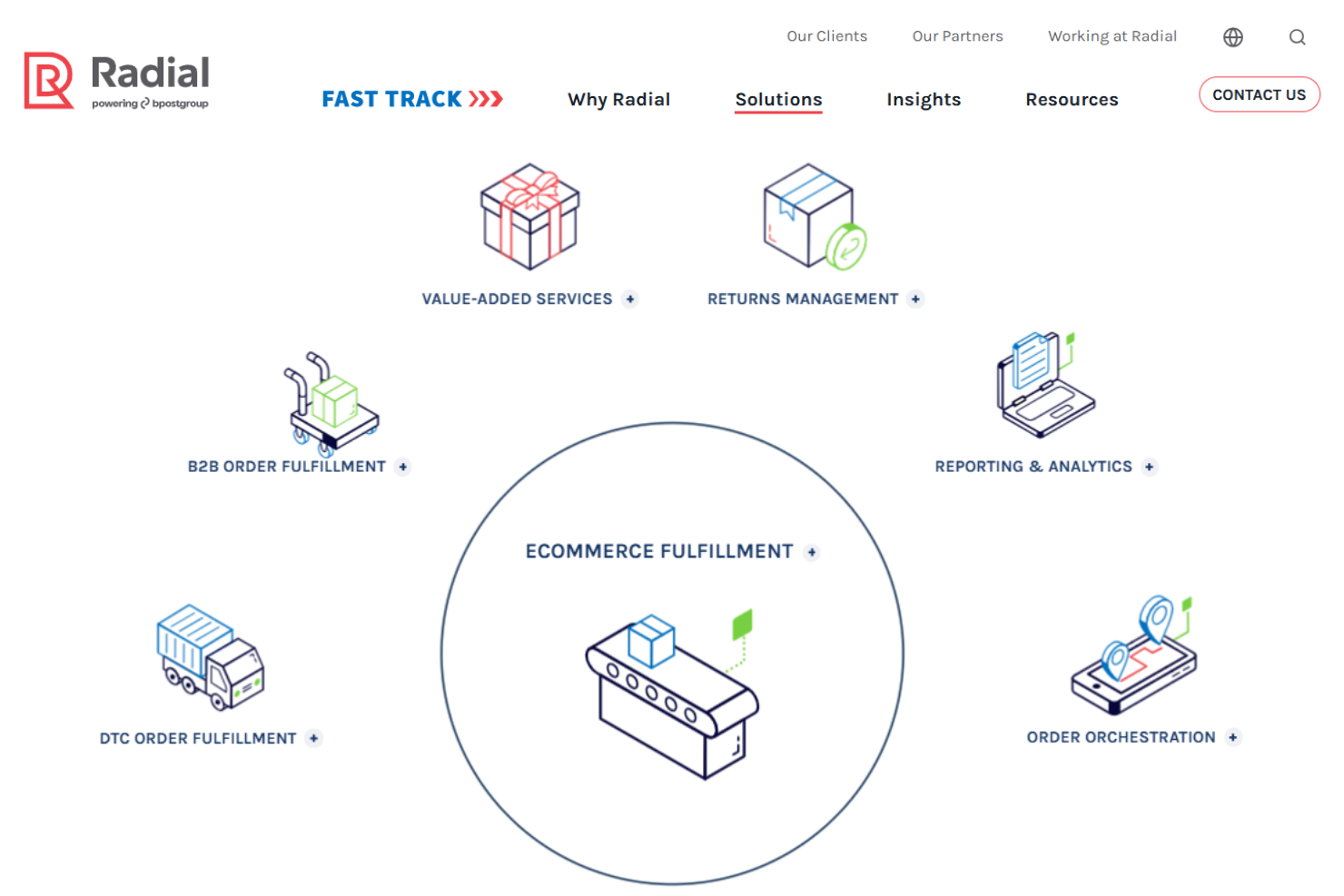
Radial provides a variety of ecommerce fulfillment services, including direct-to-consumer order fulfillment, returns management, and B2B distribution. They primarily serve industries like retail, health and beauty, and home furnishings.
Why I picked Radial: Radial excels at offering global ecommerce reach by leveraging an extensive fulfillment network with over 30 global centers. This allows your team to handle large-scale operations efficiently. Their omnichannel solutions and strategic partnerships enhance your capability to deliver on brand promises and improve customer experiences.
Standout Services: They offer fraud protection and tax compliance, which are essential for safeguarding your business and ensuring regulatory compliance. Their transportation management services help optimize shipping processes, saving your team time and reducing costs.
Target industries: Retail, health and beauty, home furnishings, electronics, and apparel.
Specialties: Omnichannel solutions, transportation management, payment solutions, fraud protection, and tax compliance.
Pros and Cons
Pros:
- Handles returns efficiently
- Offers fraud protection
- Strong in omnichannel solutions
Cons:
- Requires strategic partnerships
- May not suit small businesses

Stord offers cloud-based supply chain solutions, providing warehousing, fulfillment, and logistics services to businesses seeking integrated operations. They primarily cater to companies seeking to optimize their supply chains with a focus on technology-driven solutions.
Why I picked Stord: Stord’s cloud-based platform allows your team to manage logistics efficiently, providing visibility and control over operations. They integrate warehousing and fulfillment services with real-time data insights, enhancing decision-making capabilities. This makes them ideal for businesses aiming to improve supply chain efficiency through technology.
Standout Services: They provide real-time inventory visibility, enabling you to track stock levels and make informed decisions, thereby reducing the risk of overstocking or stockouts. Their network optimization service ensures your products are stored and shipped from the most strategic locations, cutting delivery times and costs.
Target industries: Retail, consumer goods, technology, health and beauty, and apparel.
Specialties: Cloud supply chain management, inventory visibility, network optimization, integrated logistics, and real-time data insights.
Pros and Cons
Pros:
- Network optimization capabilities
- Integrated logistics services
- Provides real-time inventory visibility
Cons:
- Focused on cloud-based solutions
- Requires tech-savvy users

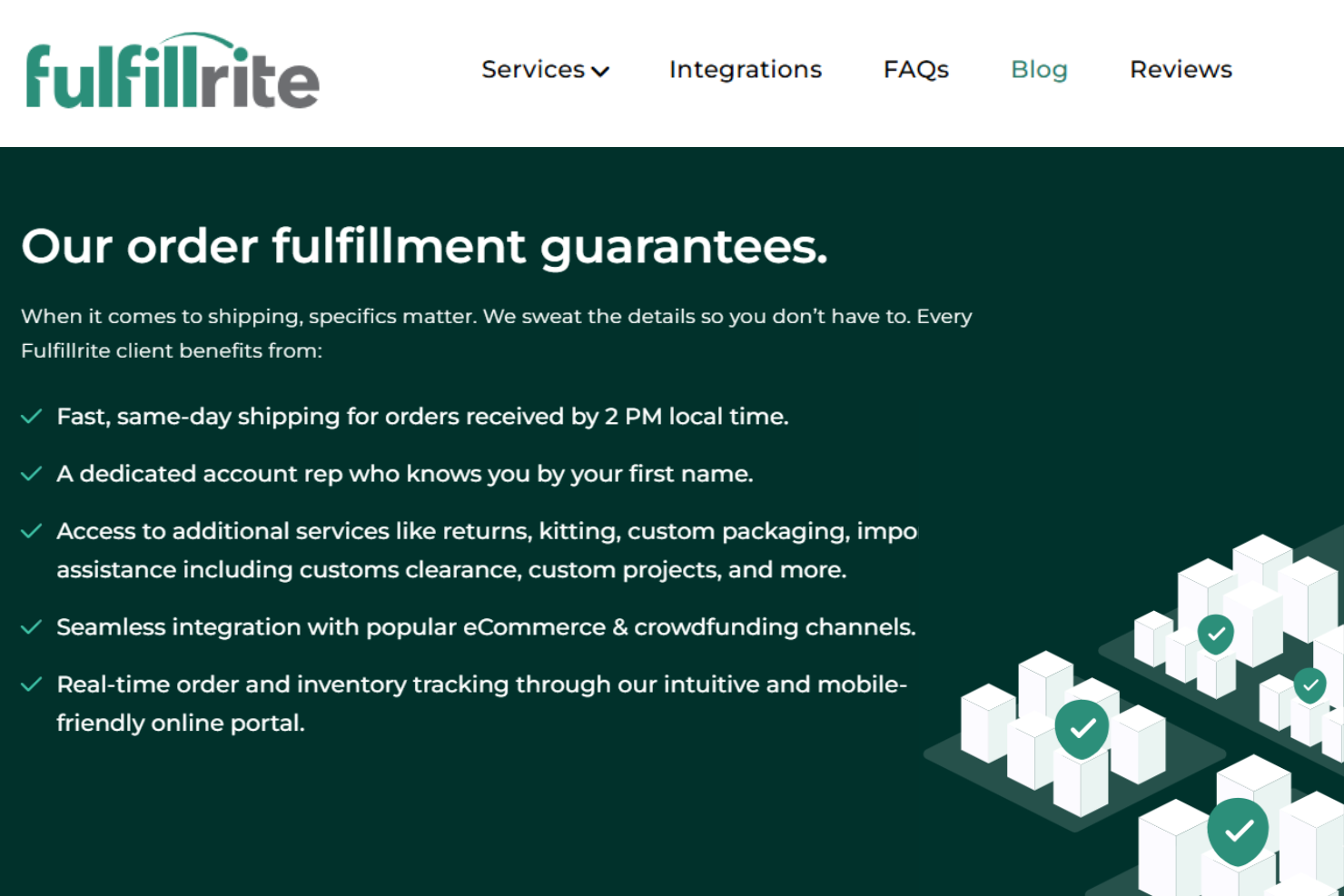
Fulfillrite provides order fulfillment services tailored for ecommerce businesses, focusing on fast and accurate shipping. They primarily serve small to medium-sized companies that need efficient logistics solutions.
Why I picked Fulfillrite: Fulfillrite excels in offering fast shipping solutions, ensuring your customers receive their orders promptly. Their straightforward integration with major ecommerce platforms helps your team manage orders efficiently. This focus on speed and integration makes them an excellent choice for enhancing your shipping operations.
Standout Services: They offer same-day order processing, ensuring your orders are packed and shipped on the same day they're received, thereby enhancing customer satisfaction. Their real-time order tracking provides your team and customers with up-to-date information on order status, reducing uncertainty and improving transparency.
Target industries: ECommerce, health and beauty, consumer electronics, apparel, and toys.
Specialties: Fast shipping, same-day processing, real-time tracking, ecommerce integration, and efficient logistics.
Pros and Cons
Pros:
- Efficient logistics for small businesses
- Real-time order tracking available
- Offers same-day order processing
Cons:
- Focused on speed and efficiency
- Limited to specific industries

Shipfusion offers ecommerce fulfillment services with a focus on technology-driven solutions, including inventory management and shipping. They primarily serve online retailers seeking efficient and scalable logistics solutions.
Why I picked Shipfusion: Shipfusion provides tech-driven solutions that integrate with your existing systems for efficient order processing and inventory management. Their cloud-based platform offers real-time tracking and analytics, helping your team make informed decisions. This tech focus makes them ideal for businesses needing advanced logistics capabilities.
Standout Services: They offer custom API integrations that allow your team to connect existing systems for seamless data flow and efficiency. Their real-time analytics give you insights into inventory and shipping, helping you optimize operations and reduce costs.
Target industries: Retail, consumer electronics, fashion, health and beauty, and home goods.
Specialties: Tech-driven solutions, custom API integrations, real-time analytics, scalable logistics, and inventory management.
Pros and Cons
Pros:
- Scalable logistics options
- Provides custom API integrations
- Focus on tech-driven solutions
Cons:
- Focused on online retailers
- Limited to tech-savvy businesses
Other Order Processing Services
Here are some additional order processing services providers that didn’t make it onto my shortlist, but are still worth checking out:
- ShipNetwork
For small businesses
- Fulfyld
For direct-to-consumer brands
- eShipper
For cost-effective shipping rates
- ShipBob
For tech-enabled fulfillment solutions
- Bolt Fulfillment
For startup-friendly services
- DHL Supply Chain
For international logistics reach
- UPS Supply Chain Solutions
For integrated supply chain services
- Kenco Group
For scalable warehousing solutions
- eFulfillment Service
For no minimum order requirements
- GoBolt
For eco-friendly logistics
- Saddle Creek Logistics
For omnichannel fulfillment services
- AMS Fulfillment
For compliance-focused fulfillment
- Aero Fulfillment Services
For customized fulfillment solutions
- OWD (One World Direct)
For flexible fulfillment options
- Speed Commerce
For fast order processing
- Boxzooka
For global ecommerce support
- PFS
For luxury brand fulfillment


Our Selection Criteria For Order Processing Services
I scored each provider using a weighted framework across six categories: core services, standout features, industry experience, onboarding, customer support, value for price, and customer reviews.
Here's what I evaluated in each area.
Core services (25% of total score)
Every provider on this list had to offer these foundational services to qualify for evaluation:
- Order fulfillment. Picking, packing, and shipping orders accurately and on time.
- Inventory management. Real-time tracking of stock levels to prevent stockouts and overselling.
- Shipping coordination. Route optimization and carrier management to reduce delivery times and costs.
- Returns processing. Efficient handling of customer returns to maintain satisfaction and reduce back-office hassle.
- Customer support. Responsive service to address order issues and keep operations running smoothly.
Additional standout services (25% of total score)
Beyond the basics, I looked for specialized capabilities that separate strong providers from generic ones:
- Custom packaging solutions. Branded unboxing experiences and protective packaging for fragile or high-value goods.
- Real-time analytics. Dashboards that show order accuracy, shipping performance, and inventory turnover.
- Subscription box services. Recurring fulfillment workflows designed for subscription-based business models.
- Multi-channel integration. Seamless connections to ecommerce platforms, order management systems, and CRM tools.
- Climate-controlled storage. Temperature-sensitive warehousing for products that require specific environmental conditions.
Industry experience (10% of total score)
Providers with deep experience in specific verticals understand the operational nuances that matter:
- Years in business. Track record of handling fulfillment at scale through market changes.
- Range of industries served. Breadth of experience across retail, consumer goods, health and beauty, and other sectors.
- Expertise in specific sectors. Specialized knowledge in areas like heavy goods, subscription boxes, or luxury products.
- Client testimonials. Direct feedback from operators in similar businesses.
- Industry certifications. Compliance credentials and quality standards that reduce risk.
Onboarding (10% of total score)
Fast, smooth onboarding means less downtime and fewer errors when you switch providers:
- Ease of setup. How quickly you can integrate their systems with your existing order management and ecommerce platforms.
- Availability of training resources. Documentation, onboarding calls, and training materials for your team.
- Speed of integration. How long it takes to go from contract signature to first order shipped.
- Support during transition. Dedicated account management and technical assistance during the switchover.
- User-friendly platform. Intuitive interfaces that reduce the learning curve for your staff.
Customer support (10% of total score)
When something breaks in the fulfillment process, response time matters:
- Response time. How fast the provider addresses order issues, shipping delays, and system errors.
- Availability of support channels. Phone, email, chat, and dedicated account managers.
- Quality of assistance. Whether support staff can actually solve problems or just escalate tickets.
- Proactive communication. Alerts about potential delays, inventory issues, or system updates.
- Customer feedback on support. Consistent reports from current clients about support quality.
Value for price (10% of total score)
Pricing transparency and return on investment determine whether a provider makes financial sense:
- Transparency of pricing. Clear breakdowns of fulfillment fees, storage costs, and shipping charges.
- Competitiveness with market rates. How costs compare to similar providers with equivalent service levels.
- Inclusion of value-added services. Custom packaging, kitting, and other services included in base pricing.
- Flexibility of pricing plans. Options to scale up or down based on order volume and seasonal demand.
- Customer perceptions of value. Whether clients feel they're getting a fair return on what they're paying.
Customer reviews (10% of total score)
What current customers say reveals how providers perform under real operating conditions:
- Consistency of positive feedback. Whether reviews show reliable service or inconsistent performance.
- Commonly mentioned strengths. Recurring themes about what the provider does well.
- Reported issues or concerns. Frequent complaints about accuracy, speed, or support quality.
- Frequency of repeat business. Client retention rates and long-term partnerships.
- Overall satisfaction ratings. Aggregate scores across multiple review platforms.
What Are Order Processing Services?
Order processing services are third-party providers that manage the entire fulfillment process for ecommerce and retail businesses—from receiving customer orders to final delivery.
They handle inventory management, order entry, picking and packing, shipping coordination, order tracking, and returns processing. Some providers also offer value-added services like custom packaging, kitting, and integration with order management systems and CRM platforms.
Operators use these services to reduce operational costs, improve order accuracy, and scale without adding warehouse space or in-house staff.
They solve common pain points like stockouts, slow order fulfillment, rising shipping costs, and the hassle of managing returns.
By outsourcing order processing, businesses can focus on growth while the service provider handles the back-office work and logistics infrastructure needed to meet customer expectations and maintain high customer satisfaction.
How to Choose Order Processing Services
Choosing the right provider comes down to matching their capabilities to your order volume, product type, and growth trajectory. Start by defining your requirements, then narrow your options based on what matters most to your operation.
| Step | What to consider | Tip |
|---|---|---|
| Assess your order volume and seasonality | Calculate average daily orders and peak season spikes. Providers price and staff differently based on volume, so know your numbers before asking for quotes. | If you see 3x volume swings during holidays, confirm the provider has flex capacity and won't hit you with surge fees. |
| Match provider specialty to your product type | Heavy goods, perishables, subscription boxes, and high-value items all require different handling, storage, and shipping expertise. | Choose a provider with case studies in your vertical—generic fulfillment shops often lack the infrastructure for specialized products. |
| Evaluate technology integration | Check whether they integrate with your ecommerce platform, order management system, CRM, and accounting tools like QuickBooks. Poor integration means manual data entry and order accuracy issues. | Ask for a demo of their API or native integrations—if setup takes more than two weeks, that's a red flag. |
| Review pricing structure and hidden costs | Compare per-order fees, storage rates, shipping markups, and charges for returns processing, kitting, or custom packaging. Pricing should be transparent and scalable. | Request a full cost breakdown based on your actual order volume—vague "pricing upon request" often hides expensive add-ons. |
| Test customer support and onboarding | Confirm they offer real-time support during your operating hours and assign a dedicated account manager. Onboarding speed matters when you're switching providers. | Run a pilot with a small percentage of orders before committing fully—you'll see how they handle problems under real conditions. |
Key Order Processing Services Features
The right features reduce operational costs, improve order accuracy, and help you scale without adding headcount.
Look for capabilities that automate manual work, integrate with your existing systems, and give you real-time visibility into inventory and order status.
- Automated order fulfillment. Wave picking, batch processing, and zone picking speed up order entry and reduce errors compared to manual order taking and data entry.
- Real-time inventory management. Live stock level tracking prevents stockouts and overselling across multiple sales channels, with automated reorder alerts and perpetual inventory counts.
- Multi-channel integration. Native connections to ecommerce platforms, marketplaces, order management systems, and CRM tools consolidate customer orders from multiple sources without duplicate data entry.
- Carrier optimization and shipping. Rate shopping algorithms compare carriers in real-time to find cost-effective options, while automated tracking and order confirmation improve customer satisfaction.
- Returns processing. Efficient reverse logistics handle customer returns with quality inspection, restocking workflows, and integration with refund and payment processing systems.
- Scalability and automation. API-driven integrations with QuickBooks, ERP platforms, and back-office systems eliminate manual business processes and handle volume spikes during peak seasons.
- Analytics and reporting. Real-time dashboards track order accuracy, fulfillment speed, and operational costs, with historical data processing to optimize stock levels and spot bottlenecks in the fulfillment process.
Benefits of Order Processing Services
Outsourcing order processing delivers measurable improvements to your operation—faster fulfillment, lower costs, fewer errors, and more time to focus on what grows the business. Here's what changes when you work with the right provider.
- Faster order fulfillment and delivery. Automated workflows and optimized picking reduce order-to-ship time from days to hours, cutting delivery windows and improving customer satisfaction scores.
- Lower operational costs. Eliminate warehouse lease expenses, reduce headcount for order entry and data processing, and leverage provider-negotiated carrier rates to shrink shipping costs by 15-30%.
- Improved order accuracy. Barcode scanning, automated order confirmation, and quality checks reduce picking errors to under 1%, cutting costly customer service calls and refund requests.
- Scalability without capital investment. Handle 3x order volume during peak seasons without hiring temporary staff, leasing additional space, or buying warehouse equipment—providers flex capacity as you need it.
- Better inventory control. Real-time stock level visibility prevents stockouts that kill sales and reduces overstock that ties up cash, improving inventory turnover and protecting margins.
- Reduced cart abandonment. Accurate shipping quotes at checkout and faster delivery promises convert more browsers into buyers, directly impacting your bottom line.
- Time back for strategic work. Outsourcing the back-office hassle of order processing, customer information management, and returns lets you focus on product development, marketing, and growth.
Costs and Pricing Structures of Order Processing Services
Order processing services typically price based on order volume, storage needs, and value-added services.
Most providers customize quotes rather than publishing rate cards, so expect to share your average monthly order count, SKU count, and shipping zones during initial conversations.
| Plan | Average price | Common features | Best for |
|---|---|---|---|
| Per-order fulfillment | $3-$8 per order | Pick, pack, ship, order confirmation, basic tracking | Low-volume sellers with predictable order sizes and simple fulfillment needs |
| Storage + fulfillment | $50-$200/month storage + $3-$6 per order | Inventory management, stock level alerts, multichannel integration, returns processing | Growing ecommerce brands with consistent inventory and moderate order volume |
| Volume-based pricing | $5,000-$20,000/month | Dedicated account management, custom packaging, real-time analytics, priority support, automation | High-volume operations shipping 5,000+ orders monthly or seasonal businesses with major spikes |
| Custom enterprise | Pricing upon request | End-to-end supply chain management, ERP integration, distributed warehousing, white-glove onboarding | National brands, omnichannel retailers, or businesses with specialized requirements like climate control |
Pricing caveats:
- Hidden fees add up. Receiving fees, kitting charges, returns processing, special packaging, and carrier fuel surcharges can increase costs by 20-40% beyond base rates.
- Minimums matter. Many providers require minimum monthly order volumes or charge low-volume fees if you don't hit thresholds.
- Storage costs vary. Rates change based on pallet vs. shelf storage, cubic footage, SKU count, and whether you need climate-controlled space.
- Setup and integration fees. Expect one-time charges for onboarding, system integration, and API setup—typically $500-$5,000 depending on complexity.
- Always verify current pricing. Rates fluctuate with carrier costs and market conditions. Confirm pricing directly with providers before making decisions.
Order Processing Services FAQs
These questions cover the practical concerns that come up once you’ve narrowed your options—implementation timelines, performance expectations, and what happens when things go wrong.
When should I outsource order processing instead of handling it in-house?
Outsource when warehouse lease costs plus labor for picking, packing, and shipping exceed what a provider would charge—usually around 300-500 orders monthly.
It also makes sense when you’re scaling fast and can’t hire and train staff quickly enough, or when you’re hitting seasonal spikes that require flex capacity. If your team is spending more time on fulfillment than growing the business, you’ve already waited too long.
Keep it in-house only if you have highly specialized handling requirements that third parties can’t replicate cost-effectively.
How long does it take to switch to a new order processing provider?
Plan for 4-8 weeks from contract signature to shipping your first order. The timeline includes system integration, inventory transfer, staff training, and test order processing to catch errors before going live.
Faster implementations are possible if you’re moving from another provider with clean data and straightforward integrations. Slower timelines happen when you’re migrating from in-house operations with custom systems or poor inventory records.
Request a detailed onboarding plan during the sales process—providers who can’t give you a clear timeline often struggle with execution.
What happens if the provider makes a mistake with my orders?
Most providers guarantee order accuracy rates above 99% and will cover the cost of shipping corrections, replacement products, and customer refunds for errors they cause.
Check the service level agreement (SLA) for specifics on liability caps, response times, and remediation processes. Better providers proactively alert you to issues before customers complain and have dedicated support to resolve problems fast.
If error rates stay high after the first 30 days, that’s a red flag. Track accuracy weekly during onboarding and monthly after that.
Can order processing services handle international shipping?
Yes, but capabilities vary widely. Some providers only ship domestically and partner with freight forwarders for international orders, adding cost and complexity.
Others have global fulfillment networks with in-country warehousing that cuts customs delays and shipping costs. If international shipping is core to your business, confirm the provider handles customs documentation, duties and taxes calculation, and compliance with import regulations.
Ask about their cross-border return processes too—getting products back from international customers is often harder than shipping them out.
What size business needs order processing services?
There’s no universal threshold, but most businesses start evaluating providers around 200-300 monthly orders when fulfillment work starts competing with growth activities.
Subscription box companies and seasonal businesses benefit earlier because order consistency or volume spikes strain in-house operations. High-value or specialized products—heavy goods, perishables, luxury items—often justify outsourcing sooner because handling expertise matters more than raw volume.
If you’re spending more than 20 hours weekly on order processing and inventory management, run the numbers on outsourcing.
How do I measure if my order processing provider is performing well?
Track order accuracy (target 99%+), average fulfillment speed from order placement to ship (24-48 hours for standard items), on-time delivery rates (95%+), and inventory accuracy during cycle counts (98%+).
Monitor customer complaints about wrong items, damaged goods, or late shipments—these should drop significantly compared to in-house operations. Review monthly invoices against quoted pricing to catch unexpected fees.
Request weekly performance reports during the first 90 days, then shift to monthly. If the provider resists sharing data or misses SLA targets consistently, start planning your exit.
Make the Pick & Ship It
Fulfillment costs, inventory headaches, and scaling challenges eat into your margins and your time. The providers in this guide solve those problems in different ways—some specialize in heavy goods, others in subscription boxes or fast-growing ecommerce brands.
Match your order volume, product type, and growth plan to the provider that handles what you need, then move forward.
If you're in the process of researching order processing services, connect with a SoftwareSelect advisor for free recommendations.
You fill out a form and have a quick chat where they get into the specifics of your needs. Then you'll get a shortlist of software to review. They'll even support you through the entire buying process, including price negotiations.
Retail never stands still—and neither should you. Subscribe to our newsletter for the latest insights, strategies, and career resources from top retail leaders shaping the industry.