

Let’s automate your order processing so you can stop drowning in spreadsheets and start shipping smarter.
You need an order processing system that delivers real-time inventory updates, automates workflows, and keeps every sales channel—online, in-store, or wholesale—in sync.
I’ve managed warehouse floors, overseen international shipping, and balanced inventory control across multiple platforms—so I know exactly what it takes to prevent stockouts and speed up order fulfillment.
In this guide, you’ll get side-by-side comparisons of solutions that integrate with your ERP, CRM, and POS, streamline invoicing, and track SKUs across Shopify, Amazon, and your brick-and-mortar.
You’ll get clear insights on functionality, pricing, and the dashboards and notifications you need to optimize your order lifecycle.
Why Trust Our Software Recommendations
6,700+
Reviews
20
Industry experts
16+
Evaluation factors
14
Years
Our team has been testing and reviewing software since 2012. As retail leaders ourselves, we know how difficult—and important—it is to choose the right software.
For this guide, we evaluated tools using hands-on testing and independent research, scoring tools using our selection criteria.
Our reviews reflect our independent judgment—not a sales pitch.
Comparing the Best Order Processing Software, Side-by-Side
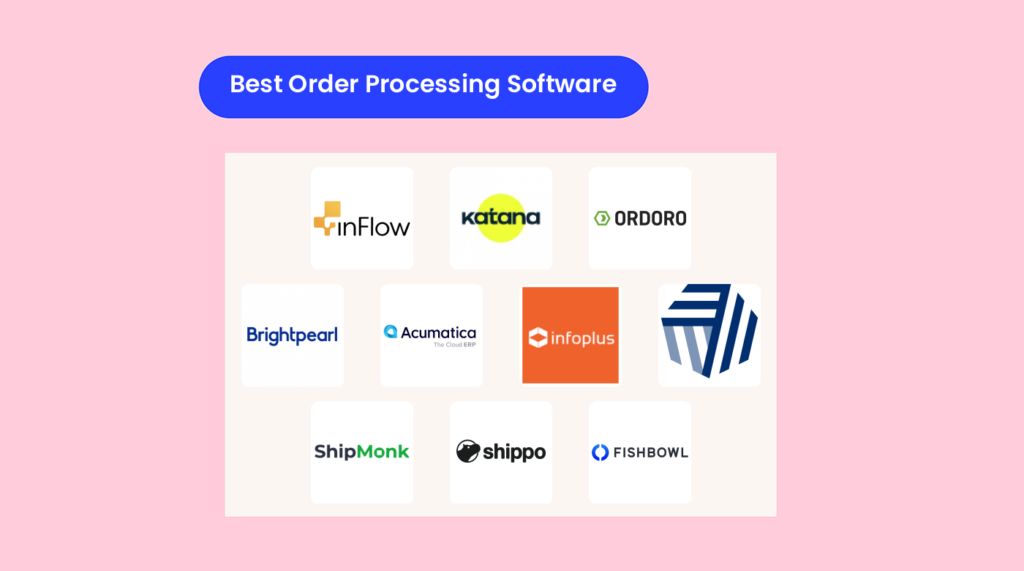
This chart lines up pricing, trial details, and what each is best at so you can see at a glance which order processing solution fits your budget and your workflows.
| Tool | Best For | Trial Info | Price | ||
|---|---|---|---|---|---|
| 1 | Best for inventory tracking | 14-day free trial + free demo available | From $129/month (billed annually) | Website | |
| 2 | Best for managing multiple sales channels | Free plan available | From $299/month | Website | |
| 3 | Best for dropshipping | 15-day free trial + free plan available | From $349/month | Website | |
| 4 | Best for automation capabilities | Free demo available | Pricing upon request | Website | |
| 5 | Best for implementing complex pricing | Free demo available | Pricing upon request | Website | |
| 6 | Best for warehouse management | Free demo available | Pricing upon request | Website | |
| 7 | Best for extensive platform integrations | 14-day free trial | From $349/month | Website | |
| 8 | Best for subscription boxes | Free demo | Pricing upon request | Website | |
| 9 | Best for shipping discounts | Free plan available | From $19/month | Website | |
| 10 | Best for QuickBooks integration | Free demo available | From $229/month (billed annually) | Website |


The Best Order Processing Software, Reviewed
Now, we’ll cover what each system excels at, who it’s built for, and any caveats to watch out for. Think of this as your rapid-fire guide to features, integrations, and real-world performance so you can pick the perfect fit for your order lifecycle.
 Best for inventory tracking
- 14-day free trial + free demo available
- From $129/month (billed annually)
Visit WebsiteCustomer Rating:4.6/5
inFlow Inventory tracks stock, sales, and orders for growing businesses. inFlow Inventory is an inventory management solution tailored for small to medium-sized businesses that need precise inventory tracking and order management. It supports companies by offering tools to manage stock levels, sales, and purchasing.
Why I picked inFlow Inventory: It's designed for businesses that require detailed inventory tracking. The software provides real-time stock updates and allows you to manage orders from a centralized platform. You can automate reorder points to ensure you never run out of stock. Its reporting features help you analyze sales trends and make informed decisions.
Standout features & integrations:
Features include barcode generation, which simplifies the process of cataloging and managing inventory. You can use the mobile app to access inventory data on the go. The software also offers customizable invoices to match your brand's identity.
Integrations include QuickBooks, Shopify, WooCommerce, Amazon, Squarespace, Xero, Zapier, Salesforce, eBay, and Etsy.
Pros and Cons
Pros:
- Automates reorder points
- Centralized order management
- Real-time stock updates
Cons:
- Occasional sync issues
- Limited customization options
Learn more about inFlow Inventory: Best for managing multiple sales channels
- Free plan available
- From $299/month
Visit WebsiteCustomer Rating:4.6/5
Katana maps orders to materials and capacity in real time. Katana MRP is a manufacturing-aware order processing and inventory platform that centralizes sales, production, and purchasing for small and midsize makers.
It connects webstores, marketplaces, and accounting tools, helping teams cut stockouts, keep work-in-progress visible, and ship on time.
Why I picked Katana:
For manufacturers selling across multiple channels, Katana keeps sales orders, production, and raw-material needs in one real-time view. It manages assemblies and ingredients with bills of materials, supports batch/lot tracking, and surfaces capacity and availability, so planners can schedule confidently.
The workflow—from sales order to purchase/production to fulfillment—feels purpose-built for make-to-stock and make-to-order shops. Tradeoffs to note: some advanced features (batch tracking, shop-floor operators) sit on higher tiers, and seat limits can be restrictive for larger teams.
Standout features and integrations:
Features include real-time inventory across locations, multichannel sales order syncing, BOM-level material planning, batch/lot and barcode support, returns handling, kits/bundles, partial fulfillment, and mobile tasking.
Integrations include Shopify, BigCommerce, WooCommerce, Amazon, eBay, QuickBooks Online, Xero, HubSpot, Salesforce, Pipedrive, Prospect CRM, ShipStation, Shippo, 2Ship, and Zapier.
Pros and Cons
Pros:
- Accurate stock control for assemblies and ingredients.
- User-friendly interface that’s easy to learn.
- Real-time inventory tracking across multiple locations.
Cons:
- Full-access user limits can be restrictive.
- Lower-tier plans lack batch tracking and shop-floor operator features.
Learn more about Katana: Best for dropshipping
- 15-day free trial + free plan available
- From $349/month
Visit WebsiteCustomer Rating:4.7/5
Ordoro simplifies dropshipping and centralizes inventory management. Ordoro is an order processing software tailored for businesses that focus on dropshipping and inventory management. It helps retailers streamline their shipping processes and manage inventory from a single platform.
Why I picked Ordoro: It's perfect for businesses that rely heavily on dropshipping and need efficient inventory management. Features like automatic inventory syncing and multichannel order management are ideal for dropshipping. Your team can also benefit from automated shipping label generation. The software simplifies the process of managing suppliers and tracking shipments.
Standout features & integrations:
Features include kitting, which allows you to bundle products for sale. You can use barcode scanning to speed up order processing. The software also offers advanced analytics to help you make data-driven decisions.
Integrations include Shopify, Amazon, eBay, WooCommerce, BigCommerce, Magento, Etsy, Squarespace, Xero, and QuickBooks.
Pros and Cons
Pros:
- Multichannel order management
- Automatic inventory syncing
- Efficient dropshipping management
Cons:
- Can be complex for beginners
- Limited customization options
Learn more about Ordoro: Best for automation capabilities
- Free demo available
- Pricing upon request
Visit WebsiteCustomer Rating:4.4/5
Brightpearl centralizes orders, inventory, and accounting. Brightpearl is a retail operating system that centralizes order processing, inventory, fulfillment, CRM, and accounting for multichannel retailers and brands.
It automates routine workflows—purchase-to-ship, invoicing, and returns—so teams move orders faster with fewer errors and clearer, real-time stock visibility across channels.
Why I picked Brightpearl:
This platform is built for retailers scaling across marketplaces and webstores who need dependable automation and unified back-office control. It cuts manual touches in order routing, allocates inventory in real time, and keeps finance in lockstep with operations, which shortens fulfillment cycles and tightens cash reconciliation.
Reporting and forecasting give managers day-to-day answers—what to buy, where to stock, and what’s at risk of delay—while expert-led implementation helps larger teams get live without duct tape.
Standout features and integrations:
Features include multichannel order management, automation rules for allocation and fulfillment, backorder and returns workflows, warehouse management, shipping label creation, CRM, retail analytics, and real-time accounting.
Integrations include Shopify, Magento, BigCommerce, Amazon, eBay, Lightspeed, Dotdigital, Klaviyo, Stripe, Square, Xero, QuickBooks, Sage Intacct, Royal Mail, USPS, DPD, FedEx, and ShipStation.
Pros and Cons
Pros:
- Technical support is frequently praised for prompt, helpful assistance.
- Automation meaningfully reduces manual tasks and errors across order workflows.
- Efficient at managing inventory and sales operations to streamline processes.
Cons:
- The system can feel complex, with onboarding and training posing challenges.
- Pricing is viewed as expensive for smaller businesses.
Learn more about Brightpearl: Best for implementing complex pricing
- Free demo available
- Pricing upon request
Visit WebsiteCustomer Rating:4.4/5
Acumatica surfaces real-time cash, AR, and order health. Acumatica Cloud ERP is a cloud-based order processing and operations platform that centralizes order capture, fulfillment, and financials for omnichannel businesses.
It automates workflows across sales, inventory, CRM, and finance, helping teams shorten order-to-cash cycles, reduce errors, and get real-time visibility into cash, AR, and fulfillment status.
Why I picked Acumatica:
This is a strong fit for retailers, distributors, and manufacturers that need real-time inventory visibility, complex pricing, and cross-company transactions without bolting together multiple systems. The platform’s role-based dashboards and automated approvals cut manual touches, while native CRM keeps customer context tied to every order.
You also get flexible licensing—pay for what you use—and an ecosystem of vetted marketplace apps, so you can extend without heavy custom code. Implementation can be involved, but the payoff is unified data and fewer reconciliation headaches.
Standout features and integrations:
Features include order management from capture to fulfillment, real-time inventory tracking, pricing and discount rules, returns management, cross-company transactions, automated workflows, and role-based dashboards.
Integrations include Salesforce, Shopify, BigCommerce, Celigo/Integrator.io, Velixo Reports, Netstock IBP, Workforce Go! HCM, DataSelf, Inventory Optimization Solution, Quality Management Suite (QMS), SPS Commerce, AcuRental, Pacejet, CADLink, Traild, Procore, AvidXchange, Avalara, Power BI, Adobe Sign, DocuSign, Smartsheet, Amazon Marketplace, Magento, and WooCommerce.
Pros and Cons
Pros:
- Real-time data visibility for faster, better decisions.
- Highly customizable to match unique order workflows.
- User-friendly interface that is easy to navigate.
Cons:
- Total cost can rise as features and users are added.
- Implementation can be complex and time-consuming.
Learn more about Acumatica: Best for warehouse management
- Free demo available
- Pricing upon request
Visit WebsiteCustomer Rating:4.4/5
Infoplus boosts efficiency with detailed warehouse and inventory control. Infoplus is a warehouse management software designed for businesses that need detailed control over their inventory and order processes. It serves companies seeking to optimize their warehouse operations and improve efficiency.
Why I picked Infoplus: It's tailored for businesses that require strong warehouse management capabilities. Features like real-time inventory tracking and advanced reporting help you keep a close eye on your stock levels. Your team can automate routine tasks, reducing manual work and errors. The software's customization options allow you to tailor it to your specific warehouse needs.
Standout features & integrations:
Features include customizable dashboards that give you a clear view of your operations. You can use automated alerts to stay informed about key inventory changes. The software also supports barcode scanning for fast, accurate inventory management.
Integrations include Shopify, Magento, BigCommerce, WooCommerce, Amazon, eBay, QuickBooks, Xero, ShipStation, and Salesforce.
Pros and Cons
Pros:
- Advanced reporting capabilities
- Real-time inventory tracking
- Strong warehouse management features
Cons:
- Requires technical setup
- Steep learning curve
Learn more about Infoplus: Best for extensive platform integrations
- 14-day free trial
- From $349/month
Visit WebsiteCustomer Rating:4.3/5
Cin7 Omni centralizes POS, ecommerce, and wholesale operations. Cin7 Omni is an inventory and order management platform that centralizes stock, purchasing, and fulfillment for omnichannel retailers, wholesalers, and light manufacturers.
It covers POS, ecommerce, B2B, and 3PL workflows—helping teams reduce stockouts, accelerate order processing, and reconcile sales and costs faster.
Why I picked Cin7 Omni:
This platform fits operators juggling multiple channels, EDI partners, and basic assembly/BOM needs who want one system of record for orders and inventory. Real-time stock visibility, robust order routing, and solid reporting support cleaner allocations and fewer manual adjustments.
It also offers strong integration coverage to keep accounting, marketplaces, and shipping in sync. Tradeoffs include a meaningful learning curve and higher pricing versus lighter SMB tools, but the operational control often offsets that for growing teams.
Standout features and integrations:
Features include order and returns management, POS, intelligent document recognition, assembly/BOM for light manufacturing, EDI, 3PL connections, forecasting and purchasing, and configurable reporting.
Integrations include QuickBooks, Xero, Shopify, Amazon, Walmart, eBay, BigCommerce, WooCommerce, ShipStation, Fulfillment by Amazon, SPS Commerce, Pipe17, and Avalara.
Pros and Cons
Pros:
- Advanced integrations connect major ecommerce, accounting, and shipping platforms.
- Centralized product management streamlines inventory control across multiple channels.
- Real-time tracking updates stock levels instantly, minimizing overselling risks.
Cons:
- Higher pricing than lighter-weight alternatives.
- Steep learning curve due to the software’s extensive feature set.
Learn more about Cin7 Omni:

ShipMonk handles fulfillment for subscription boxes with smart logistics. ShipMonk is a fulfillment and order processing software designed for businesses that offer subscription boxes and need efficient logistics management. It serves online retailers who require inventory management, order processing, and shipping solutions.
Why I picked ShipMonk: It's perfect for subscription box businesses that need a reliable fulfillment partner. The software provides real-time inventory tracking and allows you to manage orders efficiently. You can customize packing and shipping options to fit your brand's needs. ShipMonk's ability to handle high-volume orders is a plus for growing subscription services.
Standout features & integrations:
Features include order management, which simplifies the process of tracking and fulfilling customer orders. You can also take advantage of customizable packing options to enhance your brand's presentation. The software offers detailed analytics to help you understand your business performance and make informed decisions.
Integrations include Shopify, WooCommerce, BigCommerce, Magento, Amazon, Etsy, eBay, Squarespace, Walmart, and ShipStation.
Pros and Cons
Pros:
- Reliable fulfillment partner
- Real-time inventory tracking
- Efficient for high-volume orders
Cons:
- High starting price
- Complex setup process
Learn more about ShipMonk:

Shippo offers discounted rates and streamlines shipping for SMBs. Shippo is a shipping solution designed for businesses looking to save on shipping costs and improve their logistics. It serves small to medium-sized businesses that need access to discounted shipping rates and efficient shipping processes
Why I picked Shippo: It's ideal for businesses that prioritize cost savings on shipping. With features like access to discounted USPS and UPS rates, you can reduce shipping expenses. Your team can also benefit from automated label creation, which simplifies the shipping process. The ability to track shipments in real-time helps improve customer satisfaction.
Standout features & integrations:
Features include batch label creation, which allows you to process multiple shipments at once. You can customize shipping labels to match your brand. The software also offers return label creation, making it easier for your customers to return items.
Integrations include Shopify, WooCommerce, BigCommerce, Magento, Amazon, eBay, Etsy, Squarespace, Weebly, and Wix.
Pros and Cons
Pros:
- Real-time shipment tracking
- Automated label creation
- Access to discounted shipping rates
Cons:
- Occasional tracking discrepancies
- Limited advanced features
Learn more about Shippo: Best for QuickBooks integration
- Free demo available
- From $229/month (billed annually)
Visit WebsiteCustomer Rating:4/5
Fishbowl automates inventory, ordering, and manufacturing tasks. Fishbowl is an inventory management software aimed at small to medium-sized businesses that need efficient inventory tracking and order management. It helps companies manage inventory, automate ordering processes, and streamline manufacturing.
Why I picked Fishbowl: It's ideal for businesses that rely on QuickBooks for accounting and need seamless integration. The software offers advanced inventory tracking and order management features that complement QuickBooks. You can automate your reordering process, ensuring you never run out of stock. Fishbowl also provides manufacturing tools to help you manage production and assembly.
Standout features & integrations:
Features include barcode scanning, which speeds up inventory management tasks. You can set up multi-currency tracking to handle international transactions. The software also offers customizable reporting to give you insights into your business operations.
Integrations include QuickBooks, Shopify, WooCommerce, Magento, Xero, Salesforce, Amazon, eBay, BigCommerce, and ShipStation.
Pros and Cons
Pros:
- Automates reordering process
- Advanced inventory tracking
- Strong QuickBooks integration
Cons:
- Steep learning curve
- High upfront cost
Learn more about Fishbowl Inventory:
Other Order Processing Software
Here are some additional order processing software options that didn’t make it onto my shortlist, but are still worth checking out:
- 11FulfilBest for rule-based order routing
- 12Manhattan ActiveBest for personalized customer interactions
- 13ShipHeroBest for ecommerce fulfillment
- 14RadialBest for omnichannel retailers
- 15ShippingEasyBest for small retailers
- 16ShipWiseBest for B2B orders
- 17Kibo CommerceBest for scalability
- 18ShipStationBest for workflow automation
- 19MRPeasyBest for precise production planning
- 20VeeqoBest for multichannel sellers
- 21Zoho InventoryBest for small businesses
- 22LinnworksBest for multichannel selling
- 23Finale InventoryBest for inventory forecasting
- 24OdooBest for open-source ERP
- 25ExtensivBest for 3PL management
- 26Blue YonderBest for real-time inventory visibility
- 27NetSuiteBest for advanced shipping options
- 28Oracle Fusion CloudBest for enterprise solutions
- 29IBM Sterling Order ManagementBest for complex orders
- 30Sage 100Best for small business ERP
How I Evaluate Order Processing Software
I evaluate order processing software in two layers: the baseline a tool must meet—like multi-channel order sync and fulfillment routing—and the differentiators that set the best options apart.
Core Functionality (Table Stakes For This List)
When I'm selecting tools for my list, I rank each one on a scale from 0 (does not offer the functionality) to 5 (excels in this area) for each core functionality listed below. Then, I calculate the tool's total score into a percentage. Each tool needs to achieve a minimum total score of 65% to be considered for inclusion.
- Multi-Channel Order Aggregation: I check whether orders from your ecommerce store, marketplaces like Amazon or eBay, and POS systems all flow into one unified order queue.
- Real-Time Inventory Sync: Stock counts should update across every connected channel and warehouse as orders come in, so your team avoids overselling a hot SKU.
- Order Routing & Fulfillment: I evaluate how the tool assigns orders to the right warehouse, store, or 3PL—especially whether it supports split shipments and rule-based logic.
- Shipping & Carrier Integration: Multi-carrier rate comparison, label generation, and tracking updates matter here. I look at the range of supported carriers and batch shipping options.
- Returns & Refund Management: Handling a return should trigger inventory restocking and refund processing in one workflow, not force your team to update multiple systems manually.
- Reporting & Order Analytics: I look for dashboards that break down fulfillment speed, order volume by channel, and SKU-level performance rather than just basic order lists.
Once I have a list of tools that meet this criteria, I consider what sets each platform apart.
Differentiating Factors (What Sets Vendors Apart)
Here's how I compare and contrast different vendors:
Standout Features
A no-code workflow automation builder is one of the first things I look for. Being able to auto-tag high-value orders, hold flagged shipments, or split orders by warehouse without developer help saves your ops team hours each week. Fraud screening also matters—tools that score orders for risk before fulfillment help reduce chargebacks on suspicious transactions. I also evaluate backorder and pre-order handling, since retailers managing supply delays need automated reservation logic and customer notifications built into the order flow.
Beyond Features
Integration depth is one of the biggest differentiators I evaluate. A tool might check every feature box, but if it can't sync cleanly with your Shopify store, QuickBooks instance, or 3PL's WMS, your team ends up doing manual workarounds. I also look at how pricing scales with growth—some vendors charge per order, others per user, and the gap in total cost widens fast as volume increases. Scalability ties into this too. I check whether adding new warehouses, channels, or team members requires a plan upgrade or a full re-implementation.
What is Order Processing Software?
Order processing software is a cloud-based system that automates the entire order lifecycle—from order entry through invoicing and fulfillment.
Retailers, warehouse managers, and ecommerce teams use it to track SKUs, manage inventory levels in real time, and streamline workflows across all sales channels.
It eliminates manual order entry and stock level headaches, reduces errors and backorders, and speeds up your order fulfillment process so you deliver the right products on time.
How to Choose Order Processing Software
Picking the wrong order management solution can cost you time, money, and headaches.
Start by mapping out your current order lifecycle pain points, then use this checklist to zero in on a system that fits your workflows, scales with your volume, and won’t leave you high and dry when orders spike.
| Step | What to do | Why it matters |
|---|---|---|
| StepAssess your workflows | What to doDocument each stage: order entry, inventory updates, invoicing, shipping, and returns. | Why it mattersHighlights manual bottlenecks and sets your automation targets. |
| StepDefine must-have features | What to doPrioritize real-time inventory, multi-channel integrations, automated routing, and reporting needs. | Why it mattersEnsures any tool you shortlist covers your core order lifecycle. |
| StepRun a pilot | What to doTest critical workflows—create an order in your ecommerce platform, sync inventory, print a label. | Why it mattersVerifies the system works in your environment and uncovers gaps. |
| StepCompare total cost | What to doTally subscription fees, per-order or per-user charges, setup and migration costs, and support fees. | Why it mattersPrevents surprise expenses and lets you budget for growth. |
| StepCheck support & training | What to doConfirm availability of retail-savvy support, onboarding resources, and response SLA guarantees. | Why it mattersKeeps your team moving when orders—and questions—start pouring in. |
Features of Order Processing Software
When selecting order processing software, keep an eye out for the following key features:
- Real-time inventory tracking. Monitor stock levels across ecommerce platforms, POS, and warehouses instantly to prevent stockouts and overselling.
- Automated workflows. Automate order entry, shipping label creation, and invoicing so your team spends less time on manual processes and more on growth.
- Multichannel integration. Sync orders and inventory across Shopify, Amazon, in-store POS, and your ERP or CRM for a unified order management process.
- Smart order routing. Automatically route sales orders to the optimal fulfillment center or carrier based on location, cost, and inventory availability.
- Customizable dashboards. Build real-time dashboards that show order status, purchase orders, backorders, and profitability metrics in one place.
- Barcode scanning and batch processing. Speed up warehouse management with barcode-driven picking, packing, and cycle counts.
- Reporting and forecasting. Generate custom reports on SKUs, sales channels, and supply chain performance—and forecast reorder points to optimize inventory control.
Benefits of Order Processing Software
Implementing order processing software provides several benefits for your team and your business. Here are a few you can look forward to:
- Streamlined order fulfillment. Automate repetitive tasks and eliminate manual handoffs, so orders ship faster and with fewer errors.
- Improved customer satisfaction. Provide accurate order status updates and reduce backorders for a smoother customer experience.
- Enhanced profitability. Use rate shopping and cost analytics to find the most cost-effective shipping options and boost margins.
- Scalable workflows. Grow sales channels and order volume without adding headcount—your cloud-based system scales with you.
- Greater visibility. Get end-to-end insight into the order lifecycle, from purchase order creation through delivery and returns.
- Reduced manual errors. Cut down on data entry mistakes with automated order entry, barcode scanning, and real-time inventory updates.
- Data-driven decision-making. Leverage integrated reporting and forecasting to optimize reorder timing, minimize stock levels, and boost turnover.
Costs and Pricing of Order Processing Software
Pricing for order management software varies widely based on features, number of users, and order volume.
In the table below, you’ll see the common plan tiers—from free trials for small businesses to enterprise packages with full API access—so you can quickly gauge which order management solution aligns with your budget and workflows.
| Plan type | Average price | Common features | Best for |
|---|---|---|---|
| Plan typeFree plan | Average price$0/user/month | Common featuresBasic order tracking, limited integrations, essential dashboards | Best forSmall businesses testing workflows |
| Plan typePersonal plan | Average price$10–$30/user/month | Common featuresReal-time inventory updates, email support, single-channel integration | Best forSolo operators and startups |
| Plan typeBusiness plan | Average price$50–$100/user/month | Common featuresMultichannel integrations, automated workflows, customizable reports | Best forGrowing ecommerce and omnichannel retailers |
| Plan typeEnterprise plan | Average price$200–$500/user/month | Common featuresFull API access, advanced order routing, dedicated support and SLAs | Best forHigh-volume operations and large enterprises |
Additional cost considerations
Beyond the base subscription, real-world order management often incurs extra fees—think per-order transaction charges, multilocation surcharges, and implementation services.
This checklist will help you spot hidden costs before they surprise your P&L.
- Per-order or per-transaction fees. Some providers tack on fees for each shipment label or order processed—factor this into your budget.
- Usage tiers and overage charges. Watch for tiered pricing on order volume, API calls, or storage—exceeding limits can trigger hefty overages.
- Multi-location fees. If you run several warehouses or stores, check whether each location incurs extra costs.
- Implementation and migration costs. Budget for setup services, data cleanup, and any custom integrations you need.
- Support and training add-ons. Premium support packages or dedicated account management often carry an extra price tag.
Contract terms and discounts. Annual commitments usually offer lower rates, but read the fine print on cancellation penalties.
Order Processing Software FAQs
Here are some answers to common questions about order processing software:
How long does order processing software implementation take?
Expect implementation timelines between four and 12 weeks, depending on complexity. A cloud-based solution with built-in Shopify or QuickBooks connectors can be up and running in about a month.
If you’re syncing multiple warehouses, migrating decades of legacy ERP data, or building custom API integrations, plan closer to three months—and build in training time, so your team isn’t learning on the fly during peak season.
Which features deliver the biggest efficiency gains?
Real-time inventory tracking and automated workflows are the real workhorses. Live stock-level sync across channels kills overselling, while auto-routing rules eliminate manual handoffs. Add barcode-driven picking and packing, and you’ll cut warehouse labor by hours each week.
Bonus points if your system auto-generates shipping labels, invoices, and return docs without a single extra click—those little time savers add up fast.
Can order processing software integrate with ERP, CRM, and POS systems?
Yes—top platforms offer prebuilt connectors for Shopify, Amazon, QuickBooks, Salesforce, Microsoft Dynamics, and major POS systems.
But “integrated” doesn’t always mean “real time.” Always confirm whether updates push instantly or batch hourly. If you need bespoke ERP or CRM hooks, look for open APIs and check for any extra charges on custom integrations.
Does order processing software support BOPIS and ship-from-store?
Absolutely. The best order management systems let you route orders to the nearest fulfillment point—whether that’s a store shelf or regional warehouse—based on inventory levels and customer preference.
True omnichannel tools will even sync your in-store POS in real time, so sales staff know exactly what’s available for pickup and avoid awkward “sorry, we’re out” conversations.
What hidden costs come with order processing software?
Beyond your base subscription, watch for per-order or per-label fees, multi-location surcharges, and overage charges on API calls or order volume.
Implementation services—data migration, custom connectors, and training—usually hit your P&L as separate one-time invoices. Premium support tiers and dedicated account management often carry extra fees, so factor those into your total cost of ownership.
How can I measure ROI after implementing order processing software?
Track key metrics in the first 90 days: reduction in manual labor hours, drop in order errors, and fewer stockouts. Compare average order processing time and shipping cost per order before and after launch. Monitor customer satisfaction related to order accuracy and on-time delivery.
If you’re cutting processing time by 20–30% and slashing shipping spend via rate shopping, you’ll likely recoup your investment within six months.
Restore Order to Your Processes
You’ve seen how the right order management software can transform your workflows: real-time inventory updates that kill stockouts, automated routing that slashes manual handoffs, and multichannel integration that keeps ecommerce, POS, and ERP in lockstep.
Now it’s on you to pick the system that fits your budget, scales with your growth, and keeps customers smiling with accurate, on-time deliveries.
If you're in the process of researching order processing software, connect with a SoftwareSelect advisor for free recommendations.
You fill out a form and have a quick chat where they get into the specifics of your needs. Then you'll get a shortlist of software to review. They'll even support you through the entire buying process, including price negotiations.
Retail never stands still—and neither should you. Subscribe to our newsletter for the latest insights, strategies, and career resources from top retail leaders shaping the industry.