

Opening A Second Location: Everything You Need to Know


Expansion Challenges: Expanding too quickly without a plan can strain resources and staff, risking business stability.
Readiness Checklist: Key indicators for expansion include strong demand, profitability, and autonomous team leadership.
Data-Driven Site Selection: Use demographic and sales data to identify suitable new locations, not just intuition.
Operational Systems: Effective multi-location management requires robust accounting, inventory, and communication systems.
Cultural Consistency: Ensure company culture remains consistent across locations to maintain quality and brand integrity.
Your first location is humming. Sales are up, the floor’s packed, and your team is stretched.
You’re running out of space—or worse, turning away customers. It’s a good problem. But it’s still a problem.
Opening a second location might feel like the obvious next move. But unless you’ve got a plan, it’s also a fast way to drain your cash and burn out your staff.
This guide walks you through each step—deciding if you’re ready, planning the expansion, picking a location, staffing up, and launching without losing control of your first store.
Step 1: Decide If You’re Ready to Expand
Opening a second location takes more than strong sales and a full store. You’re not just growing—you’re duplicating systems, culture, and accountability across two places.
That’s a bigger operational lift than most retailers expect.
Before making any moves, take a hard look at whether your business is set up to support the added complexity without dragging down your first store.
Signs your business is ready for a second location
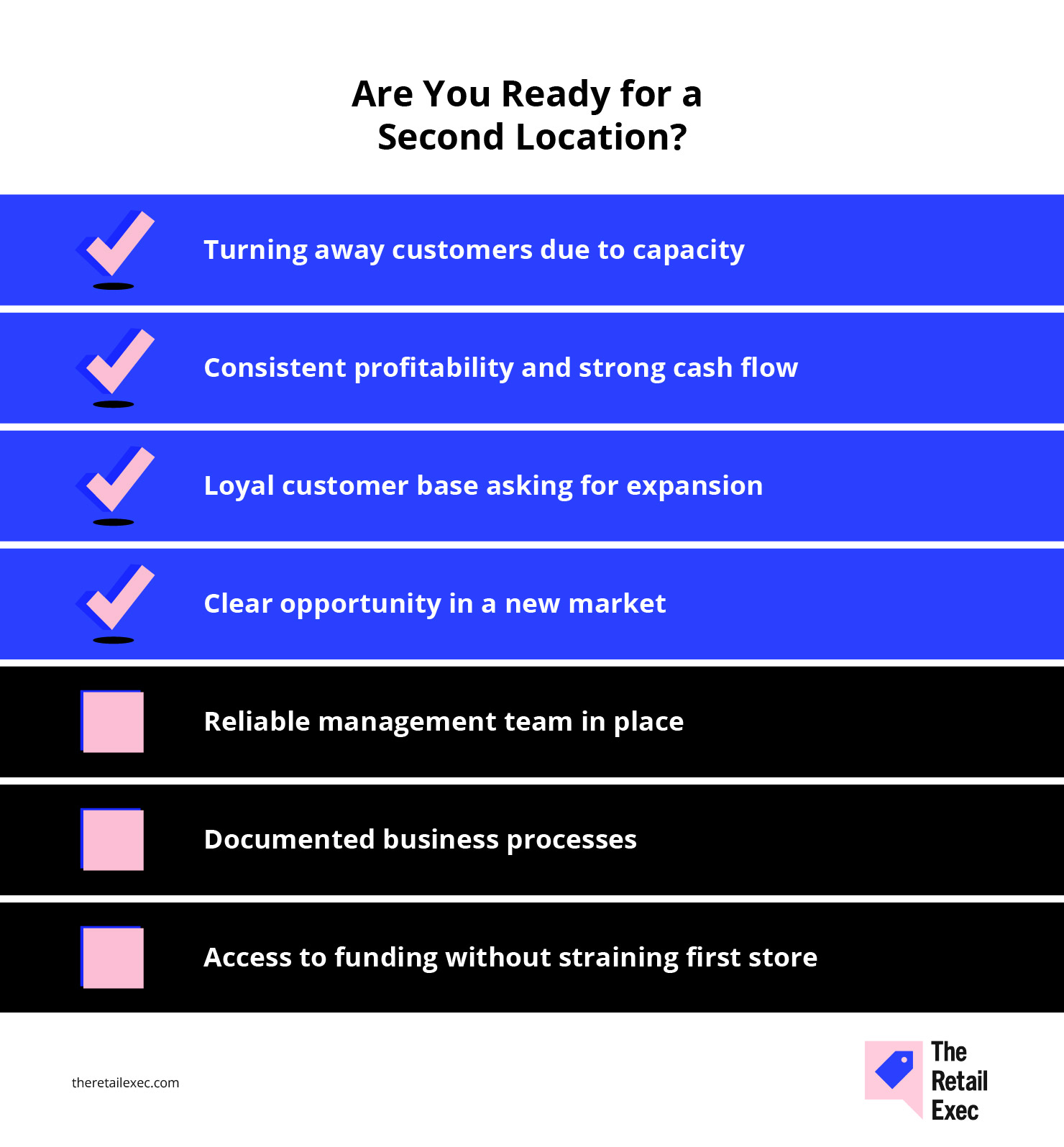
Demand matters—but so does stability. These are the signs you’ve got the right mix of both:
- Your current store is maxed out. You’re turning away customers or losing sales due to space, staffing, or inventory limits.
- Profitability is strong and consistent. Not just revenue growth, but clean margins and healthy cash flow.
- Customers are asking you to grow. You’re hearing regular feedback about opening elsewhere or serving another area.
- You’ve identified a specific market opportunity. Not just “we think we could do well,” but actual data or patterns that support it.
- Your team runs without hand-holding. You’ve got leaders who can take ownership and maintain standards without you on the floor.
- You have access to capital. Expansion won’t leave your first store starved for resources.
If even a few of these are shaky, focus on tightening up your base before layering on more risk.
Evaluate your current business health
Strong demand doesn’t guarantee a smooth expansion.
You need to know your business can absorb the added complexity—without jeopardizing what you’ve already built. A proper health check helps you spot cracks before they turn into real risks.
Here’s where to focus:
- Revisit your long-term vision. Does opening a second location move you toward your three-year goals—or just distract you from them?
- Audit your financials. Look at margins, cash flow, and your ability to weather surprise costs. Use key ratios to gauge stability, not just growth.
- Assess sales and marketing systems. Can you reliably bring in new customers and retain them? If you're still overly reliant on foot traffic or word of mouth, that won't scale.
- Pressure test your pricing. Consider how your price points hold up in a new neighborhood with different cost structures and competitors.
- Map your operations. Document inventory, staffing, and service processes. Anything that depends on you personally won’t scale.
- Evaluate your team. Do you have managers who can lead without daily oversight—or will expanding leave both locations understaffed at the top?
- Review your tech stack. Your POS, inventory, and communication tools need to support multi-location operations without turning into a patchwork.
- Know the legal terrain. Every city has different zoning, permitting, and labor laws. Start early so these don’t derail your timeline.
You don’t need perfection—you need clarity on where you stand and what’s likely to break under pressure.
Step 2: Build a Plan You Can Actually Execute
Expansion is all about execution. A second location won’t forgive sloppy planning the way a startup sometimes does.
You’ll need a clear plan that covers financials, operations, and the realities of running two stores at once.
Learn from big players, then scale it to your size
Starbucks built its growth engine on data. Its Atlas system, developed with Esri, analyzes population density, income levels, traffic patterns, competitor presence, and proximity to other Starbucks stores. With it, the company can forecast revenue and profitability before committing to a site.
“It’s a large GIS application that includes workflow, analysis, and store performance,” explains Laurence Norton, Director of Business Intelligence at Starbucks. “Atlas has been and continues to be an incredible success story for us.”
Most retailers won’t have a custom GIS platform—but you don’t need one.
Take Harbor & Pine, a mid-market lifestyle retailer with 20 stores. They created a simple location scorecard using three inputs:
- Demographics from census data to match customer profiles.
- Foot traffic data from Placer.ai to measure daily flow.
- POS sales by ZIP code to see where customers were already coming from.
This lightweight approach gave them a repeatable way to evaluate new markets without overcomplicating the process. The principle is the same: measure demand with real data, not just gut feel.
Create a business plan
Once you’ve confirmed demand, put it on paper. A business plan helps you stay disciplined, secure funding if you need it, and give your team a roadmap for execution.
It doesn’t have to be long, but it does need to be complete. Focus on these essentials:
- Executive summary. Expansion goals, concept, and financial expectations in plain language.
- Company description. An updated story that shows how the new location fits your broader strategy.
- Market analysis. Demographics, competition, and buying power in the area you’re targeting.
- Organization and management. Clear lines of responsibility for both the new site and overall business.
- Products and services. Whether you’ll replicate your current offer or adapt it for the new market.
- Marketing and sales strategy. How you’ll attract customers before launch and keep them coming back.
- Funding requirements. The capital you’ll need, where it will come from, and how you’ll use it.
- Financial projections. Realistic revenue, cost, and profitability models for the first three years.
- Appendix. Lease agreements, site surveys, or resumes of key hires—anything that strengthens the plan.
Harbor & Pine keeps their expansion plans short—usually under 20 pages—but updates them quarterly once the new store is in motion. The document works as a living reference for leadership, not a one-off exercise.
Do the homework with market research
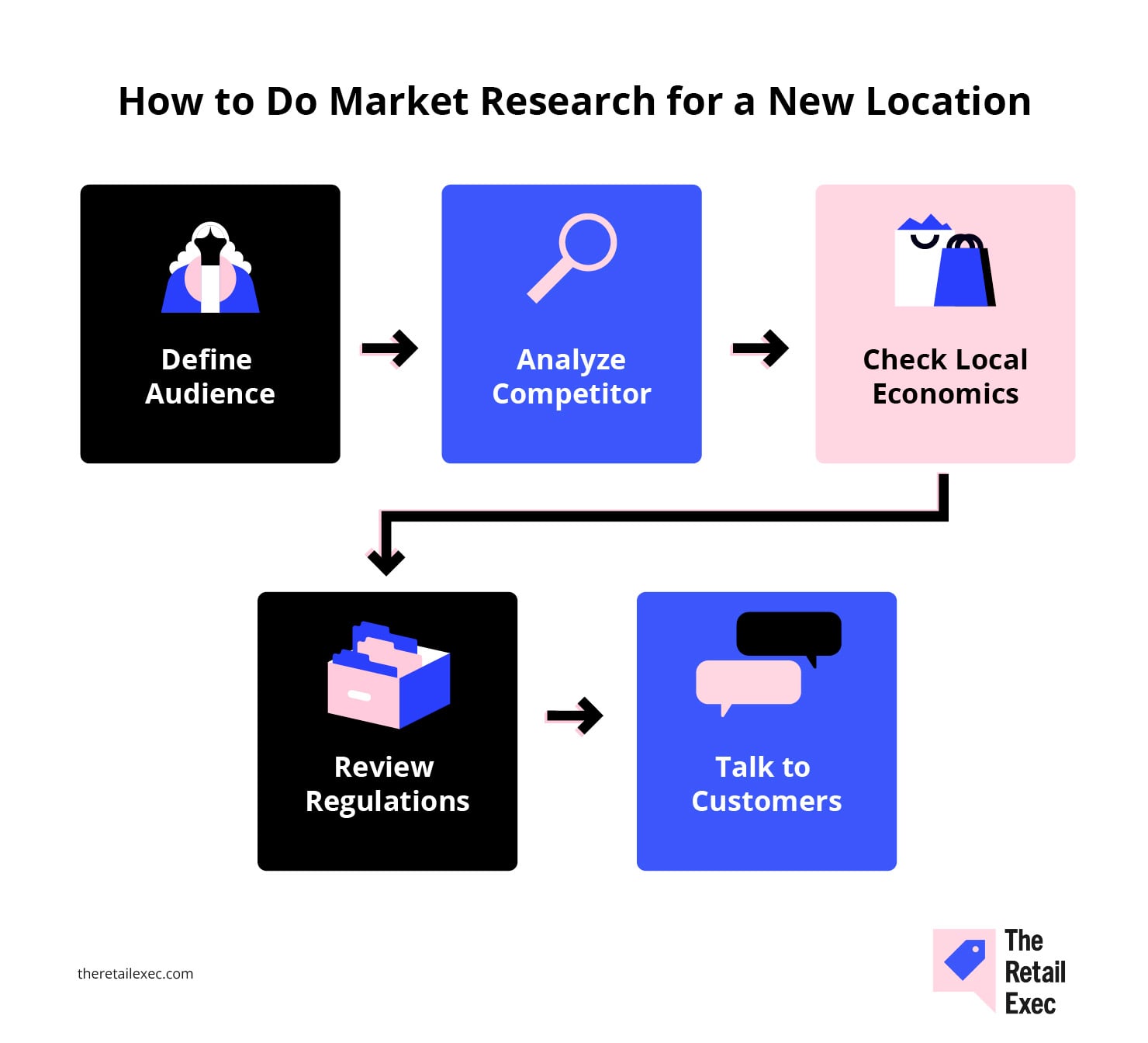
Market research tells you if your idea has legs in a new area—or if you’re about to waste months of effort. It doesn’t have to be academic, but it does need to be structured.
Start with these steps:
- Define your target audience. Get clear on who you expect to serve in the new location. Compare demographics and buying behaviors to your current customer base. If they’re different, adjust your offer and messaging.
- Map the competition. Identify direct and indirect players. Note their pricing, positioning, and customer experience. Gaps in their service can be opportunities for you.
- Check local economics. Look at employment rates, average income, and consumer spending in the area. These indicators tell you whether demand will hold.
- Talk to potential customers. Use surveys, interviews, or even informal conversations in the area. This gives you insights you won’t find in secondary data.
- Review regulations early. Licensing, zoning, signage rules, and tax policies vary by location. Knowing them upfront prevents costly delays.
Mesa Trail Outfitters—a 12-store outdoor gear retailer—used this approach before opening in a new region.
Their research showed strong seasonal demand but also revealed gaps in rental equipment availability. That insight led them to expand rentals alongside retail sales, which quickly paid off in the first year.
Stress test your finances
Opening a second location takes more than upfront capital—it requires steady cash flow to keep both stores running while the new one ramps up.
Expansion costs almost always run higher and longer than planned, so pressure test your numbers before moving forward.
Consider your funding options and how they fit your tolerance for risk:
- Bank loans. Traditional term loans or lines of credit with predictable repayment schedules.
- SBA loans. Government-backed options with favorable rates for small businesses.
- Investors. Angel or venture capital can provide cash, but expect to give up equity or control.
- Alternative financing. Crowdfunding, peer-to-peer lending, or merchant cash advances may work in specific cases, but often carry higher costs.
- Equipment financing. Useful if your expansion requires major purchases like fixtures or machinery.
No matter the mix, keep cash flow at the center. Track how you'll cover payroll, rent, and inventory while the new location builds traction using proven business scaling strategies.
Kestrel Home, an eight-showroom home goods retailer, underestimated this buffer when they opened a new store. Sales took longer to ramp than projected, and without strong cash reserves, their first location’s operations became strained.
The lesson: model conservative revenue scenarios and ensure you have enough cushion to absorb slower-than-expected growth.
Step 3: Choose the Right Location
A good site can make your second store thrive. A bad one can bleed you dry. Don’t rely on gut feel—treat location scouting as seriously as you would a major investment.
What to look for in a market
When scouting areas, weigh the fundamentals that actually impact sales and operations:
- Foot traffic. Track volume and type. Is it your target customer walking by, and is the flow steady throughout the day?
- Demographics. Age, income, and lifestyle patterns should align with your best customers.
- Competition. Identify both direct rivals and substitutes. A crowded market isn’t always bad if there’s a clear gap.
- Accessibility. Parking, public transit, and ease of deliveries all affect both customers and staff.
- Zoning and ordinances. Regulations on signage, hours, or noise can become hidden costs.
- Future development. New housing, transit, or retail projects can shift demand over the next five years.
Mesa Trail Outfitters used this framework when entering a suburban market outside Denver. On paper, foot traffic looked strong, but future development plans showed a competing lifestyle center opening nearby.
That insight led them to hold off—and saved them from opening next door to a bigger competitor two years later.
How to evaluate a property
Once you’ve narrowed your search to specific spaces, dig into the details. Use this checklist to avoid surprises:
- Size and layout
☐ Is there enough space for sales, storage, and back-office needs?
☐ Does the layout give flexibility for growth or reconfiguration? - Condition
☐ What repairs or renovations are required?
☐ Do those costs fit into your budget without straining cash flow? - Landlord reliability
☐ What’s their track record with other tenants?
☐ Have you spoken with current or past tenants for firsthand feedback? - Lease terms
☐ Are rent escalations, renewal options, and maintenance responsibilities clear?
☐ Do the terms give you flexibility to adapt if the market shifts? - Financial implications
☐ Is the total cost (rent, fees, utilities) aligned with realistic revenue projections?
☐ How will those costs affect profitability over time?
Urban Pantry Market nearly signed on a high-traffic downtown space before realizing the lease included steep annual escalations and limited signage rights.
That detail would have eroded margins fast—proof that lease fine print can be as decisive as customer demand.
Step 4: Set Up Operations for Multi-Location Life
Once the lease is signed, the real test begins. Expanding means you’re not just running a new business location—you’re running two at once.
Systems that worked when you could keep an eye on everything won’t hold up when you’re splitting time and attention.
Hire and train the right team
Your second location will only be as strong as the people running it.
New employees need to uphold your company culture, handle customers with consistency, and take ownership when you’re not in the room.
To build that team:
- Recruit intentionally. Write clear job descriptions and post where your target candidates are—whether that’s job boards, trade schools, or local community groups.
- Interview for fit and leadership. Skills matter, but so does judgment. Include current managers in the process to ensure alignment with your culture.
- Onboard thoroughly. Treat onboarding like an investment, not a checklist. Cover your brand values, customer service standards, and daily workflows.
- Train for consistency. Document service expectations and use role-play or shadowing to reinforce them. This ensures both locations deliver the same customer experience.
- Promote from within when possible. Loyal employees from your first location already understand your standards and can set the tone for new staff.
Solstice Beauty Collective, a 35-store specialty retailer, learned this lesson early.
When they staffed a second boutique entirely with new hires, customer service dipped and loyal customers noticed. Since then, every new location launches with at least one seasoned employee from an existing store to anchor the culture.
Put scalable systems in place
Running multiple stores means more moving parts—and more room for mistakes if your systems don’t scale. Before opening day, lock in tools and processes that keep your operations aligned.
- Accounting. Use accounting software that links your bank accounts, manages payroll, and provides location-level reporting. Separate duties to reduce errors and fraud, and schedule regular reconciliations to stay on top of cash flow.
- Inventory management. Choose an inventory system that syncs stock across locations in real time. Set reorder points, track transfers, and monitor shrinkage. Good visibility prevents stockouts at one store while the other drowns in overstock.
- POS system. Your point of sale should integrate with accounting and inventory, so data flows automatically. Train staff to use it effectively—speed and accuracy at checkout shape the customer experience.
- Business processes. Document workflows—from receiving shipments to handling returns—so both locations operate the same way. Consistency keeps costs down and service levels high.
- Reporting and analysis. Build dashboards with key metrics (sales per square foot, average order value, staff productivity) broken down by location. That makes it easier to spot issues early.
Spark & Cycle, a personal mobility retailer, adopted a new POS system before expanding.
By connecting it to their inventory management software, they eliminated double entry and reduced stock discrepancies across stores. The upgrade paid for itself within the first year by cutting inventory write-offs and streamlining reporting.
Dial in your supply chain
Opening a new store without rethinking your supply chain is a recipe for frustration. What worked for one location often breaks once you add another. Plan now so inventory flows smoothly across both sites.
Focus on these priorities:
- Right-size your inventory. Base forecasts on realistic sales projections, not just optimism. Carrying too much stock ties up capital, while too little means missed sales.
- Coordinate across locations. Set clear rules for transfers between stores and keep them documented. A shared system avoids overordering or double-counting.
- Strengthen supplier relationships. Alert vendors early to increased demand and negotiate terms that support growth. Build contingency plans in case a supplier can’t keep pace.
- Streamline communication. Use centralized tools for purchase orders, delivery tracking, and replenishment alerts. Email chains won’t cut it at scale.
- Plan for disruptions. Weather events, shipping delays, or sudden demand spikes can derail a launch. Map backup options, so the second location isn’t left empty-handed.
Urban Pantry Market faced this when they expanded into a new neighborhood. By centralizing purchasing and using their POS to track inventory across both stores, they avoided tying up cash in duplicate orders and cut spoilage by nearly 15% in the first year.
Step 5: Launch and Win Customers in a New Market
A new store doesn’t succeed on real estate alone—you need a marketing strategy that builds buzz, attracts new customers, and gives loyal ones a reason to spread the word. Treat the launch like a campaign, not an afterthought.
Market with intent
Start by defining your target market for the new area. Demographics, buying habits, and cultural preferences may differ from your first location. Tailor your messaging and offers accordingly.
Mix tactics that give you both reach and local credibility:
- Social media campaigns. Tease the opening with behind-the-scenes posts, countdowns, and staff introductions.
- Local advertising. Flyers, community newspapers, and targeted digital ads reach people right in your new business location’s neighborhood.
- Partnerships. Team up with nearby businesses for cross-promotions or bundled offers.
- Events. Pop-ups or preview nights create reasons for customers to show up before opening day.
- Traditional PR. Send press releases to local media and offer interviews to business reporters.
Harbor & Pine leaned on Instagram ads and a series of influencer partnerships when they opened in a new market. The combination helped them drive strong opening-week traffic and establish credibility with shoppers who had never visited their first location.
Leverage your loyal customers
Your first location’s customer base is one of the strongest tools for launching a new store. These shoppers already trust you, and many will happily help spread the word if you make it easy.
Ways to activate them:
- Announce early. Use email and social media to share expansion news before the public launch. Make customers feel like insiders.
- Offer referral rewards. Give discounts, freebies, or loyalty points to customers who bring in new faces. A small perk can turn them into vocal promoters.
- Host special previews. Invite your most loyal customers to a soft opening or private event. It builds excitement and strengthens retention.
- Encourage social sharing. Create a campaign hashtag and ask customers to post about the new location. Sweeten it with a contest or giveaway.
Solstice Beauty Collective made this part of their playbook. Before opening a second boutique, they invited top-spending customers to a pre-opening event. Photos and posts from that night fueled buzz online and gave the new store instant credibility.
Plan your grand opening

Your opening sets the tone. It’s more than a ribbon cutting—it’s the moment you introduce your brand to a new community.
Build anticipation early.
Teasers on social media, a sign in the window, or a countdown outside the storefront all keep the neighborhood curious. Loyal customers from your first location should hear about it first—they’ll bring friends and credibility.
Make opening day memorable.
Launch with something that sticks: a limited-time offer, a special product drop, or simple hospitality touches that create a buzz. The goal is for people to leave saying, “I’m coming back.”
Keep the momentum alive.
A packed day one doesn’t mean much if week two is empty. Extend the excitement with referral rewards, loyalty sign-up bonuses, or short-term promotions to draw repeat visits.
Kestrel Home took this layered approach with their most recent showroom launch—building buzz all week, filling the floor on opening day, and then sustaining traffic with follow-up campaigns. The result was steady revenue growth instead of a one-day spike.
Step 6: Keep Culture and Control Across Locations
Culture doesn’t scale automatically.
Opening a second location means doubling your risk of drift—service standards, tone, and customer experience can all splinter if you don’t anchor them.
Operators who assume culture “just carries over” usually end up fighting fires.
Codify your culture
The first step is putting it in writing.
Define the values, behaviors, and standards that actually guide how your business runs. This isn’t about lofty mission statements—it’s the rules of the road for customer interactions, problem solving, and day-to-day teamwork.
Keep it simple and specific.
A one-page guide that spells out what “great service” means in your stores will be used far more than a glossy deck full of slogans.
Update it as you learn what translates well to a new market and what doesn’t.
Solstice Beauty Collective learned this the hard way when their second boutique slipped on service quality. Customers noticed.
The fix wasn’t more training hours—it was creating a clear cultural playbook, so every employee understood what the brand stood for.
Keep teams connected
Communication breaks down fast once you’re not under the same roof. Two stores means two versions of reality, unless you put systems in place to keep everyone aligned.
- Regular manager syncs. Weekly calls or check-ins prevent problems from festering and keep priorities consistent.
- Shared dashboards. Sales, staffing, and inventory reports should be visible across locations, so decisions are based on the same numbers.
- Cross-location exchanges. Rotate staff occasionally to build shared standards and prevent “us vs them” mindsets.
- Simple communication tools. Even a shared Slack channel or WhatsApp group can reduce silos if everyone uses it.
The goal isn’t more meetings—it’s alignment. Both locations should feel like parts of the same business, not separate experiments.
Empower the right leaders
Company culture holds together when the right people set the tone. A management team that understands your values and can train new employees is the strongest safeguard against drift.
Promote from within whenever possible.
Leaders who already live your standards don’t need a crash course in what makes your business unique. For small business owners, this can also ease the burden of hiring entirely new managers for a second business location.
When hiring from the outside, make culture part of the process.
Ask how candidates would handle specific customer scenarios, not just their résumé highlights. The answers reveal whether they’ll reinforce your culture or reshape it in ways you don’t want.
Spark & Cycle uses this approach every time they expand service centers. At least one leader from the original location is embedded in the new store to train staff, oversee workflows, and ensure the customer experience feels consistent from day one.
Create a culture guide
A culture guide turns good intentions into a repeatable system. It’s a living document for your HR team and managers that explains how your company culture shows up in daily work.
At minimum, cover:
- Core values and goals
- Expected behaviors and work ethic
- Qualities you look for in new employees
- Training methods to reinforce standards
Update it regularly as you expand and learn what carries over—and what needs adapting—in a new business location.
Patreon does this well. Their culture deck separates “core values” from “core behaviors,” making it clear what never changes and what can flex depending on the situation.
For retailers, a clear culture guide helps new employees get up to speed faster and ensures a second location doesn’t drift into becoming a different kind of business.
Closing Time for Your Second Location
Opening a new business location isn’t a victory lap—it’s the start of a tougher, more complex game. Success comes from preparation: checking your financial health, planning your expansion, choosing the right market, and building systems that keep both stores strong.
Every decision matters. From your first lease negotiation to training new employees, the small calls add up to whether your second store thrives or drags down the first.
Treat expansion as a craft, not a gamble. With the right groundwork, your second location won’t just open—it’ll endure.
Retail never stands still—and neither should you. Subscribe to our newsletter for the latest insights, strategies, and career resources from top retail leaders shaping the industry.