

Key Takeaways
Vendor Confusion: Many vendors incorrectly market traditional AI as agentic AI, causing confusion about its true capabilities.
Agentic AI Explained: Agentic AI acts autonomously, making decisions and taking actions without human prompts or supervision.
Retail Use Cases: Retailers effectively using agentic AI see benefits in inventory management, dynamic pricing, and customer support.
Cost Consideration: Agentic AI implementation costs range from $50K to $1M annually, depending on scale and complexity.
Adoption and Growth: Global agentic AI market in retail is projected to grow from $46.74 billion in 2025 to $175.11 billion by 2030.
Every vendor at NRF this year had the same pitch: agentic AI.
Your email is full of it. Consultants are breathless about it. SaaS companies are suddenly "agentic-first platforms." Even your POS vendor—who couldn't get basic reporting right—is now offering "autonomous AI agents."
Here's the problem: Half of them don't know what agentic AI actually is.
You see it all the time right now. Vendors rebrand chatbots as “agentic,” whitepapers dress up standard automation as “goal‑oriented agents,” and executives nod through the hype—rarely stopping to ask the obvious: “What the hell does this actually do?”
In other words, a lot of what’s labeled agentic isn’t autonomous at all.
So let's cut through the noise. The retail landscape is being reshaped by AI-driven automation, but most of what vendors call "agentic" is just traditional AI with better branding.
Here's what agentic AI actually is, how it's different from the AI tools you probably already have, when you need it, and—this is the important part—when you absolutely don't.
What Agentic AI Actually Is (In Plain English)
Agentic AI is artificial intelligence that acts autonomously toward goals you set—without constant human supervision or prompting. Unlike chatbots or standard automation, it analyzes data, makes decisions, and takes action on its own.
The key word here is autonomous. It doesn't just predict what might happen. It doesn't generate content when you ask. It doesn't wait for you to tell it what to do.
It analyzes data, sets goals based on parameters you define, makes decisions, and takes action—on its own.
The simple definition
According to Salesforce's retail AI research, agentic AI can "act independently toward defined goals, using context and feedback to guide decisions."
Unlike traditional artificial intelligence that requires constant human intervention, autonomous systems powered by agentic AI operate independently—analyzing data, making decisions, and taking action without waiting for prompts.
In retail terms: You tell it the goal (maximize inventory turnover, optimize pricing for margin, reduce cart abandonment). It figures out how to achieve that goal and takes action—automatically.
What makes it different from the AI you already have
Let's be brutally honest: Most "AI" in retail right now falls into three categories.
Predictive AI (demand forecasting, sales analytics):
- Shows you what might happen based on historical data
- You still make the decision
- Examples: Sales forecasting tools, inventory planning software
Generative AI (ChatGPT, content tools):
- Creates text, images, summaries when you prompt it
- Requires human direction every step
- Examples: Writing product descriptions, generating marketing copy
Chatbots and AI assistants:
- Answer questions, automate customer responses
- Reactive, not proactive
- Examples: Customer support bots, voice assistants
Agentic systems are fundamentally different.
You give it a goal—"keep this product in stock while minimizing carrying costs"—and it works toward that goal continuously.
Behind the scenes, algorithms analyze patterns, predict outcomes, and take actions that drive operational efficiency—without waiting for you to prompt it.
According to Amplience's analysis, agentic AI combines LLMs (large language models), machine learning, and enterprise automation within a connected ecosystem to streamline operations—analyzing data, setting goals, and taking actions to achieve those goals without human supervision.
Here’s a quick comparison table:
| AI type | What it does | Example | Key limitation |
|---|---|---|---|
| AI typePredictive AI | What it doesShows what might happen based on historical data | Example"Based on sales velocity, you'll run out of this SKU in five days" | Key limitationYou still make the decision |
| AI typeGenerative AI | What it doesCreates text, images, summaries when you prompt it | ExampleWriting product descriptions, generating marketing copy | Key limitationRequires human direction every step |
| AI typeChatbots | What it doesAnswer questions and automate responses | Example"Current inventory is 47 units" when you ask | Key limitationReactive, not proactive |
| AI typeAgentic AI | What it doesMonitors, analyzes and automatically takes action toward goals | ExampleMonitors stock levels and automatically places the reorder | Key limitationRequires high‑quality, integrated data and governance |
Here's the catch, though: Vendors know "agentic AI" sounds impressive. So they're slapping that label on everything—including chatbots that are absolutely not autonomous.
If your vendor says their tool is "agentic," ask them: "Does it take actions toward goals without me prompting it every time?"
If the answer is "well, you have to tell it what to do," it's not agentic. It's just automation with better marketing.
Real Use Cases for Agentic AI in Retail (With Actual Data)
Okay, so agentic AI acts autonomously. What does that look like in practice?
Here are five use cases where retailers are actually deploying autonomous AI agents—and seeing real results.
Use case 1: Autonomous inventory reordering
The AI monitors inventory levels across all SKUs, analyzes sales velocity, factors in lead times and seasonality, and automatically triggers reorders when thresholds are hit.
You're not reviewing every reorder. You're not manually placing POs. The AI does it.
What it actually does:
- Tracks real-time stock levels across locations
- Predicts when you'll run out based on demand patterns
- Factors in supplier lead times and minimum order quantities
- Places orders automatically
- Adjusts for seasonal trends (orders more ahead of peak season)
- Balances stock levels to maximize profitability across your merchandising mix
Use case 2: Dynamic pricing management
The AI monitors competitor pricing, demand signals, seasonality, and customer behavior—then adjusts your prices in real-time to optimize for margin or volume (depending on your goal).
What it actually does:
- Scrapes competitor prices hourly
- Analyzes your sales velocity at different price points
- Factors in inventory levels (price down to move slow stock)
- Considers time of day, day of week, seasonality
- Adjusts prices automatically across ecommerce and POS
Use case 3: Supply chain disruption response
The AI detects disruptions—weather delays, shipping backlogs, supplier outages—and autonomously reroutes shipments, adjusts inventory allocation, or escalates to humans when needed.
What it actually does:
- Monitors weather, shipping carrier delays, port congestion
- Detects when a shipment will miss delivery window
- Automatically reroutes to alternate fulfillment center
- Reallocates inventory from low-priority stores to high-demand locations
- Alerts humans only for complex decisions (e.g., should we air-freight this?)
Have an account? Log In
Use case 4: Customer support automation
The AI handles routine customer queries end-to-end—tracking orders, processing returns, answering product questions—and escalates complex issues to human agents.
What it actually does:
- Monitors customer inquiries across email, chat, social media
- Resolves routine requests (Where's my order? How do I return this?)
- Processes returns and initiates refunds automatically
- Escalates to humans when sentiment analysis detects frustration or complexity
- Learns from human agent responses to improve over time
Use case 5: Personalized marketing at scale
The AI analyzes individual customer interactions—browsing history, purchase patterns, email engagement—to understand shopping journeys and send personalized offers at optimal times
It learns which messages influence purchasing decisions and adjusts automatically based on response rates.
What it actually does:
- Tracks customer behavior across web, email, in-store
- Identifies optimal timing for each customer (some convert on weekday mornings, others on weekend evenings)
- Generates personalized product recommendations
- Sends targeted offers via email, SMS, or app notifications
- Tests different messaging and adjusts based on performance
When You Actually Need Agentic AI (Honest Assessment)
Let's be real: Most mid-market retailers don't need agentic AI yet.
If you're running three stores and 500 SKUs, you don't need autonomous inventory reordering. You can probably eyeball it.
But if you're in any of these situations, agentic AI might make sense:
You're a good candidate if…
- High SKU count (1,000+ products). Managing inventory manually across thousands of SKUs is brutal. Autonomous reordering makes sense at scale.
- Complex operations with frequent decisions. If your team is drowning in repetitive decisions (pricing adjustments, inventory allocation, reorder timing), agentic AI can handle them automatically.
- Mature data setup. Agentic AI needs clean, integrated data. If your POS, inventory system, ecommerce platform, and CRM don't talk to each other, fix that first.
- Budget allows. Enterprise implementations cost serious money. According to industry analysis, AI implementation costs typically range from $200K to $1M+ depending on complexity and scope, with Fortune 500 retailers often investing at the higher end for full agentic AI deployments.
- You're competing on speed and personalization. If your competitive advantage is fast, personalized service at scale, agentic AI can help you deliver that in ways humans can't match.
Decision framework: Is your operation ready?
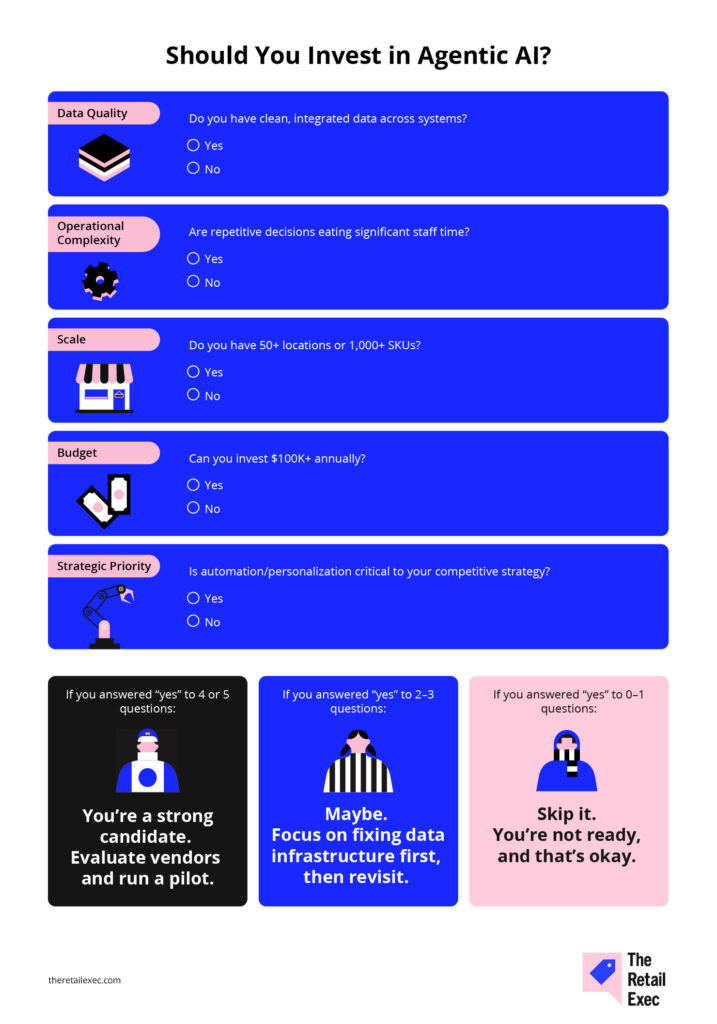
Ask yourself these questions:
- Data quality: Do you have clean, integrated data across systems? (Yes/No)
- Operational complexity: Are repetitive decisions eating significant staff time? (Yes/No)
- Scale: Do you have 50+ locations or 1,000+ SKUs? (Yes/No)
- Budget: Can you invest $100K+ annually? (Yes/No)
- Strategic priority: Is automation/personalization critical to your competitive strategy? (Yes/No)
If you answered "yes" to 4 or 5 questions: You're a strong candidate. Evaluate vendors and run a pilot.
If you answered "yes" to 2-3 questions: Maybe. Focus on fixing data infrastructure first, then revisit.
If you answered "yes" to 0-1 questions: Skip it. You're not ready, and that's okay.
When You DON'T Need Agentic AI (& What to Do Instead)
Here's where I'm going to save you a lot of money and headaches.
Red flags—skip it if…
- Small operation (under 10 locations, under 500 SKUs). You don't have the complexity that justifies autonomous AI. Standard automation or even manual processes are fine.
- Poor data quality or siloed systems. Agentic AI makes bad decisions when fed bad data. If your inventory system, POS, and ecommerce platform aren't integrated, you'll get garbage output.
- Limited budget (under $100K for AI initiatives). The cheapest meaningful agentic AI implementations typically start around $50K annually. If that's not in the budget, don't stretch for it.
- You're still figuring out basic operations. If you don't have standard operating procedures nailed down, adding autonomous AI will create chaos, not efficiency.
- The vendor is calling a chatbot "agentic". If the demo shows you typing prompts and getting responses, that's not agentic AI. That's a chatbot with a marketing team.
Better alternatives for most retailers
If agentic AI isn't right for you, here's what to do instead:
Standard automation (Zapier, Make, built-in platform automations):
- Automate email workflows, inventory alerts, order confirmations
- Cost: $50–$500/month
- Still requires you to set up rules, but handles repetitive tasks
Rule-based systems:
- Set inventory reorder points manually, let system trigger POs automatically
- Most inventory management software supports this
- Not "intelligent," but effective for predictable patterns
Predictive analytics tools:
- Use demand forecasting to inform manual decisions
- Much cheaper than agentic AI ($5K–$50K/year)
- Gives you the insights without autonomous action
Upgrade your core systems first:
- Better POS, modern inventory management, integrated ecommerce platform
- Often delivers more value than adding AI on top of broken infrastructure
What Agentic AI Actually Costs
Let's talk money, because vendors love to avoid this conversation.
Enterprise implementation: $500k–$1m+ annually
For Fortune 500 retailers deploying agentic AI at scale:
- Software licensing: $200K–$500K/year for enterprise platforms
- Cloud compute: $100K–$300K/year (agentic AI runs expensive models constantly)
- Data integration: $100K–$200K upfront to connect systems
- Staff training and change management: $50K–$100K Ongoing monitoring and optimization: $50K–$100K/year
According to Precedence Research, North America accounts for 46% of the global agentic AI market, with enterprise spending driving the majority of that investment.
Mid-market options: $50k–$200k/year
SaaS platforms from vendors like Salesforce, Symphony AI, and others typically offer agentic AI capabilities at lower price points:
- Platform subscription: $3K–$10K/month ($36K–$120K/year)
- Implementation and setup: $10K–$30K upfront
- Integration costs: $5K–$20K (depending on system complexity)
- Training: $3K–$10K
What you're paying for
When you buy agentic AI, you're paying for:
- Software licensing (the AI platform itself)
- Cloud compute (agentic AI runs constantly, analyzing data and making decisions—compute costs add up)
- Data integration (connecting your POS, inventory, ecommerce, CRM systems)
- Staff training (your team needs to know how to set goals, monitor performance, and intervene when needed)
- Ongoing monitoring (autonomous doesn't mean set-and-forget—someone needs to review outputs)
Hidden costs
Budget for these too:
- Data cleanup before implementation. Could be $20K–$100K depending on how messy your data is.
- System integration. If your systems don't talk to each other, that needs fixing first.
- Change management. Getting your team comfortable with AI making decisions.
ROI timeline
Expect 12–18 months before you see ROI from agentic AI implementations, based on typical industry case studies. This isn't instant.
Early months are spent on setup, integration, training, and tuning the AI. Real efficiency gains and cost savings typically show up in months 6–12.
The Future of Retail: How AI Innovation Is Growing (& What It Means for You)
The agentic commerce market is exploding—but that doesn't mean you need to rush.
The numbers: $46b to $175b by 2030
According to Mordor Intelligence, the global agentic AI market in retail and ecommerce is expected to reach $46.74 billion in 2025. By 2030? $175.11 billion. That's 30.2% annual growth.
Why the massive growth?
Retailers are realizing that autonomous AI can handle the volume and complexity of modern retail operations in ways humans can't match.
Pricing decisions across thousands of SKUs. Inventory allocation across hundreds of locations. Personalized product discovery for millions of customers. In-store operations from checkout to restocking.
The scale demands automation. And agentic AI is the next evolution of that automation.
Who's adopting: 76% of retailers increasing investment
Warmly's statistics show that 76% of retailers are increasing their investment in AI agents over the next year.
North America is leading adoption, capturing 40–46% of the global market share, according to Grand View Research.
What this means for you
This isn't a fad. Agentic AI is real, it's growing, and it's here to stay.
But—and this is important—you don't have to be an early adopter.
Early adopter advantage is real (less competition, more time to learn, potential for differentiation). But so is early adopter risk (bugs, immature implementation strategies, higher costs, vendor instability).
If you're not competing on bleeding-edge technology, it's perfectly fine to wait.
Let larger competitors work out the kinks. Watch what works and what doesn't. Then implement when the technology matures and costs come down.
The market will still be there in 2026, 2027, and beyond.
Agentic AI Implementation Roadmap
Okay, you've decided agentic AI makes sense for your operation. Here's how to implement it without blowing up your business.
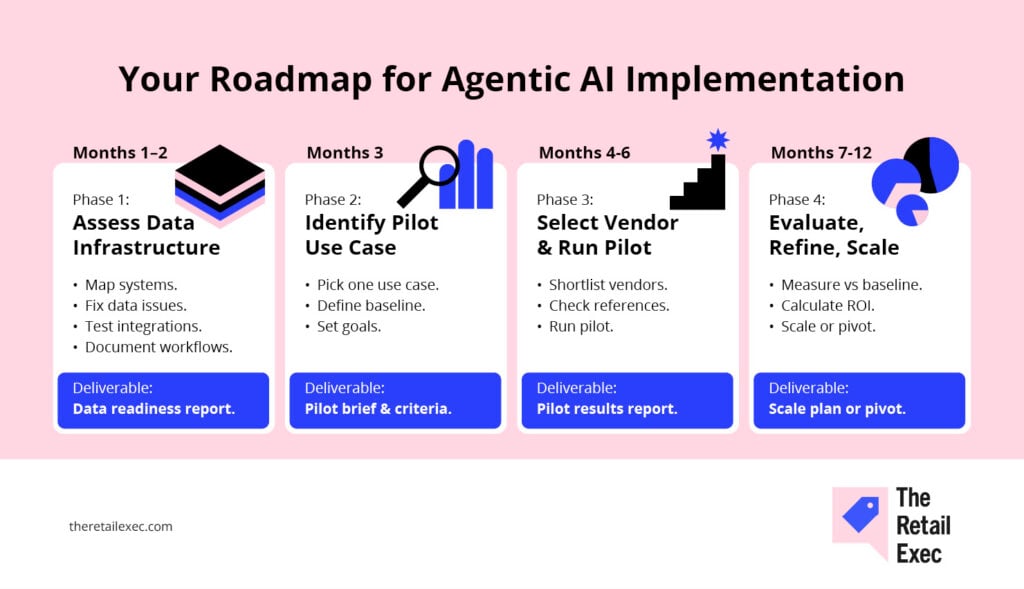
Phase 1: Assess your data infrastructure (months 1–2)
Before you talk to vendors, audit your data.
What to do:
- Map all systems: POS, inventory, ecommerce, CRM, ERP
- Identify data quality issues (duplicates, missing values, inconsistent formats)
- Test data integration (can these systems talk to each other?)
- Document current workflows and decision points
Why this matters: Agentic AI makes autonomous decisions based on your data. If your data is garbage, the AI will make garbage decisions—fast.
Deliverable: Data readiness assessment with gaps identified
More Articles
Phase 2: Identify high-impact pilot use case (month 3)
Don't try to automate everything at once. Pick ONE high-impact use case to pilot.
Best pilot candidates:
- Inventory reordering (clear ROI, measurable outcomes)
- Dynamic pricing (immediate revenue impact)
- Customer support automation (reduces labor costs, improves response times)
What to do:
- Choose a use case with clear success metrics
- Define baseline performance (current stockout rate, pricing margin, support response time)
- Set goals (reduce stockouts by 30%, improve margin by 5%, cut support costs by 25%)
Deliverable: Pilot project brief with success criteria
Phase 3: Select vendor and run pilot (months 4–6)
Evaluate vendors, pick one, and run a 3–6 month pilot.
Vendor evaluation criteria:
- Industry experience—have they deployed in retail before?
- Integration capabilities—does it work with your existing systems?
- Pricing transparency—watch out for hidden costs.
- Support and training —what happens when things break?
What to do:
- Get demos from 3–5 vendors
- Check references (talk to their retail customers)
- Negotiate pilot terms (limited scope, defined timeline, exit clause if it doesn't work)
- Run pilot with clear success metrics
Deliverable: Pilot results report with performance vs. baseline
Phase 4: Evaluate, refine, scale (months 7–12)
If the pilot works, scale gradually. If not, pivot or pull back.
What to do:
- Measure pilot results vs baseline
- Calculate actual ROI (not projected—actual)
- Identify what worked and what didn't
- If successful: Scale to additional use cases or locations
- If unsuccessful: Diagnose why (data quality? Wrong use case? Vendor issues?) and decide whether to fix or walk away
Key principle: Start small, prove value, scale gradually.
Don't skip this: Upskill your team
Even autonomous AI needs human oversight.
Someone on your team needs to:
- Set and adjust goals for the AI with proper permissions
- Provide human oversight by monitoring outputs and catching errors
- Set up notifications for AI actions that require review
- Intervene when the AI makes questionable decisions
- Refine the system over time
Budget for training. Don't assume the AI will run itself.
Set It and Don’t Forget It
Agentic AI is real. It's powerful. And it's transforming how large retailers operate.
But it's not for everyone.
If you're running a complex operation with high SKU counts, mature data infrastructure, and budget to invest—it's worth evaluating. Pick a high-impact use case, run a pilot, measure ROI, and scale if it works.
If you're a smaller operation, or your data quality is shaky, or you're still nailing basic operations—fix those issues first. Standard automation and better core systems will deliver more value than jumping straight to agentic AI.
And whatever you do, don't fall for vendors rebranding chatbots as "agentic AI." If it requires you to prompt it, it's not autonomous. It's just automation with better marketing.
The market is growing fast—projected to hit $175 billion by 2030—but you don't have to rush. Let the market mature. Let costs come down. Then move when you're ready.
Start small. Prove value. Scale when it makes sense.
That's the smart play.
Retail never stands still—and neither should you. Subscribe to our newsletter for the latest insights, strategies, and career resources from top retail leaders shaping the industry.
Agentic AI in Retail FAQs
Let’s finish up with some Qs and their requisite As.
What's the difference between agentic AI and a chatbot?
Chatbots respond to user prompts—you ask a question, they answer. Agentic AI pursues goals autonomously without constant human input.
A chatbot answers “What’s my inventory level?” when you ask. Agentic AI monitors inventory continuously and automatically reorders stock when thresholds are hit—without you prompting it.
How much does agentic AI cost for a mid-market retailer?
$50K–$200K annually for SaaS vendor solutions (Salesforce, Symphony AI, others). Enterprise implementations can run $500K–$1M+ per year.
Factor in additional costs for data integration ($10K–$30K), training ($5K–$10K), and monitoring. The cheapest meaningful implementations start around $50K/year.
Do I need agentic AI if I already use predictive analytics?
Not necessarily. Predictive analytics tells you what might happen based on data. Agentic AI takes action on those predictions autonomously.
If your team can handle decision-making based on predictive insights, you might not need autonomous agents yet. Agentic AI makes sense when the volume or frequency of decisions overwhelms human capacity.
What's a good first use case for agentic AI in retail?
Inventory reordering or dynamic pricing. Both are repetitive, data-driven decisions with clear ROI metrics. Inventory reordering reduces stockouts and overstock.
Dynamic pricing optimizes margin or volume based on real-time demand. Start with one high-impact use case, prove value, then expand to other areas.
Is agentic AI just hype?
It’s real technology with proven results—case studies show 25% drops in cart abandonment, $77 million profit improvements, and significant operational efficiencies.
But vendors are overhyping it and mislabeling chatbots as “agentic.” Approach with skepticism. Demand proof of ROI. Don’t buy it just because everyone’s talking about it.