



Yotpo is an ecommerce marketing platform that helps businesses boost customer engagement through reviews, loyalty programs, and more. I think Yotpo serves online retailers best, especially those in fashion and beauty, looking to enhance customer interaction. Yotpo offers powerful tools to drive growth and improve customer retention.
Yotpo addresses issues like customer retention and engagement for marketing teams and ecommerce departments. In this article, I'll cover Yotpo's features, pros and cons, use cases, and pricing so you can decide if this software aligns with your customer engagement needs and goals.
Yotpo Evaluation Summary
- From $79/month (billed annually)
- Free plan available
Why Trust Our Software Reviews
Yotpo Overview
In my opinion, Yotpo offers a solid ecommerce marketing platform with features that cater well to online retailers, especially in fashion and beauty. It excels in customer engagement tools like reviews and loyalty programs, outperforming competitors in these areas. However, its onboarding process can be a bit challenging, and pricing might not suit smaller businesses. If you’re looking for a platform to boost customer interaction and retention, Yotpo is worth considering. It’s best suited for businesses ready to invest time in learning the system and those that benefit from strong customer support and integration capabilities.
pros
-
User-friendly interface makes navigation easy for your team.
-
The loyalty program helps retain customers effectively.
-
Yotpo's review system boosts customer trust and engagement.
cons
-
Occasional slow response times from customer support can frustrate users.
-
Customization options might feel limited for your team.
-
Onboarding can be a bit challenging for new users.
Our Review Methodology
How We Test & Score Tools
We’ve spent years building, refining, and improving our software testing and scoring system. The rubric is designed to capture the nuances of software selection and what makes a tool effective, focusing on critical aspects of the decision-making process.
Below, you can see exactly how our testing and scoring works across seven criteria. It allows us to provide an unbiased evaluation of the software based on core functionality, standout features, ease of use, onboarding, customer support, integrations, customer reviews, and value for money.
Core Functionality (25% of final scoring)
The starting point of our evaluation is always the core functionality of the tool. Does it have the basic features and functions that a user would expect to see? Are any of those core features locked to higher-tiered pricing plans? At its core, we expect a tool to stand up against the baseline capabilities of its competitors.
Standout Features (25% of final scoring)
Next, we evaluate uncommon standout features that go above and beyond the core functionality typically found in tools of its kind. A high score reflects specialized or unique features that make the product faster, more efficient, or offer additional value to the user.
We also evaluate how easy it is to integrate with other tools typically found in the tech stack to expand the functionality and utility of the software. Tools offering plentiful native integrations, 3rd party connections, and API access to build custom integrations score best.
Ease of Use (10% of final scoring)
We consider how quick and easy it is to execute the tasks defined in the core functionality using the tool. High scoring software is well designed, intuitive to use, offers mobile apps, provides templates, and makes relatively complex tasks seem simple.
Onboarding (10% of final scoring)
We know how important rapid team adoption is for a new platform, so we evaluate how easy it is to learn and use a tool with minimal training. We evaluate how quickly a team member can get set up and start using the tool with no experience. High scoring solutions indicate little or no support is required.
Customer Support (10% of final scoring)
We review how quick and easy it is to get unstuck and find help by phone, live chat, or knowledge base. Tools and companies that provide real-time support score best, while chatbots score worst.
Customer Reviews (10% of final scoring)
Beyond our own testing and evaluation, we consider the net promoter score from current and past customers. We review their likelihood, given the option, to choose the tool again for the core functionality. A high scoring software reflects a high net promoter score from current or past customers.
Value for Money (10% of final scoring)
Lastly, in consideration of all the other criteria, we review the average price of entry level plans against the core features and consider the value of the other evaluation criteria. Software that delivers more, for less, will score higher.
Core Features
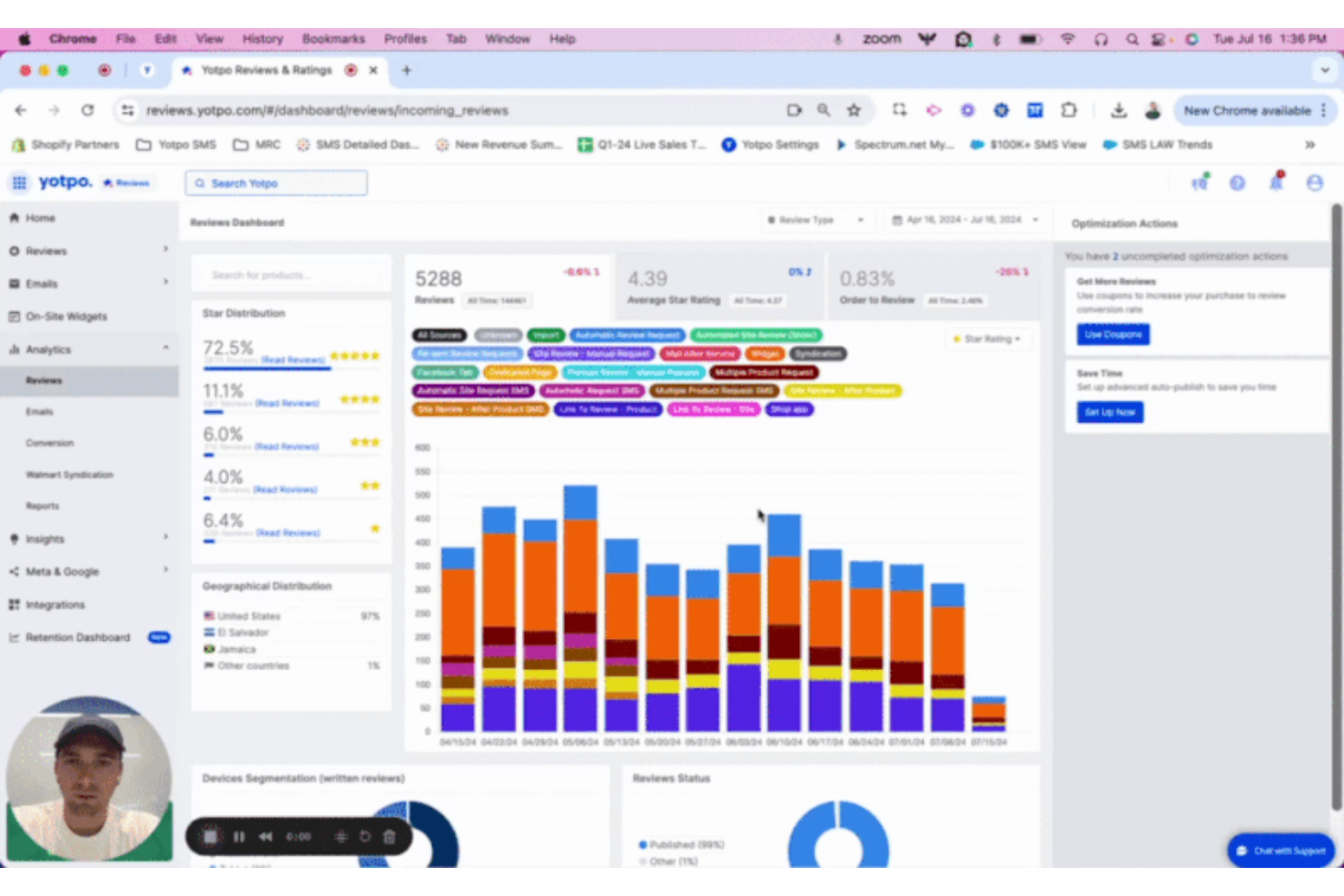
Customer Reviews: Yotpo's review system lets customers share product reviews directly on product pages, with automated review request tools that make collecting feedback easy. It’s easy to use and enhances engagement.
Loyalty Programs: Create rewarding loyalty schemes that keep customers coming back including incentives for referrals and repeat purchases. Your team can easily set up and manage these programs.
Visual Marketing: Share customer-generated photos on your site to boost authenticity. This feature helps showcase your products in real-life settings.
SMS Marketing: Reach your customers directly through SMS campaigns using pre-built templates. This feature drives engagement and can lead to higher conversion rates.
Email Marketing: Yotpo supports email marketing campaigns that help you collect reviews and re-engage customers. These tools make it easy to reach shoppers at key moments in the purchase journey.
Analytics and Insights: Track and analyze customer behavior with Yotpo's analytics. It helps your team make data-driven decisions to improve strategies.
Ease of Use
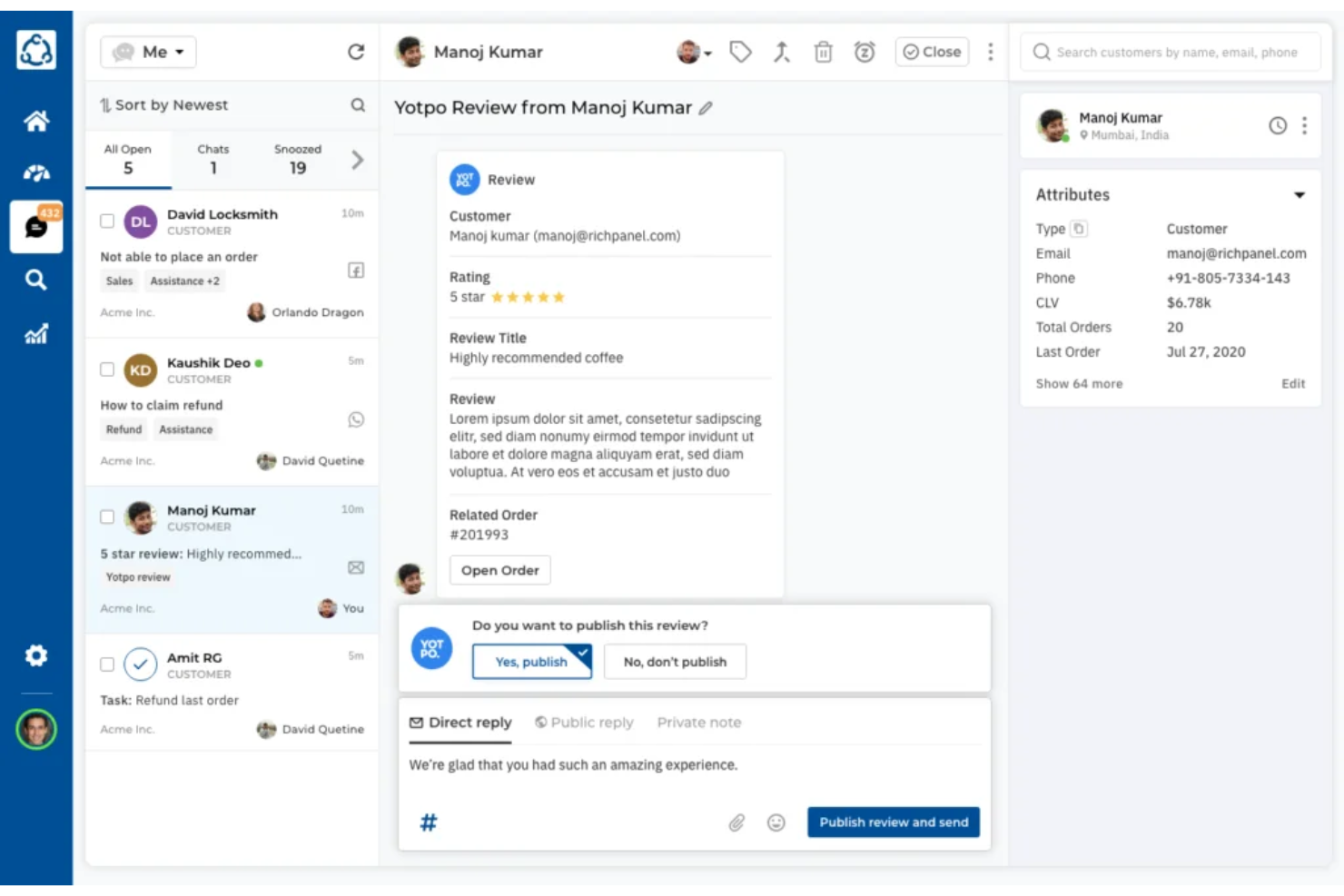
Yotpo offers a user-friendly interface that most teams find easy to navigate, but some users mention a learning curve in mastering its features. The setup process can feel a bit complex, especially for those new to ecommerce marketing platforms. However, once your team gets the hang of it, Yotpo's intuitive design and straightforward tools make daily tasks more manageable, enhancing your team's efficiency.
Integrations
Yotpo integrates with Shopify, Shopify Plus, Klaviyo, BigCommerce, Magento, WooCommerce, Klevu, Productsup, AfterShip Tracking, and Tray.io.
Yotpo also offers an API and connects with third-party integration tools.
Yotpo Specs
- Analytics
- Brand Asset Creation
- Brand Management
- Campaign Management
- Data Export
- Data Import
- Database
- Document Comparison
- External Integrations
- Feedback Management
- File Format Conversion
- File Sharing
- File Transfer
- Knowledge Base
- Marketing Automation
- Multi-App
- Multi-Site
- Multi-User
- Net Promoter Score
- Notifications
- Optimized Search Processing
- Review Monitoring
- Scheduling
- Sentiment Analysis
- Social Media Monitoring
- Social-Media Integration
- Template Designer
- Third-Party Plugins/Add-Ons
- White-label
- Workflow Management