
10 Best Print on Demand Services In 2026

Best Print on Demand Services Shortlist


Choosing the right print on demand service is essential for anyone looking to sell custom products without managing inventory or fulfillment. However, finding the right provider can be challenging, especially with so many options offering different product catalogs, printing methods, fulfillment networks, and pricing.
To help you narrow down your options, I used my ecommerce experience to research and compare the best print on demand services. In this guide, I’ll break down their key features, strengths, and differences to help you find the right service for your products and business goals.
Why Trust Our Software Recommendations
Our team has been testing and reviewing software since 2012. As retail leaders ourselves, we know how difficult—and important—it is to choose the right software.
For this guide, we evaluated tools using hands-on testing and independent research, scoring tools using our selection criteria.
Our reviews reflect our independent judgment—not a sales pitch.
Best Print on Demand Services Summary
| Tool | Best For | Trial Info | Price | ||
|---|---|---|---|---|---|
| 1 | Best for cost-effective print on demand | Free plan available | From $39/month | Website | |
| 2 | Best for high-quality custom products | Free plan available; 14-day free trial | From $24.99/month | Website | |
| 3 | Best for global printing network | Free plan available | From $29.99/month | Website | |
| 4 | Best for diverse product catalog | Free plan available | Pricing upon request | Website | |
| 5 | Best for price matching | Free plan available | Pricing upon request | Website | |
| 6 | Best for creator merch on YouTube and social | Free plan available | Free to use | Website | |
| 7 | Best for US-speed production on a low base cost | Free plan available | From $30/month | Website | |
| 8 | Best for cut-and-sew all-over print apparel | Not available | Pricing upon request | Website | |
| 9 | Best for art print and giclée quality | Not available | Pricing upon request | Website | |
| 10 | Best for eco-friendly products | Not available | From $33/user/month (billed annually) + free plan available | Website |
Best Print on Demand Services Reviews
Here are my in-depth overviews of the best service providers for print on demand, including the pros and cons of each tool, their features, and their best use cases.
Printify
Best for cost-effective print on demand

Printify is a print on demand platform that connects sellers to a global network of print providers, offering product creation tools, a catalog of 1,300+ customizable items, and integrations with major ecommerce sales channels.
Who Is Printify Best For?
Printify is a strong fit for independent sellers, small ecommerce businesses, and entrepreneurs launching custom product stores on platforms like Shopify or Etsy.
Why I Picked Printify
Printify earns its spot as one of the best on my shortlist because its print provider network lets you compare base product costs across 140+ facilities and choose the most affordable option for each item you sell. I like that when I'm pricing out a custom hoodie, I can see quotes from multiple providers side by side before committing. Printify Premium takes this further, cutting product costs by up to 20%, which adds up fast at volume.
Printify Key Services
- Product Creator: A drag-and-drop design tool with a text editor, image uploads, and Shutterstock integration for building product designs directly in-platform.
- Mockup generator: Automatically produces product preview images you can use in your store listings without needing external design software.
- Printify Pop-Up Store: A built-in storefront that lets you sell products without connecting to a third-party ecommerce platform.
- Automatic order routing: Routes incoming orders directly to your selected print provider for fulfillment without manual intervention.
Pros and Cons
Pros:
- Multiple stores per account
- Unlimited product designs
- Flexible mockup generator
Cons:
- Complicated shipping logisitcs
- Limited branding options

Printful
Best for high-quality custom products

Printful is a print-on-demand fulfillment service that lets you add custom designs to 400+ products, with in-house printing using techniques like DTG, embroidery, and sublimation, and direct integration with major ecommerce platforms and marketplaces.
Who Is Printful Best For?
Printful is a strong fit for independent creators, small brands, and online store owners who want to sell custom products without managing inventory or production.
Why I Picked Printful
Printful earns its spot as one of the best on my shortlist because the quality controls built into its in-house production are genuinely hard to replicate. Every order goes through a 3-step quality check before it ships, which is why Printful reports a reshipment rate of just 0.24%. I also like that it handles multiple print techniques—DTG, embroidery, sublimation, and DTF—so I can match the method to the product rather than settling for a one-size-fits-all approach.
Printful Key Services
- Mockup generator: Create product mockups using your own designs across multiple product categories, with options to customize colors, sizes, and placement before publishing to your store.
- White-label branding: Add custom inside and outside labels, branded packing slips, and packaging inserts so every order ships under your brand identity.
- Product catalog: Browse and sell from 400+ items spanning apparel, accessories, home goods, and more, with new products added regularly.
- Warehousing and fulfillment: Store your own inventory in Printful's fulfillment centers and have it picked, packed, and shipped alongside your POD orders.
Pros and Cons
Pros:
- No setup fees
- Wide range of integrations
- High-quality products
Cons:
- Steep learning curve
- Limited customization options

Gelato is a print-on-demand platform that lets you create, sell, and fulfill custom products globally through a network of local print partners, with direct integrations into major ecommerce platforms.
Who Is Gelato Best For?
Gelato is a strong fit for independent creators, Etsy sellers, and ecommerce entrepreneurs who want to sell custom products to international customers without managing inventory or shipping logistics.
Why I Picked Gelato
Gelato earns its spot on my shortlist because of its production model. With 140+ print partners across 32 countries, orders are automatically routed to the print facility closest to the customer, which means a store selling to buyers in Germany, Australia, and the US ships locally in each market. I also like the 60+ logistics partners working behind the scenes, helping deliver 90% of orders within five days. That level of geographic coverage is rare in the print-on-demand space.
Gelato Key Services
- Personalization Studio: Lets your customers add their own text, images, or names to products directly on your storefront before checkout.
- AI mockup generator: Creates product mockups automatically using your uploaded designs, without needing a separate design tool.
- CreateAI: A built-in AI design tool for generating and editing artwork directly within the Gelato platform.
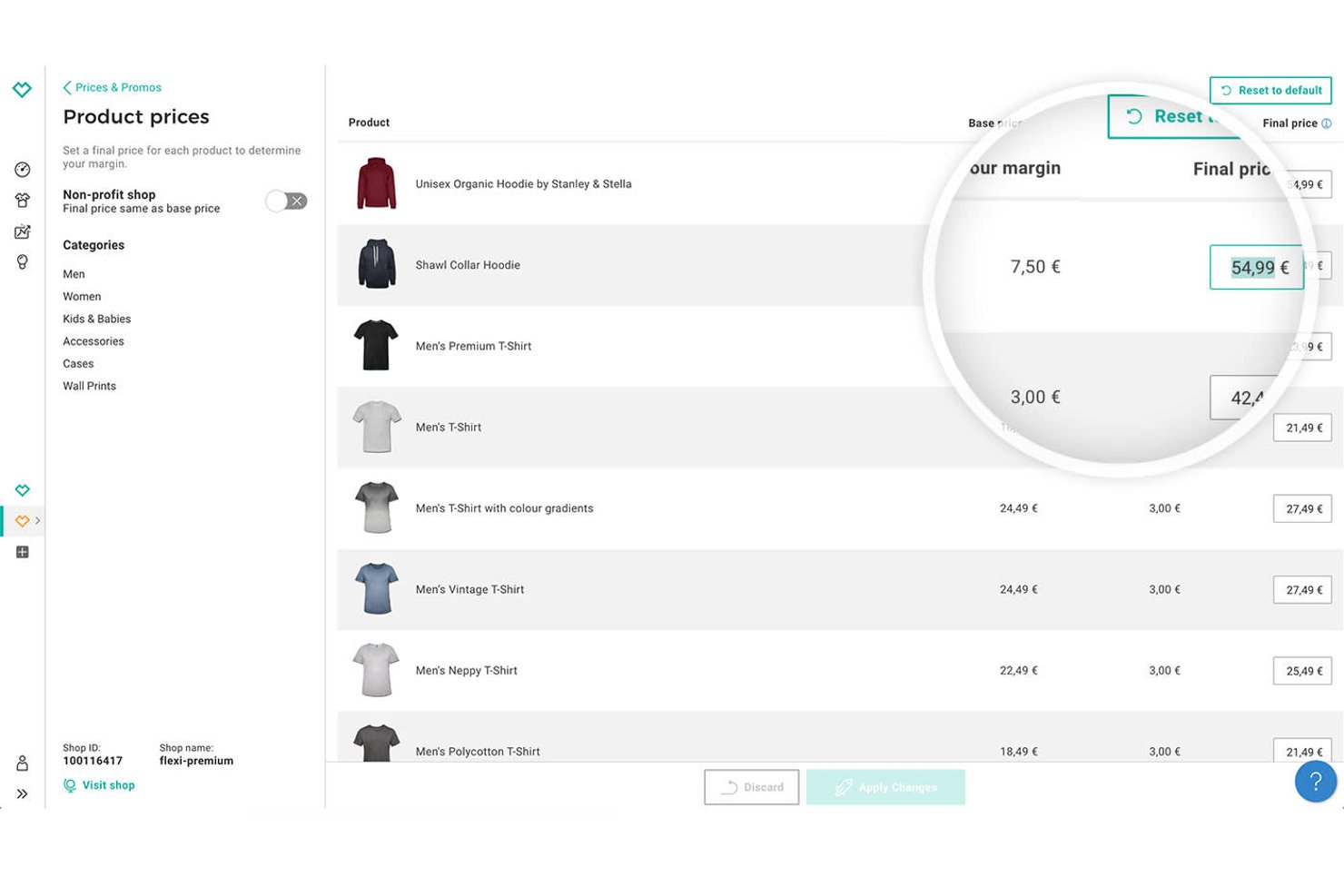
- Price Navigator: A pricing tool that helps you set product prices to hit a target profit margin across different markets.
Pros and Cons
Pros:
- Easy order and shipment tracking
- Eco-friendly printing solutions
- Wide international print coverage
Cons:
- Complex for beginners
- Limited design templates


Gooten is a print-on-demand fulfillment platform that connects your online store to a global network of production partners, handling everything from product creation and order routing to production and shipping across 500+ customizable products.
Who Is Gooten Best For?
Gooten is a strong fit for ecommerce sellers and DTC brands looking to scale a print-on-demand business without managing production or logistics in-house.
Why I Picked Gooten
Gooten earns its spot on my shortlist because the depth of its product catalog is hard to match in the print-on-demand space. With 500+ products and 200+ exclusives you won't find on other platforms, I can offer customers wall art, embroidered hats, sublimated drinkware, and custom home goods all from one supplier. I also like that Gooten supports seven printing methods, including DTG, dye-sublimation, and embroidery, so product quality isn't sacrificed for variety.
Gooten Key Services
- Global production routing: Automatically routes orders to the best-fit production partner across 80+ facilities worldwide based on location, capacity, and speed.
- White-label branding: Customize packing slips, neck labels, and order tracking pages with your brand so customers never see Gooten in the experience.
- Volume-based pricing: Unlock tiered discounts as your order volume grows, with no subscription required to access lower per-unit costs.
- API access: Connect Gooten directly to custom storefronts or proprietary systems via API for sellers who need more than a standard platform integration.
Pros and Cons
Pros:
- Real-time tracking
- Global fulfillment network
- Diverse product catalog
Cons:
- Limited control over fulfillment
- Limited currency settings


Teelaunch is a print-on-demand fulfillment platform with a global production network, a broad product catalog, and direct integrations with major selling channels like Shopify, Etsy, and WooCommerce.
Who Is Teelaunch Best For?
Teelaunch is a good fit for independent sellers and small ecommerce businesses launching custom product lines without upfront inventory investment.
Why I Picked Teelaunch
I've included Teelaunch in my top picks because its price match promise is something I don't see often in the POD space. If you find a lower base cost for a product elsewhere, Teelaunch will match it—which directly protects your margins without requiring you to switch platforms. I also like that this is backed by a delivery guarantee: if a customer claims a package didn't arrive, Teelaunch resolves it without putting you in the middle of a carrier dispute.
Teelaunch Key Services
- Mockup generator: Create product mockups directly within the platform to preview designs before publishing to your store.
- Product personalization: Let customers add their own text or images to products at checkout using Teelaunch's built-in customization tools.
- Global fulfillment network: Route orders to production facilities across multiple countries to reduce shipping times for international customers.
- White-label shipping: Send orders with unbranded packaging so customers receive a consistent, store-branded experience.
Pros and Cons
Pros:
- Satisfaction guarantee
- Global production network
- Price matching policy
Cons:
- No built-In marketing tools
- Limited product range

Best for creator merch on YouTube and social
Spreadshop is a free print-on-demand platform with dual US/EU production facilities, 300+ customizable products, and native integrations for Shopify, WooCommerce, and social commerce channels including YouTube, Instagram, and TikTok.
Who Is Spreadshop Best For?
Spreadshop is a strong fit for content creators and ecommerce store owners who want to sell branded merch across YouTube, Instagram, and TikTok without upfront costs or inventory risk.
Why I Picked Spreadshop
Spreadshop earns its spot on my shortlist because of how well it serves content creators who want to sell merch directly through YouTube, Instagram, and TikTok. As an official YouTube Shopping Partner, it lets creators tag products in videos and livestreams, turning content into a live storefront. Pair that with 95% of orders fulfilled within 48 hours from dual US and EU facilities, and your audience gets fast delivery without you touching a single shipment.
Spreadshop Key Services
- Dual US/EU production routing: Orders automatically route to the nearest facility in Las Vegas or Leipzig, cutting delivery times and shipping costs for regional customers.
- Multi-method printing: Seven-plus print techniques—including DTG, DTF, embroidery, flex, flock, sublimation, and laser transfer—cover a wide range of design styles and product types.
- Spreadconnect REST API: A JSON-based API lets you automate product creation, order management, and fulfillment across connected storefronts and custom builds.
- Performance bonus program: A reward structure that increases seller earnings as monthly sales volume grows, giving high-output shops a path to better margins.
Spreadshop Integrations
Spreadshop has five native ecommerce integrations: Shopify, WooCommerce, Squarespace, Magento, and Shopware. It also connects with YouTube, Instagram, Facebook, and TikTok for social commerce.
Pros and Cons
Pros:
- Dual US and EU fulfillment centers
- Official YouTube Shopping partner for creators
- Free to use with no startup fees
Cons:
- No native Amazon or Etsy store sync
- Shop branding limited to packing slip name
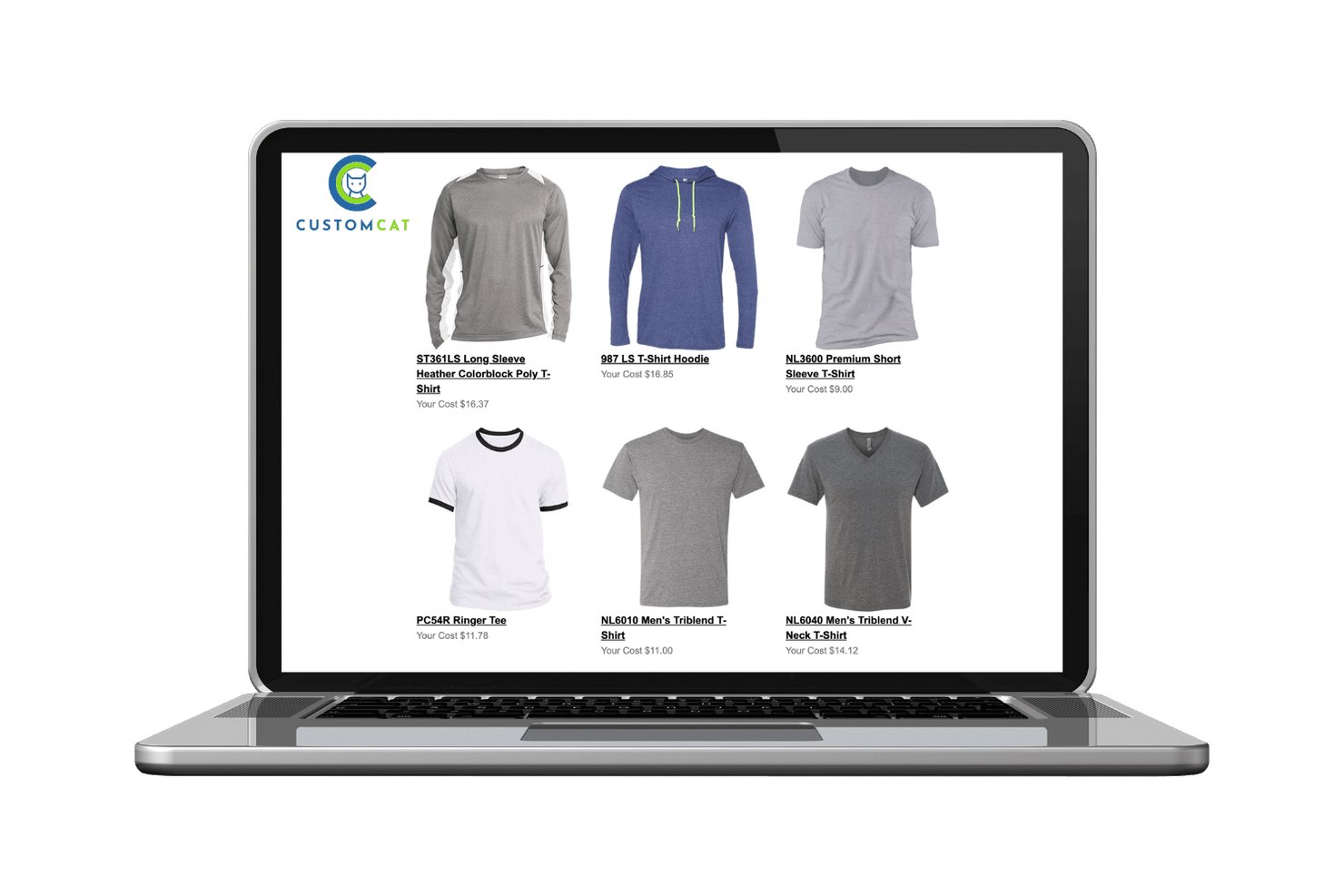
CustomCat is a print-on-demand fulfillment platform with an in-house Detroit production facility that handles apparel decoration via DTG, DTF, sublimation, and embroidery, connecting directly to Shopify, WooCommerce, BigCommerce, and Etsy storefronts.
Who Is CustomCat Best For?
CustomCat is a strong fit for US-based ecommerce sellers who prioritize fast domestic turnaround and want to protect margins with low base product costs.
Why I Picked CustomCat
CustomCat earns its spot on my shortlist because it runs its own Detroit production facility, which is what actually makes the 1–3 business day turnaround real rather than a marketing claim. I like that its proprietary DIGISOFT® printing combines DTG and DTF into a single process, producing prints with wash durability that standard DTG alone can't match. Base product prices, like t-shirts starting around $5.50, are among the lowest in the POD category, so your margins stay intact even before you factor in the PRO plan's additional 20–40% discount.
CustomCat Key Services
- DIGISOFT® design tool: Upload artwork in .png, .jpg, .eps, .ai, or .svg formats and position it directly on product mockups within the platform.
- Multi-speed domestic shipping: Choose from economy, ground, 2-day, or overnight shipping options for US orders at checkout.
- Unlimited store connections: The PRO plan lets you link as many storefronts as you need under a single subscription.
- Premium brand blank catalog: Source products from recognized brands like Bella+Canvas, Comfort Colors, Adidas, and Port Authority directly through the platform.
CustomCat Integrations
CustomCat offers four native storefront integrations: Shopify, WooCommerce, BigCommerce, and Etsy. TikTok Shop is available in beta, while Order Desk, direct API access, and CSV uploads support additional channels and custom workflows.
Pros and Cons
Pros:
- Strong phone and live chat support
- DIGISOFT prints praised for wash durability
- Fast US production with 1–3 day turnaround
Cons:
- Design tool lacks lifestyle mockup images
- No custom neck labels or branded packaging

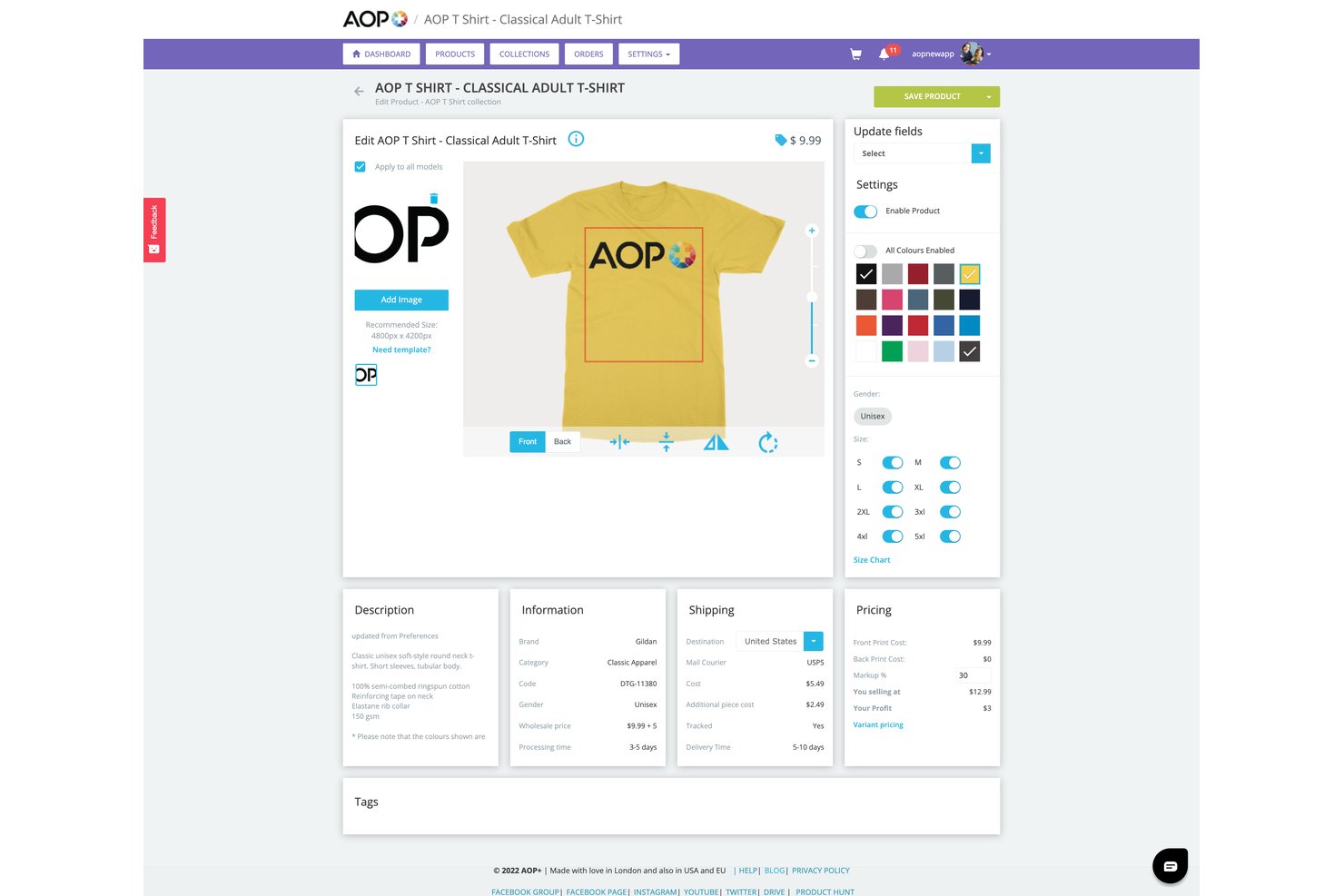
AOP+ is a print-on-demand platform built around in-house production in London, offering DTG printing, dye sublimation, and cut-and-sew all-over print for apparel, accessories, and home goods—with native integrations for Shopify, Etsy, and BigCommerce.
Who Is AOP+ Best For?
AOP+ is a strong fit for UK and EU-based ecommerce sellers who want to build a premium, design-led apparel brand around all-over print without holding inventory.
Why I Picked AOP+
AOP+ earns its spot on my shortlist because of its cut-and-sew all-over print capability, which very few POD platforms offer. I love that fabric is printed in rolls, then cut and hand-sewn in-house at AOP+'s London facility, producing garments like leggings and sublimated hoodies with true edge-to-edge coverage. Paired with an organic cotton range using vegan inks, it's a strong pick for building a premium, design-led apparel brand without holding inventory.
AOP+ Key Services
- Collections bulk upload: Upload a single design and apply it across multiple products at once, speeding up store setup for larger catalogs.
- Hero Member white-label suite: Custom garment labels, branded stickers on shipping bags, and package inserts are available at the $19.99/month tier.
- Organic and sustainable product range: Apparel made from organic cotton with vegan inks and plastic-free packaging options for eco-conscious brands.
- Manual order entry: Place orders directly through the AOP+ dashboard for channels like Amazon and eBay that don't have a native integration.
AOP+ Integrations
AOP+ offers three native integrations: Shopify, Etsy, and BigCommerce.
Pros and Cons
Pros:
- Bulk design upload across many products
- Supports organic cotton and vegan inks
- Offers handmade cut-and-sew all-over print
Cons:
- Single main production facility extends US delivery
- Limited to three native storefront integrations
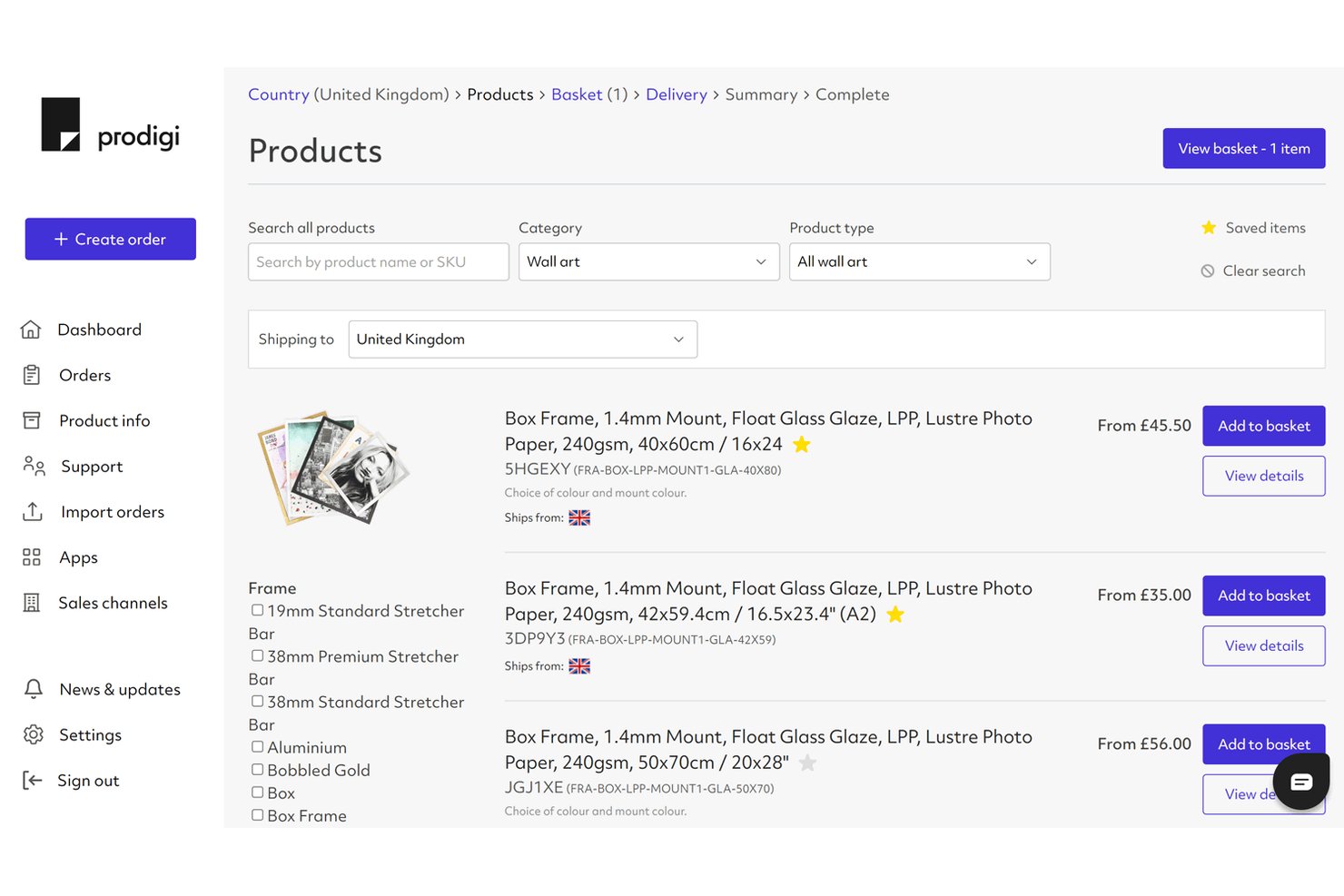
Prodigi is a print-on-demand platform specializing in fine art and giclée printing, with a catalog of 500,000+ products spanning wall art, apparel, home goods, and stationery, fulfilled through a global network of 100+ print partners across 10+ countries.
Who Is Prodigi Best For?
Prodigi is a strong fit for independent artists, photographers, and creative brands that want to sell high-quality wall art, fine art prints, and photo products without managing inventory.
Why I Picked Prodigi
Prodigi earns its spot on my shortlist because of its museum-grade giclée printing, which produces prints with the kind of color depth and archival quality that artists and photographers actually care about. I love that it pairs this with a 500,000+ product catalog, so you can sell a fine art canvas print and a greeting card of the same image from one platform. The AI mockup tool generates lifestyle scenes that make wall art listings genuinely compelling, which I think matters a lot when you're selling premium prints.
Prodigi Key Services
- Global smart routing: Automatically directs each order to the nearest of 100+ print partners across 10+ countries to reduce shipping times and costs.
- CSV bulk importer: Lets you upload and process high-volume or batch orders directly through the dashboard without API setup.
- Eco Collection: A dedicated range of products made from recycled, organic, and plastic-free materials for sustainability-focused brands.
- REST API v4.0: A fully documented API for custom integrations, enabling automated order creation, tracking updates, and branded email notifications.
Prodigi Integrations
Prodigi offers 8 native integrations, including Shopify, Etsy, WooCommerce, Wix, Squarespace, BigCommerce, Adobe Commerce, and TikTok Store. It also supports custom storefronts through REST API v4.0 and batch orders through its CSV importer.
Pros and Cons
Pros:
- Sustainability features appeal to eco-conscious brands
- AI mockup tool creates realistic product scenes
- Museum-grade giclée print quality stands out
Cons:
- Limited branding options for tech and books
- US orders sometimes experience extended delays
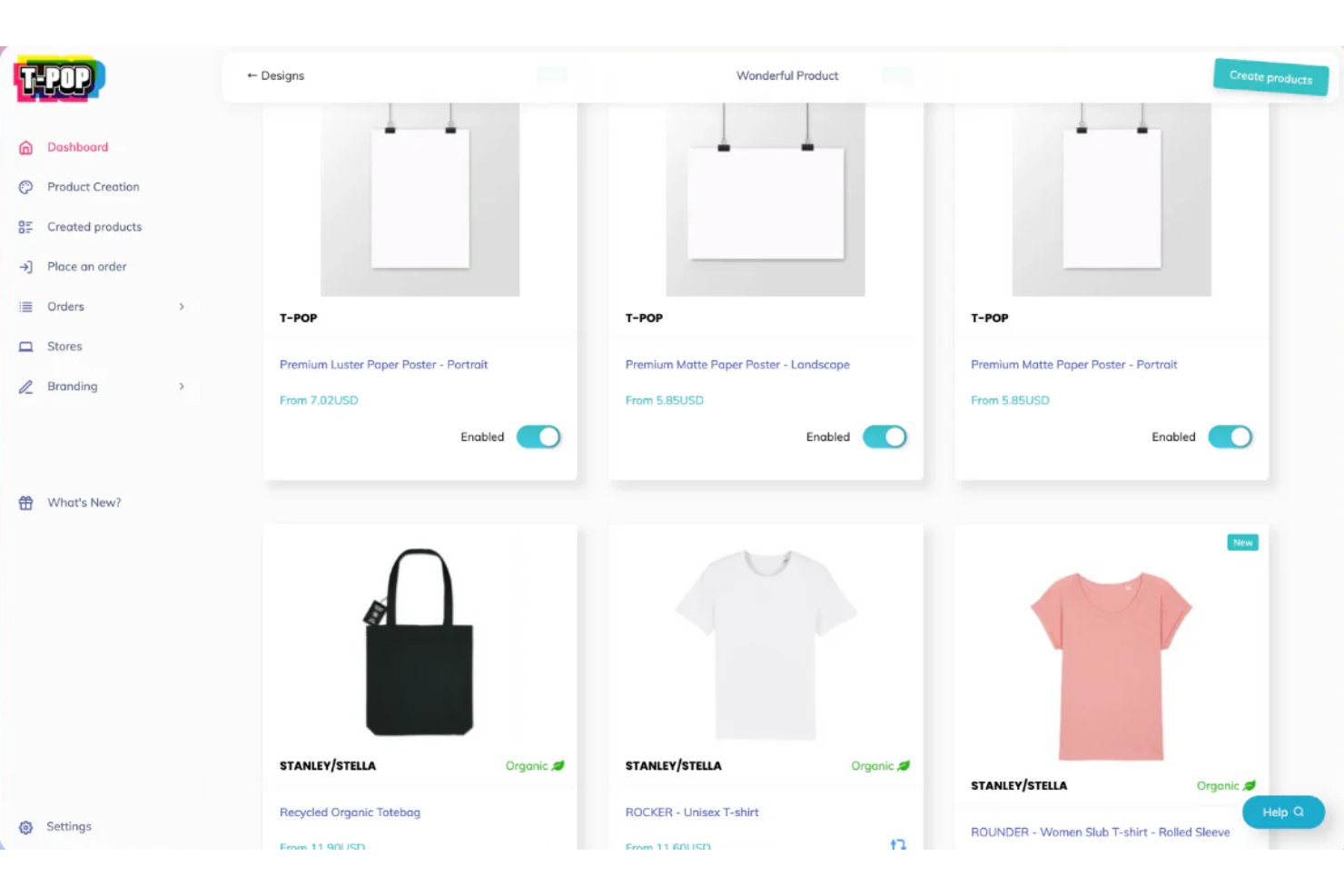
TPop is a print-on-demand ecommerce platform that combines a no-code store builder with an integrated catalog of eco-responsible products, handling design, fulfillment, and worldwide shipping from a single platform.
Who Is TPop Best For?
TPop is a solid fit for independent sellers and small creative businesses who want to sell custom-printed merchandise without compromising on sustainability.
Why I Picked TPop
TPop is one of my top picks because I love that its entire catalog is built around eco-responsibility from the ground up. Every product uses OEKO-TEX®-certified, water-based inks and textiles sourced from suppliers with verified environmental and labor standards. All packaging is plastic-free, using recyclable cardboard sleeves or flexible recycled-material pouches, which extends the sustainability commitment to the unboxing experience. Shipping uses carbon-neutral carriers to over 100 countries.
TPop Key Services
- No-code store builder: Build and customize a branded online storefront directly within TPop, without writing a single line of code.
- White-label branded packaging: Add custom packing slips, thank-you cards, flyers, and gift stickers to every order for a fully branded unboxing experience.
- Product designer tool: Create and preview custom product designs directly in the platform before adding them to your store catalog.
- Multi-channel selling: Connect your TPop catalog to external platforms like Shopify, Etsy, and WooCommerce to sell across multiple storefronts.
Pros and Cons
Pros:
- Worldwide delivery
- Zero-plastic shipping
- Eco-friendly product catalog
Cons:
- No built-in marketing tools
- Limited product customization
Other Best Print on Demand Services
Below is a list of additional service providers for print on demand that I shortlisted. While they didn’t make the top 10, they’re still valuable and worth further research.
- Apliiq
For custom apparel
- Modalyst
For dropshipping automation
- Zazzle
For unique product creation
- Print Huddle
For easy-to-use design tools


Related Ecommerce Software Reviews
If you still haven't found what you're looking for here, check out these related ecommerce tools that we've tested and evaluated.
- Ecommerce Platforms
- Inventory Management Software
- Payment Processing Software
- Shopping Cart Solutions
- Order Management Systems
- Warehouse Management Software
- WooCommerce Alternatives
How I Evaluate Print on Demand Platforms
I split my evaluation into baseline requirements—like true on-demand production and storefront integrations—and differentiators that separate the best platforms from the rest.
Core Functionality (Table Stakes For This List)
When I'm selecting tools for my list, I rank each one on a scale from 0 (does not offer the functionality) to 5 (excels in this area) for each core functionality listed below. Then, I calculate the tool's total score into a percentage. Each tool needs to achieve a minimum total score of 65% to be considered for inclusion.
- Product Catalog & Design Tools: I evaluate the range of customizable blanks and whether the design tool supports placement controls, layering, and realistic mockups for listing pages.
- On-Demand Printing & Production: Production methods matter here—I look for platforms offering multiple techniques like DTG, sublimation, and embroidery with reasonable turnaround times.
- Ecommerce Platform Integrations: Each platform should connect with storefronts where retailers actually sell, like Shopify, Etsy, WooCommerce, and Amazon, with synced product and order data.
- Automated Fulfillment & Shipping: I check whether orders flow from storefront to production to doorstep without manual steps, including carrier tracking updates pushed back to the store.
- No Inventory or Minimums: A true POD platform lets you list a single new design without buying stock upfront—I confirm there are no hidden minimum order requirements.
- White-Label Branding Options: Retailers need their brand on the package, not the printer's, so I look for custom packing slips, branded inserts, and blind shipping capabilities.
Once I have a list of tools that meet this criteria, I consider what sets each platform apart.
Differentiating Factors (What Sets Vendors Apart)
Here's how I compare and contrast different vendors:
Standout Features
A global print network is a major differentiator—platforms like Printful and Gooten route orders to the nearest facility, which cuts shipping times and costs for customers across regions. I also look for sample ordering workflows, since merchandising managers need to hold and inspect a product before listing it. Profit margin dashboards round out my evaluation, helping sellers track per-SKU costs against retail prices so they can adjust pricing or retire underperformers.
Beyond Features
Base product quality matters more than catalog size. I check whether a platform carries recognized blanks like Bella+Canvas or AS Colour, since garment feel and durability shape repeat purchase rates. Production and shipping speed is equally important—especially during peak seasons when fulfillment delays can tank customer satisfaction. I also evaluate multi-channel scalability, looking at whether a seller can manage multiple storefronts under one account and handle volume spikes without hitting capacity limits.
How To Choose The Best Print on Demand services
As you compare print on demand services, keep the following points in mind:
- Product Quality and Selection: Look for a service that offers consistent print quality and a product catalog that matches what you want to sell. Consider available printing methods, materials, sizes, colors, and customization options.
- Fulfillment and Shipping: Consider where products are produced, typical fulfillment times, shipping costs, and the regions the provider can serve. A distributed fulfillment network can also help reduce delivery times for international customers.
- Integration Capabilities: Make sure the service integrates with the ecommerce platforms and marketplaces you use, such as Shopify, WooCommerce, Etsy, or Amazon. Strong integrations can automatically send orders to the provider for production and fulfillment.
- Scalability: Choose a provider that can accommodate increasing order volumes and an expanding product catalog as your business grows. Consider production capacity, fulfillment locations, and whether the service supports bulk or high-volume orders.
- Cost and Pricing Structure: Compare product base costs, printing charges, shipping fees, and any subscription or premium plan costs. Since these expenses directly affect your margins, consider the total cost of fulfilling an order rather than focusing only on whether the service has a monthly fee.
- Branding and Customization: Look at the customization available for both products and packaging. Depending on your brand, features such as custom labels, packaging inserts, embroidery, multiple print areas, and branded packing slips may be important.
Trends in the Best Services for Print on Demand
Here are some trends I’ve observed across print on demand services and what they might indicate for the future. I reviewed product updates, press releases, and industry developments to highlight the most significant shifts.
- AI-Driven Design Tools: Print on demand services are increasingly incorporating AI-powered tools for creating designs, generating product mockups, and preparing artwork. These capabilities can help sellers create and launch new products faster.
- Sustainable Production: Providers are expanding their use of eco-friendly materials, packaging, and more localized production. As sustainability becomes a bigger purchasing consideration, these options can help sellers reduce waste and meet changing customer expectations.
- Localized Production and Fulfillment: More POD services are using distributed production networks to fulfill orders closer to customers. This can shorten delivery times, reduce shipping costs, and make international selling more practical.
- Greater Product Customization: POD providers are expanding beyond basic printed apparel with options such as embroidery, all-over printing, custom labels, personalized products, and branded packaging. This gives sellers more opportunities to differentiate their products.
- Expanded Product Catalogs: Print on demand services are continuing to add products beyond traditional T-shirts and mugs, including home decor, accessories, stationery, wall art, and specialty merchandise. Broader catalogs allow sellers to test new product categories without holding inventory.
What Is a Print on Demand Service?
A print on demand (POD) service is a provider that produces custom products only after a customer places an order, eliminating the need for businesses to purchase or store inventory upfront. These services typically handle printing, production, packaging, and order fulfillment, helping sellers reduce upfront costs and inventory risks.
The best print on demand services offer a range of customizable products and integrate with ecommerce platforms and marketplaces to automate order fulfillment. This allows businesses to focus on creating products, building their brand, and generating sales while the POD provider handles production and shipping.
Features of The Best Services for Print on Demand
When choosing an ecommerce platform for a print on demand business, it's essential to consider various features that can significantly impact your business's success. The right platform can streamline operations, enhance customer experience, and boost sales. Here are the most important features to look for in the best ecommerce platform for print on demand:
- Product Catalog: A broad selection of customizable products lets you sell across categories such as apparel, accessories, home decor, stationery, and wall art without managing inventory.
- Printing and Customization Options: Look for services that support printing methods and customization options suited to your products, such as direct-to-garment (DTG), direct-to-film (DTF), embroidery, sublimation, and all-over printing.
- Ecommerce Integrations: Integrations with platforms and marketplaces such as Shopify, WooCommerce, Etsy, and Amazon can automatically send customer orders to the POD provider for production and fulfillment.
- Order Fulfillment: Automated fulfillment allows the provider to receive, produce, package, and ship orders with minimal manual involvement from the seller.
- Global Fulfillment Network: Providers with production facilities or fulfillment partners across multiple regions can help businesses serve international customers while reducing shipping distances and delivery times.
- Shipping Options: Multiple shipping methods, transparent rates, order tracking, and estimated delivery times make it easier to manage costs and set customer expectations.
- Product and Design Tools: Mockup generators, design editors, product templates, and image preparation tools can help sellers create and preview customized products before listing them for sale.
- Branding Options: Features such as custom labels, branded packaging, packing slips, inserts, and other white-label options allow orders to provide a more consistent brand experience.
- Order and Product Management: A centralized dashboard for managing products, designs, orders, shipping status, and fulfillment issues makes it easier to oversee POD operations.
- API Access: APIs can be valuable for larger businesses that need custom storefronts, automated workflows, or direct connections between their systems and the POD provider.
- Marketing Tools: Some print on demand services offer marketing tools such as promotional mockups, product images, personalization features, discount tools, and integrations with social media or selling channels. These capabilities can help sellers promote their products and reach customers without relying entirely on separate marketing software.
Benefits of the Best Print on Demand Services
Choosing the right print on demand service can help reduce the costs and operational work involved in selling custom products. These services handle production and fulfillment while giving businesses the flexibility to expand their product offerings without maintaining inventory. Here are some of the key benefits:
- Lower Upfront Costs: Print on demand services produce items only after an order is placed, eliminating the need to purchase large quantities of inventory in advance.
- Automated Order Fulfillment: Integrations with ecommerce platforms and marketplaces can automatically send orders to the POD provider for printing, packaging, and shipping, reducing manual work.
- Flexible Product Customization: POD services let businesses apply their designs to different products and, depending on the provider, use options such as embroidery, DTG printing, custom labels, and branded packaging.
- Reduced Inventory Risk: Because products are manufactured on demand, businesses can experiment with new designs and product categories without being left with unsold stock.
- Scalable Fulfillment: POD providers can support growing order volumes without requiring businesses to invest in their own printing equipment, warehouse space, or fulfillment infrastructure.
- Broader Market Reach: Services with global production and fulfillment networks can make it easier to sell to customers across different regions while reducing shipping distances and delivery times.
Costs & Pricing
When choosing a print on demand service, it’s important to understand how pricing works and which costs can affect your profit margins. Unlike traditional ecommerce software, many POD services are free to start and charge businesses when an order is placed, while others offer optional subscriptions for additional features or product discounts.
Costs can vary based on the product, printing method, customization, shipping destination, and provider. Below is a table outlining common pricing models, their typical costs, and what they generally include:
Plan Comparison Table
| Plan Type | Average Price | Common Features |
| Free Plan | $0 | Limited product listings, basic customization, and basic support |
| Personal Plan | $25 - $30/month (billed annually) | Unlimited products, basic marketing tools, no transaction fee, and basic analytics |
| Business Plan | $45 - $80/month (billed annually) | Advanced marketing tools, multiple admin accounts, enhanced supports, and SEO tools |
| Enterprise Plan | Custom pricing | Custom integrations, priority support, advanced analytics, and unlimited admin accounts |
Each pricing model supports different needs; each plan caters to different needs, from basic ecommerce tools to paid plans that offer product discounts, additional branding options, or other advanced features. By comparing product costs, shipping fees, subscription charges, and available features, businesses can choose a print on demand service that fits their budget, expected order volume, and profit margins.
Best Print on Demand Services FAQs
Here are some commonly asked questions about the best print on demand services.
How do I integrate a print on demand service with my ecommerce platform?
Most print on demand services integrate with ecommerce platforms and marketplaces through an app, plugin, or native connection. After connecting your store, you can sync products and designs so that customer orders are automatically sent to the POD provider for production and fulfillment.
Depending on the provider, setup may also include configuring product variants, shipping settings, pricing, and order syncing. Some services also offer APIs for businesses that need a more customized integration.
How do I handle returns and exchanges with a print on demand service?
Return and exchange policies vary between print on demand services because products are typically made specifically for each order. Many providers offer replacements or refunds for products that arrive damaged, defective, or incorrectly printed, but may not cover returns caused by customer preferences, such as ordering the wrong size or changing their mind.
Review your provider’s policies carefully and create a clear return policy for your customers that reflects what the POD service will cover.
What are the shipping times and options available with print on demand services?
Shipping times vary depending on the print on demand service, production location, product type, and customer destination. Since products are made to order, total delivery time typically includes both production and shipping.
Many POD services offer standard, expedited, and international shipping options, while providers with global production networks may fulfill orders closer to the customer to reduce delivery times. Compare both production estimates and shipping options when choosing a provider, especially if you plan to sell internationally.
Are there any limitations on the types of products I can sell with print on demand?
While print on demand services offer a wide range of products, there may be limitations based on the service you choose. Common products include apparel, accessories, home decor, and stationery. Some services may offer more specialized products, but it’s important to review the product catalog of the print on demand service to ensure they offer the types of products you want to sell.