
23 Best Assortment Planning Software for 2026

The Top 10 Assortment Planning Software You Should Consider
Let’s see the leaderboard for the best assortment planning software out there and what they do best:


Assortment planning software helps you take the guesswork out of product selection by using data to predict demand, optimize inventory, and avoid costly stockouts.
These tools make it easy to match your product mix with what customers actually want—even when preferences shift or supply chains get messy.
Drawing from over a decade in retail—with both digital and IRL shelves to fill—I’ll walk you through the best assortment planning software for retailers of any size, highlighting which features actually boost margins and keep your business agile.
Why Trust Our Software Reviews
Comparing the Best Assortment Planning Software, Side-by-Side
Smart buying decisions start with clear comparisons. This chart breaks down pricing and core capabilities so you can match solutions to your operational needs and budget realities.
| Tool | Best For | Trial Info | Price | ||
|---|---|---|---|---|---|
| 1 | Best for large enterprises | Free demo available | Pricing upon request | Website | |
| 2 | Best for grocery retailers | Free demo available | Pricing is customized based on business needs | Website | |
| 3 | Best for integrated planning | Free demo available | Pricing is customized based on business needs | Website | |
| 4 | Best for demand forecasting | Free demo available | Pricing is customized based on business needs | Website | |
| 5 | Best for fashion industry | Free demo available | Pricing upon request | Website | |
| 6 | Best for real-time market data | Free demo available | Pricing upon request | Website | |
| 7 | Best for automated replenishment | Free demo available | Pricing upon request | Website | |
| 8 | Best for end-to-end supply chain | Free demo available | Pricing is customized based on business needs | Website | |
| 9 | Best for visual merchandising | 14-day free trial + free plan + free demo available | From $800/year | Website | |
| 10 | Best for small to mid-sized retailers | Free demo available | From $2,500/month (billed annually) | Website |
The 10 Best Assortment Planning Software Solutions, Reviewed
These top-tier platforms represent the strongest options for retailers serious about optimizing their product mix. Each solution offers distinct advantages depending on your industry focus, company size, and operational complexity.


Anaplan offers an assortment planning solution designed for large enterprises. It enables global companies to manage complex planning and make data-driven decisions aligned with business goals, with support for scenario planning and cross-department collaboration.
Why I picked Anaplan: Anaplan caters specifically to large enterprises with its scalable and flexible planning capabilities. It offers scenario planning to help your team visualize different outcomes and make informed decisions.
The software's collaborative features enable multiple departments to work together smoothly. Anaplan's cloud-based architecture ensures that your team can access real-time data from anywhere.
Standout features & integrations:
Features include scenario planning to explore various business outcomes, real-time data access to keep your team informed, and collaboration tools to connect different departments effectively.
Integrations include Salesforce, Workday, Microsoft Azure, ServiceNow, Google Cloud Platform, Tableau, SAP, Oracle, IBM, and Adobe.
Pros and Cons
Pros:
- Cloud-based architecture
- Facilitates cross-department collaboration
- Supports scenario planning
Cons:
- May be overkill for small businesses
- Requires extensive training


Relex Solutions provides assortment planning software tailored for grocery retailers. It enhances demand forecasting, inventory, and planogram optimization to boost sales, improve margins, and reduce supply chain costs by optimizing product offerings.
Why I picked Relex Solutions: Relex targets grocery retailers, offering demand forecasting and inventory management to effectively match customer demand. The platform includes planogram optimization to ensure optimal product placement.
It helps you make informed decisions about product assortments, minimizing slow-moving inventory. Relex emphasizes sustainability and operational efficiency, making it ideal for retail operations.
Standout features & integrations:
Features include demand sensing for accurate forecasting, automatic replenishment to maintain stock levels, and attribute-based forecasting for new products. These features ensure you have the right products available for your customers.
Integrations include SAP, Oracle, Microsoft Dynamics, Salesforce, IBM, AWS, Google Cloud, Tableau, Teradata, and Nielsen.
Pros and Cons
Pros:
- Supports planogram optimization
- Effective inventory management
- Advanced demand forecasting
Cons:
- Limited to grocery retailers
- High learning curve


Board offers an assortment planning tool designed for integrated business planning across retail operations. It helps companies align product offerings with strategic goals and unify planning and performance management to optimize decision-making.
Why I picked Board: Board excels in providing integrated planning capabilities that unify various business functions. It offers a comprehensive platform that aligns your product offerings with strategic goals.
The platform facilitates data-driven decision-making, ensuring that your team to adapt to market changes effectively. Board's flexibility in planning makes it a valuable asset for businesses aiming for cohesive operations.
Standout features & integrations:
Features include real-time analytics for informed decision-making, scenario planning for exploring different business outcomes, and performance management tools to track and improve business processes. These features work together to support your strategic goals.
Integrations include SAP, Oracle, Microsoft Dynamics, Salesforce, IBM, AWS, Google Cloud, Tableau, Qlik, and Adobe.
Pros and Cons
Pros:
- Flexible performance management
- Facilitates strategic alignment
- Real-time analytics available
Cons:
- May not suit small businesses
- Initial setup is complex

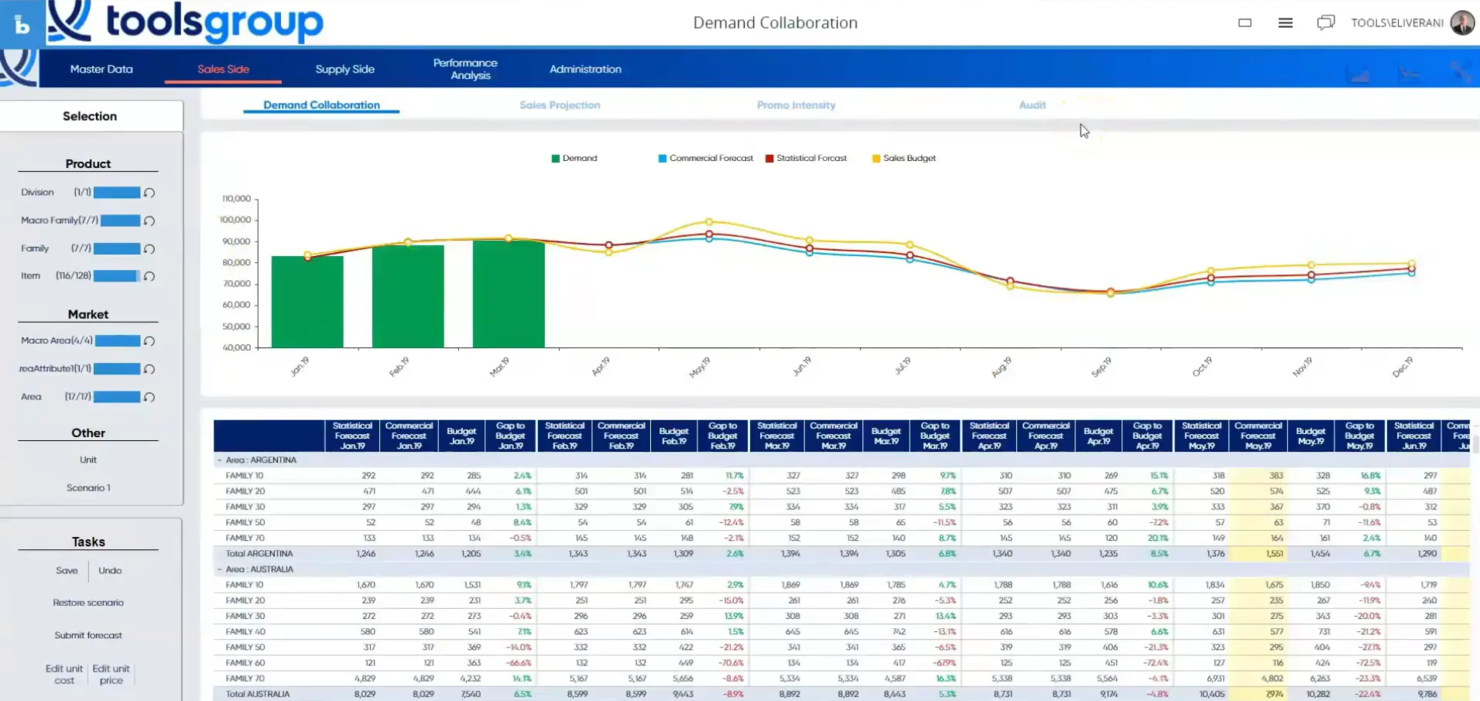
ToolsGroup offers a demand forecasting and assortment planning solution ideal for businesses needing precise inventory management. It helps companies predict demand and optimize stock to reduce waste and improve service, especially in industries with complex supply chains.
Why I picked ToolsGroup: ToolsGroup excels at demand forecasting, offering advanced algorithms that accurately predict customer needs. It helps your team maintain optimal stock levels, reducing both overstock and stockouts.
The tool's ability to adapt to changing market conditions makes it a reliable choice for dynamic industries. With its focus on precision, your business can enhance service levels and reduce waste.
Standout features & integrations:
Features include dynamic demand sensing that adapts to market changes, inventory optimization to minimize waste, and service level management to ensure customer satisfaction. Each feature works together to enhance your operational efficiency.
Integrations include SAP, Oracle, Microsoft Dynamics, Salesforce, Amazon Web Services, Google Cloud, Tableau, IBM, Teradata, and Qlik.
Pros and Cons
Pros:
- Enhances service levels
- Reduces stockouts and overstock
- Accurate demand forecasting
Cons:
- Limited customization options
- May need technical expertise


Centric Software provides an assortment planning tool tailored for the fashion industry. It enables fashion brands and retailers to utilize data analytics to optimize inventory, align products with demand, and enhance profitability through customer-driven decisions.
Why I picked Centric Software: Centric Software is specifically designed for the fashion industry, offering unique features that cater to the needs of fashion retailers. It includes advanced analytics to track fashion trends and customer preferences.
The software's user-friendly interface allows your team to easily navigate and utilize its functionalities. It integrates seamlessly with existing systems, ensuring smooth operations without disrupting your workflow.
Standout features & integrations:
Features include real-time data analytics for trend tracking, a user-friendly interface that simplifies navigation, and automation tools to streamline assortment management processes.
Integrations include SAP, Oracle, Microsoft Dynamics, Shopify, Salesforce, Adobe, AWS, Google Cloud, IBM, and NetSuite.
Pros and Cons
Pros:
- Real-time data insights
- Easy system integration
- Advanced trend analytics
Cons:
- Costly for small businesses
- May require training

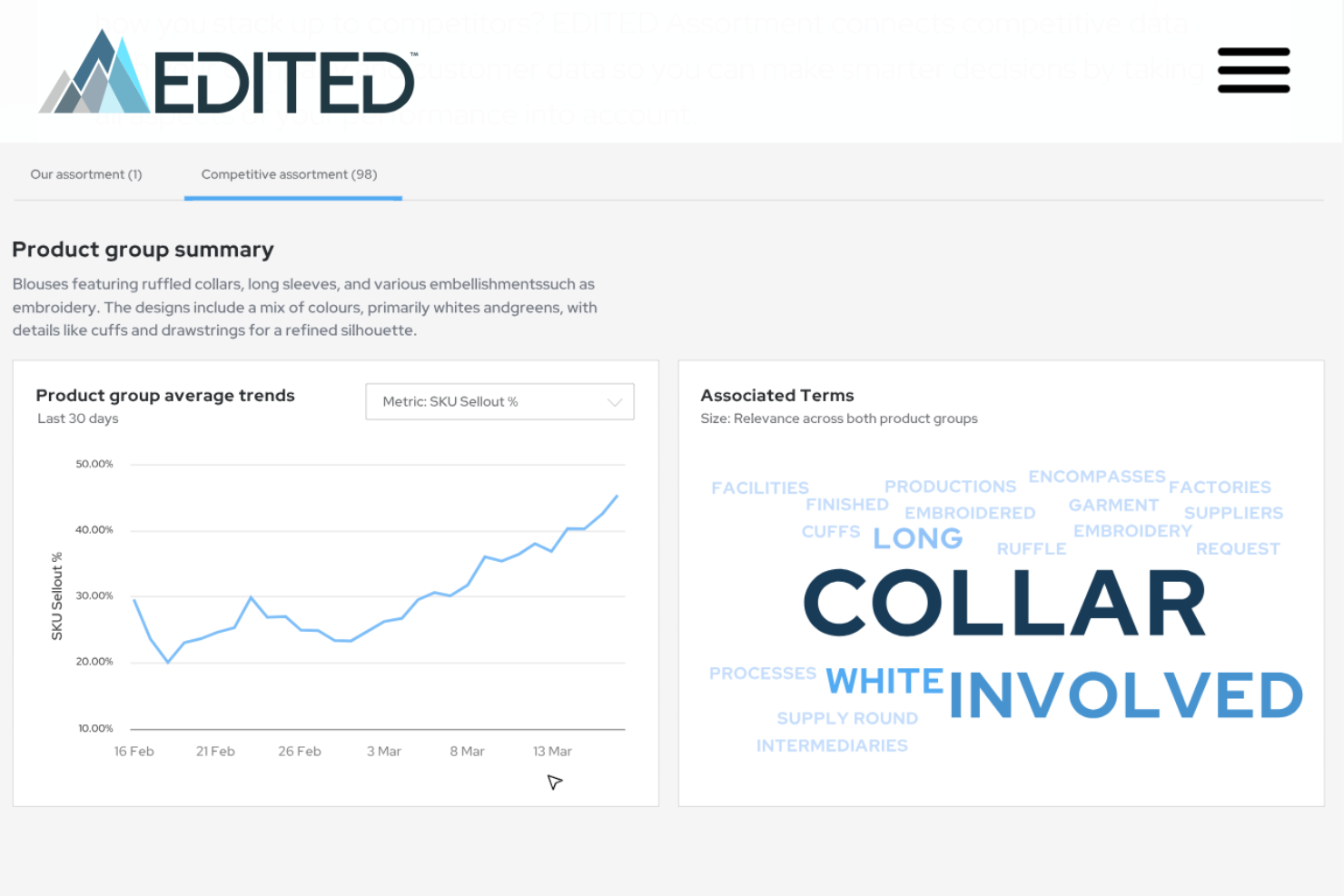
EDITED offers an assortment planning tool that provides real-time market data to fashion retailers. It helps businesses track trends and make informed assortment decisions, making it valuable for retailers needing to adapt quickly to market changes.
Why I picked EDITED: EDITED provides real-time market data, enabling your team to stay ahead of fashion trends and consumer preferences. It offers detailed analytics to support your buying decisions and optimize product assortments.
The platform's ability to deliver timely insights makes it essential for fast-paced retail environments. EDITED's focus on data-driven decision-making ensures you can respond quickly to market shifts.
Standout features & integrations:
Features include real-time trend tracking to keep your team informed, detailed analytics for data-driven decisions, and market insights to help you adapt quickly. These features work together to enhance your retail strategy.
Integrations include Shopify, Magento, WooCommerce, BigCommerce, Salesforce, SAP, Oracle, Microsoft Dynamics, NetSuite, and QuickBooks.
Pros and Cons
Pros:
- Supports data-driven decisions
- Tracks fashion trends
- Provides real-time market data
Cons:
- May need technical expertise
- Requires initial setup time

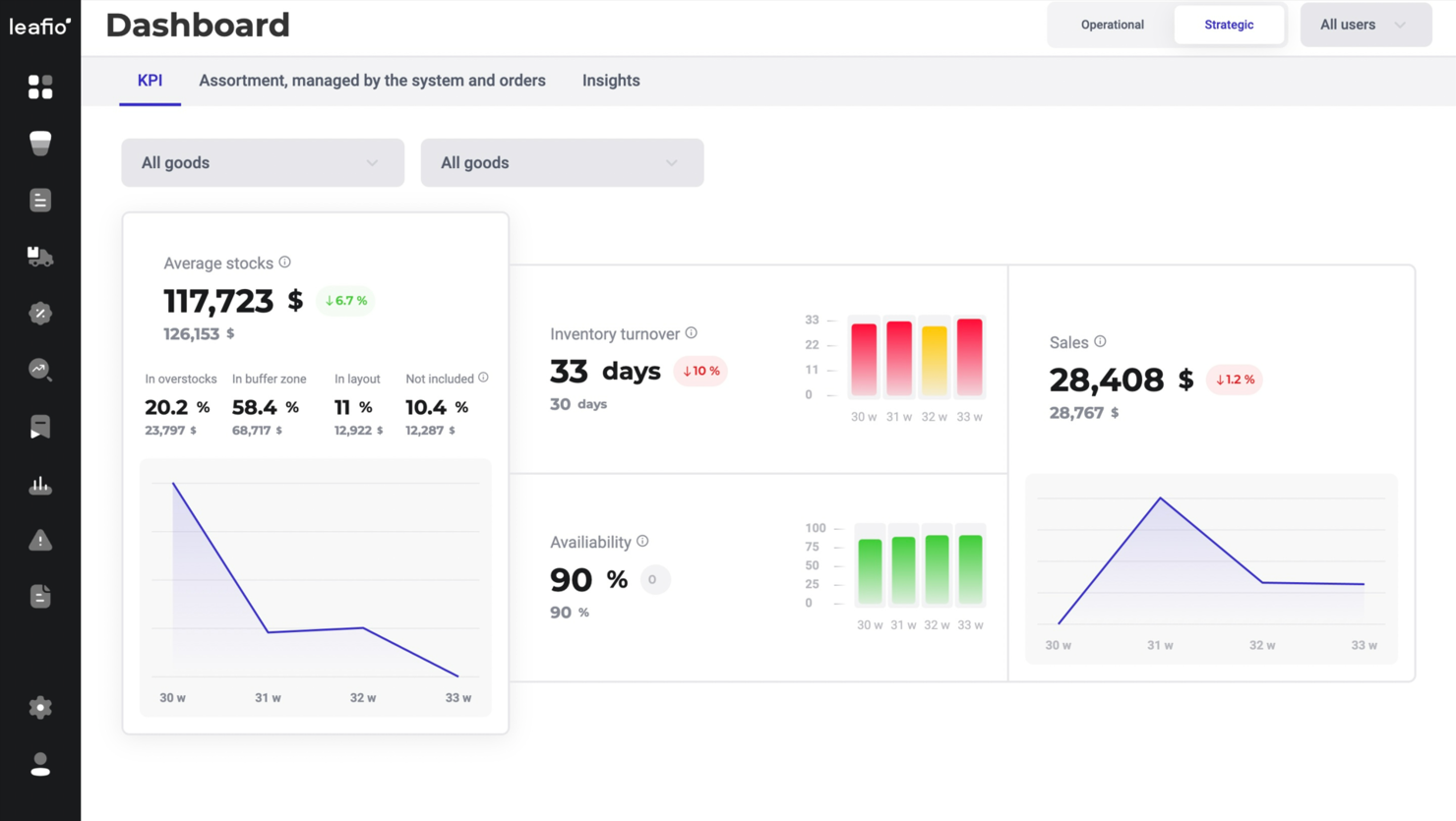
LEAFIO is an assortment planning tool focused on automated replenishment for retailers. It allows businesses to optimize stock levels and boost inventory turnover by automating restocking, making it ideal for retailers seeking efficient inventory management.
Why I picked LEAFIO: LEAFIO excels in automated replenishment, providing features that help your team maintain optimal stock levels. It includes predictive analytics to forecast demand and automate ordering processes.
The platform's user-friendly interface ensures a smooth experience for your team. LEAFIO's focus on inventory turnover helps reduce waste and improve profitability.
Standout features & integrations:
Features include predictive analytics to anticipate demand, automated ordering processes to streamline operations, and inventory turnover tools to minimize waste. These features work together to enhance your inventory management.
Integrations include SAP, Oracle, Microsoft Dynamics, Salesforce, Shopify, WooCommerce, Magento, QuickBooks, Xero, and NetSuite.
Pros and Cons
Pros:
- Improves inventory turnover
- Predictive analytics included
- Focus on automated replenishment
Cons:
- May need technical expertise
- Requires initial setup time

Solvoyo is an assortment planning tool designed for end-to-end supply chain management. It assists businesses in integrating planning processes from forecasting to inventory optimization, making it ideal for streamlining supply chain operations.
Why I picked Solvoyo: Solvoyo offers a comprehensive approach to supply chain management, integrating various planning processes into a single platform. It features demand forecasting and inventory optimization to ensure your products are available when needed.
The tool's ability to connect different stages of the supply chain sets it apart. Solvoyo's focus on end-to-end solutions helps your team manage supply chain complexities efficiently.
Standout features & integrations:
Features include demand forecasting to anticipate customer needs, inventory optimization to maintain stock levels, and supply chain visibility to track product movement. These features enhance your operational efficiency.
Integrations include SAP, Oracle, Microsoft Dynamics, Salesforce, Amazon Web Services, Google Cloud, Tableau, Qlik, IBM, and NetSuite.
Pros and Cons
Pros:
- Connects different supply chain stages
- Enhances supply chain visibility
- Integrates planning processes
Cons:
- Limited customization options
- Complex setup process


DotActiv is a visual merchandising software focused on assortment planning. It assists retailers in optimizing product displays and layouts to enhance customer experience and boost sales, making it ideal for improving store aesthetics and placement strategies.
Why I picked DotActiv: DotActiv specializes in visual merchandising, offering features that help your team design effective product layouts. It provides planogram automation to streamline the display process.
The platform includes space planning tools that ensure optimal product placement. DotActiv's focus on enhancing store aesthetics makes it a valuable tool for retailers aiming to attract more customers.
Standout features & integrations:
Features include planogram automation to streamline your display process, space planning tools to optimize product placement, and data analytics to support informed merchandising decisions. These features help you create an engaging shopping experience.
Integrations include SAP, Oracle, Microsoft Dynamics, Shopify, WooCommerce, Magento, QuickBooks, Xero, Netsuite, and Square.
Pros and Cons
Pros:
- Enhances store aesthetics
- Supports space planning
- Planogram automation included
Cons:
- High learning curve
- Limited to visual merchandising


Toolio is an assortment planning software designed for small to mid-sized retailers. It enables businesses to manage inventory, plan assortments, and improve sales forecasting, making it especially useful for retailers who optimize their supply chain and merchandise planning.
Why I picked Toolio: Toolio caters specifically to small and mid-sized retailers, offering features that help streamline inventory management and sales forecasting. It provides real-time analytics that allow your team to make data-driven decisions.
The platform's intuitive design makes it accessible for teams with limited technical expertise. Toolio's focus on supply chain optimization ensures that you can maintain efficient operations.
Standout features & integrations:
Features include real-time analytics to guide your decision-making, an intuitive design for easy navigation, and supply chain optimization to improve efficiency. These features work together to enhance your retail operations.
Integrations include Shopify, NetSuite, QuickBooks, Square, Lightspeed, Xero, BigCommerce, WooCommerce, Salesforce, and Amazon.
Pros and Cons
Pros:
- Accessible for limited technical expertise
- Focus on supply chain optimization
- Real-time analytics available
Cons:
- Not ideal for non-retail industries
- Limited scalability for large enterprises
Other Assortment Planning Software
Here are some additional assortment planning software options that didn’t make it onto my shortlist, but are still worth checking out:
- Style Arcade
For fashion buying teams
- daVinci Retail
For assortment optimization
- Oracle Retail
For cloud-based solutions
- Blue Yonder
For demand planning
- SymphonyAI
For category management
- WFX PLM
For fashion supply chain
- Streamline
For inventory forecasting
- o9 Solutions
For integrated planning
- NielsenIQ
For consumer insights
- Retalon
For omnichannel retail
- Increff
For agile merchandising
- Nextail
For predictive analytics
- Stylumia
For AI-driven fashion insights


Our Selection Criteria For Assortment Planning Software
Smart software selection cuts through vendor promises to focus on what actually moves your business. I evaluated each platform against criteria that matter for retail operations—not marketing departments.
Core functionality (25% of total score)
Every solution had to nail the basics that define assortment planning software:
- Manage product assortments across categories, seasons, and store clusters
- Optimize inventory levels to prevent stockouts while minimizing carrying costs
- Analyze sales data with depth beyond basic reporting dashboards
- Forecast demand using more than simple historical trending
- Support merchandising decisions with actionable insights, not just pretty charts
Additional standout features (25% of total score)
The software landscape moves fast, so I prioritized platforms pushing beyond table stakes:
- Real-time market insights that help you react to shifts before competitors notice
- AI-driven recommendations that actually improve decision speed and accuracy
- Customizable dashboards that match how your team actually works
- Advanced analytics that connect assortment decisions to financial outcomes
- Multi-channel integration for retailers managing complex distribution strategies
Usability (10% of total score)
Complex software that requires a PhD to operate kills adoption faster than bad coffee kills morning meetings:
- Intuitive interface design that reduces training time and user frustration
- Easy navigation between core functions without endless clicking
- Minimal learning curve for team members with varying technical backgrounds
- Responsive design that works across devices and locations
- User feedback incorporation showing vendors actually listen to operator needs
Onboarding (10% of total score)
Time-to-value matters when you're implementing mission-critical planning tools:
- Availability of training videos that cover real-world scenarios, not just feature tours
- Interactive product tours that help users understand workflow logic
- Access to webinars with implementation best practices from other retailers
- Use of chatbots for guidance during initial setup and learning phases
- Pre-built templates that accelerate deployment without starting from scratch
Customer support (10% of total score)
When planning software breaks during peak season, you need more than email support:
- 24/7 availability during critical planning periods and system issues
- Multi-channel support options including phone, chat, and dedicated account management
- Quick response time measured in minutes, not business days
- Access to knowledgeable staff who understand retail operations, not just software features
- Comprehensive help resources including documentation that actually helps solve problems
Value for money (10% of total score)
Software ROI extends beyond sticker price to include implementation costs and ongoing value delivery:
- Competitive pricing relative to feature depth and market positioning
- Flexible payment options that align with retail cash flow patterns
- Feature-to-price ratio that justifies investment against alternatives
- Discounts for long-term contracts without punitive early termination clauses
- Return on investment potential through measurable improvements in margin and efficiency
Customer reviews (10% of total score)
Real user feedback cuts through vendor demos to reveal operational reality:
- Overall satisfaction ratings from verified retail users, not planted testimonials
- Commonly mentioned pros and cons that align with your operational priorities
- Feedback on customer service during both implementation and ongoing support
- User-reported value for money based on actual business outcomes
- Frequency of updates and improvements showing vendor commitment to product evolution
What is Assortment Planning Software?
Assortment planning software is a tool that helps retailers decide which products to offer, when to sell them, and how much inventory to send to each store.
Merchandisers, planners, and buyers use it to avoid running out of popular items, reduce unsold stock, and boost profits by making smarter choices about what to stock.
By analyzing sales trends and customer demand, you can create better product mixes and adjust quickly to changes in the market.
How to Choose Assortment Planning Software
Software selection moves fast in retail—wrong choices cost more than implementation fees. Focus on operational realities that actually drive planning success, not vendor feature lists.
| Decision factor | What to evaluate | Key tip |
|---|---|---|
| Current planning workflow complexity | How many manual processes slow your cycle from forecasting to allocation | Choose platforms that eliminate your biggest bottlenecks, not ones that create new complexity. |
| Integration requirements | Which existing systems must connect: ERP, POS, financial planning, customer data | Prioritize real-time data sync over batch processing—stale data kills agile decision-making. |
| Decision speed requirements | How quickly you need to respond to market shifts, seasonal changes, promotional opportunities | Match platform capabilities to your actual decision timeline, not aspirational agility goals. |
| Team technical expertise | Your staff's comfort level with complex software and willingness to invest in training | Simple, intuitive platforms often deliver better ROI than feature-rich solutions nobody uses properly. |
| Business growth trajectory | Whether you're scaling rapidly, maintaining steady growth, or managing mature operations | Avoid over-engineering for hypothetical future needs—buy for today's reality with reasonable expansion capacity. |
| Total cost tolerance | Implementation time, training costs, ongoing fees, and expected efficiency gains | Budget 30% more than initial quotes for training and customization—most retailers underestimate change management. |
Key Features of Assortment Planning Software
Smart assortment planning software delivers capabilities that separate profitable retailers from inventory victims.
Focus on features that actually move your business metrics, not vendor checklist items.
- Demand forecasting with seasonal intelligence. Advanced algorithms predict customer demand across product lifecycles, accounting for promotional lift and regional variations. Better forecasting accuracy means fewer stockouts and markdowns eating your margins.
- Real-time assortment optimization. AI engines continuously evaluate product performance against financial targets, flagging underperformers and identifying expansion opportunities. This optimizes your entire product mix rather than managing SKUs in isolation.
- Financial planning integration. Connect merchandise planning directly to budget targets and margin requirements. Eliminates the disconnect between financial goals and operational execution that kills profitability.
- Automated allocation and replenishment. Smart distribution algorithms allocate inventory across store clusters based on local demand patterns and historical performance. Includes markdown optimization to clear slow movers while protecting core margins.
- Market trend analysis and competitive intelligence. Real-time data feeds track competitor pricing, product launches, and promotional activities. Enables proactive assortment adjustments rather than reactive scrambling.
- Planogram and visual merchandising optimization. Space planning tools connect product placement to sales performance, optimizing layouts based on customer behavior rather than aesthetic guesswork.
- Scenario planning and stress testing. Model different assortment strategies under various market conditions. Test resilience against supply chain disruptions before committing inventory dollars.
- Workflow automation and approval routing. Streamline planning processes from initial forecasting through final allocation decisions. Reduces manual handoffs that slow decision cycles and introduce errors.
Top Benefits of Assortment Planning Software
Smart assortment planning software delivers measurable improvements that show up in your P&L, not just vendor case studies.
These outcomes separate platforms that drive real business value from expensive digital distractions.
- Improved forecasting accuracy reduces inventory waste. Better demand predictions cut excess inventory by 15-25% while maintaining customer satisfaction levels. Accurate forecasting means fewer markdowns eating margins and less cash tied up in slow-moving stock.
- Streamlined planning process accelerates decision-making. Automated workflow reduces planning cycle time from weeks to days. Faster merchandise planning enables quicker responses to market shifts and competitive moves—critical advantages in fast-changing retail environments.
- Optimized allocation increases sell-through rates. Data-driven distribution across store clusters boosts inventory turn by 10-20%. The right product reaches customers when they want it, driving higher conversion and reducing stock-outs that send shoppers to competitors.
- Enhanced pricing strategies protect profitability. Real-time market intelligence enables dynamic pricing adjustments that maintain competitive position while preserving margins. Smart retailers use these insights to optimize promotional timing and depth.
- Reduced manual errors improve operational efficiency. Automation eliminates spreadsheet mistakes and miscommunications that cost time and money. Teams spend less time on data entry and more time on strategic assortment decisions that drive growth.
- Better financial planning alignment drives margin improvement. Integration between merchandise planning and financial targets ensures assortment strategies support profitability goals. This connection prevents the disconnect that kills retail performance.
- Increased customer-centric decision-making boosts satisfaction. Data-driven insights into customer preferences guide product mix decisions. Better assortment optimization means shoppers find what they want, driving loyalty and repeat purchases.
- Faster replenishment cycles reduce lost sales. Automated reordering based on real-time demand signals prevents stockouts on core items. Quick response to sell-through patterns captures more revenue during peak periods.
Costs & Pricing of Assortment Planning Software
Assortment planning software pricing reflects the business-critical nature of these platforms—expect enterprise-level investment, not consumer app pricing.
Smart retailers focus on total cost of ownership and measurable ROI rather than sticker shock from initial quotes.
| Plan type | Average price | Common features | Best for |
|---|---|---|---|
| Starter/SMB | $500-$2,000/month | Basic forecasting, limited integrations, standard reporting | Small retailers with simple assortment needs |
| Professional | $2,000-$8,000/month | Advanced analytics, ERP integration, automated workflows | Mid-sized retailers managing multiple categories |
| Enterprise | $8,000-$25,000/month | AI-driven optimization, full system integration, custom dashboards | Large retailers with complex omnichannel operations |
| Enterprise Plus | $25,000+/month | White-glove support, extensive customization, dedicated success management | Major retailers requiring specialized functionality |
Additional Cost Considerations
- Implementation and training expenses. Budget 30-50% of annual software costs for setup, data migration, and team training. Complex integrations with legacy ERP systems often require additional consulting fees that vendors conveniently omit from initial proposals.
- Integration and customization fees. Connecting planning software to existing systems rarely works out-of-the-box. Expect $10,000-$50,000 in integration costs depending on system complexity and data quality requirements.
- Ongoing support and maintenance. Annual support typically runs 15-20% of license fees. Premium support with dedicated account management can double these costs but proves worthwhile during critical planning periods.
- User licensing scalability. Most platforms charge per user, and costs escalate quickly as teams grow. Factor potential expansion when negotiating initial contracts to avoid painful pricing surprises later.
- Data storage and processing overages. High-volume retailers often exceed baseline data limits, triggering additional fees for storage and computational processing that can significantly impact total costs.
Assortment Planning Software FAQs
Here are some answers to common questions about assortment planning software:
How do you measure ROI from assortment planning software?
You measure ROI by tracking improvements in inventory turns, reductions in markdowns, and lower rates of stockouts compared to your old methods. Most retailers report inventory waste dropping by 15–25% and sell-through rates rising 10–20% within the first year.
Add up savings from fewer markdowns and less overstock, then compare those gains against the software’s costs. Don’t forget to include the time saved on planning—teams who spend less time building assortments can focus more on strategy and execution.
What data do you need before implementing assortment planning software?
You’ll need at least two years of historical sales data by SKU, accurate current inventory counts, and a well-organized product hierarchy. Bring supplier lead times, cost prices, and store clusters or location data, too.
Most platforms work best with detailed POS transactions, not just summary sales. If your data’s clean and organized before starting, you’ll cut down on delays during setup and see results faster.
Should you choose cloud-based or on-premise assortment planning software?
For most retailers, cloud-based assortment planning software is the better choice. Cloud tools are faster to launch, update automatically, and don’t require your IT team to manage servers.
They also make it easier for remote and multi-store teams to collaborate. On-premise solutions might make sense if you have strict data security rules or existing custom infrastructure, but most growing retailers prefer the flexibility of the cloud.
How do you avoid common assortment planning software implementation failures?
Start by cleaning your data and setting realistic expectations for rollout and adoption. Don’t try to customize every feature right away—focus on the core tools first and build from there.
Get buy-in from leadership early, since software that impacts merchandising or inventory planning will change how your teams work together. Provide solid training and ongoing support, so everyone’s confident using the new platform.
What happens when you outgrow your current assortment planning software?
If you hit limits with your software—like user caps, data restrictions, or missing features—some vendors can scale you up, while others might require a switch to a new system. Look at each platform’s upgrade and migration paths during your evaluation.
Cloud-based options usually offer smoother scaling, while platform changes or re-platforming can be more intensive. Negotiate upgrade options and data portability when you first sign up.
What’s the difference between assortment planning and merchandising software?
Assortment planning software helps your team choose the right mix of products for each location and customer segment, focusing on inventory depth and breadth. Merchandising software covers a wider range of tasks, including displays, promotions, and product placement.
While there’s some overlap, assortment planning is more about data-driven, SKU-level decisions, while merchandising software is broader and more execution-focused.
How does AI enhance assortment planning tools?
AI in assortment planning software can analyze sales trends, predict customer demand, and recommend optimal product mixes faster and more accurately than manual methods.
AI models spot patterns you might miss—like which items drive basket size or respond to changing seasons—so you can react in real time. Look for platforms that explain their AI’s decisions, so you stay in control and build trust with your team.
What’s the typical implementation timeline for assortment planning software?
Most retailers can fully implement assortment planning software in 2–3 months if data is clean and teams are prepared. Key steps include data integration, staff training, and initial assortment cycles.
Larger rollouts or more complex data setups can take longer. Expect a short learning curve at the start, especially if you’re moving from spreadsheets.
The Right Mix Makes All the Difference
Wrong assortment decisions kill margins faster than you can say "clearance sale." Smart retailers transform gut-feel merchandising into data-driven strategy with the right planning platform.
Choose tools that solve your operational challenges, not ones that look impressive in vendor demos.
If you're in the process of researching assortment planning software, connect with a SoftwareSelect advisor for free recommendations.
You fill out a form and have a quick chat where they get into the specifics of your needs. Then you'll get a shortlist of software to review. They'll even support you through the entire buying process, including price negotiations.
Retail never stands still—and neither should you. Subscribe to our newsletter for the latest insights, strategies, and career resources from top retail leaders shaping the industry.