
18 Best AI E-commerce Tools Reviewed in 2026

10 Best AI E-commerce Tools Shortlist
Here's my pick of the 10 best software from the 18 tools reviewed.


Running an e-commerce business isn't easy. You face constant challenges like managing inventory, engaging customers, and boosting sales. That's where AI e-commerce tools come in. They can help you address these pain points with features such as personalized recommendations and automated customer support.
In my experience, using AI-driven solutions can make a big difference. These tools analyze data and predict trends, providing insights to help you make informed decisions.
Throughout this article, I'll share my top picks for AI e-commerce tools. You'll learn how each one can benefit your team and improve your operations. My goal is to provide you with unbiased reviews so that you can choose the right solution for your needs.
Why Trust Our Software Reviews
Best AI E-commerce Tools Summary
This comparison chart summarizes pricing details for my top AI e-commerce tool selections to help you find the best one for your budget and business needs.
| Tool | Best For | Trial Info | Price | ||
|---|---|---|---|---|---|
| 1 | Best for customer support automation | Free 7-day trial + free demo available | From $10/month | Website | |
| 2 | Best for AI-driven cart recovery & personalization | Free demo available | From $250/Month | Website | |
| 3 | Best for personalized product recommendations | Free demo available | From 2.5% of sales generated by Nosto | Website | |
| 4 | Best for marketplace management | Free demo available | Pricing upon request | Website | |
| 5 | Best for AI styling recommendations | Free demo available | From $200/user/month | Website | |
| 6 | Best for AI-powered chat support | 7-day free trial + free demo available | From $24.17/month (billed annually) | Website | |
| 7 | Best for intuitive navigation design | Free demo available | From $59/month | Website | |
| 8 | Best for smart e-commerce funnels | Free trial + free demo available | From $50/month | Website | |
| 9 | Best for targeted pop-up campaigns | 14-day free trial + free demo available | From €49/month | Website | |
| 10 | Best for user experience insights | 14-day free trial + free demo available | From $21/month (billed annually) | Website |
Best AI E-commerce Tool Reviews
Below are my detailed summaries of the best AI e-commerce tools on my shortlist. My reviews offer a thorough look at the key features, pros & cons, integrations, and ideal use cases of each tool, helping you find the best one for you.

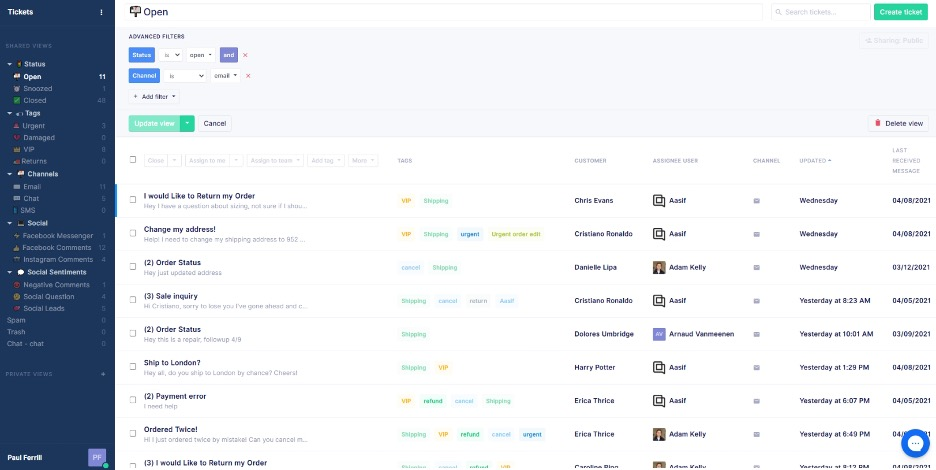
Gorgias is a conversational AI platform tailored for e-commerce businesses, focusing on customer support automation. Its main users are e-commerce teams looking to enhance customer interactions and manage support across multiple channels. Gorgias leverages AI answer suggestions to automate common queries, freeing up your team to handle complex issues.
Why I picked Gorgias: It stands out because it turns customer support into a conversion engine for e-commerce brands. With automatic ticket resolution, deep order-data access from Shopify/Adobe Commerce/BigCommerce, and conversational AI that integrates with your marketing strategy stack (social, SMS, email), it elevates support from reactive to proactive.
Standout features & integrations:
Features include a centralized helpdesk that consolidates messages from various channels, voice and SMS support for broader communication, and tools to drive sales through customer interactions.
Integrations include Shopify, Adobe Commerce, BigCommerce, WooCommerce, Instagram, Facebook, Gmail, Mailchimp, and Slack.
Pros and Cons
Pros:
- Unified multichannel inbox
- Real-time, personalized shopping assistance
- Built-in support interaction revenue tracker
Cons:
- Auto-interactions and tickets are capped
- No native phone support tools

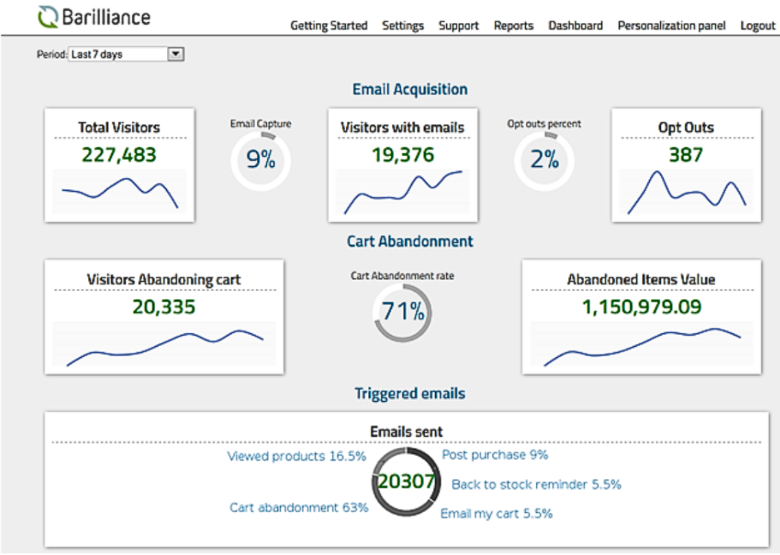
Barilliance is an e-commerce personalization platform focused on reducing cart abandonment and enhancing customer engagement. Its main users are online retailers looking to increase conversions and improve customer retention through AI-driven recommendations and personalized experiences.
Why I picked Barilliance: It offers one of the most mature personalization engines for e-commerce retailers. Its strength isn’t just abandoned-cart recovery, but also the ability to tailor product recommendations, messages, and on-site experiences in real-time. For teams focused on both recovering lost revenue and improving ongoing engagement, Barilliance provides a well-rounded, retail-specific personalization suite.
Standout features & integrations:
Features include personalized product recommendations to enhance shopping experiences, email retargeting to recover abandoned carts, and dynamic content to engage customers effectively. These tools are designed to help you increase conversions and customer loyalty.
Integrations include Shopify, Adobe Commerce, WooCommerce, BigCommerce, Salesforce Commerce Cloud, PrestaShop, Volusion, OpenCart, Lightspeed, and 3dcart.
Pros and Cons
Pros:
- Addresses cart abandonment efficiently
- Provides personalized product recommendations
- Effective email retargeting capabilities
Cons:
- Limited customization options
- May require technical setup

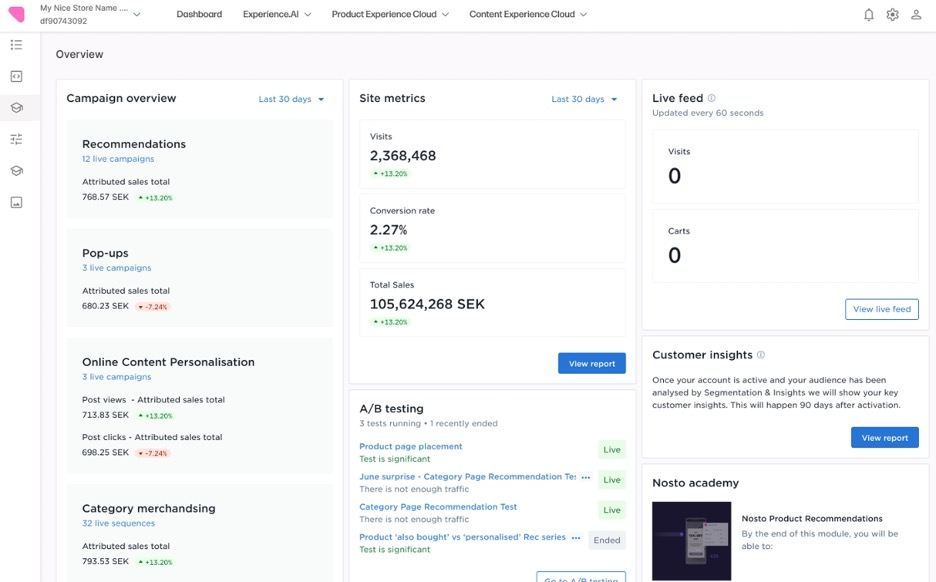
Nosto is an e-commerce personalization platform for online retailers looking to enhance customer experiences through tailored product recommendations. It analyzes shopper behavior in real time, and AI engines power recommendations, search, content personalization, and merchandising for online stores.
Why I picked Nosto: It blends enterprise-grade AI personalization with true commerce-platform flexibility: from Shopify to Adobe Commerce to BigCommerce, it gives growing online stores a unified tool to personalise product discovery, content, and email without stitching together multiple point-solutions.
Standout features & integrations:
Features include A/B testing to optimize strategies, visual search to enhance product discovery, and content personalization to tailor marketing messages. It also offers category merchandising tools that help teams adjust product sequencing based on performance.
Integrations include Shopify, Adobe Commerce, BigCommerce, WooCommerce, Salesforce Commerce Cloud, PrestaShop, Lightspeed, Shopware, SAP Commerce Cloud, and Odoo.
Pros and Cons
Pros:
- Supports multi-channel personalization
- Real-time behavioral data analysis
- Quick to deploy personalization tools
Cons:
- Limited templates and reporting capabilities
- No advanced customization options

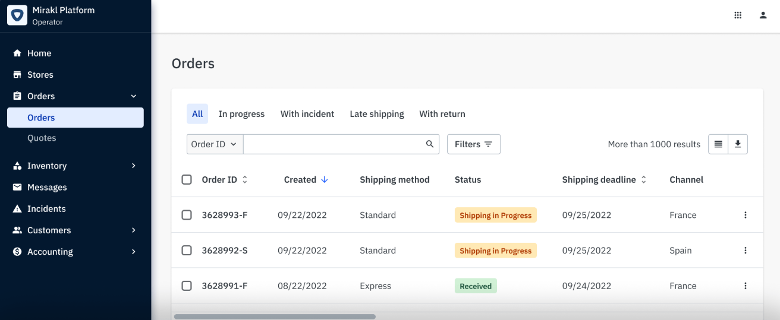
Mirakl is a marketplace platform designed for businesses looking to expand their online presence by creating and managing marketplaces. Its main users are retailers and B2B companies wanting to leverage third-party sellers to grow their product offerings and reach.
Why I picked Mirakl: It’s one of the few AI-driven platforms built for retailers and B2B brands that want to run their own high-volume marketplaces. Rather than juggling separate tools for listings, catalog management, and order processing, Mirakl unifies these needs, letting businesses scale their marketplace quickly while retaining control over quality, pricing, inventory, and seller compliance. For businesses expanding into marketplace operations, it offers the maturity and automation most competitors lack.
Standout features & integrations:
Features include automated seller onboarding to make marketplace growth easy, dynamic pricing tools to maintain competitive pricing, order management, fulfillment support, and inventory management to ensure product availability. These features help you run a thriving, efficient marketplace.
Integrations include SAP, Adobe Commerce, Salesforce Commerce Cloud, Oracle, Shopify, WooCommerce, PrestaShop, BigCommerce, NetSuite, and Microsoft Dynamics 365.
Pros and Cons
Pros:
- Automates seller onboarding processes
- Offers dynamic pricing management
- Integrates with existing e-commerce and ERP systems
Cons:
- Limited native merchandising tools
- Seller compliance requires ongoing monitoring

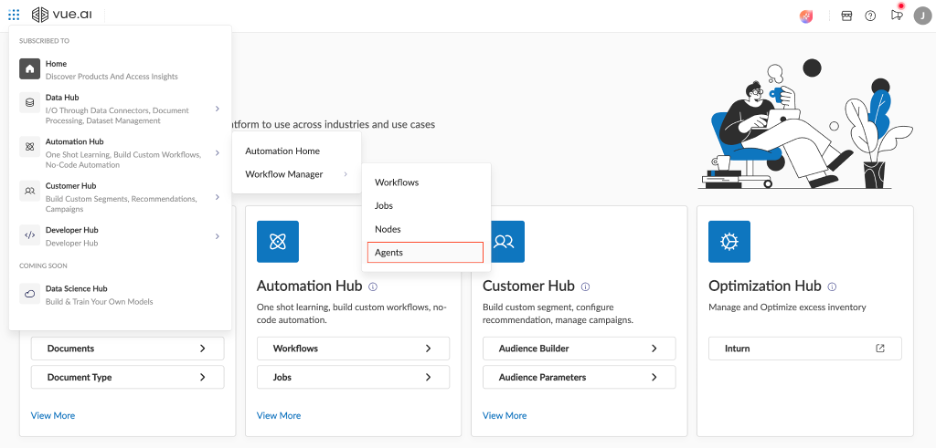
Vue.Ai is an AI-powered retail automation platform for fashion retailers looking to improve customer experiences through personalized styling recommendations. Its main users are e-commerce businesses looking to leverage AI for improved product discovery and customer engagement.
Why I picked Vue.Ai: It’s one of the few AI solutions built for fashion retail, where accurate tagging, styling recommendations, and visual discovery impact conversions. Unlike general personalization tools, Vue.Ai understands product attributes at a granular level and uses that context to improve search relevance and product discovery. For apparel and accessories brands, this level of specialization is a meaningful advantage.
Standout features & integrations:
Features include automated product tagging for inventory management, visual search to improve product discovery, and personalized email marketing to engage customers effectively. These tools work together to enhance your retail operations.
Integrations include Shopify, Adobe Commerce, WooCommerce, Salesforce Commerce Cloud, BigCommerce, Oracle Commerce Cloud, SAP Commerce Cloud, Demandware, Hybris, and PrestaShop.
Pros and Cons
Pros:
- Automates product tagging efficiently
- Enhances product discovery with visual search
- Provides personalized styling recommendations
Cons:
- Limited customization for advanced users
- May require technical setup

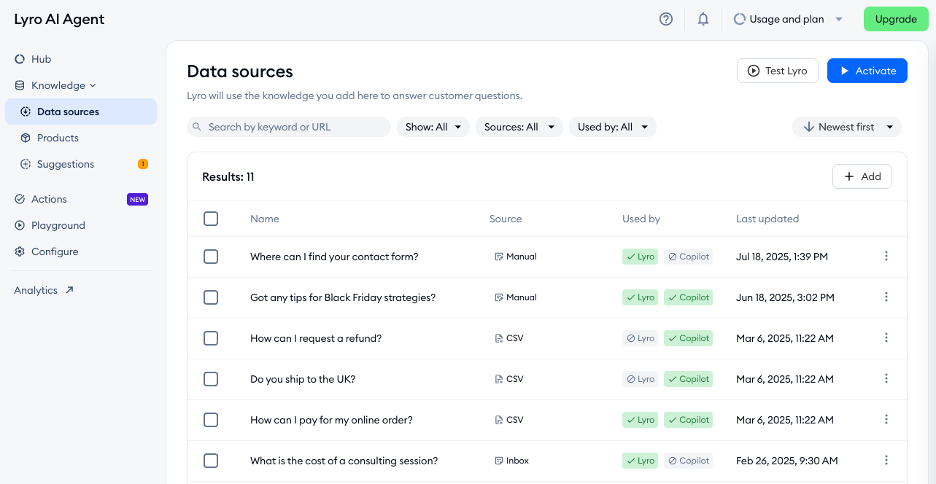
Lyro by Tidio is an AI-driven chatbot platform designed to enhance customer support and engagement for businesses. Its main users are small to medium-sized companies that want to automate customer interactions and provide instant assistance.
Why I picked Lyro by Tidio: It gives smaller e-commerce teams an accessible way to automate customer support without complex setup. Unlike heavier AI helpdesk platforms, Lyro works inside Tidio’s familiar interface, making it easy to deploy automated answers, multilingual chat, and behavior-based triggers. It’s a strong choice for growing stores that want fast, reliable AI support without switching platforms.
Standout features & integrations:
Features include customizable chat flows to tailor customer interactions, real-time visitor tracking to understand user behavior, and multilingual support to cater to a global audience. These tools help you deliver efficient customer service.
Integrations include Shopify, WordPress, Wix, BigCommerce, Squarespace, Mailchimp, HubSpot, Zapier, Google Analytics, and Slack.
Pros and Cons
Pros:
- Supports multiple languages
- Customizable chat flows
- Efficient AI-powered customer support
Cons:
- May need time for initial setup
- Limited advanced customization options

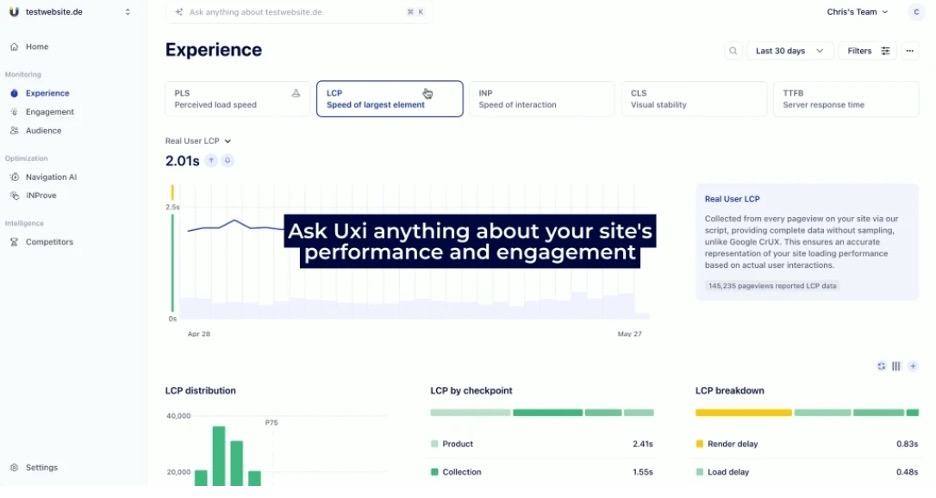
Navigation UI by Uxify is a tool that improves site navigation and user experience for e-commerce businesses. It helps teams understand how shoppers move through a site and identify areas that slow down the buying process.
Why I picked Navigation UI by Uxify: It tackles an often-overlooked conversion killer for online stores: choppy navigation. While many AI e-commerce tools focus on product recommendation or chatbots, Uxify uses AI models to anticipate user interaction patterns and adjust navigation elements to keep the browsing experience responsive and predictable, which is especially helpful for large catalogs and mobile-heavy traffic.
Standout features & integrations:
Features include real-time UX insights that identify friction points, automated performance enhancements that optimize loading behaviors, and benchmark comparisons to measure site speed and usability against competitors.
Integrations include Shopify, WordPress, WIX, Adobe Commerce, BigCommerce, and Squarespace.
Pros and Cons
Pros:
- Competitive benchmarking features
- Real-time user journey tracking
- Instant page loads with predictive prerendering
Cons:
- Limited customization in AI recommendations
- Limited control over granular performance/configuration
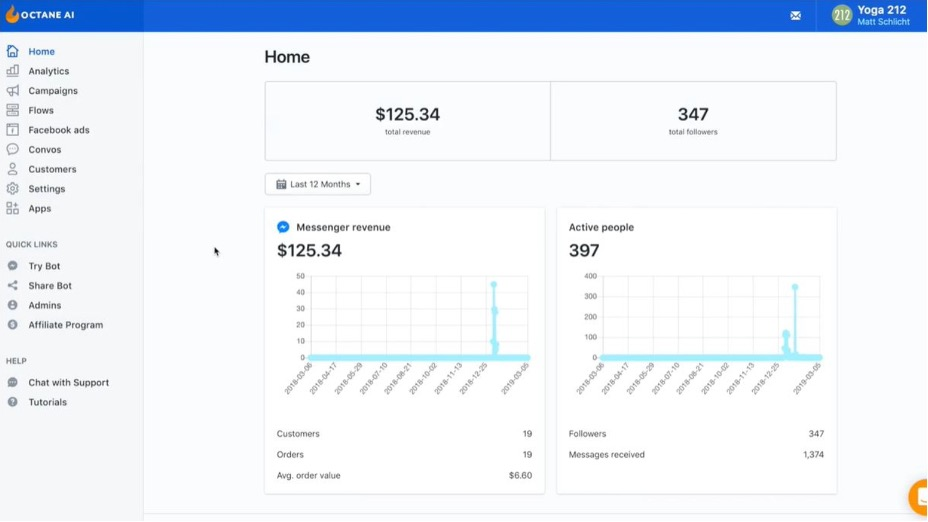
Octane AI is a quiz-based personalization platform designed for e-commerce brands that want to guide shoppers through tailored buying journeys. It helps teams collect zero-party data and use it to build structured funnels that improve product discovery. Its quiz and segmentation tools support smarter, higher-intent customer paths that feed into marketing and on-site recommendations.
Why I picked Octane AI: Its ability to turn browsing into a guided funnel that adapts to each shopper, collecting preference data through quizzes. This builds personalized paths that help customers quickly find the right products, which is especially useful for stores with multiple variations, bundles, or style-based items. For brands seeking higher-conversion buying journeys, these structured funnels offer a clear advantage over static product pages.
Standout features & integrations:
Features include a quiz builder for collecting zero-party data, smart funnels that create personalized product paths, and analytics tools that report on quiz performance and shopper behavior.
Integrations include Shopify, Klaviyo, Facebook Messenger, Instagram, Mailchimp, Zapier, Privy, Google Analytics, ReCharge, and Yotpo.
Pros and Cons
Pros:
- Integrates quiz responses directly into other tools
- Boosts conversions for multi-SKU catalogs
- Uses zero-party data to personalize recommendations
Cons:
- Quizzes need traffic for best results.
- Advanced logic needs higher-tier plans.

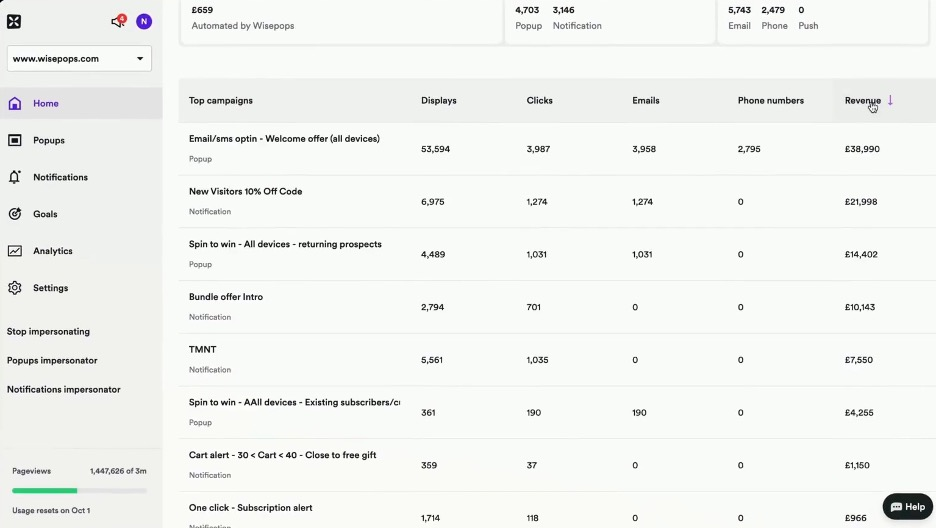
Wisepops is a pop-up and AI marketing platform designed for e-commerce businesses looking to boost conversions through targeted campaigns. Its main users are marketers and online retailers who want to engage customers with personalized pop-ups and banners.
Why I picked Wisepops: It gives e-commerce teams a flexible way to run high-conversion pop-up campaigns without relying on developers. Its AI targeting helps brands personalize offers based on behavior and timing, making it effective for stores that run frequent promotions or need to adjust messaging. For teams focused on capturing leads or driving specific actions like cart recovery, Wisepops offers both speed and control.
Standout features & integrations:
Features include a drag-and-drop editor for easy pop-up creation, advanced targeting options to reach specific audiences, and detailed analytics to measure campaign success. These tools help you create effective marketing campaigns.
Integrations include Shopify, WordPress, Mailchimp, HubSpot, WooCommerce, BigCommerce, Adobe Commerce, Squarespace, Drupal, and PrestaShop.
Pros and Cons
Pros:
- Easy-to-use pop-up editor
- Provides detailed performance analytics
- Offers advanced targeting for campaigns
Cons:
- May require setup time for new users
- Limited design customization

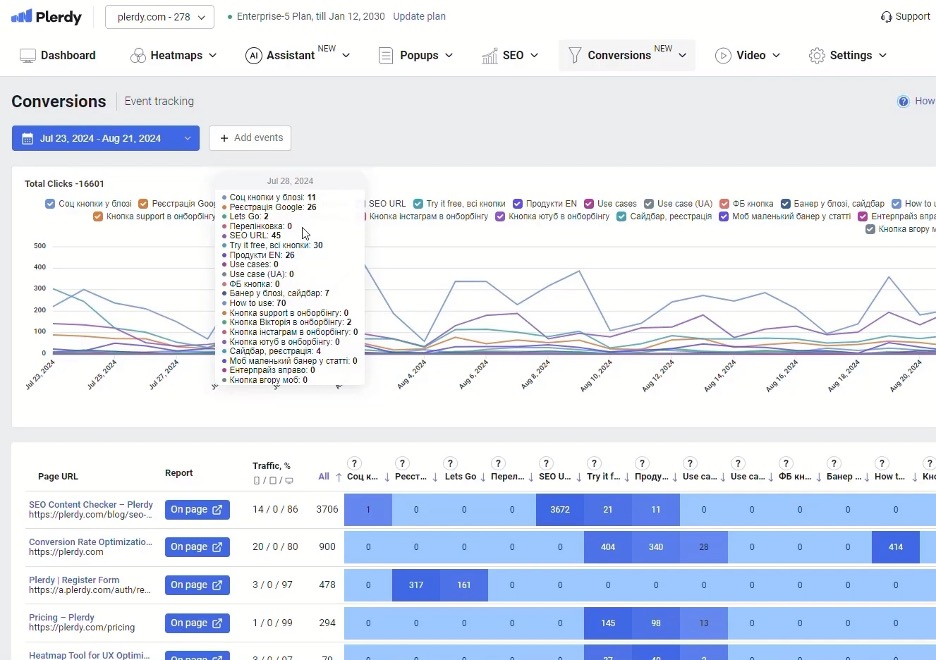
Plerdy’s AI UX Assistant is a user experience optimization tool aimed at marketers and UX designers. It provides data-driven insights to improve website performance and user engagement through AI.
Why I picked Plerdy’s AI UX Assistant: It offers e-commerce teams a practical way to understand on-site behavior without needing a dedicated CRO analyst. Instead of just showing heatmaps or recordings, Plerdy’s AI ranks UX issues by potential impact, helping teams identify changes that can improve conversions. For stores that want actionable UX insights rather than raw data, it’s an efficient and accessible choice.
Standout features & integrations:
Features include heatmap analytics to visualize user interaction, pop-up forms to capture leads, and SEO checker tools to improve search rankings. These features work together to enhance your site's overall performance.
Integrations include Google Analytics, Google Tag Manager, WordPress, Shopify, HubSpot, Drupal, Joomla, Wix, Squarespace, and Weebly.
Pros and Cons
Pros:
- Includes on-page SEO auditing tools
- Offers session replays for user insights
- Ranks UX issues by impact
Cons:
- Data-heavy reports may require interpretation
- Unintuitive Interface and dashboard
Other AI E-commerce ToolsAI E-commerce
Here are some additional AI e-commerce tools options that didn’t make it onto my shortlist, but are still worth checking out:
- Tolstoy
For interactive video content
- Shopify Magic
For a first-time e-commerce business
- Banuba
For immersive shopping experiences
- ViSenze
For visual search capabilities
- Kimonix
For merchandising analytics
- Adobe Sensei
For creative content AI tools
- Landbot.io
For no-code chatbot creation
- Lavender AI
For AI email optimization


AI E-commerce Tool Selection Criteria
When selecting the best AI e-commerce tools for this list, I considered common buyer needs and pain points, such as enhancing customer engagement and improving sales conversion rates. I also used the following framework to keep my evaluation structured and fair:
Core Functionality (25% of total score)
To be considered for inclusion in this list, each solution had to fulfill these common use cases:
- Personalizing customer experiences
- Automating customer support
- Analyzing customer behavior
- Optimizing sales funnels
- Managing inventory efficiently
Additional Standout Features (25% of total score)
To help further narrow down the competition, I also looked for unique features, such as:
- AI-driven product recommendations
- Visual search capabilities
- Real-time analytics
- Augmented reality integration
- Chatbot personalization
Usability (10% of total score)
To get a sense of the usability of each system, I considered the following:
- Intuitive interface design
- Easy navigation
- Minimal learning curve
- Customization options
- Speed of operations
Onboarding (10% of total score)
To evaluate the onboarding experience for each platform, I considered the following:
- Availability of training videos
- Interactive product tours
- Access to webinars
- Use of chatbots for guidance
- Ready-to-use templates
Customer Support (10% of total score)
To assess each software provider’s customer support services, I considered the following:
- 24/7 support availability
- Multiple support channels
- Response time
- Quality of help documentation
- Access to a dedicated support team
Value For Money (10% of total score)
To evaluate the value for money of each platform, I considered the following:
- Competitive pricing
- Features offered at each pricing tier
- Cost-benefit ratio
- Availability of a free trial
- Customer feedback on pricing
Customer Reviews (10% of total score)
To get a sense of overall customer satisfaction, I considered the following when reading customer reviews:
- Overall satisfaction ratings
- Commonly mentioned pros and cons
- Feedback on feature effectiveness
- Comments on reliability and performance
- Comparison with similar tools
How to Choose AI E-commerce Tools
It’s easy to get bogged down in long feature lists and complex pricing structures. To help you stay focused as you work through your unique software selection process, here’s a checklist of factors to keep in mind:
| Factor | What to Consider |
| Scalability | Can the tool grow with your business? Consider current and future needs. Avoid tools that might limit your expansion or require costly upgrades as you scale. |
| Integrations | Does it integrate with your existing systems? Check compatibility with your CRM, ERP, and other software to avoid data silos and manual workarounds. |
| Customizability | Can the tool be tailored to your workflows? Look for customization options that let you adapt the tool to your specific business processes and branding needs. |
| Ease of use | Is the tool user-friendly? Evaluate the interface and user feedback. A steep learning curve can delay implementation and reduce team adoption. |
| Implementation and onboarding | How quickly can you get up and running? Assess the support and resources available for onboarding to ensure a smooth transition with minimal disruption. |
| Cost | Does the price fit your budget? Compare pricing tiers and calculate the total cost of ownership, including hidden fees or extra charges for essential features. |
| Security safeguards | Does the tool protect your data? Ensure it complies with industry standards for data security and privacy. Look for encryption, access controls, and regular security updates. |
| Support availability | Is help readily available? Consider the support channels, response times, and availability. A lack of support can impede problem resolution and impact your operations. |
What Are AI E-commerce Tools?
AI e-commerce tools are software solutions that use artificial intelligence to enhance various aspects of online retail operations. These tools are used by e-commerce managers, marketers, and customer support teams to improve efficiency and customer experiences. Features such as automated customer support, personalized recommendations, and predictive analytics support decision-making, customer engagement, and sales optimization. Overall, these tools enable businesses to operate more effectively in the digital marketplace.
Features
When selecting AI e-commerce tools, keep an eye out for the following key features:
- Personalized recommendations: Suggest products to customers based on their behavior and preferences, increasing the likelihood of purchase.
- Automated customer support: Uses AI chatbots to handle common queries, reducing the workload on support teams.
- Predictive analytics: Analyzes data to forecast trends and customer behavior, aiding in strategic decision-making.
- Visual search capabilities: Allow customers to search for products using images, enhancing the shopping experience.
- Dynamic pricing: Adjusts prices in real-time based on market conditions and demand, helping maximize revenue.
- Inventory optimization: Uses AI to manage stock levels efficiently, preventing overstock and stockouts.
- Real-time analytics: Provides insights into customer interactions and sales performance, enabling quick adjustments.
- AI-driven merchandising: Tailors product displays and promotions to match customer preferences, boosting engagement.
- Augmented reality integration: Offers virtual try-ons and interactive experiences, enriching the customer journey.
- Email retargeting: Sends personalized emails to recover abandoned carts and re-engage customers, increasing conversion rates.
Benefits
Implementing AI e-commerce tools provides several benefits for your team and your business. Here are a few you can look forward to:
- Higher customer loyalty: AI-driven experiences help shoppers feel understood and supported, increasing repeat purchases.
- More predictable revenue: Forecasting and demand modeling reduce uncertainty around inventory, cash flow, and sales cycles.
- Less manual work for teams: Automations reduce repetitive tasks across support, merchandising, and high-quality content creation, freeing time for strategic work.
- Faster optimization cycles: Real-time insights help teams adjust pricing, campaigns, and inventory decisions without waiting for long reports.
- Lower return rates: Tools like AR try-ons and better recommendations help shoppers choose the right products the first time.
- Improved marketing efficiency: Better targeting and personalized messaging reduce wasted ad spend and improve ROI.
- Stronger cross-channel consistency: Unified data ensures shoppers get a coherent experience across web, email, chat, and social.
- Scalable operations: AI handles complexity as catalog sizes, traffic, and product variations grow.
Costs & Pricing
Selecting AI e-commerce tools requires an understanding of the various pricing models and plans available. Costs vary based on features, team size, add-ons, and more. The table below summarizes common plans, their average prices, and typical features included in AI e-commerce tools solutions:
Plan Comparison Table for AI E-commerce Tools
| Plan Type | Average Price | Common Features |
| Free Plan | $0/user/month | Basic analytics, limited product recommendations, and standard support. |
| Personal Plan | $10-$30/month | Enhanced analytics, basic automation features, and email support. |
| Business Plan | $30-$80/month | Full analytics suite, advanced personalization, and priority email support. |
| Enterprise Plan | $250/month or custom | Custom integrations, dedicated account management, and 24/7 premium support. |
AI E-commerce Tools FAQs
Here are some answers to common questions about the best AI tools for e-commerce:
How do AI e-commerce tools handle seasonal demand fluctuations in retail?
AI e-commerce tools use advanced algorithms and AI technology to analyze historical sales data, current trends, and external market signals. These systems identify seasonal patterns and adjust forecasts, so you can prepare inventory for high-traffic periods and avoid stockouts during slower cycles. Many tools now use generative AI and AI models to refine predictions based on real-time retail activity.
Can AI e-commerce tools improve customer personalization?
Yes. AI e-commerce tools boost personalization by analyzing customer behavior and producing tailored product suggestions, personalized marketing tools, copywriting, and dynamic AI-generated recommendations. These insights help you run targeted campaigns across email and social media, increasing engagement and customer loyalty.
How often should I review performance metrics when using AI e-commerce tools?
Most retailers review key metrics weekly, though high-volume stores may check results daily. AI agents can monitor performance in the background and highlight trends or issues before they affect revenue. Regular reviews ensure you’re getting the most value from your AI capabilities and adapting strategies based on real customer activity.
What types of data do AI e-commerce tools analyze for retail operations?
These tools look at sales transactions, customer data, product catalogs, website activity, and external market indicators. AI systems convert this information into insights used for demand forecasting, SEO-optimized content decisions, merchandising choices, and customer engagement improvements.
How can AI e-commerce tools help with merchandising decisions for retail brands?
AI analyzes sales trends, browsing behavior, and product engagement to show which items are performing well and which need attention. These insights help teams adjust product placements, manage product images, and optimize promotions. By relying on real-time data, your merchandising decisions are guided by actual retail behavior rather than guesswork.
What’s Next:
If you're in the process of researching AI e-commerce tools, connect with a SoftwareSelect advisor for free recommendations.
You fill out a form and have a quick chat where they get into the specifics of your needs. Then you'll get a shortlist of software to review. They'll even support you through the entire buying process, including price negotiations.