

Ecommerce platforms for manufacturers are valuable assets for any company. With the right software, teams can streamline their sales processes and improve customer engagement. But finding the right ecommerce platform for manufacturers can be a challenge, especially with so many options available.
Using my experience with ecommerce and B2B software, I tested and compared several of the top ecommerce platforms for manufacturers available. From there, I compiled my results into in-depth reviews to help you find the best software for your unique needs. I’m confident that you’ll discover your next ecommerce platform for manufacturers in the list below.
Why Trust Our Software Reviews
We’ve been testing and reviewing ecommerce software since 2021. As ecommerce experts ourselves, we know how critical and difficult it is to make the right decision when selecting software.
We invest in deep research to help our audience make better software purchasing decisions. We’ve tested more than 2,000 tools (!!!) for different ecommerce management use cases and written over 1,000 comprehensive software reviews. Learn how we stay transparent & our ecommerce platform for manufacturers review methodology.
Payroll Software Comparison Table
This comparison table summarizes pricing details for my top ecommerce software for manufacturing selections:
| Tool | Best For | Trial Info | Price | ||
|---|---|---|---|---|---|
| 1 | Best for syncing product and customer data | 30-day free trial | Pricing upon request | Website | |
| 2 | Best for advanced search and discovery | Free plan + free demo available | From $1/month | Website | |
| 3 | Best for user-friendly online store setup | 3-day free trial | From $29/month (billed annually) | Website | |
| 4 | Best for scalable multi-brand management | Free demo available | Pricing upon request | Website | |
| 5 | Best for full store ownership | 14-day free trial | Pricing upon request | Website | |
| 6 | Best for cost-effective customization | Free plan available | Free plan available | Website | |
| 7 | Best for B2B digital transformation | Free plan available OR Free demo available | Pricing upon request | Website | |
| 8 | Best for Customizable Website Building | 14-day free trial | From $35/month | Website | |
| 9 | Best for composable commerce flexibility | Free trial available | From $49,500/year (billed annually) | Website | |
| 10 | Best for ERP-integrated B2B sales | Free demo available | From $1,265/month | Website |


Best Ecommerce Platform for Manufacturers Reviews
Below are my detailed summaries of the best payroll software that made it onto my shortlist. My reviews offer a detailed look at the key features, pros & cons, integrations, and ideal use cases of each tool to help you find the best one for you.

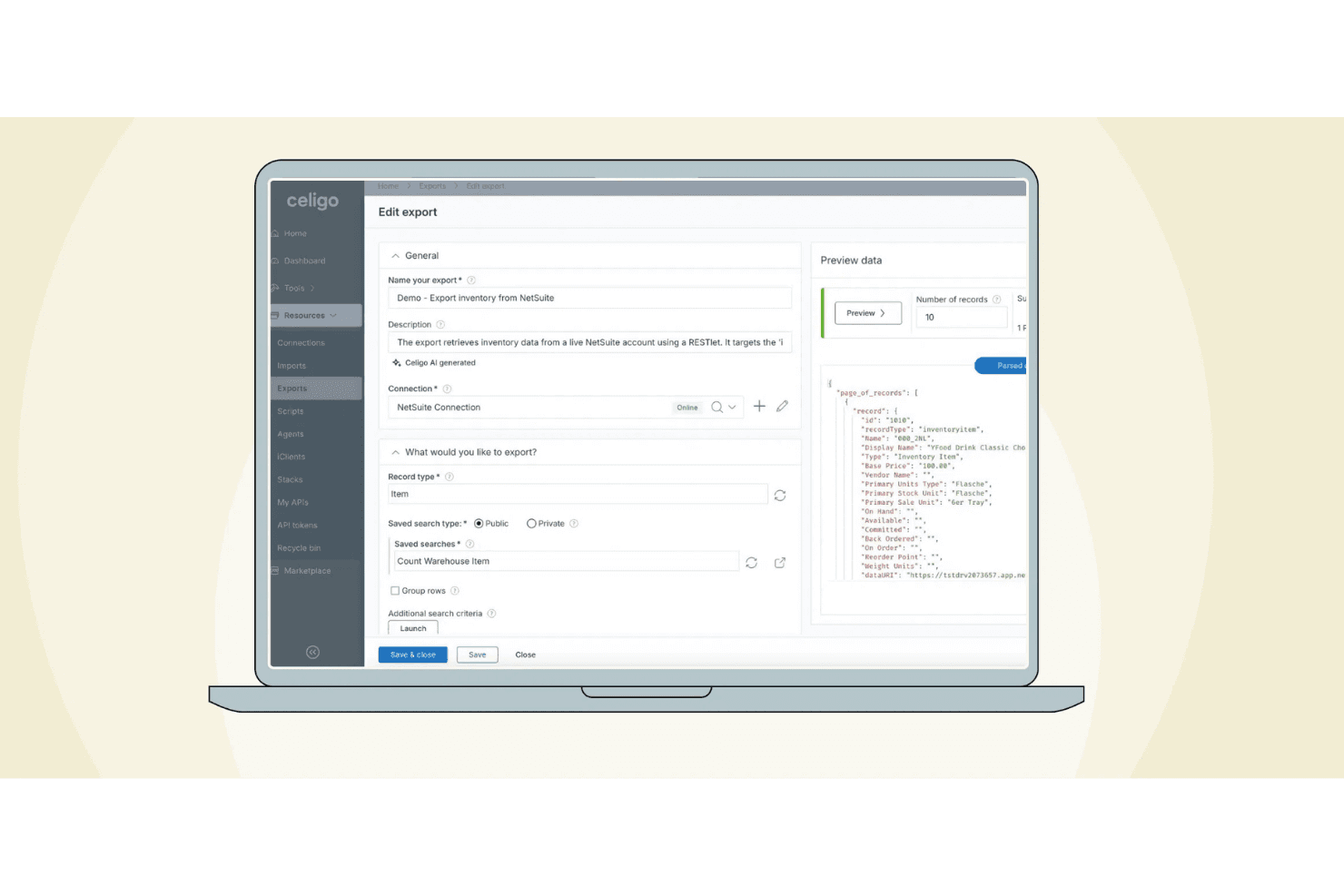
Celigo lets users configure and preview NetSuite inventory exports. Celigo is an iPaaS (integration platform as a service) that connects ecommerce storefronts, ERPs, marketplaces, and 3PLs through 1,000+ prebuilt connectors and AI-powered workflow automation.
Who Is Celigo Best For?
Celigo is the right fit for operations and IT teams at mid-market to enterprise manufacturers who need to sync data across their ERP, storefront, and fulfillment systems without building custom integrations from scratch.
Why I Picked Celigo
I've included Celigo in my top picks because it's the best option I've found for keeping product and customer data in sync across an entire manufacturing tech stack. When a Shopify B2B order comes in, Celigo automatically pushes it into NetSuite, updates inventory across every connected channel, and triggers fulfillment at the 3PL without anyone touching a spreadsheet. Its AI-driven error management resolves 96% of integration exceptions automatically, so data mismatches don't quietly snowball into order fulfillment problems.
Celigo Key Features
- EDI trading partner integration: Connect with hundreds of major retailers and distributors using prebuilt EDI connectors via AS2 protocol for buy-side and sell-side transactions.
- Automatic error management: An AI-driven system detects and resolves integration exceptions without manual intervention, covering 96% of errors automatically.
- Omnichannel inventory sync: Real-time inventory updates flow across your ERP, 3PL, and all connected storefronts simultaneously to prevent overselling.
- Universal connectors: For any system outside the prebuilt library, Celigo supports HTTP, FTP, JDBC, GraphQL, Webhooks, and AS2 protocols to connect custom or niche tools.
Celigo Integrations
Celigo offers 1,000+ prebuilt integrations, including Shopify, Shopify B2B, BigCommerce, NetSuite, Microsoft Dynamics 365 Business Central, Acumatica, Amazon, Walmart Marketplace, ShipBob, and Loop Returns. Universal connectors support REST, SOAP, GraphQL, HTTP, FTP, JDBC, AS2, and webhooks.
Pros and Cons
Pros:
- Real-time inventory and order updates
- AI resolves most data integration errors
- Automates product and customer data sync
Cons:
- Does not support quoting or RFQs
- No native storefront or buyer portal
Learn more about Celigo: Best for advanced search and discovery
- Free plan + free demo available
- From $1/month
Visit WebsiteCustomer Rating:4.6/5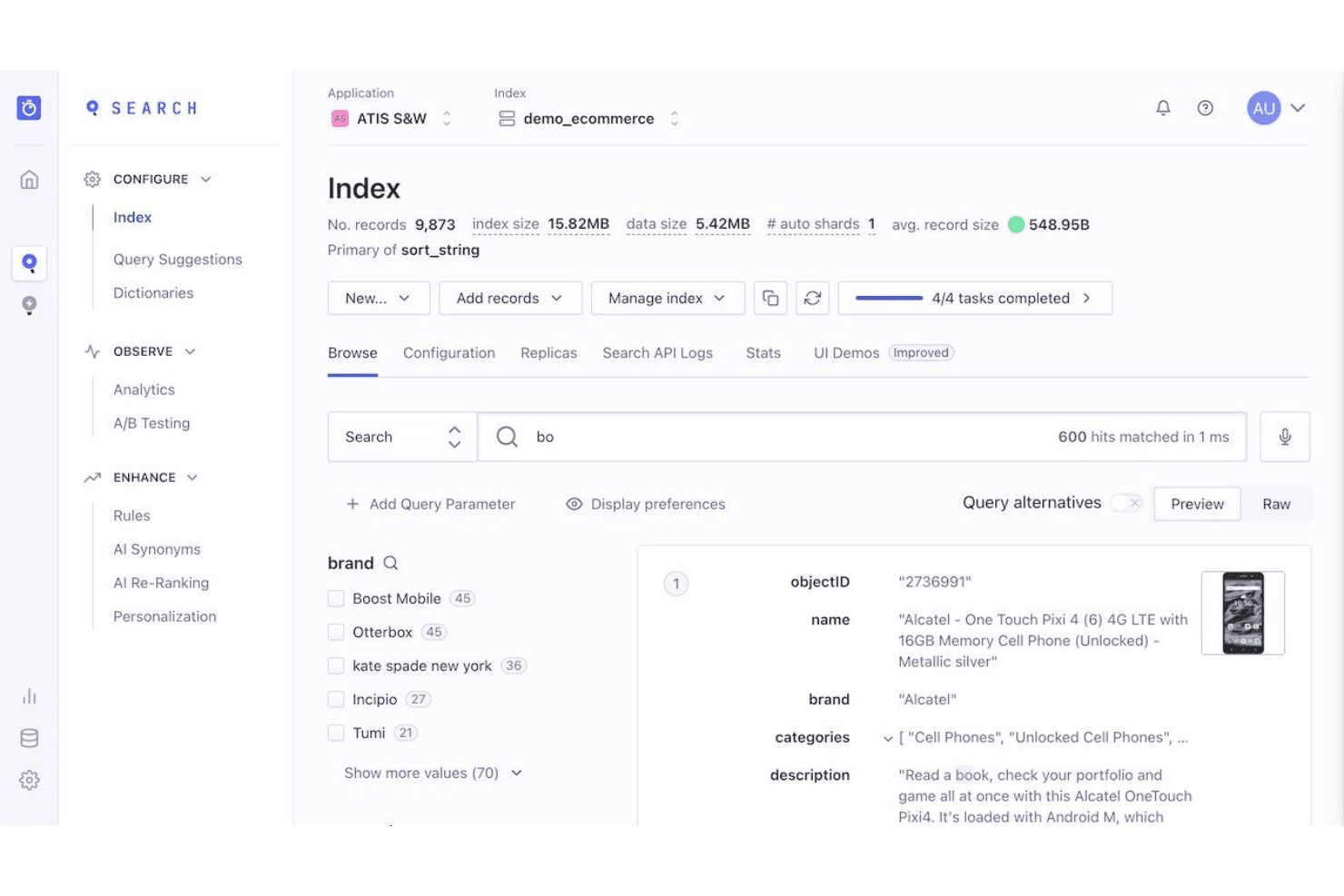
Algolia lets users browse, search, and manage index records in real time. Algolia is an AI-powered search and discovery platform that layers onto existing ecommerce stacks to deliver real-time product search, AI-driven recommendations, and no-code merchandising tools across complex manufacturer catalogs.
Who Is Algolia Best For?
Algolia is a strong fit for manufacturers building composable commerce stacks who need AI-powered search and discovery layered on top of an existing ecommerce engine.
Why I Picked Algolia
Algolia earns its spot on my shortlist because manufacturers with large, complex SKU catalogs genuinely struggle with search that can't handle part numbers, technical specs, or imprecise buyer queries. I love how NeuralSearch combines semantic and keyword matching in a single API call, surfacing the right product even when a buyer's search input is vague or misspelled. Algolia's AI Merchandising Studio also lets non-technical teams boost or pin products for specific queries without touching code.
Algolia Key Features
- NeuralSearch: A hybrid search engine that combines vector-based semantic search with keyword matching in a single API call to handle vague or technical queries.
- Personalized catalog access control: Restricts product visibility at the account level so each buyer only sees the SKUs and pricing they're entitled to view.
- AI Attribute Enrichment: Uses generative AI to automatically expand product records with enhanced attributes and descriptions, improving filter accuracy across large SKU sets.
- Rules engine: Supports up to 10,000 configurable rules per index to pin, boost, bury, or redirect products for specific queries or categories.
Algolia Integrations
Algolia offers six documented ecommerce integrations, including Shopify, Salesforce Commerce Cloud, Adobe Commerce, BigCommerce, commercetools, and Supabase. Its APIs and SDKs support custom connections to ERP, PIM, WMS, CRM, and inventory systems.
Pros and Cons
Pros:
- Business users control merchandising without code
- Speeds up large catalog product discovery
- Excels at long-tail and technical queries
Cons:
- Requires pairing with a separate ecommerce platform
- No quoting or buyer self-service features
Learn more about Algolia: Best for user-friendly online store setup
- 3-day free trial
- From $29/month (billed annually)
Visit WebsiteCustomer Rating:4.5/5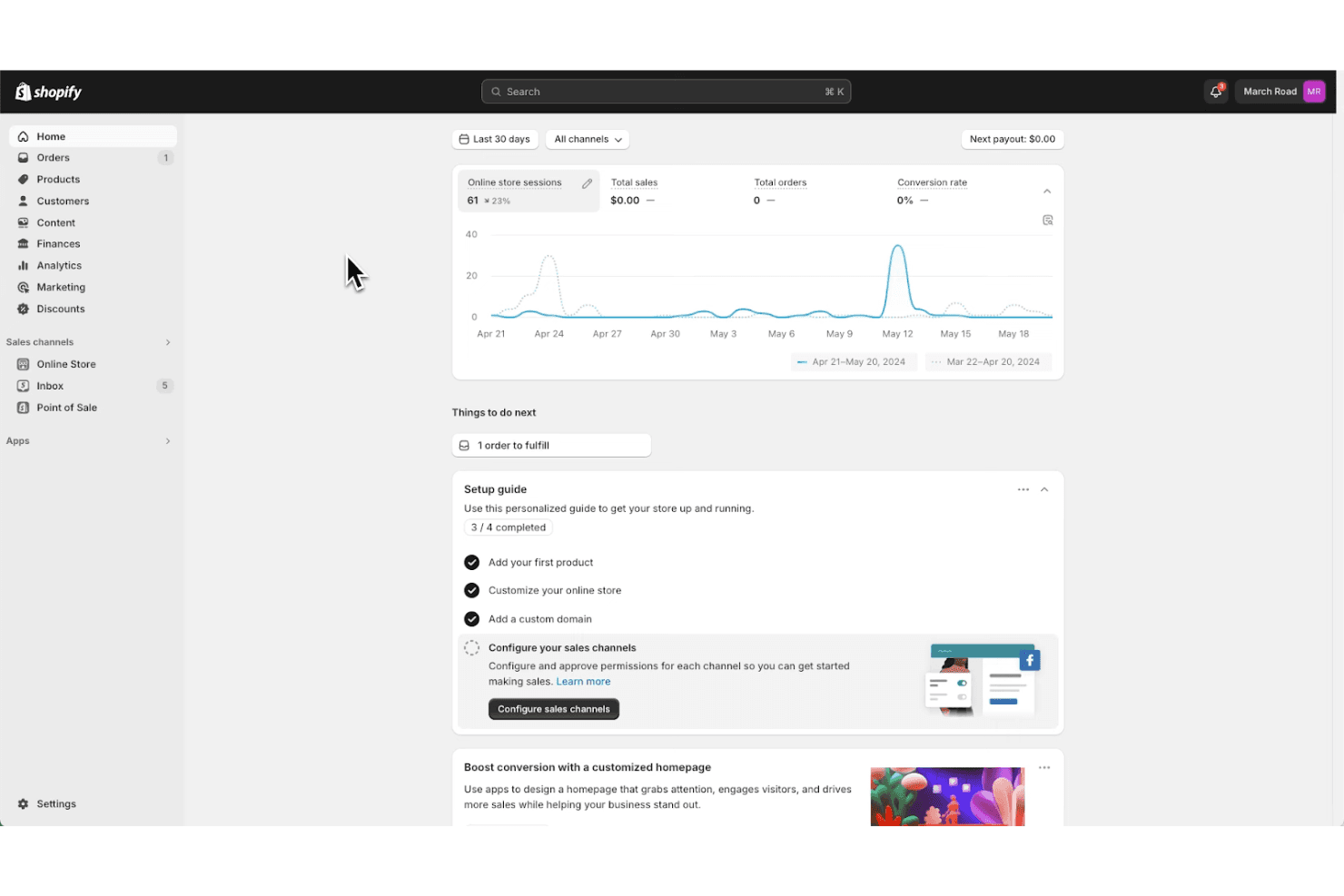
Shopify's dashboard tracks store sessions, sales, and setup progress. Shopify is a cloud-based ecommerce platform that supports both B2B and D2C selling from a single admin, with tools for custom catalogs, tiered pricing, buyer portals, multi-channel selling, and ERP integration.
Who Is Shopify Best For?
Shopify is a strong fit for manufacturers launching hybrid B2B and D2C storefronts who need to get online fast without heavy technical overhead.
Why I Picked Shopify
Shopify earns its spot on my shortlist because it's the fastest path to a live B2B or hybrid storefront I've seen, without sacrificing the features manufacturers actually need. I love that a single admin handles both wholesale and D2C selling with shared inventory, so a manufacturer can serve distributors on net terms while running a consumer store simultaneously. Customer-specific catalogs and company account hierarchies (supporting up to 10,000 buyer locations) make structured wholesale access feel native rather than bolted on.
Shopify Key Features
- Shopify Flow automation: A no-code workflow builder that automates B2B tasks like multi-level order approvals, reorder triggers, and customer tagging.
- Headless commerce via Hydrogen and Oxygen: A React-based framework paired with global edge hosting for building fully custom manufacturer storefronts and buyer portals.
- Draft orders for sales rep quoting: Sales reps can create draft orders tied to company-specific pricing and net terms, then send buyers a direct checkout link.
- Multi-warehouse inventory management: Tracks and syncs inventory across up to 10 locations, with configurable fulfillment priority rules for bulk B2B orders.
Shopify Integrations
Shopify offers integrations with Oracle NetSuite, Microsoft Dynamics 365 Business Central, Infor, Acumatica, Brightpearl by Sage, Boomi, Jitterbit, Celigo, SPS Commerce, and Orderful. Its REST, GraphQL, and Storefront APIs support custom ERP, MRP, WMS, PIM, and CRM integrations.
Pros and Cons
Pros:
- Extensive app ecosystem fills feature gaps
- Company account hierarchies support 10,000 locations
- B2B and D2C selling unified in one admin
Cons:
- No native RFQ or product configurator
- Core B2B features only on Plus plan
 Best for scalable multi-brand management
- Free demo available
- Pricing upon request
Visit WebsiteCustomer Rating:4.5/5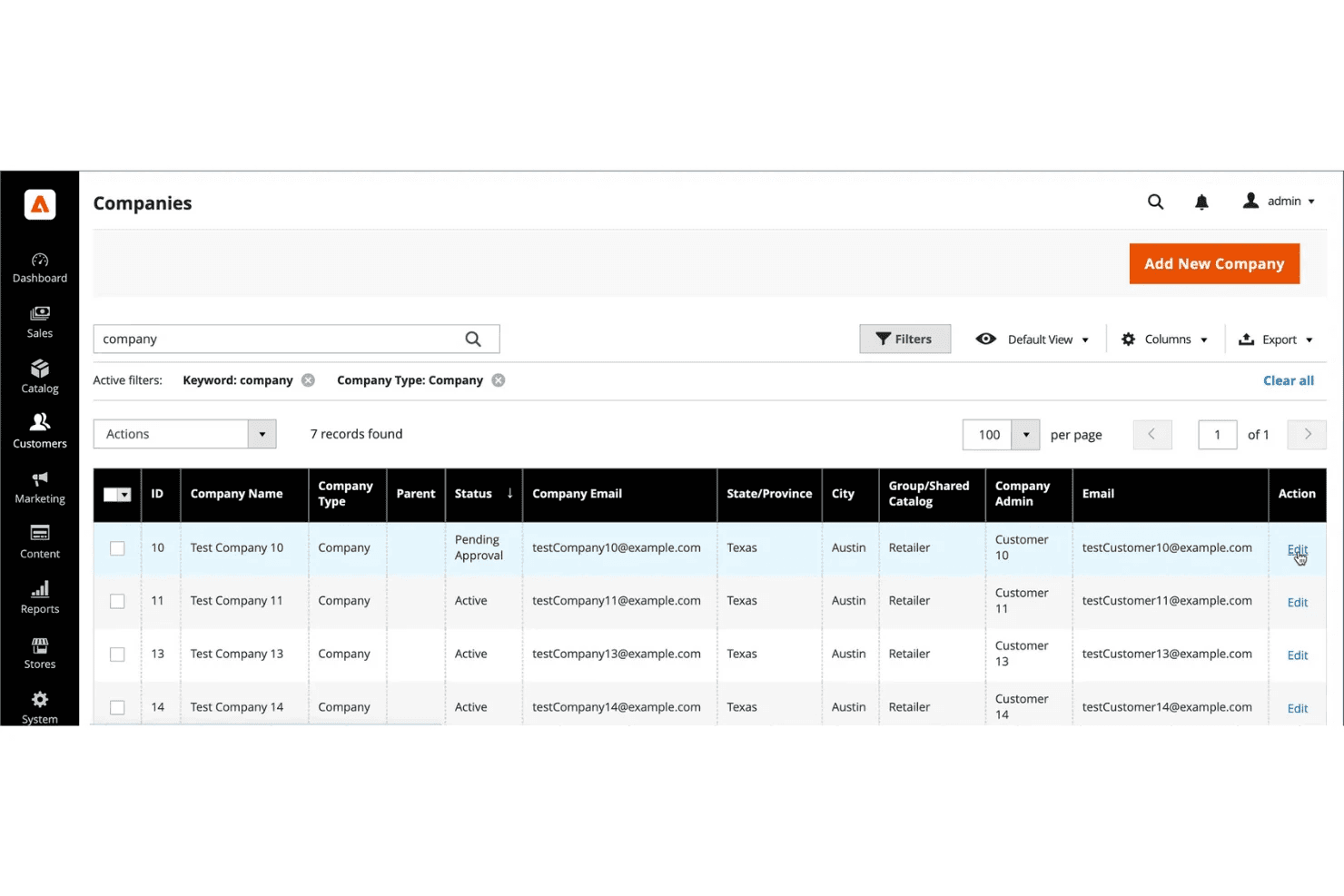
Adobe Commerce lets users manage and review B2B company accounts centrally. Adobe Commerce is an enterprise ecommerce platform built for manufacturers that combines native B2B commerce tools—including company hierarchies, shared catalogs, negotiable quotes, and purchase approval workflows—with multi-site management, ERP integrations, and headless architecture.
Who Is Adobe Commerce Best For?
Adobe Commerce fits enterprise manufacturers managing multiple brands, product lines, or regional storefronts who need B2B and D2C selling from a single platform.
Why I Picked Adobe Commerce
Adobe Commerce earns its spot on my shortlist because no other platform handles scalable multi-brand management at the same level. I'm particularly impressed by its multisite architecture, which lets you centrally manage hundreds of storefronts across brands, regions, and product lines from a single admin, each with its own catalog and pricing. Its native B2B suite, including company hierarchies, shared catalogs, and negotiable quotes, means wholesale and D2C operations run in parallel without separate backends.
Adobe Commerce Key Features
- Purchase approval workflows: Configurable multi-step approval rules based on order value and organizational hierarchy keep procurement policy enforced at checkout.
- AI-powered search and category merchandising: Automatically re-ranks search results and category pages to surface the most relevant products for each buyer.
- Integration Starter Kit: Pre-built bi-directional templates connect Adobe Commerce to SAP S/4HANA, Microsoft Dynamics 365 F&O, and Epicor, cutting integration development time by roughly 50%.
- Requisition lists: Buyers save standard order bundles and reorder in one click, speeding up repeat purchasing across high-volume accounts.
Adobe Commerce Integrations
Adobe Commerce offers documented integrations with SAP S/4HANA, Microsoft Dynamics 365 Finance & Operations, Epicor, and IBM Sterling Order Management. Marketplace integrations support NetSuite, Oracle, Infor, and Acumatica, while App Builder, API Mesh, and webhooks support custom connections.
Pros and Cons
Pros:
- Enables central control of many storefronts
- Manages millions of SKUs and price points
- Handles B2B and D2C channels together
Cons:
- Punchout and EDI require third-party extensions
- High internal and external implementation effort
Learn more about Adobe Commerce: Best for full store ownership
- 14-day free trial
- Pricing upon request
Visit WebsiteCustomer Rating:4.3/5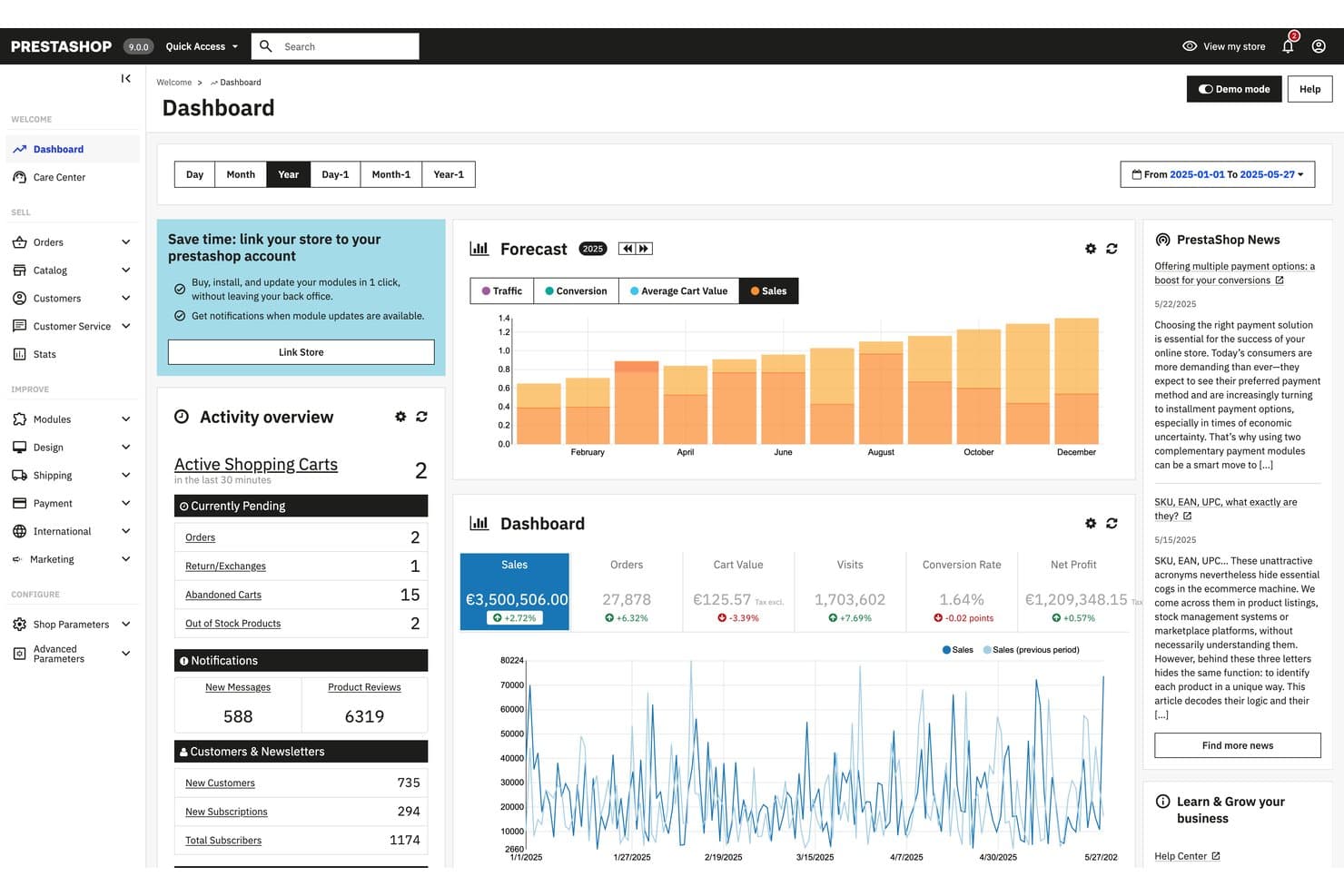
PrestaShop's dashboard gives manufacturers real-time sales and order insights. PrestaShop is an open-source ecommerce platform that lets manufacturers build and self-host their own storefronts, with native multi-store management, B2B pricing controls, and a marketplace of 4,000+ modules for extending catalog, quoting, and ERP connectivity.
Who Is PrestaShop Best For?
PrestaShop is a strong fit for SMB and mid-market manufacturers who want full ownership of their storefront without recurring platform licensing fees.
Why I Picked PrestaShop
PrestaShop earns its spot on my list because the open-source model gives manufacturers genuine ownership of their storefront, including full access to the source code with no platform licensing fees eating into margins. I particularly like the native multi-store architecture, which lets you run a wholesale B2B portal and a D2C consumer storefront from one back office, each with its own catalog, pricing, and branding. Customer group segmentation with tiered, volume-based pricing rules means you can assign negotiated rates to specific accounts without manual workarounds.
PrestaShop Key Features
- Quantity-based pricing breakpoints: Set tiered price rules by volume thresholds so wholesale buyers automatically receive lower unit rates as order size increases.
- Multi-language and multi-currency storefront: Run storefronts in multiple languages across 20 currencies from a single back office, supporting international distribution networks.
- REST API for ERP and system connectivity: Connect PrestaShop to external ERP, PIM, or inventory systems via a RESTful Web Services API that exposes products, orders, customers, and catalog data.
- Addons Marketplace with 4,000+ modules: Extend native functionality with third-party modules for quoting, bulk ordering, account approvals, and ERP connectors directly from the back office.
PrestaShop Integrations
PrestaShop’s Addons Marketplace offers 4,000+ modules, including connectors for SAP, Sage, Microsoft Dynamics, Odoo, Salesforce, and Akeneo. Its REST API supports custom ERP, PIM, inventory, and production-system integrations, while EDI and Punchout require custom development.
Pros and Cons
Pros:
- Large module ecosystem for specialized workflows
- Multi-store B2B and D2C from one backend
- Full code ownership for storefront customization
Cons:
- Technical expertise needed for maintenance and upgrades
- Advanced B2B features require paid modules
Learn more about PrestaShop: Best for cost-effective customization
- Free plan available
- Free plan available
Visit WebsiteCustomer Rating:4.3/5
OpenCart's Extension Marketplace lets users browse and install paid plugins. OpenCart is an open-source ecommerce platform that supports multi-store management, customer group pricing, product catalog management, and a 13,000+ extension marketplace for adding B2B and manufacturing-specific functionality.
Who Is OpenCart Best For?
OpenCart suits small to mid-sized manufacturers with in-house development resources who want full control over their storefront without paying platform licensing fees.
Why I Picked OpenCart
OpenCart earns its spot on my shortlist because it's the only platform here where the software itself costs nothing, giving manufacturers with in-house developers a genuinely low total cost of ownership. I like that native multi-store management lets you run a B2B wholesale storefront and a D2C consumer storefront from one admin panel, no workarounds needed. Customer group pricing adds another layer, letting you set distinct price tiers for dealers, distributors, and retail buyers at the product level.
OpenCart Key Features
- Account approval workflow: Admins can manually review and approve new business buyer registrations before granting access to wholesale pricing or restricted catalog areas.
- Quantity-based discount tiers: Set volume pricing rules that automatically apply discounts when buyers purchase above defined thresholds, layered on top of group-specific prices.
- 51 pre-installed payment gateways: Includes PayPal, Klarna, Square, and Worldpay out of the box, so you can support diverse buyer payment preferences without additional setup.
- Open-source code access: Full access to the platform's source code lets your development team build custom manufacturing workflows, proprietary integrations, or bespoke storefront logic.
OpenCart Integrations
OpenCart offers marketplace integrations with NetSuite via Patchworks, SAP via eShopSync, and MYOB and Acumatica via APPSeCONNECT. Its built-in API and third-party REST API extensions support custom ERP, PIM, and inventory connections.
Pros and Cons
Pros:
- Large extension marketplace for custom features
- Multi-store management supports B2B and D2C
- No platform licensing fees for manufacturers
Cons:
- ERP integration relies on third-party extensions
- No native quoting or RFQ workflows
Learn more about OpenCart: Best for B2B digital transformation
- Free plan available OR Free demo available
- Pricing upon request
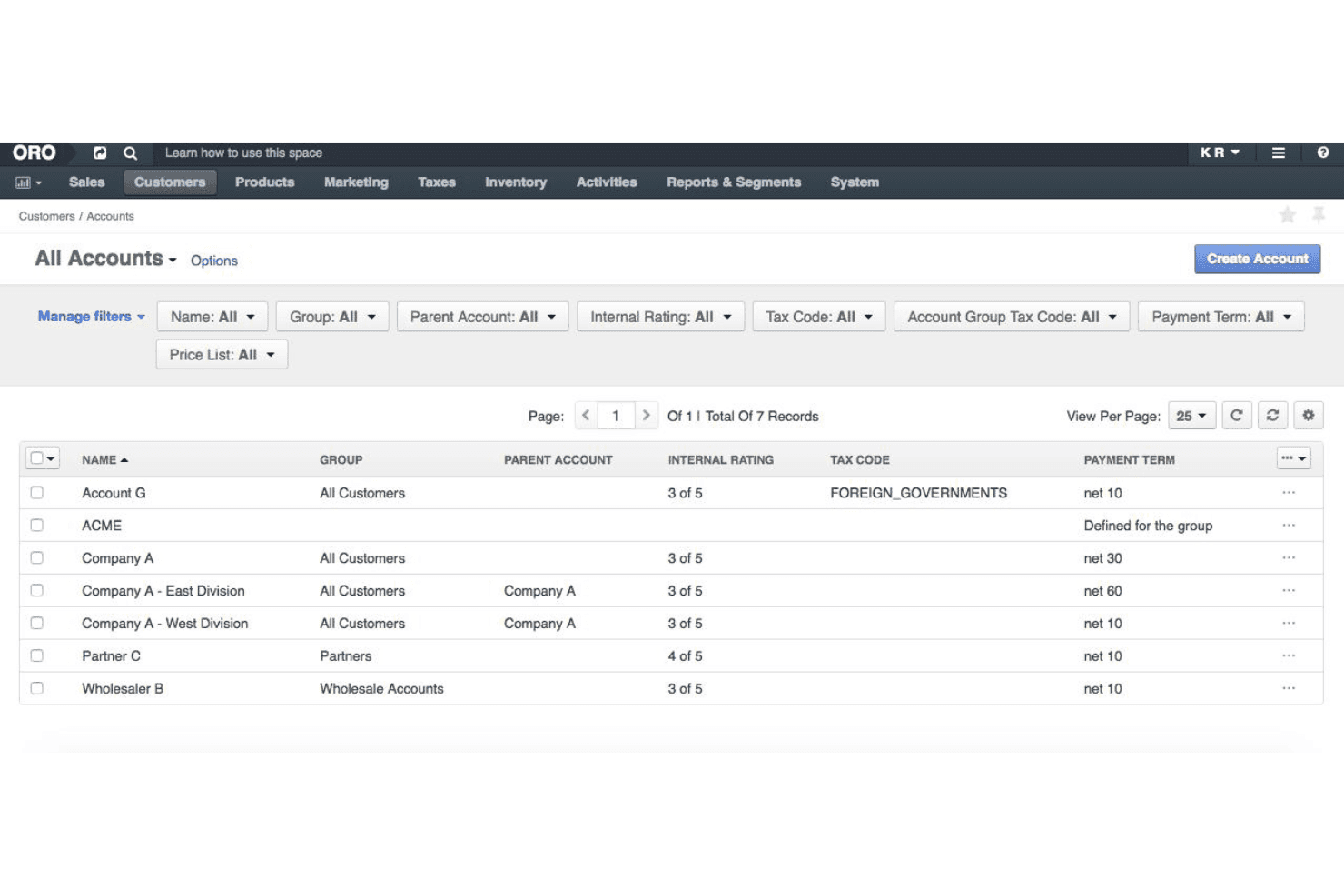
OroCommerce lets users manage and filter all customer accounts in one view. OroCommerce is a B2B ecommerce platform built specifically for manufacturers, wholesalers, and distributors, combining storefront management, RFQ and quoting workflows, CPQ, built-in CRM, PIM/DAM, and ERP integrations in a single platform.
Who Is OroCommerce Best For?
OroCommerce fits mid-market and enterprise manufacturers, wholesalers, and distributors that need native B2B workflows—like RFQ, tiered pricing, and account hierarchies—without adapting a B2C platform to fit.
Why I Picked OroCommerce
OroCommerce earns its spot on my shortlist because it's the only platform I've found that was built from scratch for B2B commerce rather than adapted from a B2C foundation. I'm particularly impressed by its native RFQ and multi-round negotiation workflows, which let manufacturers handle complex quoting without custom development. Its CPQ layer generates real-time pricing during quoting based on configured product logic, which is exactly what made-to-order manufacturers need.
OroCommerce Key Features
- Account hierarchy management: Buyers can create and manage sub-accounts, assign purchasing roles to team members, and set spend approval rules directly within their portal.
- Multi-organization storefronts: Run multiple brands, business units, and buyer portals from a single backend instance under one license with no per-site fees.
- Punchout catalog integration: Connects with enterprise procurement systems like SAP Ariba and Coupa, letting buyers shop within their own eProcurement tools while transacting through OroCommerce.
- Visual workflow builder: A low-code tool for configuring approval chains, onboarding steps, and checkout logic without custom development.
OroCommerce Integrations
OroCommerce offers integrations with SAP Business One, Epicor Prophet 21, NetSuite, Microsoft Dynamics, JD Edwards, Infor, Akeneo, ContentServ, SAP Ariba, and Coupa. REST APIs and message queues support custom ERP, PIM, WMS, and 3PL integrations.
Pros and Cons
Pros:
- Native RFQ, CPQ, and quoting workflows
- Handles complex account hierarchy management natively
- Built for B2B manufacturers from scratch
Cons:
- Six-month implementations are common for enterprises
- Requires technical teams for setup and updates
Learn more about OroCommerce: Best for Customizable Website Building
- 14-day free trial
- From $35/month
Visit WebsiteCustomer Rating:3.5/5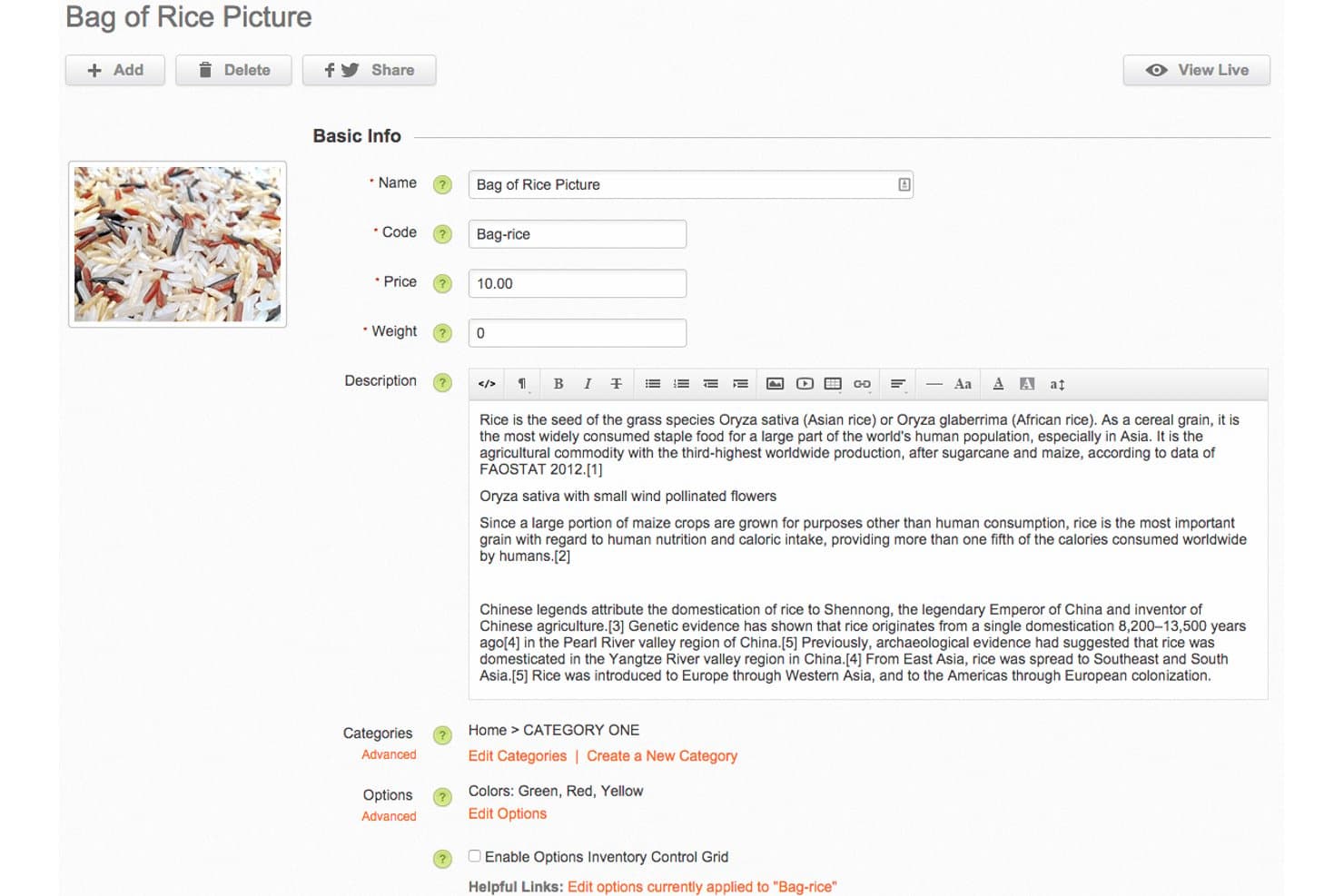
Volusion lets users add detailed product info, pricing, and options. Volusion is an SMB-focused ecommerce platform that offers storefront building, inventory management, customer group pricing, and order management for businesses selling products online.
Who Is Volusion Best For?
Volusion suits small D2C manufacturers looking for an approachable, customizable storefront without the complexity of enterprise ecommerce platforms.
Why I Picked Volusion
I picked Volusion as one of the best because its module-based Site Designer gives small D2C manufacturers real control over how their storefront looks and functions, without needing a developer. I like that you can customize themes with HTML and CSS, add homepage slideshows, image galleries, and content blocks, and configure category pages with subcategories built for product-focused browsing. The Premium Checkout add-on also lets you capture custom shopper requests at checkout, which works well for made-to-order or configurable product setups.
Volusion Key Features
- Customer group pricing: Supports up to five configurable pricing levels, letting you offer differentiated pricing for wholesale buyers or specific customer segments.
- Multi-warehouse inventory management: Assigns products to specific warehouse locations and calculates shipping rates based on the fulfillment origin.
- Automatic reorder alerts: Triggers stock replenishment notifications and auto-generates purchase orders when inventory drops below set thresholds.
- Recurring pricing tool: Configures subscription or recurring billing for products, useful for manufacturers selling consumable or replenishable goods.
Volusion Integrations
Volusion offers about 84 marketplace apps, including Avalara AvaTax, ShipStation, and Shippo; QuickBooks connectivity is available through Webgility. Its XML API, limited to Business and Prime plans, supports custom integrations, and Zapier is available.
Pros and Cons
Pros:
- Customer group pricing with five pricing tiers
- Built-in inventory and multi-warehouse tools
- No transaction fees on any sales
Cons:
- Cannot run separate B2B and D2C stores
- No RFQ or quote management system
Learn more about Volusion: Best for composable commerce flexibility
- Free trial available
- From $49,500/year (billed annually)

Elastic Path lets users organize products using hierarchies and nodes. Elastic Path is a composable, API-first ecommerce platform built for manufacturers and B2B sellers, offering modular tools for complex catalog management, account-based pricing, self-service buyer portals, and multi-channel selling across B2B and D2C storefronts.
Who Is Elastic Path Best For?
Elastic Path is a strong fit for mid-market to enterprise manufacturers and distributors that need a fully composable, API-first commerce platform to handle complex B2B catalogs, account-based pricing, and multi-channel selling across both wholesale and D2C storefronts.
Why I Picked Elastic Path
Elastic Path earns its spot on my shortlist because its composable architecture lets manufacturers swap, extend, or replace individual commerce components without rebuilding the entire stack. I particularly like the Product Experience Manager, which handles unlimited SKUs, variants, configurable options, and customer-specific catalogs in one place, eliminating the need for a separate PIM. Its account hierarchy system, with role-based buyer access and spend-threshold approvals, maps directly to how real wholesale procurement teams actually operate.
Elastic Path Key Features
- PunchOut gateway: Connects your storefront directly to enterprise eProcurement systems like SAP Ariba and Coupa via cXML PunchOut workflows.
- Unlimited price books: Supports multiple simultaneous price books tied to customers, volume thresholds, time periods, or geography for flexible pricing control.
- Composer iPaaS: A built-in integration platform with 100+ connectors and 3,000+ actions for linking ERPs, OMS, CRM, and fulfillment systems.
- Self-service buyer portal: Buyers can manage accounts, submit quick-order CSV uploads, access invoices, and route approvals through spend-threshold workflows.
Elastic Path Integrations
Elastic Path Composer offers 100+ connectors, including SAP, Oracle NetSuite, Microsoft Dynamics 365, Epicor, Stripe, PayPal, and TradeCentric for SAP Ariba and Coupa PunchOut. Its API-first architecture supports custom ERP, inventory, and manufacturing system integrations.
Pros and Cons
Pros:
- PunchOut gateway supports enterprise procurement integration
- Unlimited customer-specific catalogs and price books
- Built-in account hierarchies for B2B selling
Cons:
- Lacks native multi-round RFQ negotiation
- Requires in-house developers for customizations
Learn more about Elastic Path:
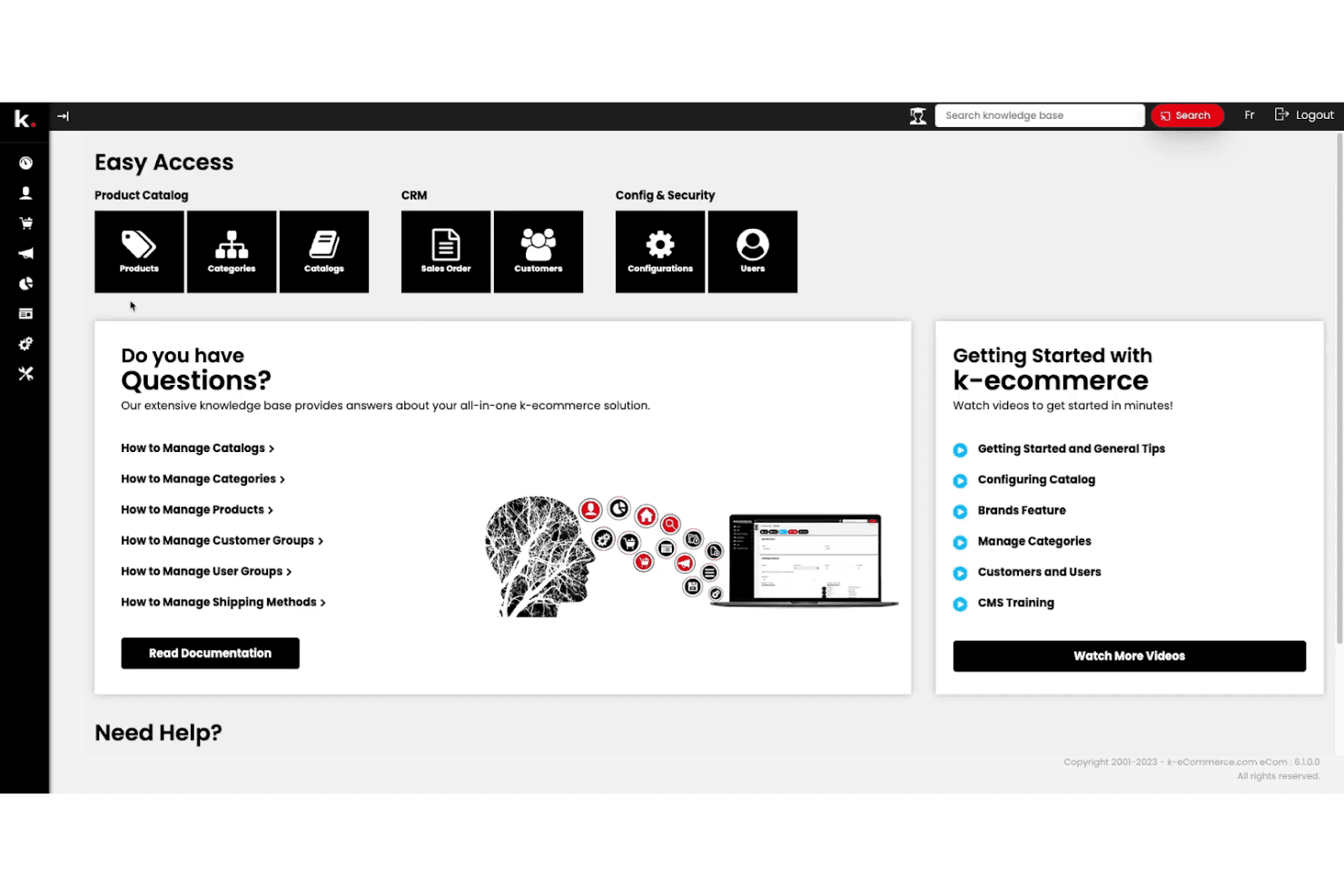
K-eCommerce houses catalog, CRM, and configuration functions for B2B operations. K-eCommerce is a B2B ecommerce platform built specifically for manufacturers and distributors, offering native ERP integration, customer-specific catalog and pricing management, self-service buyer portals, and a dedicated sales rep ordering interface.
Who Is K-eCommerce Best For?
K-eCommerce is the right fit for manufacturers and distributors running Microsoft Dynamics, Acumatica, or SAP Business One who need a B2B storefront that pulls pricing and inventory directly from their ERP.
Why I Picked K-eCommerce
K-eCommerce earns its spot on my shortlist because its ERP integration isn't bolted on—it's the foundation the entire platform is built around. I'm particularly impressed by how it syncs customer-specific contract pricing and real-time inventory directly from Microsoft Dynamics, Acumatica, or SAP Business One, with no middleware in the way. The Sales Rep Portal also stands out to me: reps can pull up a buyer's ERP-accurate pricing and place orders on their behalf without leaving the platform.
K-eCommerce Key Features
- Model Match search: Filters products by make, model, and year so buyers in parts-heavy industries can locate the right SKU without manual catalog browsing.
- Bulk CSV/Excel order upload: Buyers can import large order lists directly into the storefront instead of adding items one by one.
- Punchout catalog integration: Connects your storefront to enterprise procurement systems like Ariba and Coupa via cXML so large buyers can purchase without leaving their own procurement workflow.
- KIP integrated payments: A PCI Level 1 certified B2B payment portal that lets buyers pay multiple invoices simultaneously, with automatic ERP reconciliation on each transaction.
K-eCommerce Integrations
K-eCommerce offers seven native ERP integrations, including Microsoft Dynamics, Acumatica, and SAP Business One, plus Avalara AvaTax and Thomson Reuters Onesource. It also supports Amazon, eBay, and paid cXML Punchout integrations with Ariba and Coupa.
Pros and Cons
Pros:
- Dedicated B2B buyer and sales rep portals
- Handles 100,000+ SKU complex catalogs
- Native ERP integration with no middleware
Cons:
- No headless commerce or API-first option
- Limited ERP compatibility beyond Dynamics and SAP B1
Learn more about K-eCommerce:
Other Ecommerce Platforms for Manufacturers
Here are some additional payroll software options that didn’t make it onto my shortlist, but are still worth checking out:
- 11Sana CommerceBest for ERP integration
- 12WooCommerceBest for WordPress integration
- 13IntershopBest for comprehensive B2B solutions
- 14MRPeasyBest for small manufacturers
- 15KatanaBest for visual production planning
- 16OdooBest for ERP and CRM integration
- 17NetSuite SuiteCommerceBest for large enterprises
- 18commercetoolsBest for headless commerce architecture
- 19BigCommerceBest for scalability and integrations
- 20VirtinaBest for custom ecommerce solutions
Related Reviews
How I Evaluate Ecommerce Platforms for Manufacturers
I split my evaluation into two layers: the baseline B2B capabilities a platform needs—like ERP integration and tiered pricing—and the differentiators that make one a better fit for manufacturers.
Core Functionality (Table Stakes For This List)
When I'm selecting tools for my list, I rank each one on a scale from 0 (does not offer the functionality) to 5 (excels in this area) for each core functionality listed below. Then, I calculate the tool's total score into a percentage. Each tool needs to achieve a minimum total score of 65% to be considered for inclusion.
- B2B Commerce Capabilities: I check whether a platform supports customer-specific pricing, net terms, and account hierarchies—the kind of buying experience wholesale distributors and procurement teams expect.
- ERP & Manufacturing Integration: Real-time sync with systems like SAP, NetSuite, or Epicor matters here, so I evaluate prebuilt connectors and API depth for production, inventory, and order data.
- Product Catalog Management: I look for how well each platform handles high SKU counts, configurable products, and technical specifications—things like material grades, tolerances, or custom dimensions.
- Quote & RFQ Management: Many manufacturer buyers need to negotiate pricing before placing an order, so I evaluate the in-platform quoting workflow from request through approval to order conversion.
- Multi-Channel & Hybrid Selling: Manufacturers increasingly sell B2B and D2C from one system, so I look at how each platform manages multiple storefronts, warehouses, and sales channels under a single admin.
- Self-Service Buyer Portal: Repeat purchasing drives revenue for most manufacturers, so I evaluate portal features like saved order lists, quick-reorder pads, sub-account permissions, and invoice access.
Once I have a list of tools that meet the criteria, I consider what sets each platform apart.
Differentiating Factors (What Sets Vendors Apart)
Here's how I compare and contrast different vendors:
Standout Features
Punchout and EDI support is a major differentiator—manufacturers selling to enterprise buyers often need cXML or OCI connections to procurement systems like Ariba or Coupa. I also evaluate whether a platform includes an advanced product configurator that lets buyers customize products with rule-based compatibility checks and live pricing. For manufacturers who sell through channel partners, dedicated dealer portals with co-branded storefronts and territory-based pricing can shape the entire buying experience.
Beyond Features
The integration ecosystem matters a lot here—I check whether a platform connects natively to the ERP, PIM, and WMS tools a manufacturer already relies on, since rip-and-replace isn't realistic. Implementation timelines vary wildly in this category, so I evaluate whether vendors offer migration tooling and certified partners with manufacturing experience. I also consider deployment flexibility, especially for manufacturers who need multi-region support with local tax compliance and multi-currency checkout.
How to Choose an Ecommerce Platform for Manufacturers
It’s easy to get bogged down in long feature lists and complex pricing structures. To help you stay focused as you work through your unique software selection process, here’s a checklist of factors to keep in mind:
| Factor | What to Consider |
| Scalability | Will the platform grow with your business needs? |
| Integrations | Does it smoothly connect with your current systems? |
| Customizability | Can it be tailored to match your specific workflows? |
| Ease of Use | Will your team find it intuitive to manage? |
| Budget | Does the platform fit within your financial plans? |
| Security Safeguards | Are there security measures to protect your data? |
| Support | Does it offer reliable customer support when needed? |
| Mobile Compatibility | Can you manage the platform from mobile devices? |
Use this checklist to keep your software selection process organized and focused.
Trends in Ecommerce Platforms for Manufacturers
In my research, I sourced countless product updates, press releases, and release logs from different ecommerce platform vendors. Here are some of the emerging trends I’m keeping an eye on for manufacturing companies to consider:
- Headless commerce: More platforms are offering headless setups, allowing manufacturers to decouple the front and back end. This gives businesses more flexibility to create custom user experiences without being tied to a specific frontend system.
- AI-driven personalization: Manufacturers are increasingly using AI optimization to personalize the shopping experience for their customers. Platforms are incorporating AI to recommend products, optimize search results, and tailor pricing, making interactions more relevant.
- B2B customer portals: Vendors are focusing on advanced customer portals designed specifically for B2B buyers. These portals allow manufacturers to offer personalized pricing, order histories, and tailored catalogs to make purchasing smoother for repeat customers.
- Self-service tools: There's a growing demand for self-service features that allow B2B buyers to manage their accounts, track orders, and configure products independently. Platforms are adding these tools to reduce the burden on sales teams while empowering customers.
- Sustainability and traceability: More manufacturers are prioritizing sustainability in their supply chain, and ecommerce platforms are responding by offering features that track product origins and sustainability metrics. These tools help manufacturers meet consumer demands for transparency.
What is an Ecommerce Platform for Manufacturers?
An ecommerce platform for manufacturers is a digital tool that helps manufacturers sell their products online, manage orders, and handle B2B transactions. These tools are typically used by sales teams, supply chain managers, and ecommerce specialists to simplify operations and improve customer experiences. Inventory management, customer portals, and personalized pricing help streamline processes and improve efficiency. Overall, these platforms make it easier for manufacturers to manage large product catalogs and serve B2B clients effectively. Specialized sectors like automotive benefit from dedicated auto parts ecommerce platforms that understand industry-specific requirements.
Features of Ecommerce Platforms for Manufacturers
When choosing an ecommerce platform for manufacturers, it's crucial to consider features that cater specifically to the unique needs of the manufacturing industry. Below are some of the most important features that can help give your online business a competitive advantage:
- Inventory Management: Efficiently tracks stock levels and manages inventory to prevent overstocking or stockouts.
- Order Management: Streamlines the order processing workflow from order placement to delivery, ensuring timely fulfillment.
- B2B Functionality: Supports bulk ordering, custom pricing, and account management tailored for business clients.
- Product Customization: Allows customers to customize products according to their specifications, enhancing customer satisfaction.
- Integration Capabilities: Integrates with existing ERP, CRM, and other business systems to ensure data consistency.
- Advanced Analytics: Provides detailed insights into sales, customer behavior, and market trends to inform business decisions.
- Mobile Compatibility: Ensures the platform is accessible and functional on mobile devices, catering to on-the-go users.
- Security Features: Implements robust security measures to protect sensitive data and transactions.
- Scalability: Supports business growth by accommodating increasing product lines, customer bases, and order volumes.
- Customer Support: Offers reliable support to address any issues or questions, ensuring smooth operation.
By streamlining complex tasks like inventory and order management, these trends will alleviate common pain points manufacturers face, such as stock issues and slow fulfillment. With tailored B2B features, fluid integrations, and strong security, businesses can operate more efficiently while confidently scaling their business model for future growth.
Benefits of Ecommerce Platforms for Manufacturers
When selecting an ecommerce platform for a manufacturing business, keep an eye out for the following key features:
- Customizable product catalogs: Allows manufacturers to create detailed catalogs and product information tailored to specific customers or industries.
- Real-time inventory tracking: Helps manage stock levels and avoid overselling by updating inventory in real-time.
- ERP integration: Syncs the platform with existing enterprise resource planning systems for smoother data and process management.
- B2B-specific pricing options: Provides flexible pricing structures, such as volume discounts or customer-specific pricing, to meet complex B2B ecommerce platform needs.
- Self-service customer portals: Enables new customers to save their payment information and existing or previous customers to manage their orders, view order history, and reorder purchases independently.
- Multi-channel sales support: Allows manufacturers to sell through multiple channels like their ecommerce website, marketplaces, and social media platforms from one system.
- Advanced reporting and analytics: Offers insights into sales, customer behavior, and product performance to help drive informed decisions.
- Order management tools: Streamlines the process of receiving, processing, and fulfilling orders efficiently across different channels.
Costs and Pricing of Ecommerce Platforms for Manufacturers
Selecting payroll software requires an understanding of the various pricing models and plans available. Costs vary based on features, team size, add-ons, and more. The table below summarizes common plans, their average prices, and typical features included in these software solutions:
Plan Comparison Table for Ecommerce Platforms for Manufacturers
| Plan Type | Average Price | Common Features |
| Free Plan | $0 | Basic website setup, limited product listings, basic support |
| Personal Plan | $30 - $50/month | Custom domain, basic analytics, limited customization, email support |
| Business Plan | $100 - $300/month | Advanced analytics, multiple payment gateways, marketing tools, 24/7 support |
| Enterprise Plan | $500 - $2,000+/month | Custom integrations, dedicated account manager, advanced security features, SLA |
A breakdown of ecommerce platforms for manufacturers plan types and their costs and features.
Ecommerce Platforms For Manufacturers FAQs
Here are some answers to common questions about ecommerce platforms for manufacturers:
How does an ecommerce platform integrate with my existing ERP system?
Most ecommerce platforms for manufacturers offer direct integrations with popular ERP systems. This integration helps sync your inventory, orders, and customer data between systems in real time. It ensures our team can avoid manual data entry, reducing errors and saving time. You’ll want to make sure your chosen platform supports the ERP you’re already using.
Can an ecommerce platform handle complex B2B pricing?
Yes, many ecommerce platforms for manufacturers are designed to manage complex B2B pricing structures. They often allow you to create tiered pricing, customer-specific discounts, and volume-based rates. This flexibility ensures your platform can cater to different client types, from small businesses to large enterprises, without needing manual adjustments.
How customizable are ecommerce platforms for manufacturers?
Most platforms offer high levels of customization, allowing you to tailor your online store to your business needs. You can usually adjust the layout, product catalogs, and user experience. Additionally, many platforms provide access to APIs and plugins that enable deeper customizations. Your team can adapt the platform to your specific workflows, branding, and product lines.
What kind of support is available for setting up an ecommerce platform?
Many ecommerce platforms offer comprehensive onboarding support, including training videos, documentation, and customer success managers. Some even provide implementation specialists to help guide your team through the setup process. You’ll want to choose a platform that aligns with your team’s technical skill level and offers sufficient support for your setup needs.
Can I use an ecommerce platform to manage multiple storefronts?
Yes, many ecommerce platforms for manufacturers allow you to manage multiple storefronts from a single backend. This feature is especially useful for businesses operating in multiple regions or serving different customer segments. You can centralize inventory, orders, and customer data while maintaining separate online stores for each brand or market.
How do ecommerce platforms help with order management?
ecommerce platforms for manufacturers typically include tools to streamline order processing, fulfillment, and tracking. These tools can automate tasks like updating inventory levels, generating shipping labels, and notifying customers about order status. By using these features, your team can manage large volumes of orders more efficiently and reduce errors.