

Package tracking should feel like magic: the order’s out, the customer’s informed, and your team isn’t stuck refreshing 10 different carrier sites.
But let’s be real—between missed scans, vague updates, and a million “Where’s my order?” emails, that’s not usually the case.
If you're managing ecommerce logistics, customer service, or internal deliveries, you know how quickly things can spiral.
Package tracking software cuts through the chaos by consolidating data, automating notifications, and giving everyone—from your ops team to your customers—real visibility into what’s happening.
We’ve reviewed dozens of these platforms and narrowed it down to the 19 best options on the market. Whether you need multi-carrier tracking, branded updates, or internal mailroom support, you’ll find a tool here to match your workflow—and your budget.
Why Trust Our Software Recommendations
6,700+
Reviews
20
Industry experts
16+
Evaluation factors
14
Years
Our team has been testing and reviewing software since 2012. As retail leaders ourselves, we know how difficult—and important—it is to choose the right software.
For this guide, we evaluated tools using hands-on testing and independent research, scoring tools using our selection criteria.
Our reviews reflect our independent judgment—not a sales pitch.
Package Tracking Software Comparison Table
This comparison table summarizes pricing details for my top package tracking software selections:
| Tool | Best For | Trial Info | Price | ||
|---|---|---|---|---|---|
| 1 | Best for customer engagement | Free demo available | Pricing available upon request | Website | |
| 2 | Best for field service teams | 14-day free trial | From $0.15 per order | Website | |
| 3 | Best for tracking automation | 7-day free trial | From $29/month | Website | |
| 4 | Best for retail brands | Free demo available | Pricing upon request | Website | |
| 5 | Best for package protection | Free demo available | From $349/month | Website | |
| 6 | Best for small businesses | 30-day free trial | From $19/month | Website | |
| 7 | Best for multi-carrier support | 7-day free trial and free plan available | From $11/month | Website | |
| 8 | Best for delivery insights | Free plan available; 30-day free trial | From $0.07/month | Website | |
| 9 | Best for real-time tracking | Free demo available | Pricing upon request | Website | |
| 10 | Best for internal mailrooms | Free trial available | From $1,295 (one-time) or from $99/month | Website |


The Best Package Tracking Software for Savvy Retailers, Reviewed
Now, let’s get into the weeds with some reviews that offer a detailed look at the key features, pros & cons, integrations, and ideal use cases of each tool to help you find the best one for you.
 Best for customer engagement
- Free demo available
- Pricing available upon request
Visit WebsiteCustomer Rating:4.7/5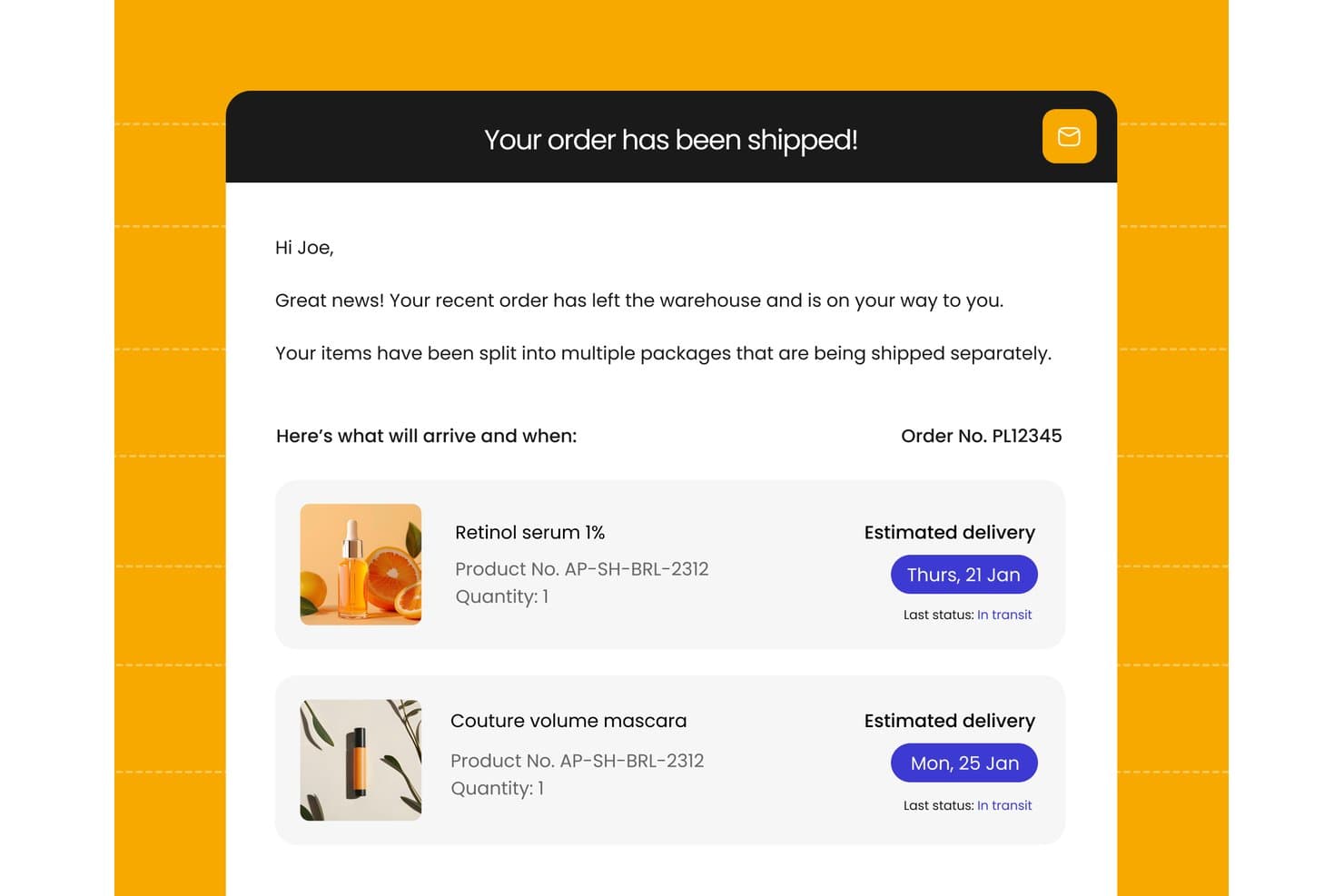
parcelLab sends shipment notifications with per-item delivery dates. parcelLab is a post-purchase experience platform that combines multi-carrier tracking across 550+ carriers, branded order status pages, automated omnichannel notifications, returns management, and AI-powered delivery analytics.
Who Is parcelLab Best For?
parcelLab is built for enterprise retailers and ecommerce brands that want to turn the post-purchase experience into a customer retention and revenue channel.
Why I Picked parcelLab
parcelLab earns its spot on my shortlist because no other platform turns the post-purchase tracking experience into an active revenue channel the way it does. I love how branded tracking pages embed personalized product recommendations and promotional content directly where customers are already paying attention, with users reporting 29% higher revenue per email. The Trending Late AI also stands out to me: it flags at-risk shipments before delays become visible to customers, so you're sending proactive updates rather than fielding complaints.
parcelLab Key Features
- Multi-channel automated notifications: Sends branded post-purchase updates across email, SMS, WhatsApp, Messenger, Line, and push notifications using 50+ configurable event triggers.
- Carrier Performance Benchmarking: Scores carriers on a 1–5 scale across on-time rate, exception rate, and dispatch punctuality, benchmarked against 21 industry verticals.
- Self-service returns portal: Gives customers a white-labeled, brand-domain-hosted portal to initiate returns, select return methods, and track reverse shipment status.
- parcelLab Copilot: An in-app AI assistant that answers analytics queries and surfaces optimization recommendations directly within the platform dashboard.
parcelLab Integrations
parcelLab offers a native Shopify app plus marketplace integrations with Salesforce Commerce Cloud and Salesforce Service Cloud, along with Zendesk, Gorgias, Klaviyo, and Postscript integrations. Its REST API, webhooks, and CSV/SFTP options support custom connections.
Pros and Cons
Pros:
- Detailed carrier benchmarking for performance insights
- AI predicts delivery delays before they happen
- Customizable branded tracking pages boost revenue
Cons:
- No support for inbound supply shipments
- Only available for enterprise-scale businesses
Learn more about parcelLab:
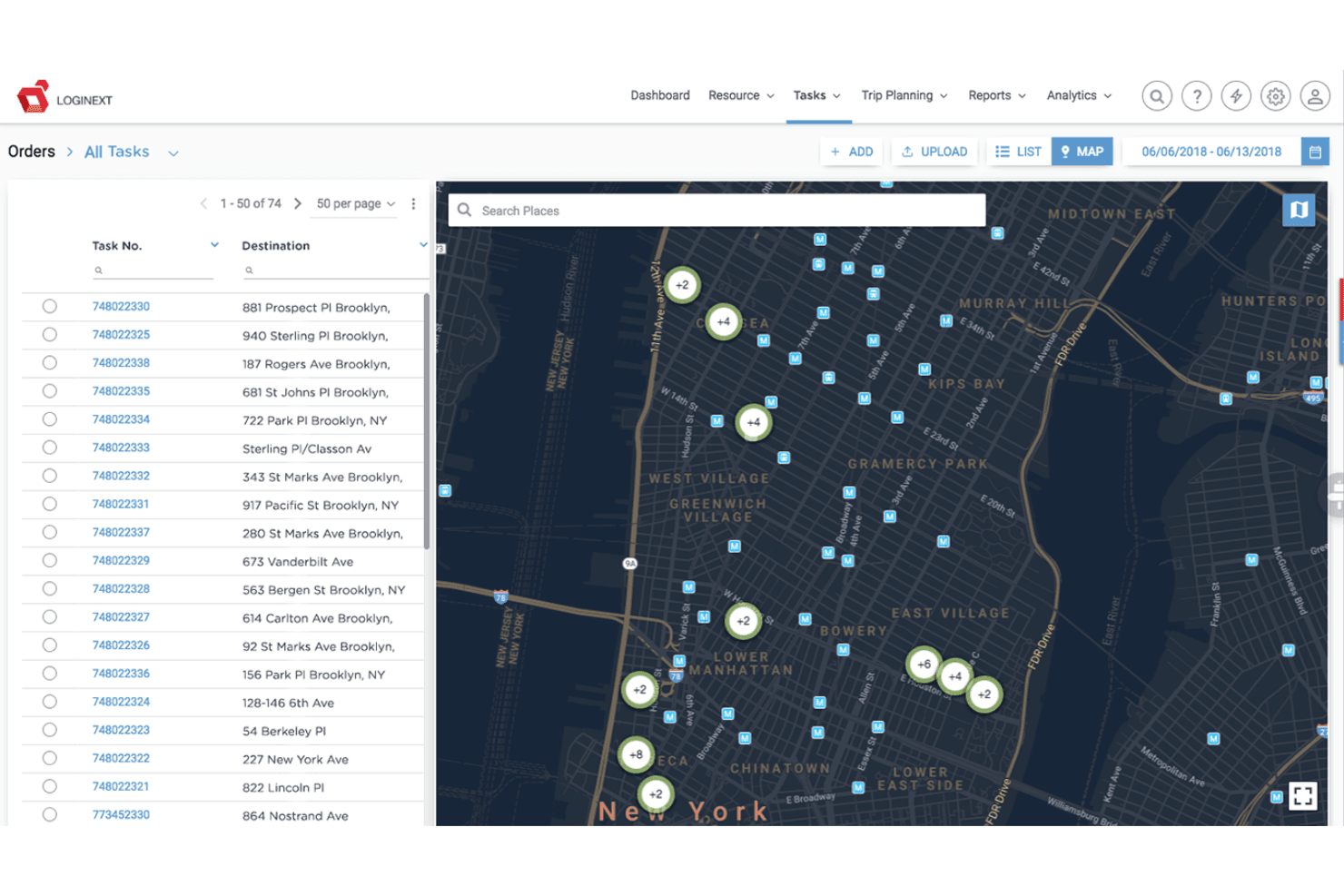
LogiNext Mile maps and lists package delivery tasks across NYC. LogiNext Mile is a last-mile delivery tracking platform that connects 500+ carriers in a unified control tower, with AI-powered predictive ETAs, multi-channel customer notifications, and automated exception management across the full shipment lifecycle.
Who Is LogiNext Mile Best For?
LogiNext Mile is a strong fit for enterprise operations teams managing high-volume, multi-carrier last-mile delivery across distributed field networks.
Why I Picked LogiNext Mile
LogiNext Mile earns its spot on my shortlist because of how it handles delivery exceptions across distributed field networks. I especially like its AI-native exception layer, which predicts SLA breaches before they happen and automatically triggers re-routing or escalations, cutting carrier follow-ups by 60%+. Pair that with predictive ETAs calculated from live traffic, weather, and route history, and field service teams get ahead of delays instead of reacting to them.
LogiNext Mile Key Features
- Branded tracking pages: Customizable tracking pages let you apply your logo, brand colors, and header/footer elements, with embedded promotional images for post-purchase visibility.
- Multi-channel automated notifications: Triggers SMS, email, WhatsApp, and IVR alerts at key shipment milestones using geofence, time-based, or distance rules with Dynamic Tags for personalization.
- Carrier performance scorecards: Tracks SLA adherence, on-time delivery rates, and historical carrier behavior to support benchmarking and carrier contract decisions.
- Delivery performance analytics dashboard: Interactive dashboards with branch and driver-level drill-downs, status distribution reports, and up to three years of historical data for trend analysis.
LogiNext Mile Integrations
LogiNext Mile integrates with Shopify, Magento, SAP, Oracle, Microsoft Dynamics, Power BI, and Okta, plus 500+ global and local carrier connectors. An open REST API and webhooks support custom integrations.
Pros and Cons
Pros:
- Branded tracking pages support post-purchase marketing
- Exception alerts automate re-routing and escalations
- Predictive ETAs based on live traffic data
Cons:
- Real-time tracking depends on strong network connectivity
- Custom reports often require vendor assistance
Learn more about LogiNext Mile:
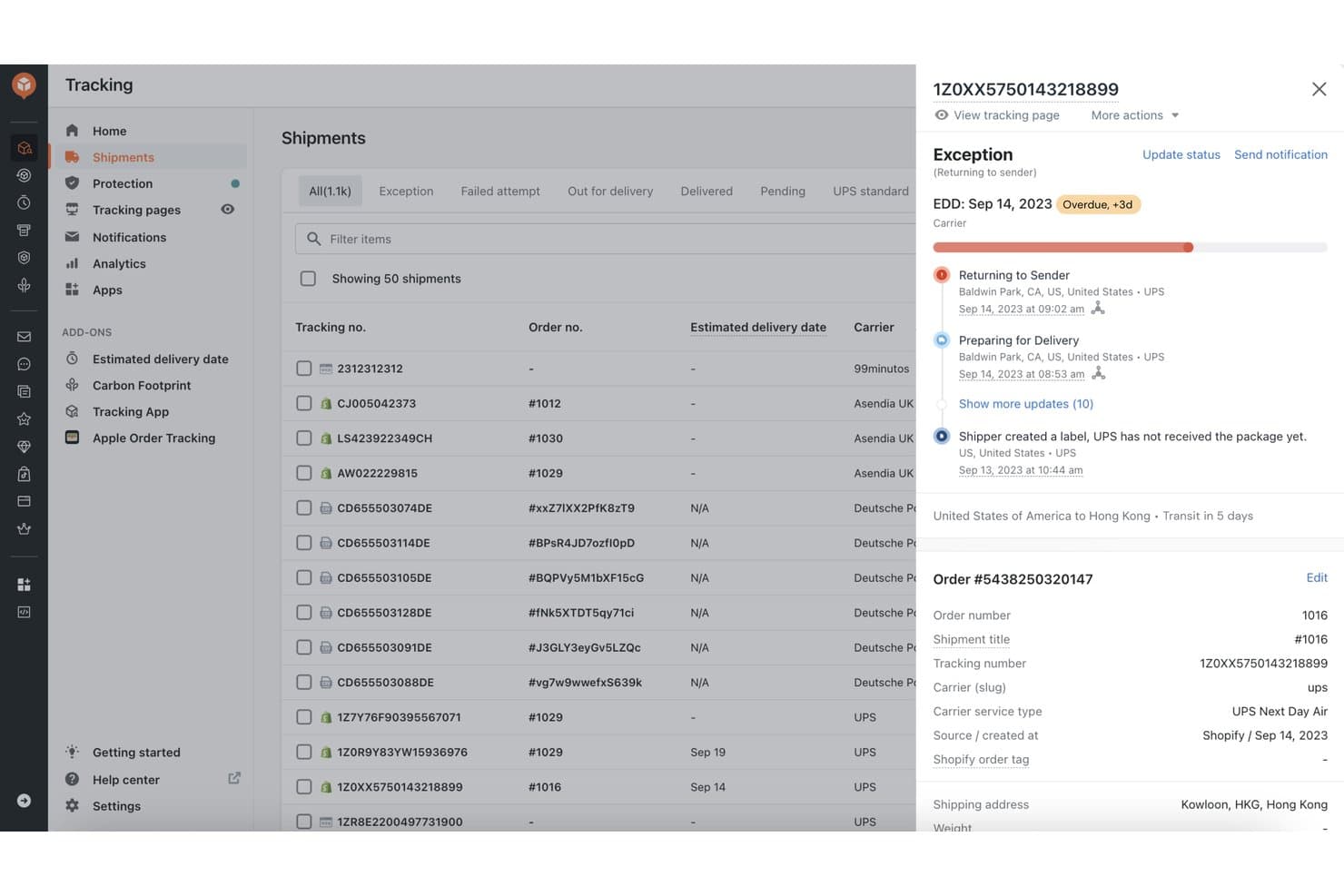
AfterShip lets users track shipment exceptions and delivery status in detail. AfterShip is a package tracking platform that unifies shipment data from 1,400+ global carriers, automates delivery notifications, and offers branded tracking pages, exception monitoring, and post-purchase analytics.
Who Is AfterShip Best For?
AfterShip is a strong fit for ecommerce and retail operations teams that manage high shipment volumes across multiple carriers and need automated tracking, exception alerts, and customer notifications working together.
Why I Picked AfterShip
AfterShip earns its spot on my shortlist because no other tool automates tracking intelligence at the same depth. I'm particularly impressed by its AI-powered carrier auto-detection, which identifies the correct carrier even when a tracking number initially mismatches, and its predictive EDD that claims 95% delivery date accuracy across 1,400+ global carriers. When an exception hits, AfterShip flags, categorizes, and routes it automatically, cutting WISMO tickets by up to 65% without manual triage.
AfterShip Key Features
- Branded tracking pages: Customer-facing tracking pages with custom CSS, domain hosting, and AfterShip branding removal on Premium and above.
- Carrier performance scorecards: On-time performance dashboards and carrier benchmarking reports that compare SLA adherence across lanes and routes.
- Split-order digest notifications: Automated email and SMS alerts that consolidate multi-parcel shipment updates into a single notification per order.
- Returns management: A built-in returns portal with exchange-first flows, 300,000+ drop-off locations, printless QR code returns, and fraud detection.
AfterShip Integrations
AfterShip offers 70+ native integrations, including Shopify, BigCommerce, Magento, WooCommerce, Salesforce Commerce Cloud, eBay, Amazon Seller, Klaviyo, Gorgias, and Zendesk. Its Tracking API and webhooks support custom OMS, WMS, ERP, TMS, and BI integrations.
Pros and Cons
Pros:
- Branded tracking pages boost repeat sales
- Centralizes tracking for over 1,400 carriers
- AI-powered delivery dates with 95% accuracy
Cons:
- Advanced features require higher plan tiers
- Pricing and add-ons structure is confusing
Learn more about AfterShip:
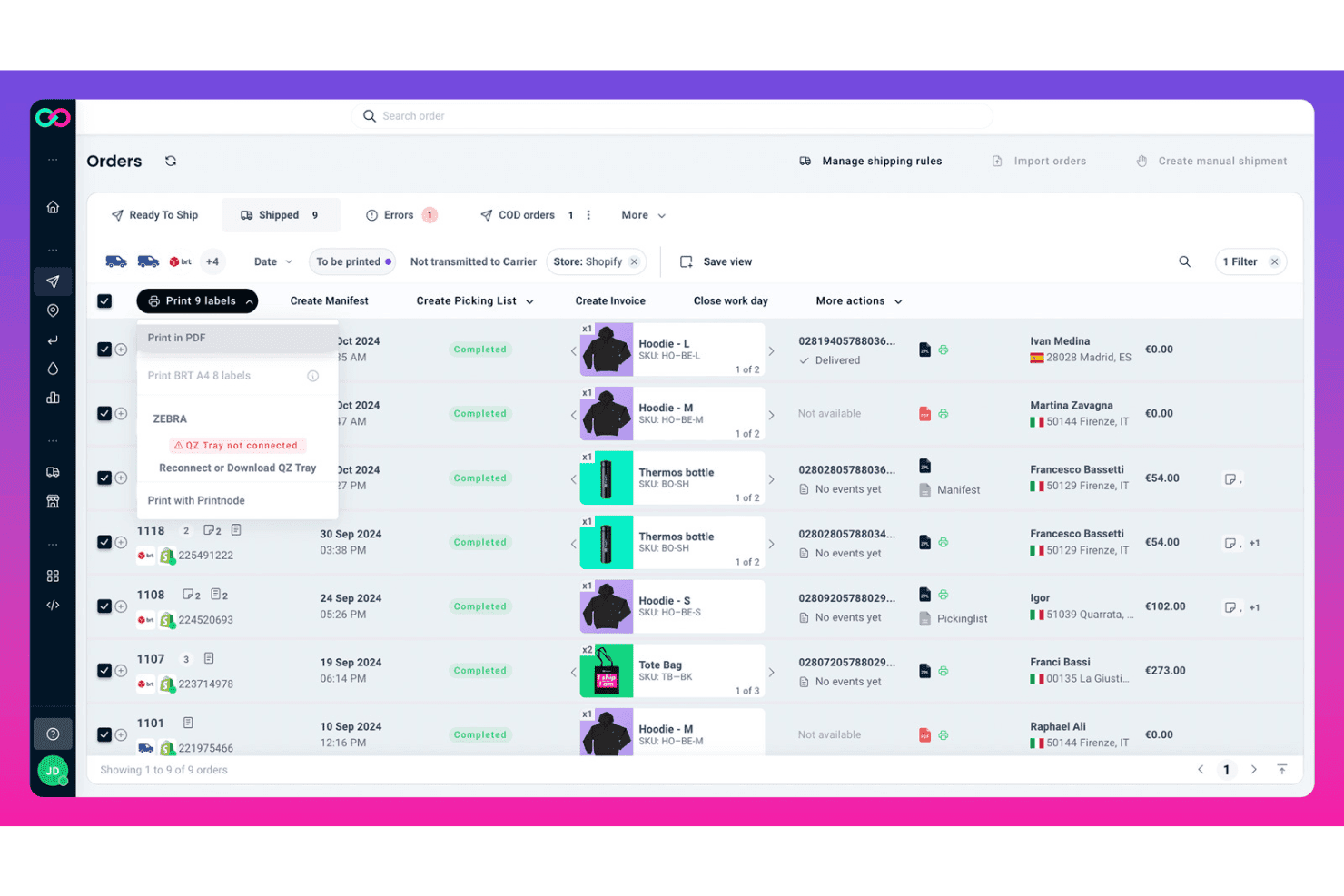
This platform manages and prints shipping labels for e-commerce orders. Narvar is a post-purchase tracking platform built for retail brands that combines multi-carrier shipment tracking, branded tracking pages, proactive customer notifications, predictive delivery ETAs, and returns management.
Who Is Narvar Best For?
Narvar is a strong fit for mid-to-large retail brands that need post-purchase tracking, branded customer experiences, and returns management in one platform.
Why I Picked Narvar
Narvar earns its spot on my shortlist because no other package tracking platform is as purpose-built for retail brands at scale. I'm particularly impressed by Narvar Promise, which uses four ML models trained on 74 billion consumer interactions to deliver 95%+ estimated delivery date accuracy across product pages, cart, and checkout. Pair that with branded tracking pages that embed live product recommendations and cross-sell modules, and post-purchase touchpoints become real revenue channels.
Narvar Key Features
- Omnichannel proactive notifications: Narvar Notify sends automated shipment updates across email, SMS, WhatsApp, Line, and push using 40+ pre-built templates.
- AI-powered exception management: IRIS™ detects delivery exceptions proactively and triggers contextual customer notifications to address delays and missed deliveries.
- Self-serve track page editor: A no-code editor lets you build fully branded tracking pages with custom logos, colors, seasonal themes, and segmentation across 40+ attributes.
- Carrier performance scorecards: The Hub Dashboard benchmarks carrier performance with delivery metrics and KPIs to support data-driven carrier decisions.
Narvar Integrations
Narvar integrates with 50+ ecommerce and OMS platforms, including Shopify, Magento, BigCommerce, Salesforce Commerce Cloud, Oracle, SAP, and Kibo. It also connects with Zendesk, Salesforce Service Cloud, Klaviyo, and Bloomreach, with an open API for custom integrations.
Pros and Cons
Pros:
- AI-powered exception alerts reduce support tickets
- Branded tracking pages enable post-purchase marketing
- Predictive delivery dates improve conversion
Cons:
- No transparent self-serve pricing available
- Long setup time and technical onboarding
Learn more about Narvar:
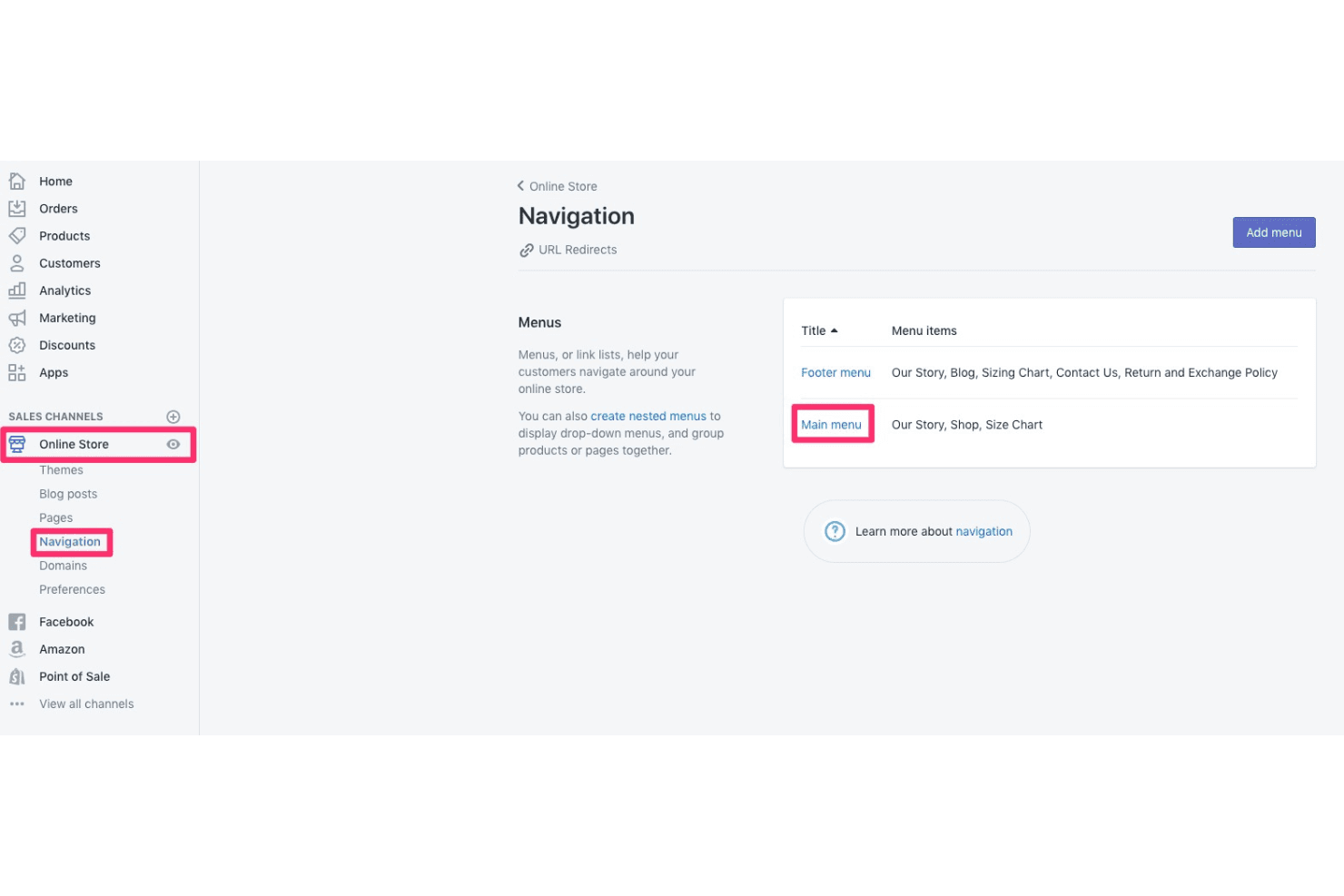
Route lets users customize store navigation menus via Shopify's Online Store settings. Route is a post-purchase platform that combines package protection, branded order tracking, multi-carrier shipment visibility, automated notifications, returns management, and post-purchase marketing in one place.
Who Is Route Best For?
Route is a strong fit for DTC ecommerce brands that want to protect orders and turn the post-purchase experience into a retention and revenue channel.
Why I Picked Route
Route earns its spot on my shortlist because no other tool I've seen turns package protection into a full post-purchase revenue channel. I particularly like its AI-powered claims engine, which resolves lost, stolen, or damaged orders in minutes without any merchant intervention. Its branded tracking pages go further than basic status updates, embedding product recommendations directly into the post-purchase window to drive repeat purchases.
Route Key Features
- Multi-channel automated notifications: Route sends order status updates via email, SMS, and push notifications, with per-event toggles and full branding controls in the Merchant Portal.
- Returns management portal: Route's self-service returns module supports QR code returns, exchange-first AI logic, automated label generation, and in-store return options.
- Cash back loyalty incentive: Shoppers who add package protection at checkout receive discounts on future purchases, built natively into the post-purchase flow.
- Shopper sentiment reporting: The Insights Report surfaces customer experience data from claims resolution, giving merchants visibility into post-purchase satisfaction trends.
Route Integrations
Route offers native integrations with Shopify, BigCommerce, WooCommerce, Salesforce Commerce Cloud, and Adobe Commerce (Magento). It also supports an open API and webhooks for custom integrations.
Pros and Cons
Pros:
- Multi-channel delivery notifications reduce WISMO tickets
- Branded tracking pages drive post-purchase sales
- AI-powered claims resolve lost packages fast
Cons:
- International package protection is not comprehensive
- Advanced analytics and reporting are limited
Learn more about Route:
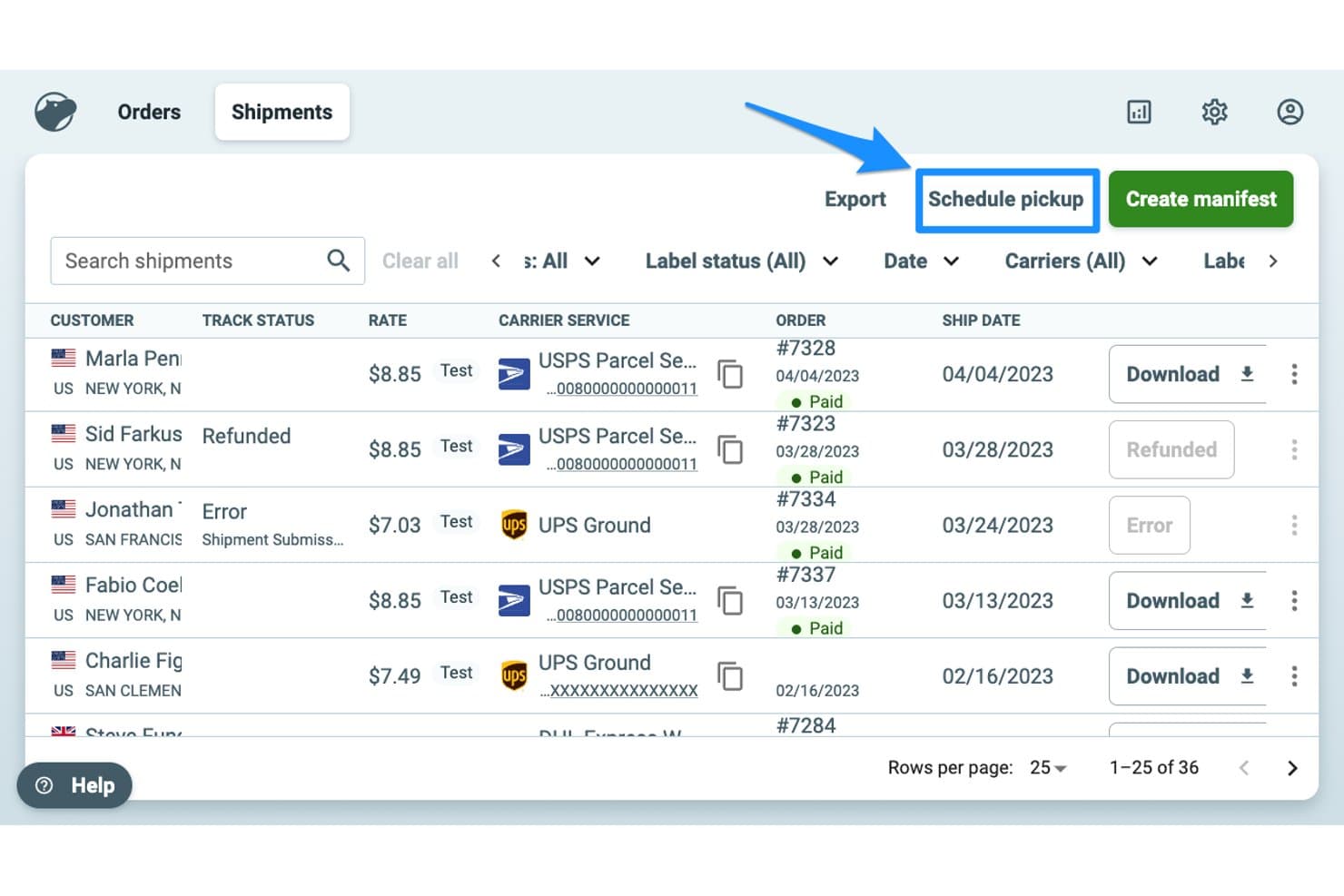
Shippo lets users schedule pickups directly from the shipments dashboard. Shippo is a multi-carrier shipping and package tracking platform that covers label creation, real-time shipment tracking across 40+ carriers, branded tracking pages, automated notifications, returns management, and AI-powered analytics via Shippo Intelligence.
Who Is Shippo Best For?
Shippo is a strong fit for small e-commerce businesses and DTC brands that need an affordable, easy-to-set-up shipping and tracking solution without enterprise complexity.
Why I Picked Shippo
Shippo earns its spot on my shortlist because it's built from the ground up for small e-commerce businesses that need real tracking capability without a steep learning curve or price tag. I particularly like Shippo Intelligence, which gives you carrier performance benchmarking, geographic delay maps, and an AI-powered weekly digest that flags cost changes and service shifts. The branded tracking pages on the Pro plan also let you embed product recommendations directly in the post-purchase experience, turning a routine delivery update into a repeat-purchase opportunity.
Shippo Key Features
- Multi-carrier tracking dashboard: Monitor shipments across 40+ carriers in a single unified interface with standardized tracking statuses.
- Scan-based returns: Generate return labels that only incur a charge once the package is physically scanned by the carrier.
- Automated email notifications: Trigger pre-built shipping and delivery emails at key milestones without any manual intervention.
- Standalone tracking: Track packages created outside of Shippo by submitting any tracking number directly through the API.
Shippo Integrations
Shippo has native integrations with Shopify, WooCommerce, BigCommerce, Magento 2, Wix, Webflow, and Square, plus marketplace integrations with Amazon, eBay, Etsy, Walmart, and TikTok Shop. Its REST API and webhooks support custom integrations.
Pros and Cons
Pros:
- Branded tracking pages feature product recommendations
- Scan-based return labels reduce shipping costs
- Batch label creation for high-volume shipping
Cons:
- No dedicated exception management workflow module
- Automated notifications limited to email channel
Learn more about Shippo: Best for multi-carrier support
- 7-day free trial and free plan available
- From $11/month
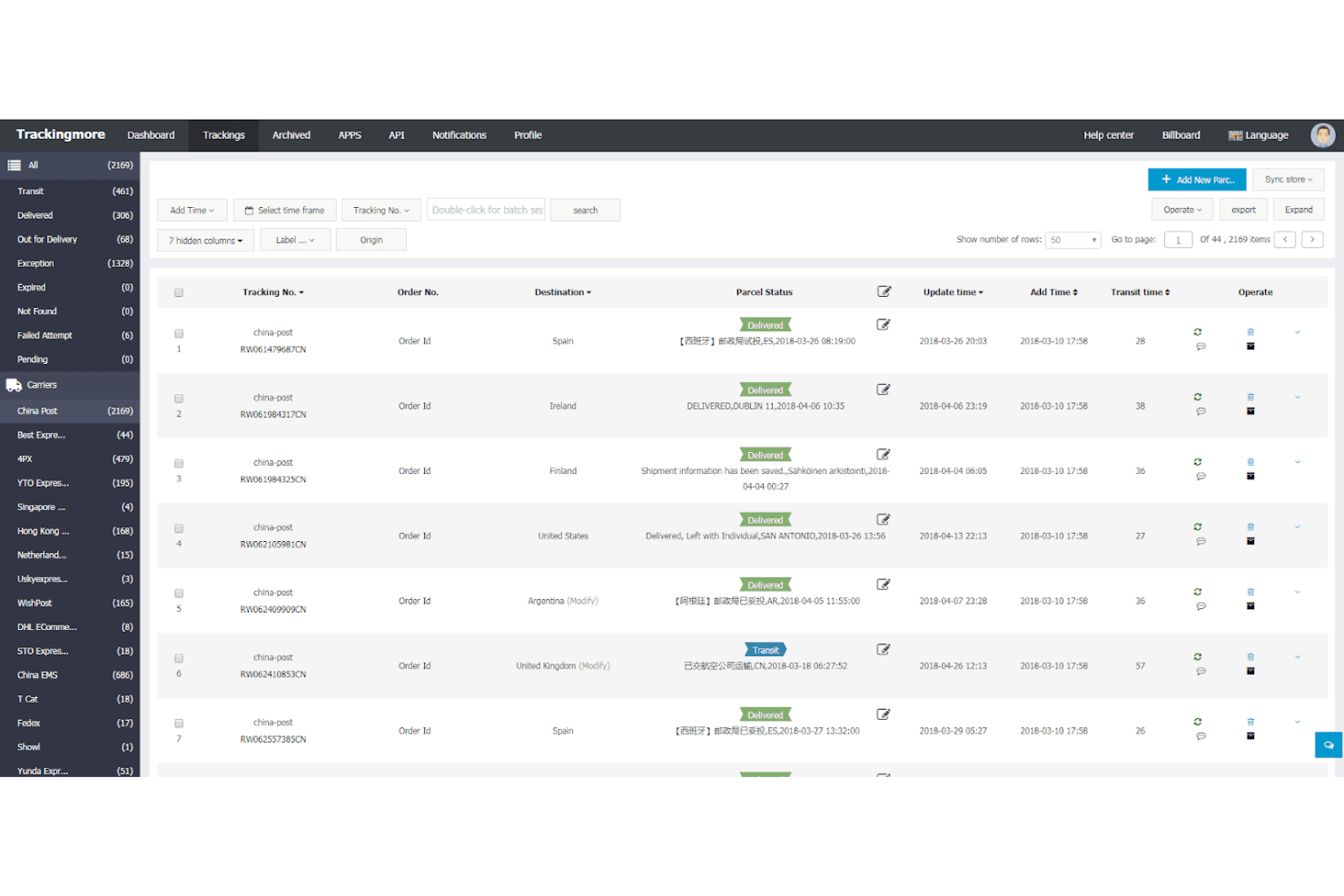
TrackingMore displays all shipments with real-time parcel statuses in one dashboard. TrackingMore is a package tracking platform that consolidates shipment data across 1,600+ global carriers and airlines into a single dashboard, with tools for branded tracking pages, automated notifications, and carrier performance analytics.
Who Is TrackingMore Best For?
TrackingMore is a strong fit for ecommerce teams managing shipments across a large mix of carriers, particularly those scaling into international markets.
Why I Picked TrackingMore
TrackingMore earns its spot on my shortlist because no other tool in this category comes close to its carrier breadth: 1,600+ global carriers and 110+ airlines unified under one dashboard. I love that its AI-powered auto-detection identifies the correct carrier from a tracking number alone, hitting 97% accuracy across 300M+ shipment records. When a shipment stalls, the carrier performance scorecards on Pro plans let me benchmark exception rates and transit times by carrier to make smarter routing decisions.
TrackingMore Key Features
- Branded tracking page editor: A drag-and-drop editor lets you build custom tracking pages with your logo, colors, product recommendations, discount codes, and embedded order lookup widgets.
- Klaviyo integration: Connects shipment status milestones directly to Klaviyo email flows, letting you trigger marketing sequences based on delivery events.
- Delivery feedback collection: A built-in post-delivery survey captures customer satisfaction data directly on the tracking page after a shipment is confirmed delivered.
- Carrier performance benchmarking: Pro plans include transit time analysis and exception rate comparisons across carriers to help you evaluate which partners are meeting delivery SLAs.
TrackingMore Integrations
TrackingMore offers integrations with Shopify, WooCommerce, Magento, Amazon, eBay, Klaviyo, and Google Analytics 4 (GA4). Its RESTful API, webhooks, SDKs, and Postman collections support custom connections.
Pros and Cons
Pros:
- Branded tracking pages drive post-purchase revenue
- AI-powered auto-carrier detection minimizes tracking errors
- Covers 1,600+ global carriers in one dashboard
Cons:
- Real-time updates lag with some major carriers
- Lacks built-in exception resolution workflows
Learn more about TrackingMore: Best for delivery insights
- Free plan available; 30-day free trial
- From $0.07/month
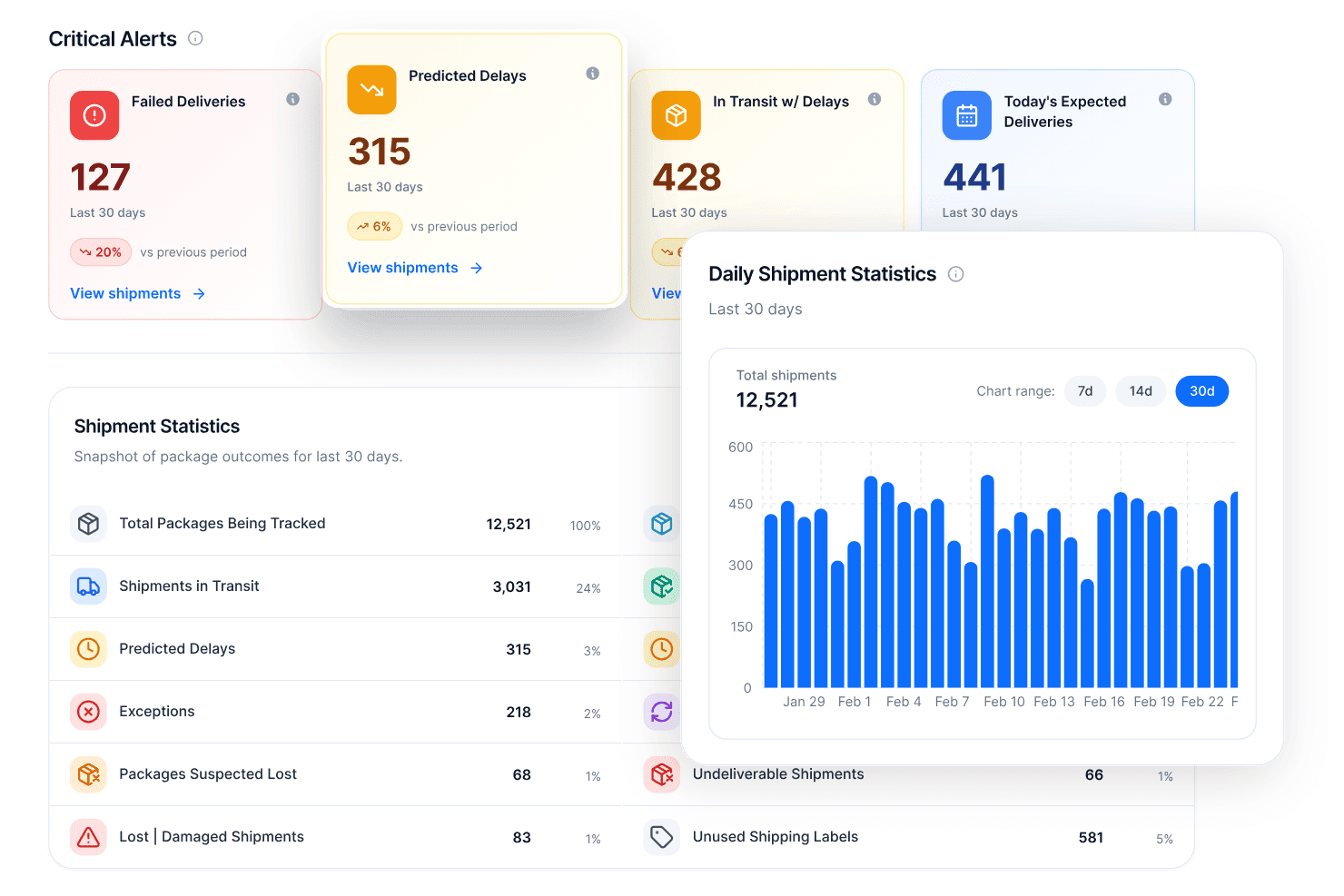
LateShipment.com tracks failed deliveries, delays, and shipment stats in real time. Lateshipment.com is a post-purchase tracking platform that combines multi-carrier shipment tracking, branded tracking pages, automated shipping notifications, predictive delivery ETAs, exception management, and returns handling in one place.
Who Is Lateshipment.com Best For?
Lateshipment.com is a strong fit for DTC ecommerce brands that want to turn post-purchase tracking into a revenue-generating touchpoint, not just a customer service function.
Why I Picked Lateshipment.com
Lateshipment.com earns its spot as one of the best on my shortlist because the delivery insights it surfaces go far beyond a status dashboard. I particularly like the predictive exception alerts, which flag potential delays 24–36 hours before a customer is affected and auto-generate helpdesk tickets in Zendesk or Gorgias without any manual triage. The carrier performance scorecards are another standout: they benchmark on-time rates, service failures, and shipping spend across carriers, giving you real data to use in contract negotiations.
Lateshipment.com Key Features
- Branded tracking page builder: A no-code, drag-and-drop editor lets you create white-labeled tracking pages with embedded product recommendations, promotions, and referral programs.
- Multi-channel notification triggers: Configure alerts across email, SMS, and WhatsApp using 13 shipping event triggers and 8 exception event triggers for granular, milestone-based customer updates.
- Shipping refund recovery (OneAudit): Automatically audits carrier invoices for 50+ service and billing errors, files claims on your behalf, and charges only 35% of recovered refunds.
- Self-service returns portal (OneReturn): A branded returns experience with smart exchange-first flows, custom policy enforcement, and multi-warehouse routing built directly into the platform.
Lateshipment.com Integrations
Lateshipment.com advertises 1,200+ pre-built integrations, including Shopify, BigCommerce, Magento, WooCommerce, Salesforce Commerce Cloud, ShipStation, Shippo, Zendesk, Gorgias, and Klaviyo. It also offers an open API, webhooks, and custom integrations.
Pros and Cons
Pros:
- Automated carrier refund audits recover shipping costs
- Branded tracking pages drive post-purchase sales
- Predictive ETAs and exception alerts reduce delays
Cons:
- Limited shipping refund coverage by carrier
- Occasional false positive lost package alerts
Learn more about Lateshipment.com:
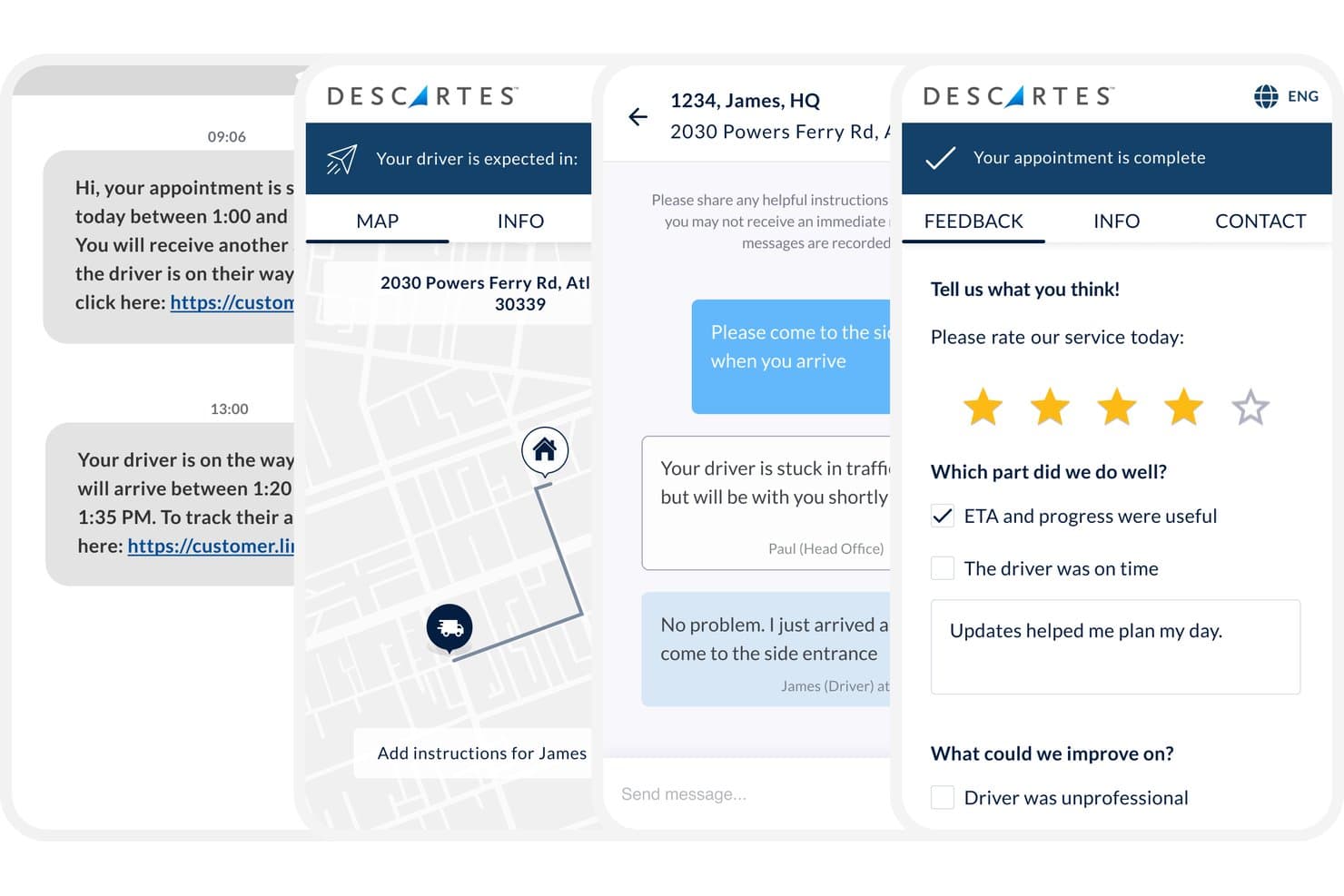
Descartes ShipTrack keeps customers informed with real-time driver tracking and updates. Descartes ShipTrack is a last-mile delivery tracking platform that provides live driver geolocation, real-time ETA management, automated notifications, and a branded self-service portal for end customers and operations teams.
Who Is Descartes ShipTrack Best For?
Descartes ShipTrack is a strong fit for retailers and logistics operators running their own last-mile delivery fleets who need live driver visibility and real-time customer ETAs.
Why I Picked Descartes ShipTrack
Descartes ShipTrack earns its spot on my shortlist because no other tool I've reviewed matches its depth of live delivery visibility. I'm particularly impressed by the queue position indicator, which shows customers exactly how many stops remain before their delivery arrives, and the real-time driver map embedded directly in the branded client portal. When you're running your own last-mile fleet for same-day or BOPIS orders, that level of granularity is hard to replicate with a generic tracking tool.
Descartes ShipTrack Key Features
- Proof of delivery capture: Collect driver signatures, photos, geotags, and timestamps at each delivery event for a complete audit record.
- Workflow builder: Build and deploy custom delivery workflows to all mobile devices at once without any engineering work.
- Exception alerts: Automatically flag stalled or rerouted shipments and surface negative customer feedback to your operations team in real time.
- KPI dashboards and reporting: Monitor daily delivery performance, SLA compliance, and operational metrics through built-in dashboards with data export for BI tools.
Descartes ShipTrack Integrations
Descartes ShipTrack integrates with Descartes GLN, Google Maps, HERE, and Waze, plus WMS, ERP, and other enterprise platforms through its open platform. Specific carrier and ecommerce connectors aren’t clearly documented.
Pros and Cons
Pros:
- Branded portal supports multi-company operations
- Queue position shows delivery order progress
- Live driver map with real-time ETA
Cons:
- No e-commerce post-purchase marketing features
- Carrier support is limited and unclear
Learn more about Descartes ShipTrack:
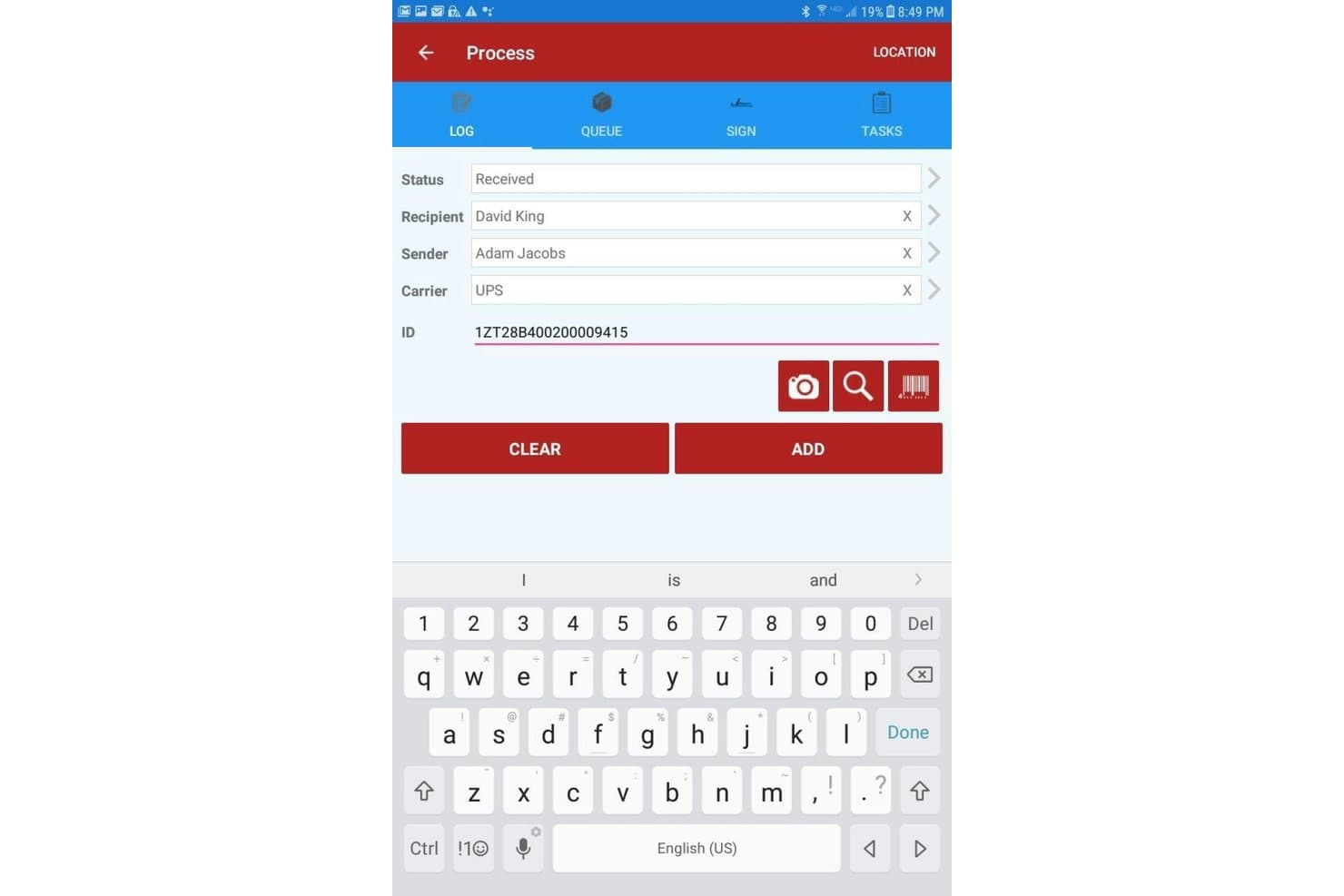
TekTrack lets users log incoming packages with carrier and tracking ID details. TekTrack is an inbound package tracking system that logs, manages, and routes packages from arrival through internal delivery using SmartScan™ barcode processing, automated multi-channel notifications, and chain-of-custody audit trails.
Who Is TekTrack Best For?
TekTrack is a strong fit for facilities and operations teams managing high-volume inbound package receiving across corporate mailrooms, campuses, or multi-location networks.
Why I Picked TekTrack
TekTrack earns its spot on my list because it's purpose-built for one thing: managing inbound packages inside a facility, and it does that exceptionally well. I love how SmartScan™ processes any carrier label in under four seconds, auto-matches it to an internal recipient, and immediately triggers notifications across email, SMS, and WhatsApp. For corporate mailrooms handling hundreds of packages daily, the chain-of-custody audit trail means no package goes missing without a clear record of exactly who touched it and when.
TekTrack Key Features
- Offline mode: Scans, logs, signs, and captures photos without an internet connection, then auto-syncs when connectivity returns.
- Digital signature and photo capture: Records proof-of-delivery via signature pad, touchscreen, or badge barcode, with optional photos embedded in delivery notifications.
- Multi-location dashboard: Manages multiple mailrooms, buildings, and campuses from a single admin interface with independent workflows per location.
- Self-service recipient portal: Gives recipients a brandable portal to check their own package status and view chain-of-custody history without contacting mailroom staff.
TekTrack Integrations
TekTrack’s documented integrations include Active Directory, LDAP, ERP systems, relational databases, and smart locker systems. Its Automation module also provides a REST API for custom integrations and supports CSV or Excel imports.
Pros and Cons
Pros:
- Works fully offline for internal receiving
- Unlimited notifications via email, SMS, WhatsApp
- Automates package intake with SmartScan™ technology
Cons:
- Lacks outbound carrier API tracking feeds
- No customer-facing tracking for e-commerce orders
Learn more about TekTrack:
Other Package Tracking Software
Here are some additional package tracking software options that didn’t make it onto my shortlist, but are still worth checking out:
- 11EzTrackItBest for small office solutions
- 12ShipStationBest for ecommerce sellers
- 13SendCloudBest for European shipping
- 14DetrackBest for real-time driver tracking
- 15ClickpostBest for logistics automation
- 16ShippyProBest for API integration
- 17GigatrakBest for asset tracking
- 18Parcel PerformBest for predictive analytics
- 19ShipupBest for post-purchase communication
Related Retail Logistics Software to Consider
While you're here, you might be interested in some of these other great roundups we've done:
- Best Inventory Management Software
- Best Shipment Tracking Software
- Best Order Tracking Software
- Best B2B Order Management Software
- Best POS Inventory Management Software
How I Evaluate Package Tracking Software
I look for two things: baseline criteria every tool must meet—multi-carrier tracking, exception alerts—and differentiators like branded pages and WISMO-reducing features that set platforms apart.
Core Functionality (Table Stakes For This List)
When I'm selecting tools for my list, I rank each one on a scale from 0 (does not offer the functionality) to 5 (excels in this area) for each core functionality listed below. Then, I calculate the tool's total score into a percentage. Each tool needs to achieve a minimum total score of 65% to be considered for inclusion.
- Multi-Carrier Tracking Support: I check how many carriers each platform covers and whether it handles regional carriers your 3PLs might use, not just the big four.
- Real-Time Status Updates: Each tool should surface live location and delivery milestones, so your ops team sees a stuck shipment before a customer calls about it.
- Automated Shipment Notifications: I evaluate the channels available (email, SMS, push) and whether you can set triggers for specific events like out-for-delivery or a failed attempt.
- Branded Tracking Pages: Retail buyers expect a post-purchase experience that stays on-brand, so I look at how much control you get over layout, colors, and messaging.
- Exception & Delay Management: I look for automatic flagging of stalled or rerouted shipments, since manually monitoring hundreds of daily orders for exceptions isn't realistic.
- Analytics & Reporting Dashboards: Useful reporting goes beyond shipment counts. I evaluate whether you can benchmark carrier on-time rates and spot trends across store locations.
Once I have a list of tools that meet this criteria, I consider what sets each platform apart.
Differentiating Factors (What Sets Vendors Apart)
Here's how I compare and contrast different vendors:
Standout Features
Post-purchase marketing is a big differentiator. Some platforms let you embed product recommendations and promotions directly into tracking pages and notification emails, turning a transactional touchpoint into a revenue driver. I also evaluate whether a tool includes returns tracking—retail teams dealing with high return volumes benefit from having forward and reverse logistics visibility in one place. Carrier performance scorecards matter too, since comparing on-time rates and damage claims across carriers helps your ops team make smarter shipping decisions at contract renewal time.
Beyond Features
Ecosystem integrations are one of the first things I check. A tracking tool that connects natively to your ecommerce platform, OMS, and WMS means your team isn't manually syncing order data across systems. Scalability is equally important—I look at whether a platform can handle holiday peak volumes without throttling updates or delaying notifications. Finally, I evaluate total cost of ownership, especially how pricing scales with shipment volume and whether features like SMS alerts or API calls come with added costs that can quietly inflate your bill.
Related Reviews
What is Package Tracking Software?
Package tracking software is exactly what it sounds like: a tool that helps businesses keep tabs on shipments in real-time—from warehouse to doorstep (or office mailroom). But it’s more than just a digital map with moving dots.
At its core, this software gives logistics teams, ecommerce sellers, and customer service reps a centralized view of where every package is, what carrier it’s with, and whether it’s on time.
That means fewer “Where’s my order?” emails, faster resolutions, and happier customers.
Modern platforms do more than just track—they notify, analyze, and even anticipate delays. With features like branded tracking pages, automated status updates, and performance dashboards, these tools turn post-purchase chaos into a smooth, trackable process.
Whether you're shipping across town or across the globe, package tracking software brings visibility and control to your fulfillment workflow.
How to Choose Package Tracking Software
Choosing the right package tracking tool isn’t about picking the one with the longest feature list—it’s about finding the one that actually fits how your team works.
Here’s a checklist to help you focus on what matters most:
| Factor | What to consider |
|---|---|
| FactorScalability | What to considerWill it grow with you? Look for platforms that can handle higher shipment volumes without breaking your budget—or your backend. |
| FactorIntegrations | What to considerDon’t force your team to juggle tools. Make sure it plugs into your ecommerce platform, WMS, CRM, or whatever else you’re already using. |
| FactorCustomizability | What to considerCan you make it yours? Look for tools that let you brand tracking pages and tailor notifications to match your customer experience. |
| FactorEase of use | What to considerYour ops team doesn’t have time to “figure it out.” Choose something intuitive that your team can adopt without weeks of training. |
| FactorBudget | What to considerKnow what you're getting for your money. Watch out for hidden fees—like per-shipment charges—that can add up fast. |
| FactorSecurity safeguards | What to considerCustomer data is gold—protect it. Look for encryption, access controls, and compliance features to keep everything locked down. |
| FactorCustomer support | What to considerThings will break. When they do, make sure support is fast, helpful, and easy to reach—ideally with live chat or a dedicated rep. |
| FactorReporting capabilities | What to considerYou can’t improve what you can’t measure. Go for tools that give you deep insights into delivery speed, carrier reliability, and customer experience. |
Trends in Package Tracking Software
Package tracking is no longer just about knowing where a box is. It's about visibility, speed, security, and customer experience—all evolving fast. Here are the trends shaping the next generation of tracking tools:
- Real-time tracking powered by IoT devices. Smart sensors and RFID tags are replacing manual scans to give up-to-the-minute location updates, reducing lost shipments and blind spots.
- AI-driven predictive delivery analytics. Platforms are using machine learning to forecast delays, optimize routes, and alert customers proactively—before problems happen.
- Blockchain for end-to-end transparency. Some tracking systems now use blockchain to create tamper-proof shipment records, adding trust and reducing disputes in high-stakes logistics.
- Smart packaging with condition monitoring. Sensors embedded in packaging now track temperature, humidity, and shock—essential for sensitive goods like perishables or electronics.
- Integration with consumer tracking devices. Tools like Apple AirTags are being embraced by shippers and airlines alike, giving customers more visibility and making “lost package” a thing of the past.
Features of Package Tracking Software
The best package tracking software does more than just show a dot on a map. Here are the must-have features to look for when choosing a solution:
- Real-time tracking. See exactly where your packages are at every stage of the journey—no more guesswork or delayed updates.
- Predictive analytics. Anticipate delivery times and potential delays using historical and real-time data to stay ahead of issues.
- Customizable tracking pages. Maintain brand consistency with tracking pages that reflect your logo, colors, and messaging.
- Automated notifications. Keep customers in the loop with SMS or email updates triggered by delivery milestones.
- Integration capabilities. Sync easily with ecommerce platforms, CRMs, ERPs, and carrier systems to streamline operations.
- Reporting tools. Access dashboards that break down delivery performance, carrier reliability, and operational KPIs.
- Package insurance. Offer shipping protection as an add-on or standard feature to build trust and reduce loss-related headaches.
- Sustainability tracking. Monitor emissions and carbon impact of deliveries to meet internal goals or customer expectations.
- Personalized customer portals. Give customers a branded experience where they can track, manage, and get support on orders.
- Blockchain security. Ensure data integrity and transparency with tamper-proof tracking records for high-trust logistics.
Benefits of Shipment Tracking Software
Adopting the right tracking solution isn’t just about knowing where your packages are—it’s about transforming your logistics into a smarter, smoother, and more customer-friendly operation.
Here’s what you stand to gain:
- Improved customer satisfaction. Real-time updates and automated notifications reduce anxiety and build trust with buyers.
- Operational efficiency. Consolidated tracking and smart integrations help your team spend less time hunting for packages and more time solving real problems.
- Cost savings. Predictive insights and package insurance reduce losses, missed deliveries, and the need for manual intervention.
- Brand consistency. Custom tracking pages and branded notifications keep your customer experience seamless after checkout.
- Environmental responsibility. Sustainability tracking helps you measure and manage carbon emissions for greener operations.
- Stronger data security. Blockchain-based tracking and secure integrations protect customer data and shipment records.
- Deeper customer engagement. Personalized tracking portals give customers more control and transparency, increasing post-purchase loyalty.
Costs & Pricing of Package Tracking Software
Pricing for package tracking software isn’t one-size-fits-all. Most tools use volume-based tiers, charging based on the number of shipments tracked per month, with additional fees for higher volumes or premium features. Here's what you can expect:
Typical monthly pricing tiers (and what they include)
| Plan type | Average price | Common features | Best for |
|---|---|---|---|
| Plan typeFree Plan | Average price$0/month for up to 50–100 shipments | Common featuresBasic tracking, limited notifications, single carrier support | Best forSmall teams or businesses testing the waters |
| Plan typeStarter Plan | Average price$9–$29/month for up to 500 shipments | Common featuresBranded tracking pages, basic analytics, a few integrations | Best forDTC brands with low monthly volume |
| Plan typeBusiness Plan | Average price$30–$100/month for 2,000–5,000 shipments | Common featuresMulti-carrier support, real-time updates, CRM integrations | Best forEcommerce brands scaling up |
| Plan typeEnterprise Plan | Average price$100+/month or custom pricing for 10,000+ shipments | Common featuresPredictive analytics, advanced automations, custom SLAs, dedicated support | Best forHigh-volume or complex logistics operations |
Additional cost considerations
- Per-shipment pricing. Some tools (e.g., AfterShip, TrackingMore) charge $0.01–$0.05 per shipment after exceeding monthly limits—this can scale quickly.
- Flat per-user pricing. Less common in tracking software, but some tools (especially full logistics suites) charge per user/month (e.g., $39/user).
- One-time or setup fees. Enterprise solutions may include onboarding or implementation costs, particularly for custom integrations.
- Feature-based pricing. Advanced capabilities like branded returns portals, claims automation, or carbon tracking are often locked behind higher-tier plans.
- Premium support. SLAs, priority support, or a dedicated account manager may incur additional monthly or annual charges.
Package Tracking Software FAQs
Here are some answers to common questions about package tracking software:
How does package tracking software actually work?
A package tracking system collects data from carriers using barcodes, GPS, APIs, or RFID scans. As packages move through the supply chain, that information updates in real time—giving you full chain of custody visibility in one centralized dashboard.
Is package tracking software worth it for small businesses?
Absolutely. Even entry-level parcel tracking software can eliminate manual data entry, reduce customer service headaches, and streamline delivery management. It’s a smart investment if you’re dealing with multiple carriers or handling inbound packages regularly.
Can I use this software without switching shipping carriers?
Yes—most tracking software providers integrate with your existing carriers, like UPS, FedEx, or USPS. You don’t have to change your delivery partners; the software just enhances what you already have with smarter tracking and better delivery management.
How accurate is real-time tracking?
It depends on your carriers and the tracking method—barcode scan updates are standard, but IoT sensors or GPS add more precise location data. The best systems also track performance over time, helping you optimize across your supply chain.
What’s the ROI on tracking software?
From fewer lost packages to less manual data entry and improved customer satisfaction, the ROI can be huge—especially at scale. Many providers even share customer success stories highlighting reduced support tickets and smoother delivery operations.
How long does setup take for shipment tracking software?
It varies. Some parcel tracking software is plug-and-play and up in under an hour. For more robust systems with deep integrations across your supply chain, setup might take a few days to a few weeks—especially if you’re linking multiple tools and teams.