
E-handelsplattformer for produsenter er verdifulle ressurser for alle virksomheter. Med riktig programvare kan team effektivisere salgsprosessene og forbedre kundeengasjementet. Men det kan være utfordrende å finne den rette e-handelsplattformen for produsenter, særlig med så mange tilgjengelige alternativer.
Med utgangspunkt i erfaringen min med e-handel og B2B-programvare testet og sammenlignet jeg flere av de beste tilgjengelige e-handelsplattformene for produsenter. Deretter samlet jeg resultatene i grundige anmeldelser for å hjelpe deg med å finne den beste programvaren for dine unike behov. Jeg er sikker på at du finner din neste e-handelsplattform for produsenter i listen nedenfor.
Hvorfor du kan stole på programvareanmeldelsene våre
Vi har testet og anmeldt e-handelsprogramvare siden 2021. Som e-handelseksperter vet vi hvor avgjørende og vanskelig det er å ta den riktige beslutningen når du skal velge programvare.
Vi investerer i grundige undersøkelser for å hjelpe målgruppen vår med å ta bedre beslutninger om programvarekjøp. Vi har testet mer enn 2 000 verktøy (!!!) for ulike bruksområder innen e-handelsstyring og skrevet over 1 000 omfattende programvareanmeldelser. Les hvordan vi ivaretar åpenhet og metoden vår for å anmelde e-handelsplattformer for produsenter.
Sammenligningstabell for e-handelsprogramvare
Denne sammenligningstabellen oppsummerer prisopplysningene for mine beste utvalg av e-handelsprogramvare for produksjonsvirksomheter:
| Tool | Best For | Trial Info | Price | ||
|---|---|---|---|---|---|
| 1 | Best for syncing product and customer data | 30-day free trial | Pricing upon request | Website | |
| 2 | Best for advanced search and discovery | Free plan + free demo available | From $1/month | Website | |
| 3 | Best for user-friendly online store setup | 3-day free trial | From $29/month (billed annually) | Website | |
| 4 | Best for scalable multi-brand management | Free demo available | Pricing upon request | Website | |
| 5 | Best for full store ownership | 14-day free trial | Pricing upon request | Website | |
| 6 | Best for cost-effective customization | Free plan available | Free plan available | Website | |
| 7 | Best for B2B digital transformation | Free plan available OR Free demo available | Pricing upon request | Website | |
| 8 | Best for Customizable Website Building | 14-day free trial | From $35/month | Website | |
| 9 | Best for composable commerce flexibility | Free trial available | From $49,500/year (billed annually) | Website | |
| 10 | Best for ERP-integrated B2B sales | Free demo available | From $1,265/month | Website |


Anmeldelser av de beste e-handelsplattformene for produsenter
Nedenfor finner du mine detaljerte sammendrag av den beste e-handelsprogramvaren som kom med på kortlisten min. Anmeldelsene mine gir et detaljert innblikk i de viktigste funksjonene, fordelene og ulempene, integrasjonene og ideelle bruksområdene for hvert verktøy, slik at du kan finne det beste alternativet for deg.

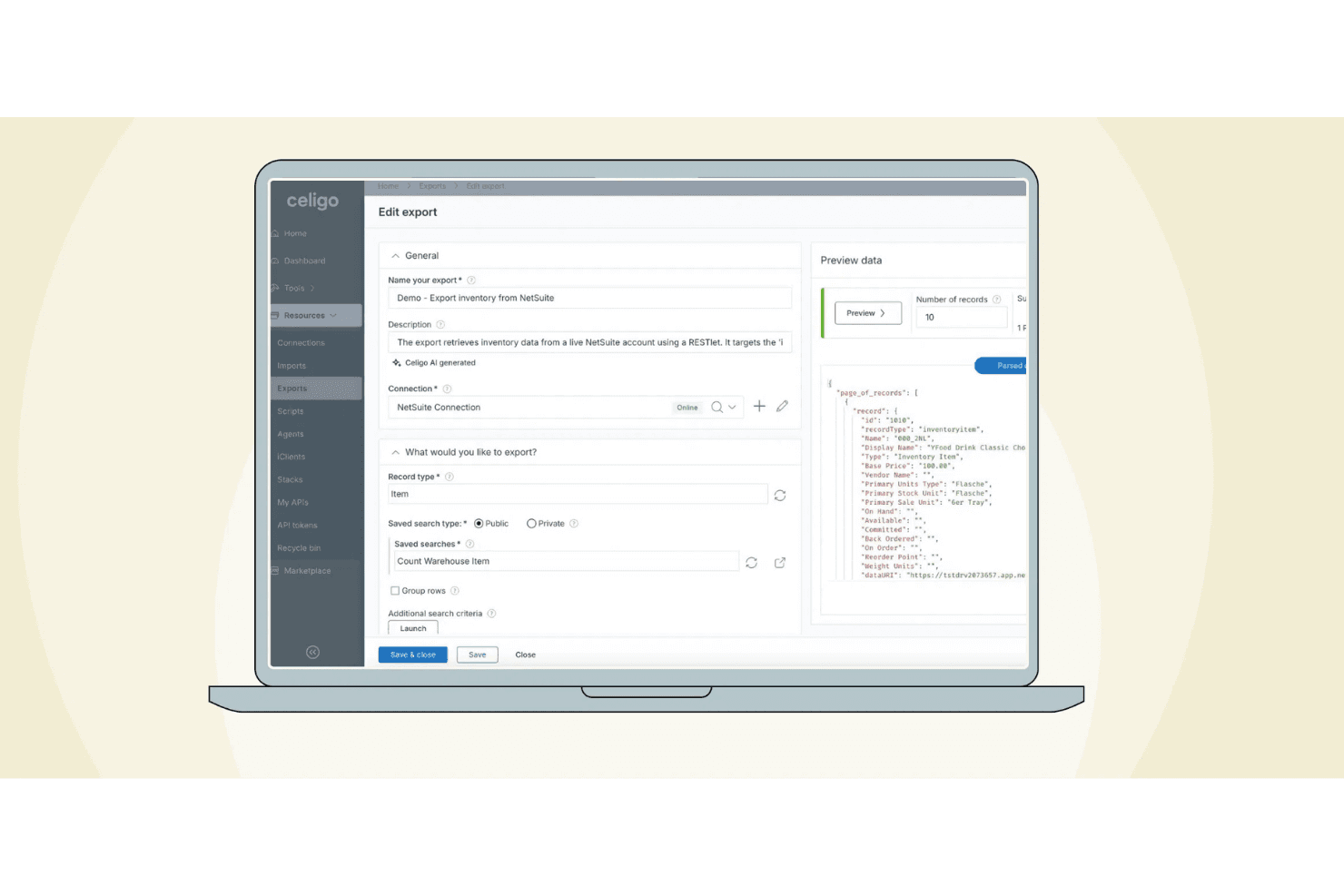
Celigo lets users configure and preview NetSuite inventory exports. Celigo is an iPaaS (integration platform as a service) that connects ecommerce storefronts, ERPs, marketplaces, and 3PLs through 1,000+ prebuilt connectors and AI-powered workflow automation.
Who Is Celigo Best For?
Celigo is the right fit for operations and IT teams at mid-market to enterprise manufacturers who need to sync data across their ERP, storefront, and fulfillment systems without building custom integrations from scratch.
Why I Picked Celigo
I've included Celigo in my top picks because it's the best option I've found for keeping product and customer data in sync across an entire manufacturing tech stack. When a Shopify B2B order comes in, Celigo automatically pushes it into NetSuite, updates inventory across every connected channel, and triggers fulfillment at the 3PL without anyone touching a spreadsheet. Its AI-driven error management resolves 96% of integration exceptions automatically, so data mismatches don't quietly snowball into order fulfillment problems.
Celigo Key Features
- EDI trading partner integration: Connect with hundreds of major retailers and distributors using prebuilt EDI connectors via AS2 protocol for buy-side and sell-side transactions.
- Automatic error management: An AI-driven system detects and resolves integration exceptions without manual intervention, covering 96% of errors automatically.
- Omnichannel inventory sync: Real-time inventory updates flow across your ERP, 3PL, and all connected storefronts simultaneously to prevent overselling.
- Universal connectors: For any system outside the prebuilt library, Celigo supports HTTP, FTP, JDBC, GraphQL, Webhooks, and AS2 protocols to connect custom or niche tools.
Celigo Integrations
Celigo offers 1,000+ prebuilt integrations, including Shopify, Shopify B2B, BigCommerce, NetSuite, Microsoft Dynamics 365 Business Central, Acumatica, Amazon, Walmart Marketplace, ShipBob, and Loop Returns. Universal connectors support REST, SOAP, GraphQL, HTTP, FTP, JDBC, AS2, and webhooks.
Pros and Cons
Pros:
- Real-time inventory and order updates
- AI resolves most data integration errors
- Automates product and customer data sync
Cons:
- Does not support quoting or RFQs
- No native storefront or buyer portal
Learn more about Celigo: Best for advanced search and discovery
- Free plan + free demo available
- From $1/month
Visit WebsiteCustomer Rating:4.6/5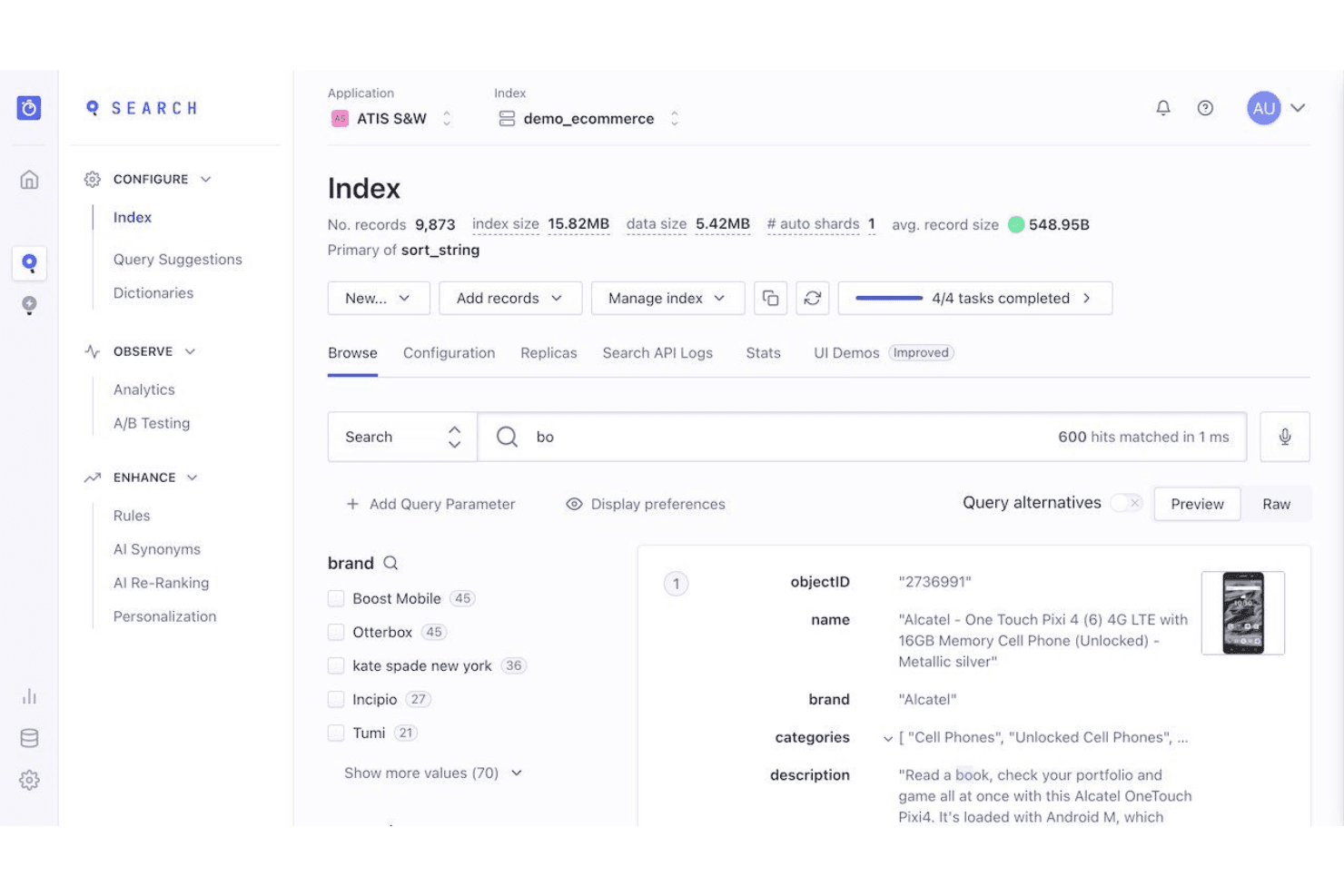
Algolia lets users browse, search, and manage index records in real time. Algolia is an AI-powered search and discovery platform that layers onto existing ecommerce stacks to deliver real-time product search, AI-driven recommendations, and no-code merchandising tools across complex manufacturer catalogs.
Who Is Algolia Best For?
Algolia is a strong fit for manufacturers building composable commerce stacks who need AI-powered search and discovery layered on top of an existing ecommerce engine.
Why I Picked Algolia
Algolia earns its spot on my shortlist because manufacturers with large, complex SKU catalogs genuinely struggle with search that can't handle part numbers, technical specs, or imprecise buyer queries. I love how NeuralSearch combines semantic and keyword matching in a single API call, surfacing the right product even when a buyer's search input is vague or misspelled. Algolia's AI Merchandising Studio also lets non-technical teams boost or pin products for specific queries without touching code.
Algolia Key Features
- NeuralSearch: A hybrid search engine that combines vector-based semantic search with keyword matching in a single API call to handle vague or technical queries.
- Personalized catalog access control: Restricts product visibility at the account level so each buyer only sees the SKUs and pricing they're entitled to view.
- AI Attribute Enrichment: Uses generative AI to automatically expand product records with enhanced attributes and descriptions, improving filter accuracy across large SKU sets.
- Rules engine: Supports up to 10,000 configurable rules per index to pin, boost, bury, or redirect products for specific queries or categories.
Algolia Integrations
Algolia offers six documented ecommerce integrations, including Shopify, Salesforce Commerce Cloud, Adobe Commerce, BigCommerce, commercetools, and Supabase. Its APIs and SDKs support custom connections to ERP, PIM, WMS, CRM, and inventory systems.
Pros and Cons
Pros:
- Business users control merchandising without code
- Speeds up large catalog product discovery
- Excels at long-tail and technical queries
Cons:
- Requires pairing with a separate ecommerce platform
- No quoting or buyer self-service features
Learn more about Algolia: Best for user-friendly online store setup
- 3-day free trial
- From $29/month (billed annually)
Visit WebsiteCustomer Rating:4.5/5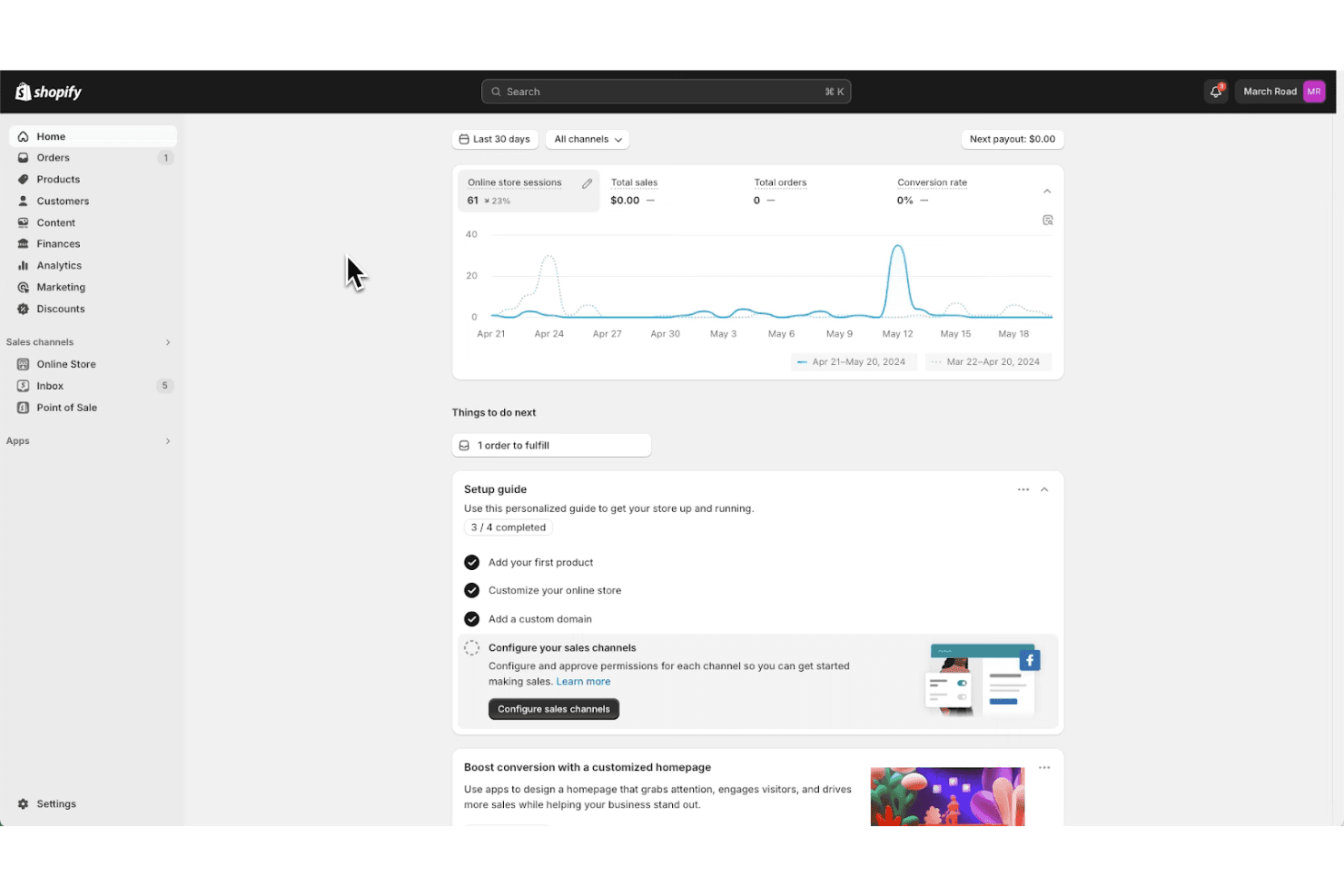
Shopify's dashboard tracks store sessions, sales, and setup progress. Shopify is a cloud-based ecommerce platform that supports both B2B and D2C selling from a single admin, with tools for custom catalogs, tiered pricing, buyer portals, multi-channel selling, and ERP integration.
Who Is Shopify Best For?
Shopify is a strong fit for manufacturers launching hybrid B2B and D2C storefronts who need to get online fast without heavy technical overhead.
Why I Picked Shopify
Shopify earns its spot on my shortlist because it's the fastest path to a live B2B or hybrid storefront I've seen, without sacrificing the features manufacturers actually need. I love that a single admin handles both wholesale and D2C selling with shared inventory, so a manufacturer can serve distributors on net terms while running a consumer store simultaneously. Customer-specific catalogs and company account hierarchies (supporting up to 10,000 buyer locations) make structured wholesale access feel native rather than bolted on.
Shopify Key Features
- Shopify Flow automation: A no-code workflow builder that automates B2B tasks like multi-level order approvals, reorder triggers, and customer tagging.
- Headless commerce via Hydrogen and Oxygen: A React-based framework paired with global edge hosting for building fully custom manufacturer storefronts and buyer portals.
- Draft orders for sales rep quoting: Sales reps can create draft orders tied to company-specific pricing and net terms, then send buyers a direct checkout link.
- Multi-warehouse inventory management: Tracks and syncs inventory across up to 10 locations, with configurable fulfillment priority rules for bulk B2B orders.
Shopify Integrations
Shopify offers integrations with Oracle NetSuite, Microsoft Dynamics 365 Business Central, Infor, Acumatica, Brightpearl by Sage, Boomi, Jitterbit, Celigo, SPS Commerce, and Orderful. Its REST, GraphQL, and Storefront APIs support custom ERP, MRP, WMS, PIM, and CRM integrations.
Pros and Cons
Pros:
- Extensive app ecosystem fills feature gaps
- Company account hierarchies support 10,000 locations
- B2B and D2C selling unified in one admin
Cons:
- No native RFQ or product configurator
- Core B2B features only on Plus plan
 Best for scalable multi-brand management
- Free demo available
- Pricing upon request
Visit WebsiteCustomer Rating:4.5/5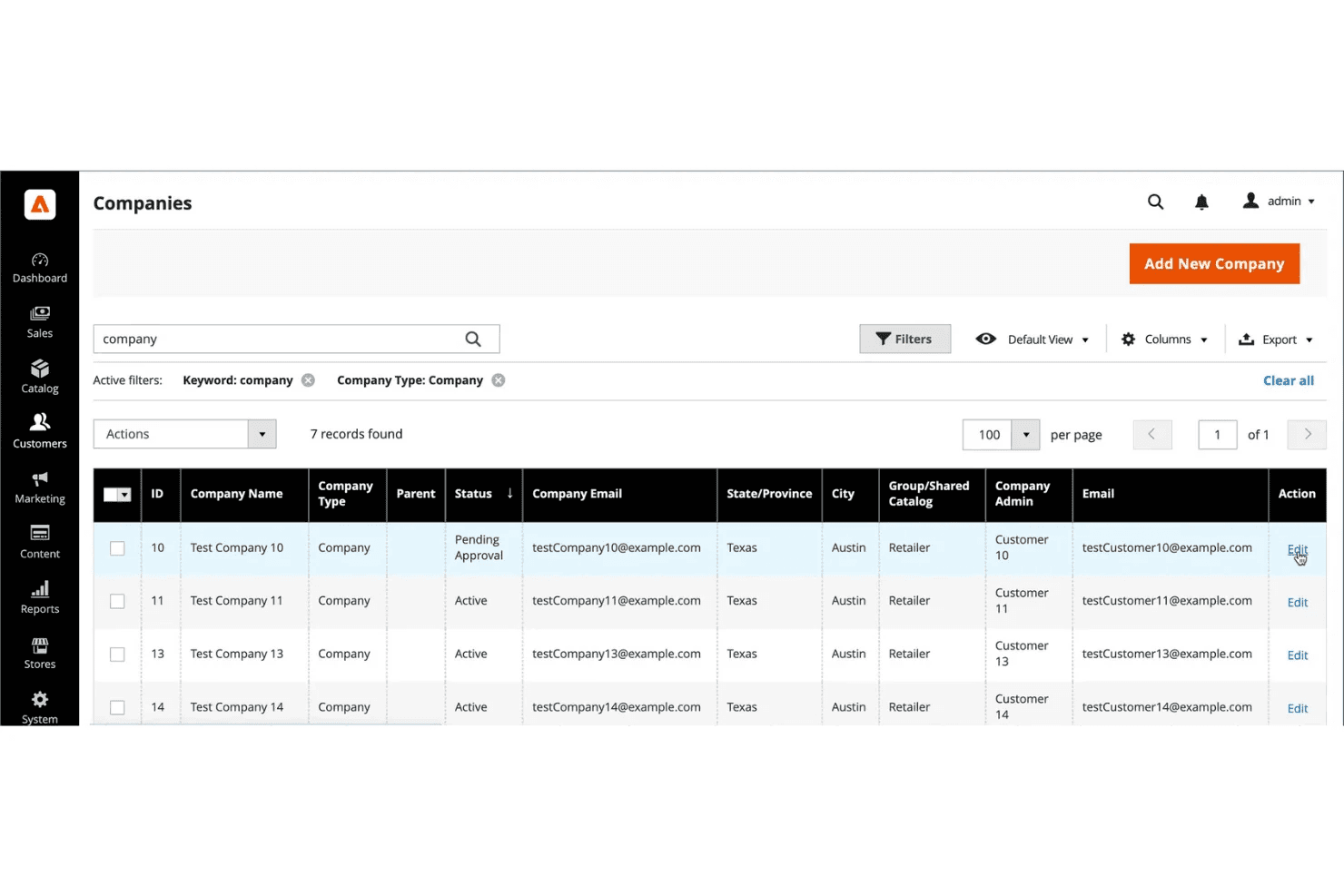
Adobe Commerce lets users manage and review B2B company accounts centrally. Adobe Commerce is an enterprise ecommerce platform built for manufacturers that combines native B2B commerce tools—including company hierarchies, shared catalogs, negotiable quotes, and purchase approval workflows—with multi-site management, ERP integrations, and headless architecture.
Who Is Adobe Commerce Best For?
Adobe Commerce fits enterprise manufacturers managing multiple brands, product lines, or regional storefronts who need B2B and D2C selling from a single platform.
Why I Picked Adobe Commerce
Adobe Commerce earns its spot on my shortlist because no other platform handles scalable multi-brand management at the same level. I'm particularly impressed by its multisite architecture, which lets you centrally manage hundreds of storefronts across brands, regions, and product lines from a single admin, each with its own catalog and pricing. Its native B2B suite, including company hierarchies, shared catalogs, and negotiable quotes, means wholesale and D2C operations run in parallel without separate backends.
Adobe Commerce Key Features
- Purchase approval workflows: Configurable multi-step approval rules based on order value and organizational hierarchy keep procurement policy enforced at checkout.
- AI-powered search and category merchandising: Automatically re-ranks search results and category pages to surface the most relevant products for each buyer.
- Integration Starter Kit: Pre-built bi-directional templates connect Adobe Commerce to SAP S/4HANA, Microsoft Dynamics 365 F&O, and Epicor, cutting integration development time by roughly 50%.
- Requisition lists: Buyers save standard order bundles and reorder in one click, speeding up repeat purchasing across high-volume accounts.
Adobe Commerce Integrations
Adobe Commerce offers documented integrations with SAP S/4HANA, Microsoft Dynamics 365 Finance & Operations, Epicor, and IBM Sterling Order Management. Marketplace integrations support NetSuite, Oracle, Infor, and Acumatica, while App Builder, API Mesh, and webhooks support custom connections.
Pros and Cons
Pros:
- Enables central control of many storefronts
- Manages millions of SKUs and price points
- Handles B2B and D2C channels together
Cons:
- Punchout and EDI require third-party extensions
- High internal and external implementation effort
Learn more about Adobe Commerce: Best for full store ownership
- 14-day free trial
- Pricing upon request
Visit WebsiteCustomer Rating:4.3/5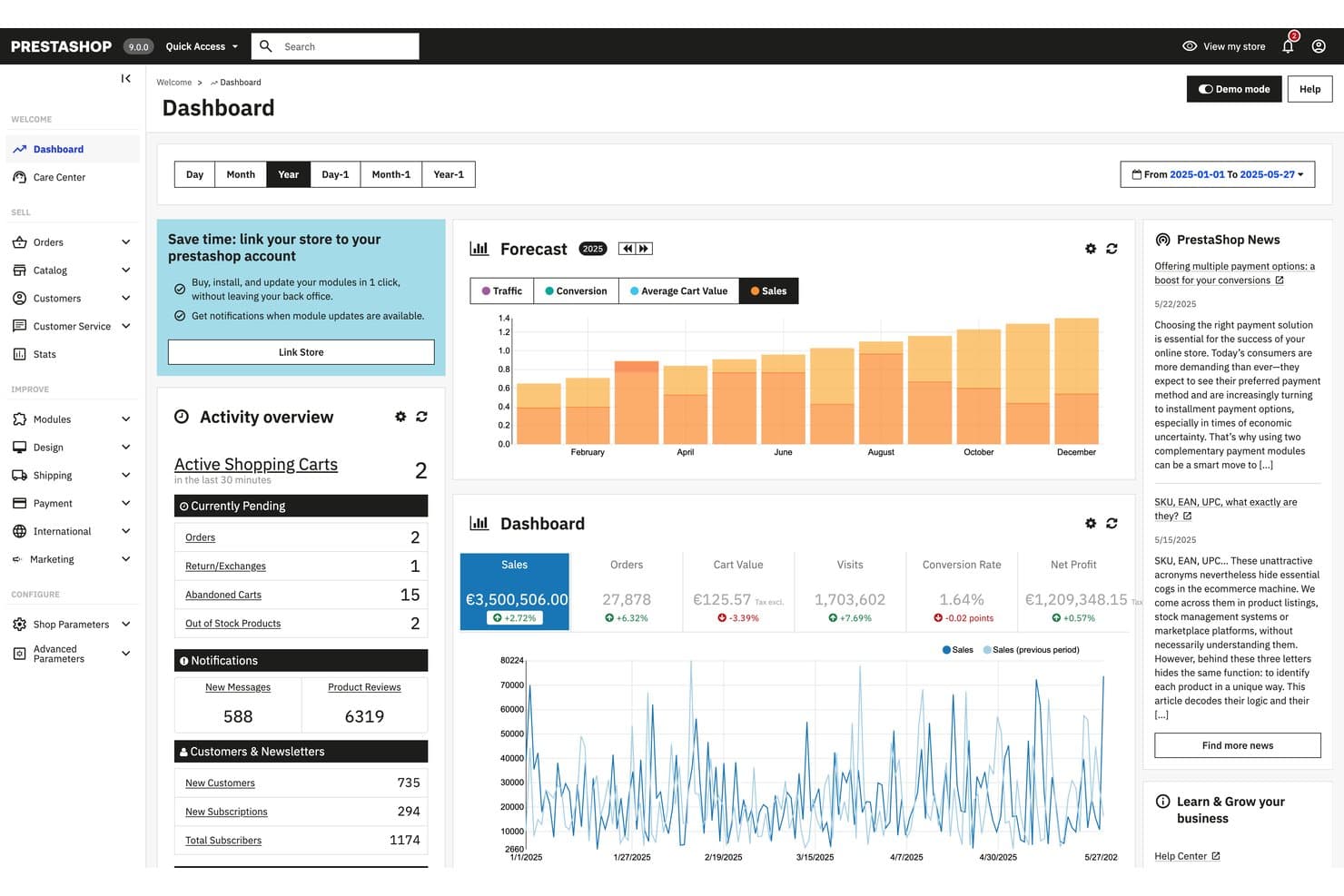
PrestaShop's dashboard gives manufacturers real-time sales and order insights. PrestaShop is an open-source ecommerce platform that lets manufacturers build and self-host their own storefronts, with native multi-store management, B2B pricing controls, and a marketplace of 4,000+ modules for extending catalog, quoting, and ERP connectivity.
Who Is PrestaShop Best For?
PrestaShop is a strong fit for SMB and mid-market manufacturers who want full ownership of their storefront without recurring platform licensing fees.
Why I Picked PrestaShop
PrestaShop earns its spot on my list because the open-source model gives manufacturers genuine ownership of their storefront, including full access to the source code with no platform licensing fees eating into margins. I particularly like the native multi-store architecture, which lets you run a wholesale B2B portal and a D2C consumer storefront from one back office, each with its own catalog, pricing, and branding. Customer group segmentation with tiered, volume-based pricing rules means you can assign negotiated rates to specific accounts without manual workarounds.
PrestaShop Key Features
- Quantity-based pricing breakpoints: Set tiered price rules by volume thresholds so wholesale buyers automatically receive lower unit rates as order size increases.
- Multi-language and multi-currency storefront: Run storefronts in multiple languages across 20 currencies from a single back office, supporting international distribution networks.
- REST API for ERP and system connectivity: Connect PrestaShop to external ERP, PIM, or inventory systems via a RESTful Web Services API that exposes products, orders, customers, and catalog data.
- Addons Marketplace with 4,000+ modules: Extend native functionality with third-party modules for quoting, bulk ordering, account approvals, and ERP connectors directly from the back office.
PrestaShop Integrations
PrestaShop’s Addons Marketplace offers 4,000+ modules, including connectors for SAP, Sage, Microsoft Dynamics, Odoo, Salesforce, and Akeneo. Its REST API supports custom ERP, PIM, inventory, and production-system integrations, while EDI and Punchout require custom development.
Pros and Cons
Pros:
- Large module ecosystem for specialized workflows
- Multi-store B2B and D2C from one backend
- Full code ownership for storefront customization
Cons:
- Technical expertise needed for maintenance and upgrades
- Advanced B2B features require paid modules
Learn more about PrestaShop: Best for cost-effective customization
- Free plan available
- Free plan available
Visit WebsiteCustomer Rating:4.3/5
OpenCart's Extension Marketplace lets users browse and install paid plugins. OpenCart is an open-source ecommerce platform that supports multi-store management, customer group pricing, product catalog management, and a 13,000+ extension marketplace for adding B2B and manufacturing-specific functionality.
Who Is OpenCart Best For?
OpenCart suits small to mid-sized manufacturers with in-house development resources who want full control over their storefront without paying platform licensing fees.
Why I Picked OpenCart
OpenCart earns its spot on my shortlist because it's the only platform here where the software itself costs nothing, giving manufacturers with in-house developers a genuinely low total cost of ownership. I like that native multi-store management lets you run a B2B wholesale storefront and a D2C consumer storefront from one admin panel, no workarounds needed. Customer group pricing adds another layer, letting you set distinct price tiers for dealers, distributors, and retail buyers at the product level.
OpenCart Key Features
- Account approval workflow: Admins can manually review and approve new business buyer registrations before granting access to wholesale pricing or restricted catalog areas.
- Quantity-based discount tiers: Set volume pricing rules that automatically apply discounts when buyers purchase above defined thresholds, layered on top of group-specific prices.
- 51 pre-installed payment gateways: Includes PayPal, Klarna, Square, and Worldpay out of the box, so you can support diverse buyer payment preferences without additional setup.
- Open-source code access: Full access to the platform's source code lets your development team build custom manufacturing workflows, proprietary integrations, or bespoke storefront logic.
OpenCart Integrations
OpenCart offers marketplace integrations with NetSuite via Patchworks, SAP via eShopSync, and MYOB and Acumatica via APPSeCONNECT. Its built-in API and third-party REST API extensions support custom ERP, PIM, and inventory connections.
Pros and Cons
Pros:
- Large extension marketplace for custom features
- Multi-store management supports B2B and D2C
- No platform licensing fees for manufacturers
Cons:
- ERP integration relies on third-party extensions
- No native quoting or RFQ workflows
Learn more about OpenCart: Best for B2B digital transformation
- Free plan available OR Free demo available
- Pricing upon request
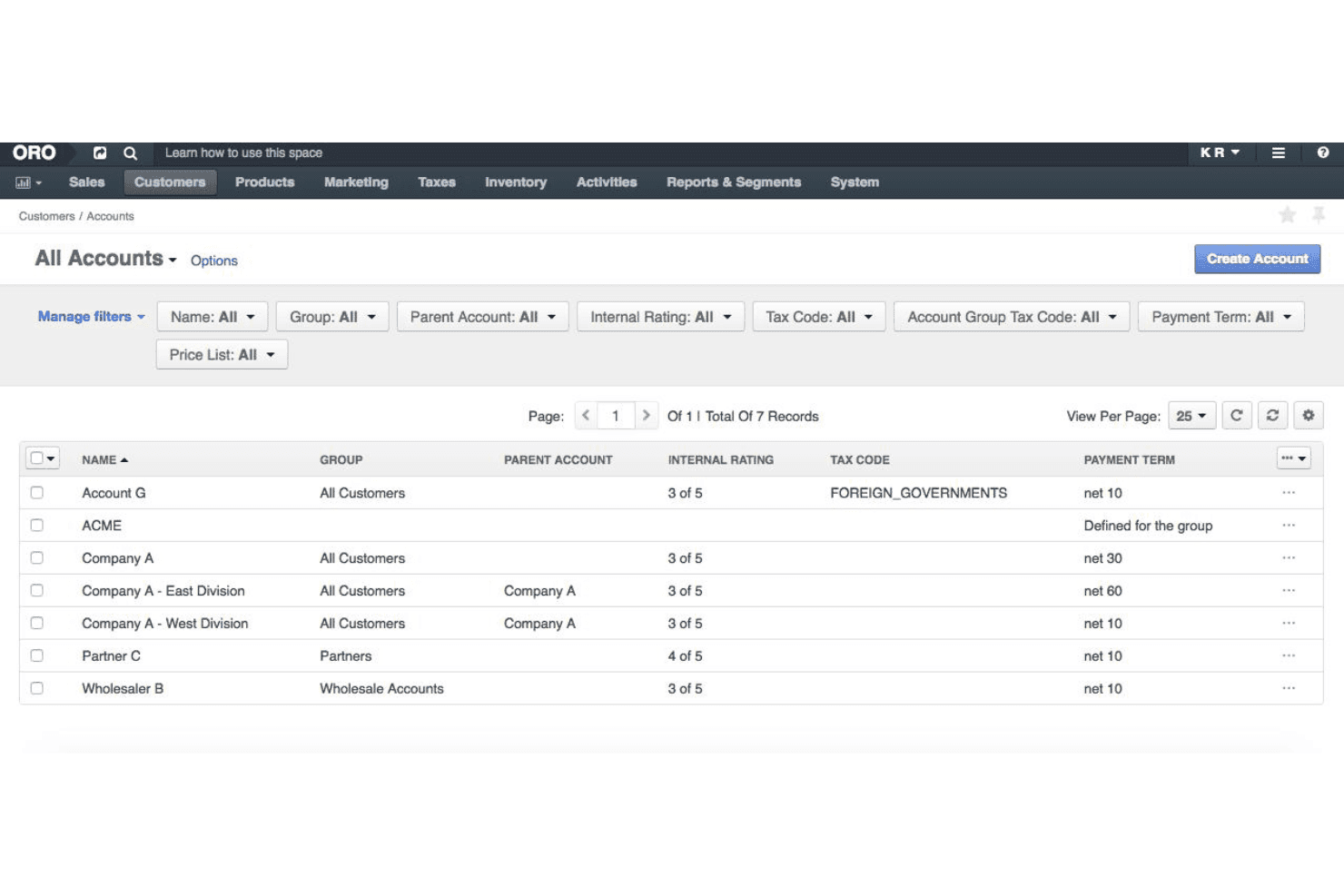
OroCommerce lets users manage and filter all customer accounts in one view. OroCommerce is a B2B ecommerce platform built specifically for manufacturers, wholesalers, and distributors, combining storefront management, RFQ and quoting workflows, CPQ, built-in CRM, PIM/DAM, and ERP integrations in a single platform.
Who Is OroCommerce Best For?
OroCommerce fits mid-market and enterprise manufacturers, wholesalers, and distributors that need native B2B workflows—like RFQ, tiered pricing, and account hierarchies—without adapting a B2C platform to fit.
Why I Picked OroCommerce
OroCommerce earns its spot on my shortlist because it's the only platform I've found that was built from scratch for B2B commerce rather than adapted from a B2C foundation. I'm particularly impressed by its native RFQ and multi-round negotiation workflows, which let manufacturers handle complex quoting without custom development. Its CPQ layer generates real-time pricing during quoting based on configured product logic, which is exactly what made-to-order manufacturers need.
OroCommerce Key Features
- Account hierarchy management: Buyers can create and manage sub-accounts, assign purchasing roles to team members, and set spend approval rules directly within their portal.
- Multi-organization storefronts: Run multiple brands, business units, and buyer portals from a single backend instance under one license with no per-site fees.
- Punchout catalog integration: Connects with enterprise procurement systems like SAP Ariba and Coupa, letting buyers shop within their own eProcurement tools while transacting through OroCommerce.
- Visual workflow builder: A low-code tool for configuring approval chains, onboarding steps, and checkout logic without custom development.
OroCommerce Integrations
OroCommerce offers integrations with SAP Business One, Epicor Prophet 21, NetSuite, Microsoft Dynamics, JD Edwards, Infor, Akeneo, ContentServ, SAP Ariba, and Coupa. REST APIs and message queues support custom ERP, PIM, WMS, and 3PL integrations.
Pros and Cons
Pros:
- Native RFQ, CPQ, and quoting workflows
- Handles complex account hierarchy management natively
- Built for B2B manufacturers from scratch
Cons:
- Six-month implementations are common for enterprises
- Requires technical teams for setup and updates
Learn more about OroCommerce: Best for Customizable Website Building
- 14-day free trial
- From $35/month
Visit WebsiteCustomer Rating:3.5/5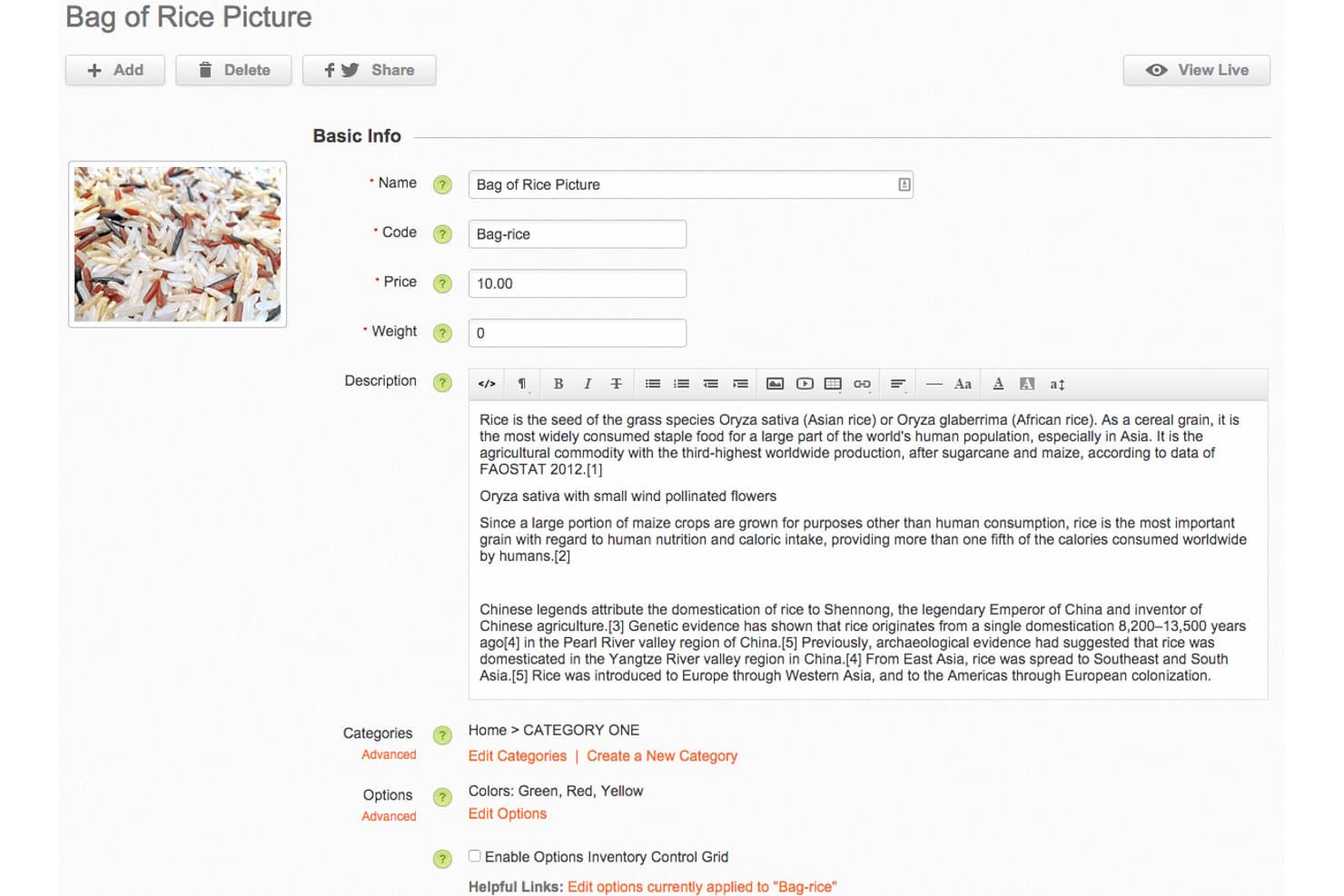
Volusion lets users add detailed product info, pricing, and options. Volusion is an SMB-focused ecommerce platform that offers storefront building, inventory management, customer group pricing, and order management for businesses selling products online.
Who Is Volusion Best For?
Volusion suits small D2C manufacturers looking for an approachable, customizable storefront without the complexity of enterprise ecommerce platforms.
Why I Picked Volusion
I picked Volusion as one of the best because its module-based Site Designer gives small D2C manufacturers real control over how their storefront looks and functions, without needing a developer. I like that you can customize themes with HTML and CSS, add homepage slideshows, image galleries, and content blocks, and configure category pages with subcategories built for product-focused browsing. The Premium Checkout add-on also lets you capture custom shopper requests at checkout, which works well for made-to-order or configurable product setups.
Volusion Key Features
- Customer group pricing: Supports up to five configurable pricing levels, letting you offer differentiated pricing for wholesale buyers or specific customer segments.
- Multi-warehouse inventory management: Assigns products to specific warehouse locations and calculates shipping rates based on the fulfillment origin.
- Automatic reorder alerts: Triggers stock replenishment notifications and auto-generates purchase orders when inventory drops below set thresholds.
- Recurring pricing tool: Configures subscription or recurring billing for products, useful for manufacturers selling consumable or replenishable goods.
Volusion Integrations
Volusion offers about 84 marketplace apps, including Avalara AvaTax, ShipStation, and Shippo; QuickBooks connectivity is available through Webgility. Its XML API, limited to Business and Prime plans, supports custom integrations, and Zapier is available.
Pros and Cons
Pros:
- Customer group pricing with five pricing tiers
- Built-in inventory and multi-warehouse tools
- No transaction fees on any sales
Cons:
- Cannot run separate B2B and D2C stores
- No RFQ or quote management system
Learn more about Volusion: Best for composable commerce flexibility
- Free trial available
- From $49,500/year (billed annually)

Elastic Path lets users organize products using hierarchies and nodes. Elastic Path is a composable, API-first ecommerce platform built for manufacturers and B2B sellers, offering modular tools for complex catalog management, account-based pricing, self-service buyer portals, and multi-channel selling across B2B and D2C storefronts.
Who Is Elastic Path Best For?
Elastic Path is a strong fit for mid-market to enterprise manufacturers and distributors that need a fully composable, API-first commerce platform to handle complex B2B catalogs, account-based pricing, and multi-channel selling across both wholesale and D2C storefronts.
Why I Picked Elastic Path
Elastic Path earns its spot on my shortlist because its composable architecture lets manufacturers swap, extend, or replace individual commerce components without rebuilding the entire stack. I particularly like the Product Experience Manager, which handles unlimited SKUs, variants, configurable options, and customer-specific catalogs in one place, eliminating the need for a separate PIM. Its account hierarchy system, with role-based buyer access and spend-threshold approvals, maps directly to how real wholesale procurement teams actually operate.
Elastic Path Key Features
- PunchOut gateway: Connects your storefront directly to enterprise eProcurement systems like SAP Ariba and Coupa via cXML PunchOut workflows.
- Unlimited price books: Supports multiple simultaneous price books tied to customers, volume thresholds, time periods, or geography for flexible pricing control.
- Composer iPaaS: A built-in integration platform with 100+ connectors and 3,000+ actions for linking ERPs, OMS, CRM, and fulfillment systems.
- Self-service buyer portal: Buyers can manage accounts, submit quick-order CSV uploads, access invoices, and route approvals through spend-threshold workflows.
Elastic Path Integrations
Elastic Path Composer offers 100+ connectors, including SAP, Oracle NetSuite, Microsoft Dynamics 365, Epicor, Stripe, PayPal, and TradeCentric for SAP Ariba and Coupa PunchOut. Its API-first architecture supports custom ERP, inventory, and manufacturing system integrations.
Pros and Cons
Pros:
- PunchOut gateway supports enterprise procurement integration
- Unlimited customer-specific catalogs and price books
- Built-in account hierarchies for B2B selling
Cons:
- Lacks native multi-round RFQ negotiation
- Requires in-house developers for customizations
Learn more about Elastic Path:
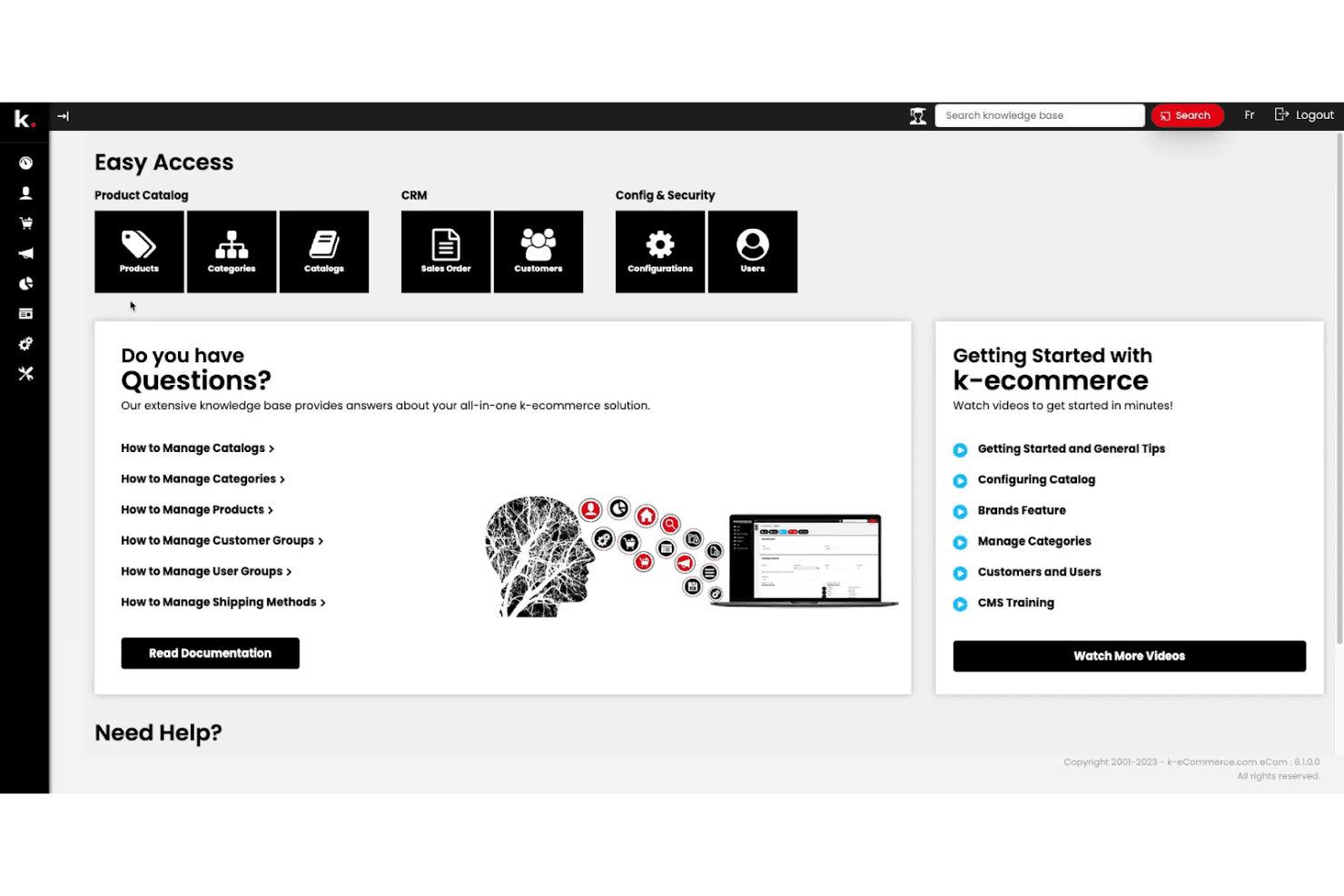
K-eCommerce houses catalog, CRM, and configuration functions for B2B operations. K-eCommerce is a B2B ecommerce platform built specifically for manufacturers and distributors, offering native ERP integration, customer-specific catalog and pricing management, self-service buyer portals, and a dedicated sales rep ordering interface.
Who Is K-eCommerce Best For?
K-eCommerce is the right fit for manufacturers and distributors running Microsoft Dynamics, Acumatica, or SAP Business One who need a B2B storefront that pulls pricing and inventory directly from their ERP.
Why I Picked K-eCommerce
K-eCommerce earns its spot on my shortlist because its ERP integration isn't bolted on—it's the foundation the entire platform is built around. I'm particularly impressed by how it syncs customer-specific contract pricing and real-time inventory directly from Microsoft Dynamics, Acumatica, or SAP Business One, with no middleware in the way. The Sales Rep Portal also stands out to me: reps can pull up a buyer's ERP-accurate pricing and place orders on their behalf without leaving the platform.
K-eCommerce Key Features
- Model Match search: Filters products by make, model, and year so buyers in parts-heavy industries can locate the right SKU without manual catalog browsing.
- Bulk CSV/Excel order upload: Buyers can import large order lists directly into the storefront instead of adding items one by one.
- Punchout catalog integration: Connects your storefront to enterprise procurement systems like Ariba and Coupa via cXML so large buyers can purchase without leaving their own procurement workflow.
- KIP integrated payments: A PCI Level 1 certified B2B payment portal that lets buyers pay multiple invoices simultaneously, with automatic ERP reconciliation on each transaction.
K-eCommerce Integrations
K-eCommerce offers seven native ERP integrations, including Microsoft Dynamics, Acumatica, and SAP Business One, plus Avalara AvaTax and Thomson Reuters Onesource. It also supports Amazon, eBay, and paid cXML Punchout integrations with Ariba and Coupa.
Pros and Cons
Pros:
- Dedicated B2B buyer and sales rep portals
- Handles 100,000+ SKU complex catalogs
- Native ERP integration with no middleware
Cons:
- No headless commerce or API-first option
- Limited ERP compatibility beyond Dynamics and SAP B1
Learn more about K-eCommerce:
Andre e-handelsplattformer for produsenter
Her er noen flere alternativer innen e-handelsprogramvare som ikke kom med på kortlisten min, men som likevel er verdt å undersøke:
- 11Sana CommerceBest for ERP integration
- 12WooCommerceBest for WordPress integration
- 13IntershopBest for comprehensive B2B solutions
- 14MRPeasyBest for small manufacturers
- 15KatanaBest for visual production planning
- 16OdooBest for ERP and CRM integration
- 17NetSuite SuiteCommerceBest for large enterprises
- 18commercetoolsBest for headless commerce architecture
- 19BigCommerceBest for scalability and integrations
- 20VirtinaBest for custom ecommerce solutions
How I Evaluate Ecommerce Platforms for Manufacturers
I split my evaluation into two layers: the baseline B2B capabilities a platform needs—like ERP integration and tiered pricing—and the differentiators that make one a better fit for manufacturers.
Core Functionality (Table Stakes For This List)
When I'm selecting tools for my list, I rank each one on a scale from 0 (does not offer the functionality) to 5 (excels in this area) for each core functionality listed below. Then, I calculate the tool's total score into a percentage. Each tool needs to achieve a minimum total score of 65% to be considered for inclusion.
- B2B Commerce Capabilities: I check whether a platform supports customer-specific pricing, net terms, and account hierarchies—the kind of buying experience wholesale distributors and procurement teams expect.
- ERP & Manufacturing Integration: Real-time sync with systems like SAP, NetSuite, or Epicor matters here, so I evaluate prebuilt connectors and API depth for production, inventory, and order data.
- Product Catalog Management: I look for how well each platform handles high SKU counts, configurable products, and technical specifications—things like material grades, tolerances, or custom dimensions.
- Quote & RFQ Management: Many manufacturer buyers need to negotiate pricing before placing an order, so I evaluate the in-platform quoting workflow from request through approval to order conversion.
- Multi-Channel & Hybrid Selling: Manufacturers increasingly sell B2B and D2C from one system, so I look at how each platform manages multiple storefronts, warehouses, and sales channels under a single admin.
- Self-Service Buyer Portal: Repeat purchasing drives revenue for most manufacturers, so I evaluate portal features like saved order lists, quick-reorder pads, sub-account permissions, and invoice access.
Once I have a list of tools that meet the criteria, I consider what sets each platform apart.
Differentiating Factors (What Sets Vendors Apart)
Here's how I compare and contrast different vendors:
Standout Features
Punchout and EDI support is a major differentiator—manufacturers selling to enterprise buyers often need cXML or OCI connections to procurement systems like Ariba or Coupa. I also evaluate whether a platform includes an advanced product configurator that lets buyers customize products with rule-based compatibility checks and live pricing. For manufacturers who sell through channel partners, dedicated dealer portals with co-branded storefronts and territory-based pricing can shape the entire buying experience.
Beyond Features
The integration ecosystem matters a lot here—I check whether a platform connects natively to the ERP, PIM, and WMS tools a manufacturer already relies on, since rip-and-replace isn't realistic. Implementation timelines vary wildly in this category, so I evaluate whether vendors offer migration tooling and certified partners with manufacturing experience. I also consider deployment flexibility, especially for manufacturers who need multi-region support with local tax compliance and multi-currency checkout.
Slik velger du en e-handelsplattform for produsenter
Det er lett å gå seg vill i lange funksjonslister og kompliserte prisstrukturer. For å hjelpe deg med å holde fokus mens du arbeider deg gjennom din unike prosess for valg av programvare, får du her en sjekkliste over faktorer du bør ha i mente:
| Faktor | Hva du bør vurdere |
| Skalerbarhet | Vil plattformen vokse i takt med virksomhetens behov? |
| Integrasjoner | Kan den kobles sømløst til de eksisterende systemene dine? |
| Tilpasningsmuligheter | Kan den tilpasses de spesifikke arbeidsflytene dine? |
| Brukervennlighet | Vil teamet ditt oppleve det som intuitivt å administrere? |
| Budsjett | Passer plattformen innenfor de økonomiske planene dine? |
| Sikkerhetstiltak | Finnes det sikkerhetstiltak som beskytter dataene dine? |
| Kundestøtte | Tilbyr den pålitelig kundestøtte ved behov? |
| Mobilkompatibilitet | Kan du administrere plattformen fra mobile enheter? |
Bruk denne sjekklisten for å holde programvarevalget organisert og målrettet.
Trender innen e-handelsplattformer for produsenter
I undersøkelsen min hentet jeg inn utallige produktoppdateringer, pressemeldinger og lanseringslogger fra ulike leverandører av e-handelsplattformer. Her er noen av de fremvoksende trendene jeg følger med på, og som produksjonsbedrifter bør vurdere:
- Hodeløs handel: Flere plattformer tilbyr hodeløse oppsett, slik at produsenter kan koble fra front- og backend. Dette gir virksomheter større fleksibilitet til å skape tilpassede brukeropplevelser uten å være bundet til et bestemt frontend-system.
- AI-drevet personalisering: Produsenter bruker i økende grad AI-optimalisering for å tilpasse handleopplevelsen for kundene sine. Plattformene tar i bruk AI for å anbefale produkter, optimalisere søkeresultater og tilpasse priser, slik at interaksjonene blir mer relevante.
- B2B-kundeportaler: Leverandørene fokuserer på avanserte kundeportaler som er utviklet spesielt for B2B-kjøpere. Disse portalene gjør det mulig for produsenter å tilby personlige priser, ordrehistorikk og tilpassede kataloger, slik at kjøpsprosessen blir enklere for tilbakevendende kunder.
- Selvbetjeningsverktøy: Det er økende etterspørsel etter selvbetjeningsfunksjoner som lar B2B-kjøpere administrere kontoene sine, spore bestillinger og konfigurere produkter selvstendig. Plattformene legger til disse verktøyene for å redusere belastningen på salgsteamene og samtidig gi kundene større kontroll.
- Bærekraft og sporbarhet: Flere produsenter prioriterer bærekraft i forsyningskjeden, og e-handelsplattformene svarer ved å tilby funksjoner som sporer produktenes opprinnelse og bærekraftsindikatorer. Disse verktøyene hjelper produsenter med å møte forbrukernes krav om åpenhet.
Hva er en e-handelsplattform for produsenter?
En e-handelsplattform for produsenter er et digitalt verktøy som hjelper produsenter med å selge produktene sine på nettet, administrere bestillinger og håndtere B2B-transaksjoner. Disse verktøyene brukes vanligvis av salgsteam, ledere for forsyningskjeden og e-handelsspesialister for å forenkle driften og forbedre kundeopplevelsene. Lagerstyring, kundeportaler og personlige priser bidrar til å effektivisere prosesser og forbedre effektiviteten. Samlet sett gjør disse plattformene det enklere for produsenter å administrere store produktkataloger og betjene B2B-kunder på en effektiv måte. Spesialiserte sektorer som bilindustrien kan dra nytte av dedikerte e-handelsplattformer for bildeler som forstår bransjespesifikke krav.
Funksjoner i e-handelsplattformer for produsenter
Når du velger en e-handelsplattform for produsenter, er det avgjørende å vurdere funksjoner som er spesielt tilpasset produksjonsbransjens unike behov. Nedenfor finner du noen av de viktigste funksjonene som kan gi nettvirksomheten din et konkurransefortrinn:
- Lagerstyring: Sporer lagernivåer effektivt og administrerer lagerbeholdningen for å forhindre overfylte lagre eller utsolgte varer.
- Ordreadministrasjon: Effektiviserer arbeidsflyten for ordrebehandling fra bestilling til levering og sikrer rettidig oppfyllelse.
- B2B-funksjonalitet: Støtter massebestillinger, tilpassede priser og kontoadministrasjon skreddersydd for bedriftskunder.
- Produkttilpasning: Lar kunder tilpasse produkter etter egne spesifikasjoner, noe som øker kundetilfredsheten.
- Integrasjonsmuligheter: Integreres med eksisterende ERP-, CRM- og andre forretningssystemer for å sikre datakonsistens.
- Avansert analyse: Gir detaljert innsikt i salg, kundeatferd og markedstrender for å danne grunnlag for forretningsbeslutninger.
- Mobilkompatibilitet: Sikrer at plattformen er tilgjengelig og fungerer på mobile enheter, slik at den dekker behovene til brukere på farten.
- Sikkerhetsfunksjoner: Implementerer robuste sikkerhetstiltak for å beskytte sensitive data og transaksjoner.
- Skalerbarhet: Støtter virksomhetens vekst ved å håndtere et økende antall produktlinjer, kunder og ordrevolumer.
- Kundestøtte: Tilbyr pålitelig støtte for å løse problemer eller besvare spørsmål og sikre problemfri drift.
Ved å effektivisere komplekse oppgaver som lager- og ordreadministrasjon vil disse trendene avhjelpe vanlige utfordringer produsenter møter, for eksempel lagerproblemer og langsom ordreoppfyllelse. Med skreddersydde B2B-funksjoner, sømløse integrasjoner og sterk sikkerhet kan virksomheter arbeide mer effektivt, samtidig som de trygt skalerer forretningsmodellen sin for fremtidig vekst.
Fordeler med netthandelsplattformer for produsenter
Når du velger en netthandelsplattform for en produksjonsvirksomhet, bør du se etter følgende viktige funksjoner:
- Tilpassbare produktkataloger: Lar produsenter opprette detaljerte kataloger og produktinformasjon skreddersydd for bestemte kunder eller bransjer.
- Lagersporing i sanntid: Bidrar til å administrere lagernivåer og unngå oversalg ved å oppdatere lagerbeholdningen i sanntid.
- ERP-integrasjon: Synkroniserer plattformen med eksisterende systemer for virksomhetsressursplanlegging, slik at data- og prosessadministrasjonen blir enklere.
- Prisalternativer spesifikt for B2B: Tilbyr fleksible prisstrukturer, for eksempel volumrabatter eller kundespesifikke priser, for å dekke komplekse behov knyttet til B2B-netthandelsplattformer.
- Selvbetjente kundeportaler: Gjør det mulig for nye kunder å lagre betalingsinformasjonen sin, og for eksisterende eller tidligere kunder å administrere ordrene sine, se ordrehistorikk og legge inn nye bestillinger på egen hånd.
- Støtte for salg i flere kanaler: Lar produsenter selge gjennom flere kanaler, for eksempel netthandelsnettstedet, markedsplasser og sosiale medieplattformer, fra ett system.
- Avansert rapportering og analyse: Gir innsikt i salg, kundeatferd og produktytelse for å bidra til velinformerte beslutninger.
- Verktøy for ordreadministrasjon: Effektiviserer prosessen med å motta, behandle og oppfylle ordrer effektivt på tvers av ulike kanaler.
Kostnader og priser for netthandelsplattformer for produsenter
Ved valg av lønnsprogramvare er det viktig å forstå de ulike prismodellene og abonnementene som er tilgjengelige. Kostnadene varierer basert på funksjoner, teamstørrelse, tillegg og mer. Tabellen nedenfor oppsummerer vanlige abonnementer, gjennomsnittsprisene deres og typiske funksjoner som er inkludert i disse programvareløsningene:
Sammenligningstabell for netthandelsplattformer for produsenter
| Abonnementstype | Gjennomsnittspris | Vanlige funksjoner |
| Gratisabonnement | $0 | Grunnleggende nettstedoppsett, begrenset antall produktoppføringer, grunnleggende kundestøtte |
| Personlig abonnement | $30 - $50/måned | Egendefinert domene, grunnleggende analyse, begrensede tilpasningsmuligheter, kundestøtte via e-post |
| Bedriftsabonnement | $100 - $300/måned | Avansert analyse, flere betalingsløsninger, markedsføringsverktøy, kundestøtte døgnet rundt |
| Storbedriftsabonnement | $500 - $2,000+/måned | Tilpassede integrasjoner, dedikert kundeansvarlig, avanserte sikkerhetsfunksjoner, SLA |
En oversikt over abonnementstyper for netthandelsplattformer for produsenter, samt kostnadene og funksjonene deres.
Vanlige spørsmål om e-handelsplattformer for produsenter
Her er noen svar på vanlige spørsmål om e-handelsplattformer for produsenter:
Hvordan integreres en e-handelsplattform med mitt eksisterende ERP-system?
De fleste e-handelsplattformer for produsenter tilbyr direkte integrasjoner med populære ERP-systemer. Denne integrasjonen bidrar til å synkronisere lagerbeholdning, bestillinger og kundedata mellom systemene i sanntid. Det sikrer at teamet vårt kan unngå manuell dataregistrering, noe som reduserer feil og sparer tid. Du bør kontrollere at plattformen du velger, støtter ERP-systemet du allerede bruker.
Kan en e-handelsplattform håndtere komplekse B2B-priser?
Ja, mange e-handelsplattformer for produsenter er utviklet for å håndtere komplekse B2B-prisstrukturer. De lar deg ofte opprette trinnvis prissetting, kundespesifikke rabatter og mengdebaserte priser. Denne fleksibiliteten sikrer at plattformen kan tilpasses ulike kundetyper, fra små bedrifter til store virksomheter, uten behov for manuelle justeringer.
Hvor tilpasningsbare er e-handelsplattformer for produsenter?
De fleste plattformer tilbyr omfattende tilpasningsmuligheter, slik at du kan skreddersy nettbutikken etter bedriftens behov. Du kan vanligvis justere utforming, produktkataloger og brukeropplevelse. I tillegg gir mange plattformer tilgang til API-er og programtillegg som muliggjør mer omfattende tilpasninger. Teamet ditt kan tilpasse plattformen til bestemte arbeidsflyter, merkevareprofil og produktserier.
Hvilken type støtte er tilgjengelig for å sette opp en e-handelsplattform?
Mange e-handelsplattformer tilbyr omfattende støtte ved oppstart, inkludert opplæringsvideoer, dokumentasjon og kundesuksessansvarlige. Noen tilbyr også implementeringsspesialister som kan veilede teamet ditt gjennom oppsettprosessen. Du bør velge en plattform som samsvarer med teamets tekniske ferdighetsnivå og tilbyr tilstrekkelig støtte for oppsettbehovene dine.
Kan jeg bruke en e-handelsplattform til å administrere flere nettbutikker?
Ja, mange e-handelsplattformer for produsenter lar deg administrere flere nettbutikker fra ett enkelt administrasjonsgrensesnitt. Denne funksjonen er spesielt nyttig for virksomheter som opererer i flere regioner eller betjener ulike kundesegmenter. Du kan sentralisere lagerbeholdning, bestillinger og kundedata, samtidig som du opprettholder separate nettbutikker for hver merkevare eller hvert marked.
Hvordan bidrar e-handelsplattformer til ordrehåndtering?
E-handelsplattformer for produsenter omfatter vanligvis verktøy for å effektivisere ordrebehandling, ordreoppfyllelse og sporing. Disse verktøyene kan automatisere oppgaver som oppdatering av lagerbeholdning, generering av fraktetiketter og varsling av kunder om ordrestatus. Ved å bruke disse funksjonene kan teamet ditt håndtere store ordrevolumer mer effektivt og redusere feil.