

Local Express vs. Mercatus: Comparison & Expert Reviews for 2026
Curious how Local Express and Mercatus really stack up for grocery ecommerce? I break down the key differences so you can pick the best-fit platform with confidence.

We review tools independently, and commissions help fund our testing. See our transparency policy, our methodology, or suggest a tool.
For grocers, the right ecommerce platform can shape everything from checkout speed to fulfillment and customer loyalty. The challenge is finding a solution that fits your existing systems while giving your team the flexibility to grow.
If you’re weighing Local Express against Mercatus, you probably want a grocery ecommerce platform that keeps your business moving while making customers happy. The two come at that from opposite ends. Local Express builds outward from the store, adding kiosks, scan and go, and your own delivery fleet, while Mercatus builds inward from the shopper, treating personalization and loyalty as the product. Both sell to regional chains and independents, so size alone will not settle this one.
In this article, you’ll get a full comparison of Local Express and Mercatus, including direct pros and cons, ideal use cases, pricing, security, and day-to-day usability. I’ll give you the details you need so you can confidently pick the right solution for your business..
Local Express
4.8/5
- Free demo available
- Pricing upon request
Mercatus
0/5
- Free demo available
- Pricing upon request
Why Trust Our Software Recommendations
6,700+
Reviews
20
Industry experts
16+
Evaluation factors
14
Years
Our team has been testing and reviewing software since 2012. As retail leaders ourselves, we know how difficult—and important—it is to choose the right software.
For this guide, we evaluated tools using hands-on testing and independent research, scoring tools using our selection criteria.
Our reviews reflect our independent judgment—not a sales pitch.
| Local Express | Mercatus | |
|---|---|---|
| Free Trial | Free demo available | Free demo available |
| Pricing | Pricing upon request | Pricing upon request |
Local Express vs. Mercatus Pricing & Hidden Costs
Neither company publishes a rate card, so both start with a quote, though the contracts differ in shape. Local Express sells four packages, eCommerce Omnichannel, In-Store Kiosk Only, Prepared Foods PRO, and Commerce Enterprise, and markets itself hard on zero commissions. Its terms of service tell a fuller story: one-time integration fees billed separately for each mobile app, a monthly subscription that accrues whether or not you are live, per-location fees as you add stores, and a transaction fee set as a percentage of every order. Mercatus publishes even less. It names three editions, DXP for independents launching fast, DXPlus for growing retailers, and the flagship DXPro, but attaches no feature matrix, no store-count threshold, and no price to any of them. The only fee disclosed anywhere on its site is an activation charge for the expanded Salsify catalog.
To find the best fit, map the features, integrations, and support levels you actually need over the next year or two before either sales call. Ask both for one-time and ongoing costs in writing, including fees for scaling up, premium modules, and custom integrations. With Local Express, read the transaction fee clause in the contract against the zero commission marketing. With Mercatus, ask which edition you are being quoted and what moves you up a tier, because none of that is public.
| Local Express | Mercatus | |
|---|---|---|
| 2-Factor Authentication | Yes | Yes |
| A/B Testing | Yes | Yes |
| Analytics | Yes | Yes |
| API | Yes | Yes |
| BitCoin | Yes | Yes |
| Conversion Tracking | Yes | Yes |
| Dashboard | Yes | Yes |
| Data Export | Yes | Yes |
| Data Import | Yes | Yes |
| Data Visualization | Yes | Yes |
| Design Templates | Yes | Yes |
| External Integrations | Yes | Yes |
| Inventory Tracking | Yes | Yes |
| Keyword Tracking | Yes | Yes |
| Marketing Automation | Yes | Yes |
| Multi-User | Yes | Yes |
| Notifications | Yes | Yes |
| Order Management | Yes | Yes |
| Payment Gateway Integration | Yes | Yes |
| Payment Processor | Yes | Yes |
| PayPal | Yes | Yes |
| Product Catalog | Yes | Yes |
| Review Monitoring | Yes | Yes |
| SAP Integration | Yes | Yes |
| Scheduling | Yes | Yes |
| Stripe | Yes | Yes |
| Third-Party Plugins/Add-Ons | Yes | Yes |
| Integration | Local Express | Mercatus |
|---|---|---|
| IntegrationSquare | Local Express✅ | Mercatus❌ |
| IntegrationClover | Local Express✅ | Mercatus❌ |
| IntegrationNCR | Local Express✅ | Mercatus✅ |
| IntegrationStripe | Local Express✅ | Mercatus❌ |
| IntegrationFiserv | Local Express❌ | Mercatus✅ |
| IntegrationDoorDash | Local Express✅ | Mercatus✅ |
| IntegrationUber Eats | Local Express✅ | Mercatus❌ |
| IntegrationSalesforce | Local Express❌ | Mercatus✅ |
| IntegrationGoogle Analytics | Local Express✅ | Mercatus✅ |
Local Express integrates with roughly 100 apps, and point of sale is where it pulls ahead, listing around 30 systems including Square, Clover, NCR, IT Retail, and ECRS. Mercatus advertises 60 or so pre-built integrations and names four POS vendors, NCR, Toshiba, Retalix, and GK Software, though it files them under checkout and payments and publishes nothing about what those connections actually do. Two things worth weighing: Mercatus is stronger on enterprise tooling, with Salesforce, Ping Identity, and Tableau on the list, while Local Express is the only one of the two that will push your catalog onto Uber Eats and Grubhub.
| Factor | Local Express | Mercatus |
|---|---|---|
| FactorRegulatory Compliance | Local ExpressReports SOC 2 and GDPR compliance, though none of it is documented publicly and the site carries no trust page. | MercatusClaims PCI DSS compliance, but names a version of the standard retired in 2024, and lists no SOC 2 or ISO certification. |
| FactorThird-Party Certification | Local ExpressNone published, with the compliance claims coming from the company rather than any audit it shows you. | MercatusCertified by Fiserv as an EBT integrator, the only third-party certification either platform publishes. |
| FactorCustomer Data | Local ExpressYou own merchant and customer data, though the terms grant a perpetual license to use it in anonymized form. | MercatusRuns as an embedded customer data platform, unifying loyalty, point of sale and ecommerce activity for targeting. |
| FactorUptime Guarantee | Local ExpressNo platform-wide commitment, though the LEA Price Agent page carries a 99% uptime SLA of its own. | MercatusClaims 99.9% uptime, but only on the mobile app page, with no SLA document or public status page. |
| FactorAccessibility | Local ExpressNo accessibility policy or WCAG commitment published anywhere on the site. | MercatusFormal WCAG 2.0 AA policy tied to Ontario's AODA legislation, though marketing pages claim WCAG 2.1. |
Both tools provide strong security foundations, but Mercatus leads with broader compliance and enterprise-grade reliability. I find Local Express best for most grocers needing straightforward data security, while Mercatus shines for large chains with heavy compliance needs and complex systems.
| Factor | Local Express | Mercatus |
|---|---|---|
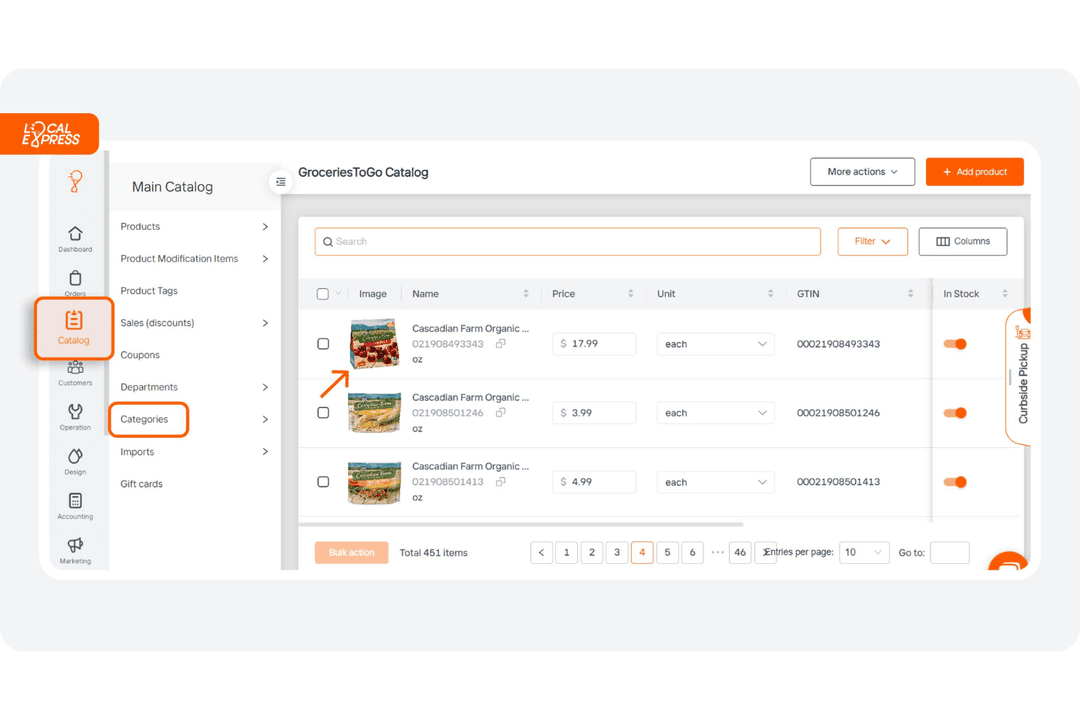
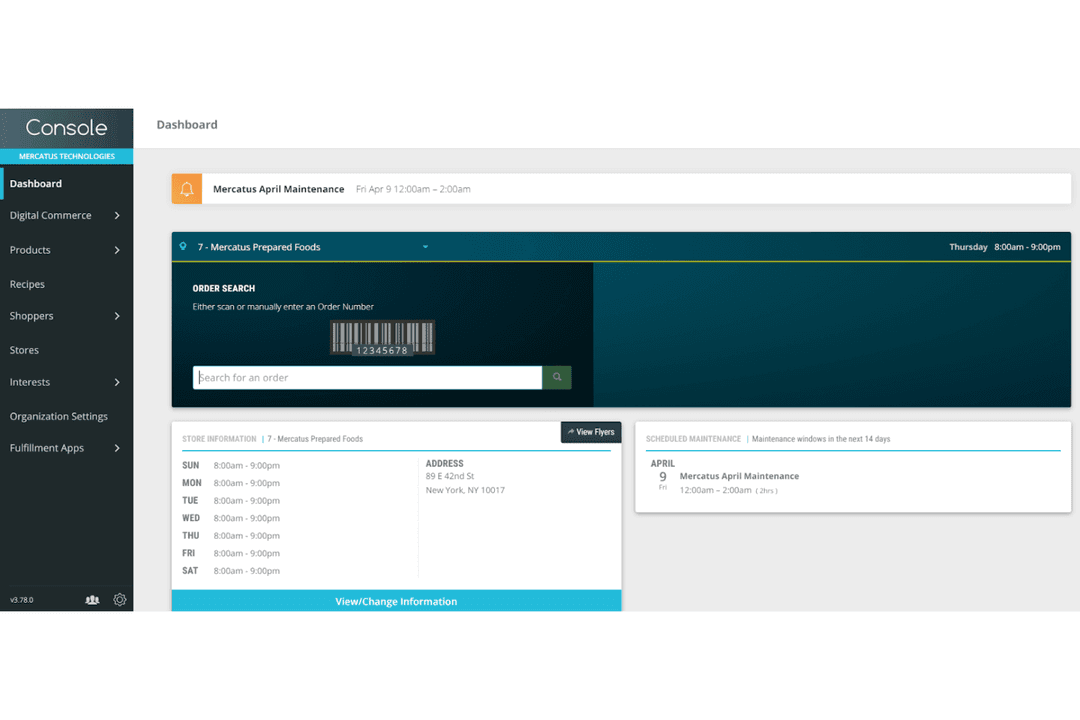
| FactorUser Interface | Local ExpressDrag-and-drop storefront and app builder with a unified admin dashboard and multi-level staff permissions. | MercatusMercatus Console centralizes orders, reporting, store hours and catalog, with access set by employee role. |
| FactorOnboarding | Local ExpressFour guided steps running from business analysis through POS integration, storefront design, and launch. | MercatusNo published methodology; the one documented rollout ran ten months, converting a few stores per month. |
| FactorDay-to-Day Tasks | Local ExpressPickers work from a web portal or mobile app with scanners, batch picking, and store mapping for routes. | MercatusThe Mercatus Pick App handles scanning, variable weight items and prepared foods, and ships with the platform. |
| FactorCurbside Handoff | Local ExpressReserved parking stalls and QR code contactless pickup, with the customer signaling arrival. | MercatusFlybuy geolocation tracks the customer's approach and gives associates an ETA, with a claimed two minute wait. |
| FactorSupport | Local ExpressLive chat, phone, and email with extended daily hours, plus a knowledge base in English and Spanish. | MercatusAn assigned program manager per account, with no published response times or support hours. |
Local Express is the faster of the two to get live, running a four-step onboarding that opens with a business analysis and hands over a finished storefront. Mercatus operates on a more gradual implementation timeline, with larger retail deployments often rolling out location by location over several months rather than all at once. I think Local Express suits teams that want to be trading quickly, while Mercatus is built for chains that treat the rollout as a program with a budget line.
Local Express
- Keeps customer relationships, revenue, and margin in-house
- Bundles AI upselling, price checks, and product imagery
- Syncs with any POS and unifies in-store with online data
- Feature breadth can overwhelm teams at first
- Full value needs a staged rollout, not one switch-on
- Product data cleanup has to happen before launch
Mercatus
- Customizable storefronts align closely with grocery branding needs
- Real-time inventory sync connects online and in-store availability
- Loyalty and digital coupon features encourage repeat shopping
- Upfront setup requires more time and technical resources
- Fewer pre-built templates than some competitors offer
- Pricing transparency is limited without direct sales inquiry
Local Express
- Independent GrocersEasy onboarding, hands-on support, and grocery-specific integrations make it ideal for local stores moving online.
- Specialty Food ShopsNiche product catalogs, complex pricing, and custom fulfillment options are supported out of the box.
- Regional Grocery ChainsMulti-store management and branded customer experiences scale to operators running hundreds or even a couple thousand locations.
- Small eCommerce TeamsAccessible setup and guided onboarding help small, resource-limited teams launch fast.
- In-House Delivery TeamsBuilt-in delivery integrations and outsourcing only the final leg simplify running delivery operations at a lower cost per order.
- Community MarketplacesMultiple vendors and inventory sources can be unified for local delivery or pickup.
Mercatus
- Multi-Store ChainsMercatus excels at managing multiple store locations with centralized control, comprehensive reporting, and customized workflows for each site.
- Regional Grocery BrandsThe platform enables tailored branding, localized promotions, and unique loyalty programs supporting regional marketing strategies.
- Specialty Food RetailersSpecialty grocers with distinct inventory benefit from advanced catalog management, integrations, and online grocery sales features.
- Omnichannel OperationsMercatus unifies ecommerce, in-store, and delivery workflows, making it well-suited for grocers needing a seamless omnichannel experience.
- Enterprise Ecommerce TeamsLarge retailers value enterprise-grade integration options, specialized support, and security, especially in Mercatus’s advanced pricing tiers.
- Grocery Membership ProgramsRetailers running membership or subscription services use Mercatus’s promotion and loyalty features to encourage repeat purchases and boost retention.
Who Should Use Local Express, and Who Should Use Mercatus?
Local Express fits grocers who want one system across the whole store, particularly independents and regional chains running their own pickers and drivers who also want kiosks, scan and go, and marketplace listings in the same stack. Be aware that its LEA agents are pitched at operations of 50 to 500 stores, so the AI layer aims higher than the rest of the platform. Mercatus fits retailers whose growth depends on knowing their shoppers, with an embedded customer data platform, mature loyalty integrations, and a retail media network Mercatus runs on your behalf. Both chase the same segment, so the real question is whether you are buying store surfaces or shopper intelligence.
| Local Express | Mercatus | |
|---|---|---|
| Marketplace Listing | Local Express One-click listing onto DoorDash, Uber Eats, and Grubhub as additional sales channels | Mercatus Uses Instacart and DoorDash for delivery labor only, and lists your catalog onto no marketplace |
| Personalization | Local Express Four LEA agents covering shopping, repricing, catalog enrichment, and natural-language analytics | Mercatus AisleOne Intelligence as an embedded CDP, with churn signals and 50+ customer data attributes |
| Retail Media | Local Express Run in-house across app, site, kiosk and email, with your team managing the campaigns | Mercatus Managed by Mercatus as a service, powered by CitrusAd, including CPG sampling on pickup orders |
| Store Surfaces | Local Express Self-service kiosks, Scan Pay and Go, and a kitchen display system for prepared foods | Mercatus Order Ahead for deli and catering with a unified cart, but no kiosk or scan and go product |
| Online Storefront | Both ship a branded storefront and native mobile apps built for grocery, with your brand fronting the experience rather than the platform’s. |
|---|---|
| Order Fulfillment | Each covers in-store pickup, curbside and local delivery, with picking tools for staff and third-party couriers handling the last mile. |
| POS Integration | Both sync against the point of sale you already run rather than replacing it, though only Local Express publishes the list of systems it supports. |
| Quote-Based Pricing | Neither publishes rates, so both begin with a sales conversation, and neither documents what moves you between tiers. |