


Local Express vs. Instacart Storefront: Comparison & Expert Reviews for 2026
See how Local Express and Instacart Storefront stack up for grocery ecommerce—I break down what sets each apart so you can find your best-fit solution.

We review tools independently, and commissions help fund our testing. See our transparency policy, our methodology, or suggest a tool.
Selling groceries online means balancing convenience for customers with control over your brand, operations, and margins. The right platform should make that easier without forcing your business into a one-size-fits-all model.
If you’re struggling to choose between Local Express and Instacart Storefront, you’re not alone. Finding a grocery ecommerce platform that fits your store’s needs—whether you want control over branding, easier integrations, or a better customer experience—can feel overwhelming. Each platform takes a different approach to online grocery sales and fulfillment.
In this article, you’ll get a clear comparison with expert insights into each tool’s pros and cons, top use cases, pricing, security, and usability. By the end, you’ll know which option is a better fit for your business and what to expect if you’re pivoting to a grocery ecommerce platform.
Local Express
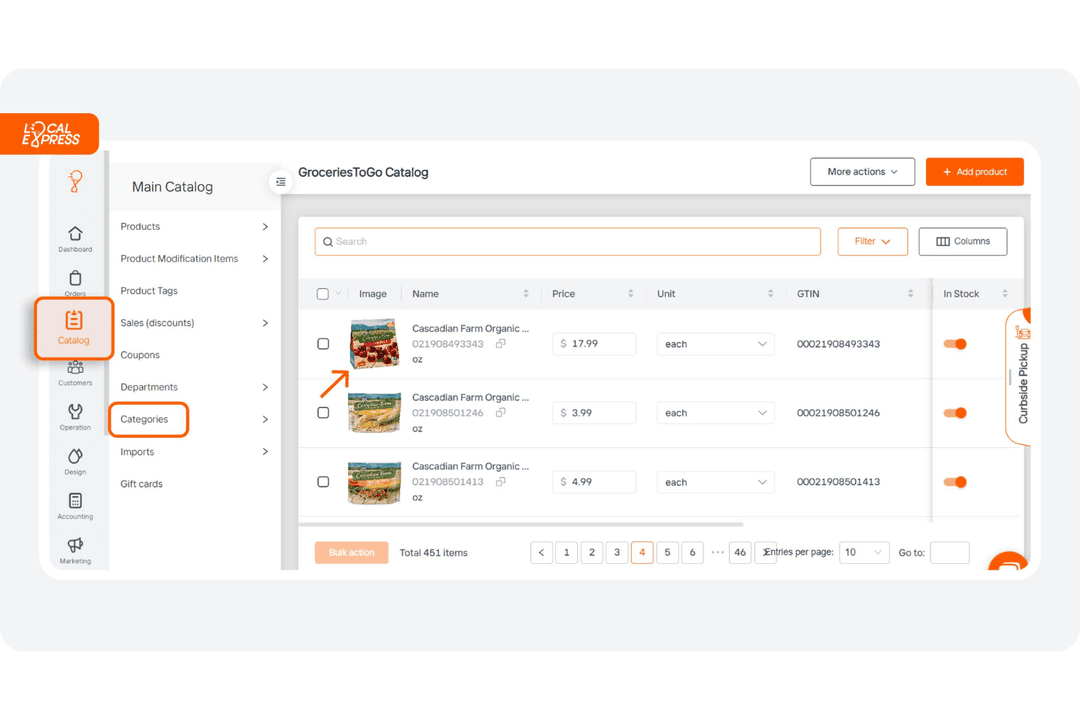
4.8/5
- Free demo available
- Pricing upon request
Instacart Storefront
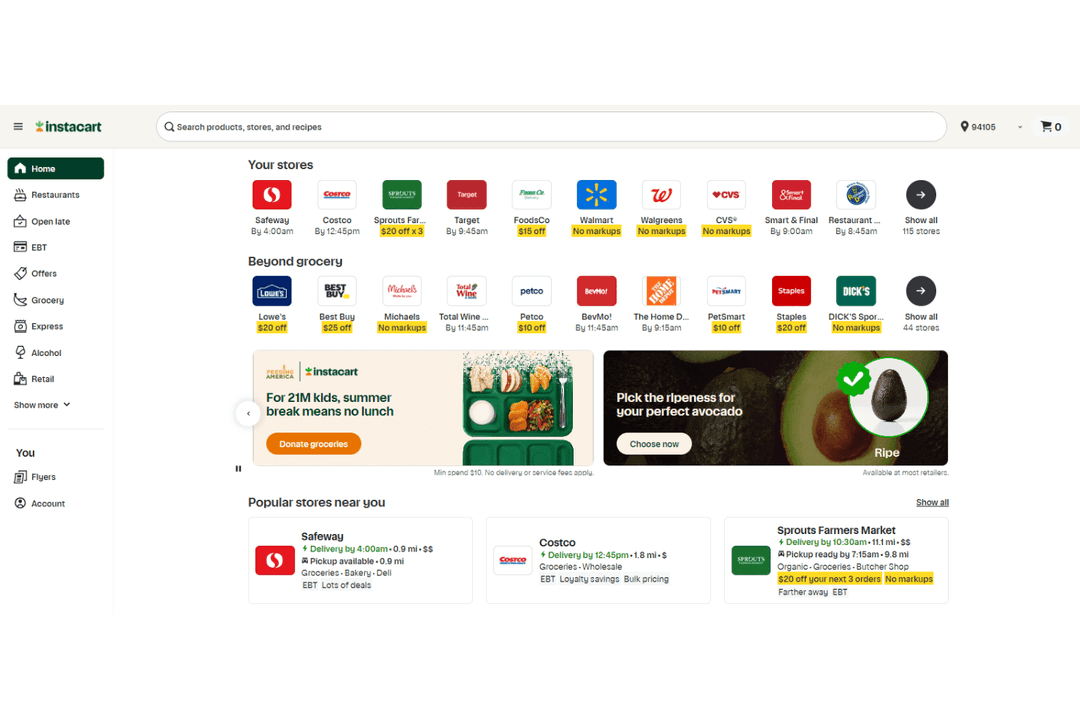
4/5
- Free demo available
- Pricing upon request
Why Trust Our Software Recommendations
6,700+
Reviews
20
Industry experts
16+
Evaluation factors
14
Years
Our team has been testing and reviewing software since 2012. As retail leaders ourselves, we know how difficult—and important—it is to choose the right software.
For this guide, we evaluated tools using hands-on testing and independent research, scoring tools using our selection criteria.
Our reviews reflect our independent judgment—not a sales pitch.
| Local Express | Instacart Storefront | |
|---|---|---|
| Free Trial | Free demo available | Free demo available |
| Pricing | Pricing upon request | Pricing upon request |
Local Express vs. Instacart Storefront Pricing & Hidden Costs
Neither company publishes rates, so both conversations start with a quote. Local Express builds a package around the features, integrations, and services your operation needs, so the number moves with how much of the suite you switch on. Storefront Pro works differently: its platform fees are designed to be offset by retail media, and Instacart says Carrot Ads covers upwards of 65% of monthly platform costs for the average retailer. That reframes the comparison, because part of what you pay is meant to come back as ad revenue rather than out of your margin.
To find the right fit, look beyond the headline price and dig into the details of each agreement. I’d recommend running some order volume scenarios and seeing how costs change across your busiest and slowest periods. Ask about onboarding, support, and integration fees, and with Storefront Pro press hard on what ad monetization realistically looks like at your traffic level, because that 65% figure is an average across retailers rather than a floor you can bank on.
| Local Express | Instacart Storefront | |
|---|---|---|
| 2-Factor Authentication | Yes | Yes |
| A/B Testing | Yes | Yes |
| Analytics | Yes | Yes |
| API | Yes | Yes |
| BitCoin | Yes | Yes |
| Conversion Tracking | Yes | Yes |
| Dashboard | Yes | Yes |
| Data Export | Yes | Yes |
| Data Import | Yes | Yes |
| Data Visualization | Yes | Yes |
| Design Templates | Yes | Yes |
| External Integrations | Yes | Yes |
| Inventory Tracking | Yes | Yes |
| Keyword Tracking | Yes | Yes |
| Marketing Automation | Yes | Yes |
| Multi-User | Yes | Yes |
| Notifications | Yes | Yes |
| Order Management | Yes | Yes |
| Payment Gateway Integration | Yes | Yes |
| Payment Processor | Yes | Yes |
| PayPal | Yes | Yes |
| Product Catalog | Yes | Yes |
| Review Monitoring | Yes | Yes |
| SAP Integration | Yes | Yes |
| Scheduling | Yes | Yes |
| Stripe | Yes | Yes |
| Third-Party Plugins/Add-Ons | Yes | Yes |
| Integration | Local Express | Instacart Storefront |
|---|---|---|
| IntegrationSquare POS | Local Express✅ | Instacart Storefront✅ |
| IntegrationClover POS | Local Express✅ | Instacart Storefront✅ |
| IntegrationStripe | Local Express✅ | Instacart Storefront✅ |
| IntegrationGoogle Analytics | Local Express✅ | Instacart Storefront❌ |
| IntegrationPayPal | Local Express✅ | Instacart Storefront❌ |
| IntegrationDoorDash | Local Express✅ | Instacart Storefront❌ |
| IntegrationAPI | Local Express❌ | Instacart Storefront✅ |
| IntegrationZapier | Local Express❌ | Instacart Storefront❌ |
Local Express and Instacart Storefront offer similar support for POS integrations, making either a viable option for connecting core retail systems. Local Express pulls ahead on overall integration breadth, with additional connections to services like DoorDash and PayPal that can give grocers more flexibility across payments, delivery, and operations.
| Factor | Local Express | Instacart Storefront Pro |
|---|---|---|
| FactorCustomer data | Local ExpressHeld in your own store records | Instacart Storefront ProPartitioned by tenant ID so only your site can reach it, on the Pro tier only |
| FactorCertifications | Local ExpressSOC 2, with GDPR support | Instacart Storefront ProNone published |
| FactorPayment security | Local ExpressBank level encryption and PCI-compliant processing | Instacart Storefront ProCard payments processed by Stripe, Venmo payments by Braintree |
| FactorNamed Regulations | Local ExpressGDPR | Instacart Storefront ProCCPA, CPRA, VCDPA, CPA, CTDPA, UCPA |
This is where the tiers matter most. On standard Storefront your shoppers are Instacart account holders, shared with the marketplace, and Instacart fields their privacy requests. Pro partitions that data behind a tenant ID and hands compliance back to you across CCPA and the newer state laws, with an API for deletion requests. Local Express holds SOC 2 and supports GDPR with bank level encryption. Neither company publishes an uptime or support SLA.
| Factor | Local Express | Instacart Storefront Pro |
|---|---|---|
| FactorAdmin interface | Local ExpressDrag-and-drop dashboard built for store staff | Instacart Storefront ProInstacart Platform Portal, covering catalog, orders, stores, merchandising, and reporting |
| FactorSetup process | Local ExpressFour steps: business analysis, catalog and POS integration, storefront design, launch | Instacart Storefront ProStandard tier uses an intake form; Pro requires a representative and more configuration |
| FactorSelf-serve scope | Local ExpressMost configuration is done for you at launch | Instacart Storefront ProBranding, collections, campaigns, and flyers are self-serve; enabling capabilities needs a rep |
| FactorOngoing data work | Local ExpressCatalog cleaned and matched during onboarding | Instacart Storefront ProDaily inventory file uploads over SFTP |
| FactorSupport | Local ExpressLive chat, phone, and email plus a help center | Instacart Storefront ProEnterprise Technical Support and a status page, with no published response times |
Both platforms put a lot behind a representative. Instacart’s Platform Portal lets you handle branding, collections, campaigns, flyers, and reporting yourself, but enabling most capabilities, from ads to partner pick to loyalty, needs an Instacart contact. Local Express runs a four-step launch that opens with a business analysis and hands over a finished storefront. Neither expects you to bring a developer.
Local Express
- Keeps customer relationships, revenue, and margin in-house
- Bundles AI upselling, price checks, and product imagery
- Syncs with any POS and unifies in-store with online data
- Feature breadth can overwhelm teams at first
- Full value needs a staged rollout, not one switch-on
- Product data cleanup has to happen before launch
Instacart Storefront
- Fast setup with branded storefronts for grocers
- Direct integration with Instacart’s fulfillment and delivery network
- Built-in merchandising and digital marketing tools
- Limited ability to manage multiple store banners under one login
- Some fees and commissions can reduce overall margins
- Advanced analytics are less granular than competing platforms
Local Express
- Independent GrocersEasy onboarding, hands-on support, and grocery-specific integrations make it ideal for local stores moving online.
- Specialty Food ShopsNiche product catalogs, complex pricing, and custom fulfillment options are supported out of the box.
- Regional Grocery ChainsMulti-store management and branded customer experiences scale to operators running hundreds or even a couple thousand locations.
- Small eCommerce TeamsAccessible setup and guided onboarding help small, resource-limited teams launch fast.
- In-House Delivery TeamsBuilt-in delivery integrations and outsourcing only the final leg simplify running delivery operations at a lower cost per order.
- Community MarketplacesMultiple vendors and inventory sources can be unified for local delivery or pickup.
Instacart Storefront
- Independent GrocersInstacart Storefront provides turnkey ecommerce, rapid launch, and support for single-location retailers without in-house developers.
- Regional Grocery ChainsPre-built omnichannel functions, centralized reporting, and marketing tools support expanded reach and brand control across locations.
- Digital MarketersMerchandising levers, promotions, email integrations, and analytics tailored for grocery ecommerce campaigns are available.
- Operations ManagersReal-time inventory sync, order management, and built-in fulfillment workflows help manage day-to-day grocery operations with less manual work.
- Enterprise RetailersCustom integration options, premium analytics, and dedicated account management scale for complex corporate needs.
- Meal Planning AppsNative integration support and food catalog data enable digital meal planners or recipe providers to connect users with real-time availability and delivery.
Who Should Use Local Express, and Who Should Use Instacart Storefront?
Local Express suits grocers who want one system covering kiosks, scan and go, their own drivers, and marketplace listings, with AI agents handling pricing, catalog work, and analytics. Storefront Pro suits retailers already trading on Instacart Marketplace, since a Storefront site is built on that relationship and shares its catalog. If personalization and retail media are what you are buying, Instacart has more of both. If you want the customer relationship kept structurally separate from Instacart, note that only the Pro tier isolates your shopper data and the standard tier does not.
| Local Express | Instacart Storefront | |
|---|---|---|
| Cost Structure | Local Express Fixed subscription alongside integration, per-location, and percentage-based transaction fees in the contract | Instacart Storefront Platform fees intended to be offset by Carrot Ads retail media, which is switched off by default on Pro sites |
| Demand Source | Local Express You drive your own traffic, with optional one-click listing onto DoorDash, Uber Eats, and Grubhub | Instacart Storefront Personalization runs on Instacart shopper data, and the site requires an existing Marketplace relationship |
| Fulfillment | Local Express Your own pickers and drivers, or third-party couriers reached through DoorDash, Uber, Nash, and Burq | Instacart Storefront Four models, from Instacart shoppers picking and delivering to your associates handling both ends |
| In-Store Surfaces | Local Express Self-service kiosks, Scan Pay and Go, and a kitchen display system for prepared foods | Instacart Storefront Caper Carts and FoodStorm, both Instacart-owned, with in-store shopping context gated to the Pro tier |
| AI Personalization | Both lead with machine learning for discovery and recommendations, though Local Express packages it as named agents you configure yourself. |
|---|---|
| Branded Storefront | Both put your brand on the web store and native apps rather than the platform’s, though Instacart builds and submits your apps for you. |
| Pickup and Delivery | Each covers in-store pickup, curbside, and local delivery, with picking workflows and driver handoff sitting behind them. |
| Quote-Based Pricing | Neither publishes rates, so both begin with a sales conversation and a contract rather than a signup page. |
| SNAP and EBT | Each accepts EBT at checkout alongside mainstream cards and wallets, with eligibility flagged at the item level. |