

10 Best AI Agents for Ecommerce in 2026

Best AI Agents for Ecommerce Shortlist


The best AI agent for ecommerce that handles shopping questions, product discovery, customer support, and post-purchase tasks. These tools connect with catalogs, commerce platforms, and service workflows to guide shoppers while routing complex issues to your team.
I evaluated options for catalog accuracy, sales assistance, returns, integrations, governance, and channel coverage so you can choose an agent that fits your store’s operations and growth plans.
Why Trust Our Software Recommendations
Our team has been testing and reviewing software since 2012. As retail leaders ourselves, we know how difficult—and important—it is to choose the right software.
For this guide, we evaluated tools using hands-on testing and independent research, scoring tools using our selection criteria.
Our reviews reflect our independent judgment—not a sales pitch.
Comparison Table: AI Agents for Ecommerce
Compare pricing and specs, side by side, for ecommerce AI agents that made it onto my shortlist.
| Tool | Best For | Trial Info | Price | ||
|---|---|---|---|---|---|
| 1 | Best for live catalog-grounded agent deployment | Free plan + free demo available | From $1/month | Website | |
| 2 | Best for product personalization at scale | Free demo available | Pricing upon request | Website | |
| 3 | Best for merchant- and shopper-facing agents | Free demo available | Pricing upon request | Website | |
| 4 | Best for conversational shopping | Free demo available | Pricing upon request | Website | |
| 5 | Best for enterprise catalog-grounded AI discovery | Free demo available | Pricing upon request | Website | |
| 6 | Best for Shopify-native support and sales | Free demo + 30-day free trial available | From $40/month | Website | |
| 7 | Best for outcome-based AI support | Free demo + 14-day free trial available | From $0.99/resolution | Website | |
| 8 | Best for post-purchase actions | Free demo + 30-day free trial available | From $1.20/resolution | Website | |
| 9 | Best for visual and conversational product discovery | Free demo + 14-day free trial available | Pricing upon request | Website | |
| 10 | Best for proactive cart recovery | Free demo + 14-day free trial available | From $10/3000 sessions/month (billed annually) | Website |
AI Agents for Ecommerce Reviews
Below are my summaries of the best ecommerce AI agents that made my shortlist. These reviews examine each tool’s features, capabilities, and integrations to help you find the right fit.
Algolia
Best for live catalog-grounded agent deployment
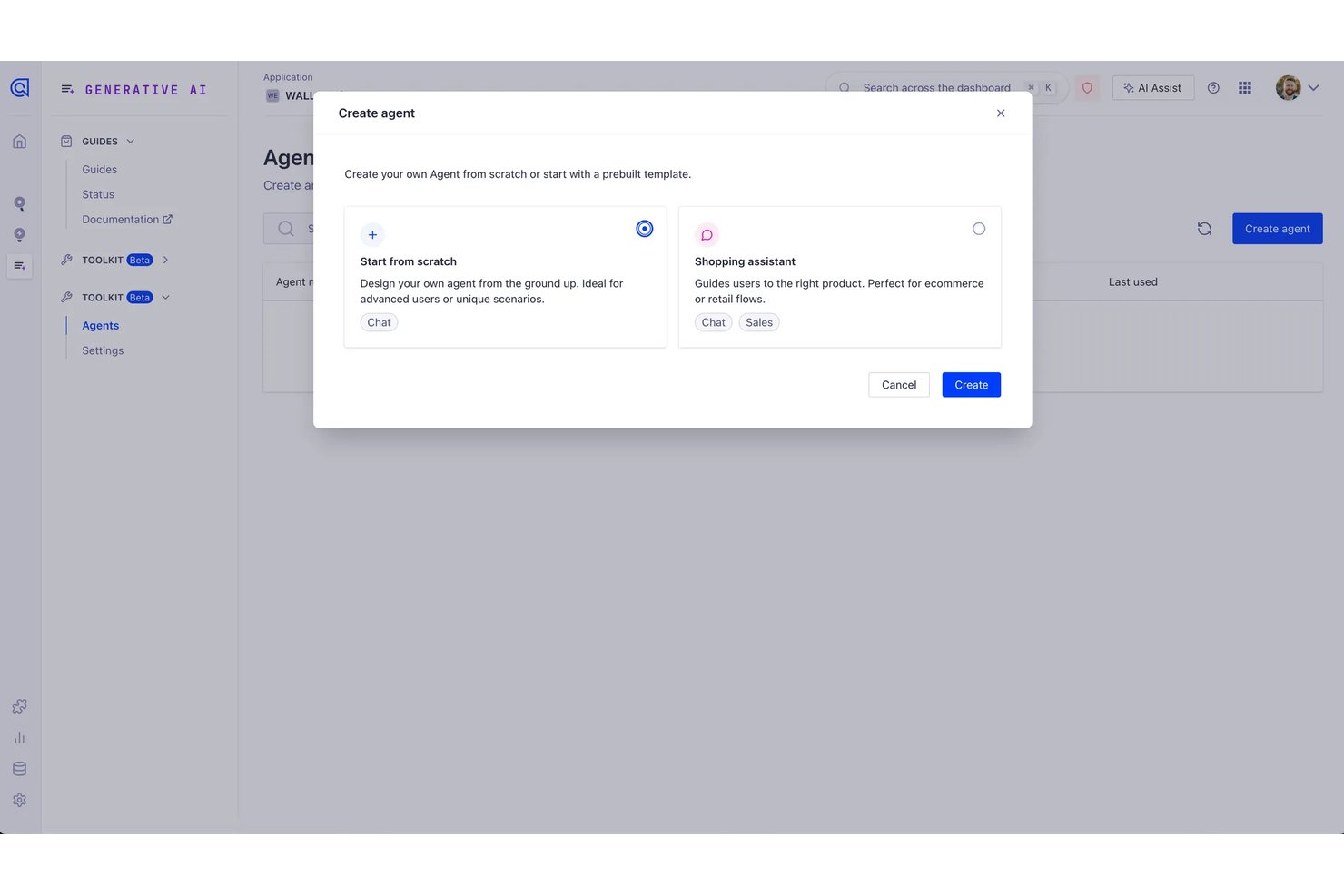
Algolia is a search and discovery platform for ecommerce that adds conversational search, product Q&A, real-time personalization, and recommendations to storefronts.
Who Is Algolia Best For?
Algolia is a strong fit for ecommerce teams that already run search-driven storefronts and want control over how their AI agents are built.
Why I Picked Algolia
I picked Algolia because Agent Studio lets teams build their own shopping agents on top of an existing Algolia product index, which is the key reason agent answers about pricing, inventory, and compatibility stay accurate. Teams can set up an agentic search bar that suggests conversational prompts as shoppers type, or guided selling flows for compatibility and fitment questions. The MCP Server also exposes the catalog to external agents such as ChatGPT and Claude.
Algolia Key Features
- AI Recommendation models: Choose from five recommendation models—Frequently Bought Together, Related Items, Looking Similar, Trending Items, and Personalized Recommendations—each retraining on fresh interaction data.
- Merchandising Studio: Configure search ranking, campaign rules, and promote/demote logic in the dashboard without writing code.
- Bring-your-own-LLM support: Connect Agent Studio to OpenAI, Anthropic, Google Gemini, AWS Bedrock, or Azure OpenAI.
- Agent governance controls: Set input/output guardrails, token limits, per-IP request caps, conversation-depth limits, and approved-domain lists.
Algolia Integrations
Algolia offers integrations with Salesforce Commerce Cloud, Adobe Commerce, Shopify, BigCommerce, WordPress, Zendesk, and Commercetools. It also offers an API for custom connections.
Pros and Cons
Pros:
- Real-time personalization improves product discovery
- Configurable guardrails control agent responses
- Catalog-grounded answers reduce hallucinations
Cons:
- Recommendations require event tracking setup
- Agents cannot place orders

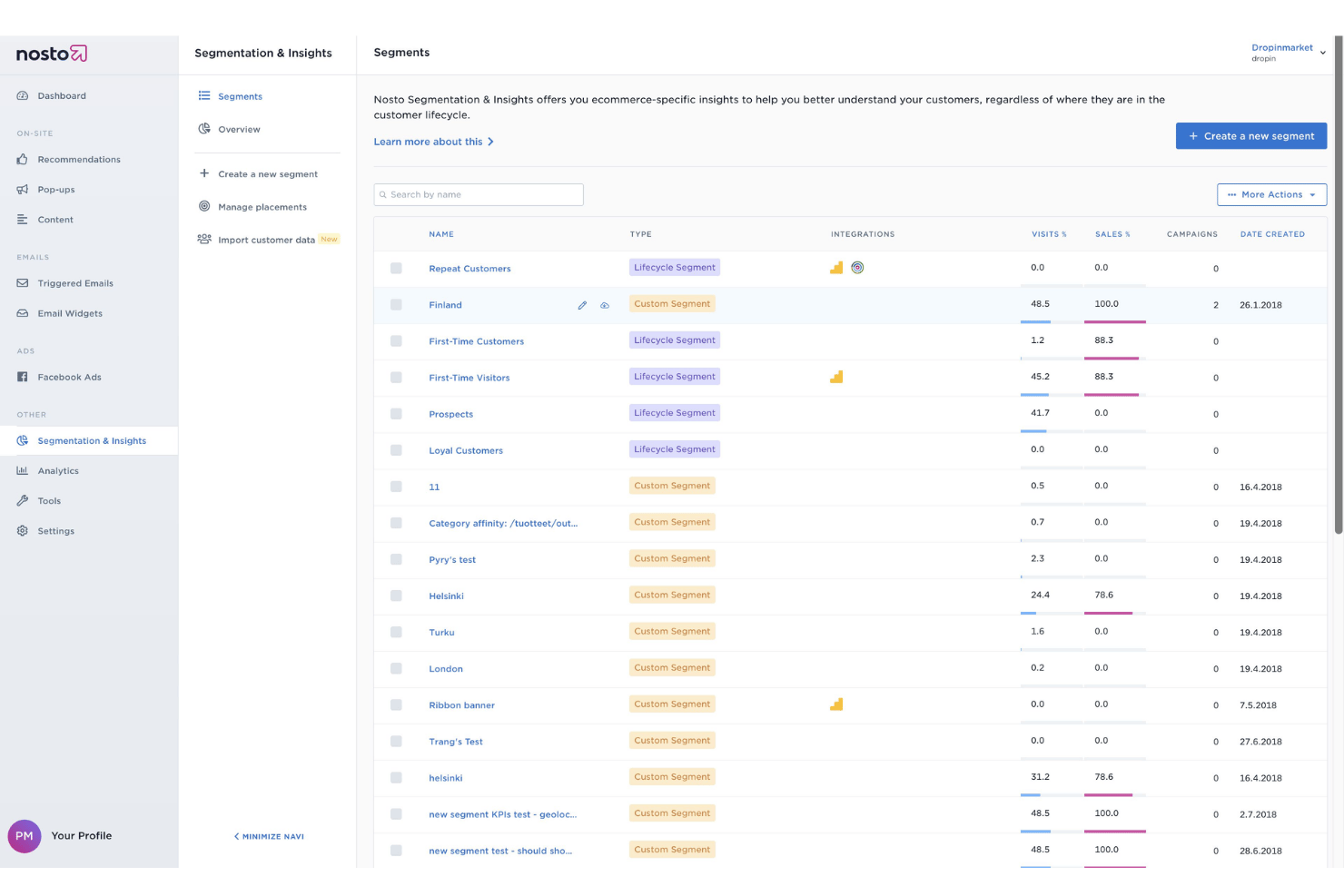
Nosto is a commerce experience platform with an AI agent layer, Huginn, that spans personalized search, product recommendations, category merchandising, and behavioral analytics across your storefront, email, and content channels.
Who Is Nosto Best For?
Nosto is a strong fit for mid-market and enterprise ecommerce teams that rely on behavioral data to merchandise large catalogs.
Why I Picked Nosto
I've included Nosto in my top picks because its Large Intent Model, trained on billions of behavioral and transactional data points, powers real-time personalization across product recommendations and category pages. I particularly like how AI Reveals proactively surfaces untapped customer segments and intelligent product bundles without you having to ask. Its vector-based Personalized Search also factors in stock levels, profit margin, and seasonality to merchandise results automatically.
Nosto Key Features
- Ask Huginn: Allows you to query conversion trends, customer segments, and experiment ideas directly.
- Category merchandising: Ranks category pages using real-time signals like stock levels, profit margin, seasonality, and conversion rate.
- Huginn Connect: An API and MCP integration layer that links Huginn to external AI tools like Shopify Sidekick.
- Shoppable UGC: Turns user-generated content into shoppable storefronts, so shoppers can buy from customer photos and social content.
Nosto Integrations
Nosto offers integrations with Shopify, Adobe Commerce, BigCommerce, Salesforce Commerce Cloud, Shopware, VTEX, Tapcart, and Google Analytics. An API is also available for custom integrations.
Pros and Cons
Pros:
- Conversational and image search aid discovery
- Huginn supports approval-gated merchandising decisions
- Real-time personalization handles large catalogs
Cons:
- AI Search availability remains limited
- Huginn requires approval before changes launch

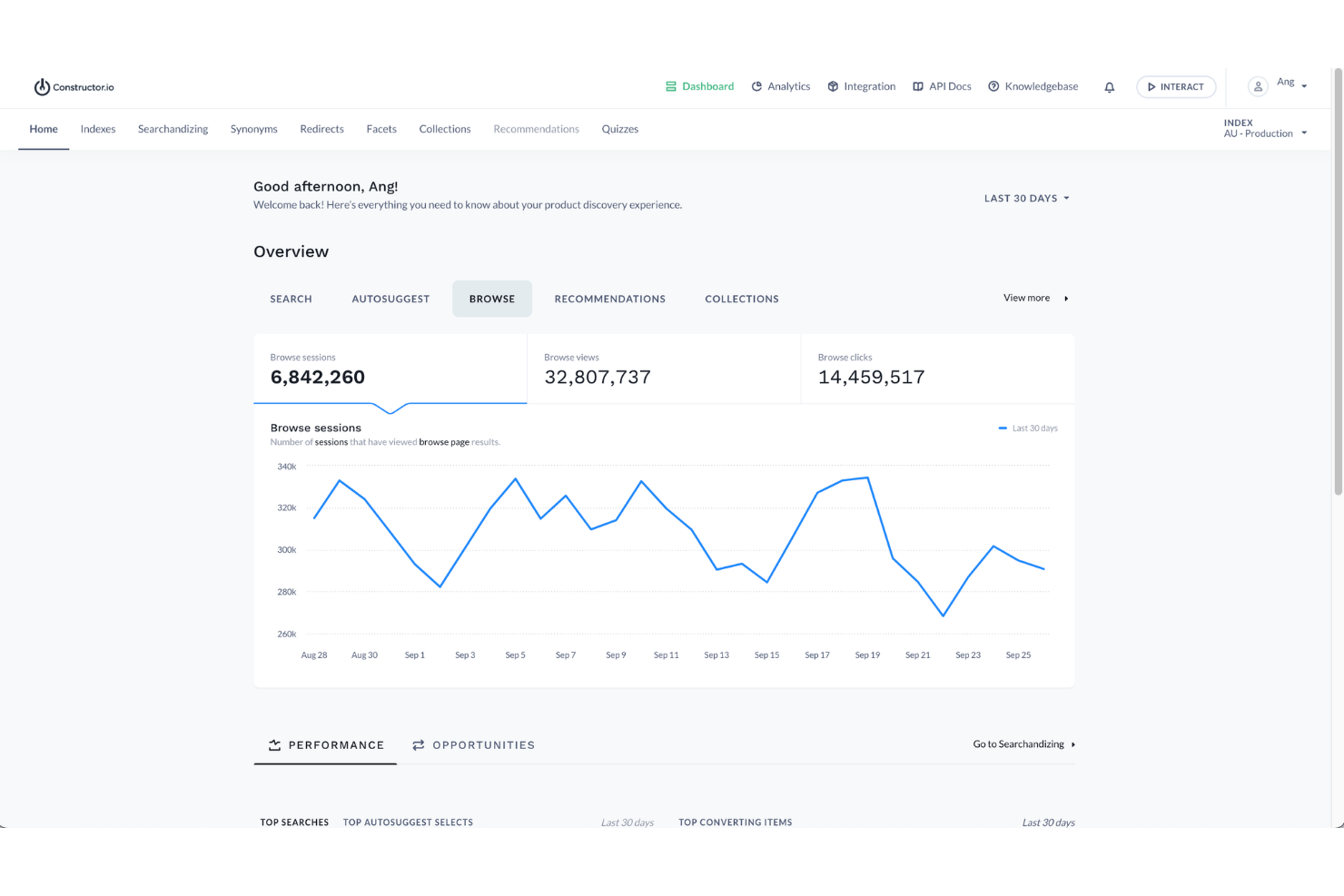
Constructor is an AI-native product discovery platform that powers personalized search, browse, and recommendation experiences.
Who Is Constructor Best For?
Constructor is a strong fit for enterprise retailers with dedicated merchandising teams and large product catalogs.
Why I Picked Constructor
I've included Constructor in my top picks because it runs separate AI agents for shoppers and merchandisers on one discovery engine. The AI Shopping Agent guides shoppers through natural-language discovery, while the Merchant Intelligence Agent gives merchandisers explainable, approvable control over search rankings and browse rules. What I also like is that the Product Insights Agent (PIA) answers sizing, compatibility, and returns questions on product pages, drawing on specs, reviews, and support content.
Constructor Key Features
- Personalized search and browse: Optimizes search and browse rankings based on real shopper behavior, tuning results toward conversion and revenue signals.
- Image search: Shoppers can upload a photo into the search field on the web or mobile to find visually similar products.
- Attribute enrichment: Automatically generates and corrects product attributes in your catalog, filling gaps and fixing inconsistencies without manual data entry.
- Cross-channel product recommendations: Deliver personalized product content across email, SMS, and mobile push via integrations with partners like Braze and Movable Ink.
Constructor Integrations
Constructor offers integrations with Shopify, Stripe, Movable Ink, BigCommerce, Commercetools, VTEX, Elastic Path, Fabric, and Braze. It also offers an API for custom integrations.
Pros and Cons
Pros:
- Behavioral signals refine personalized discovery
- Contextual product answers draw from multiple sources
- Shared intelligence across shopper and merchant agents
Cons:
- Agent scope excludes orders and returns support
- Merchant changes still require manual approval

Best for conversational shopping
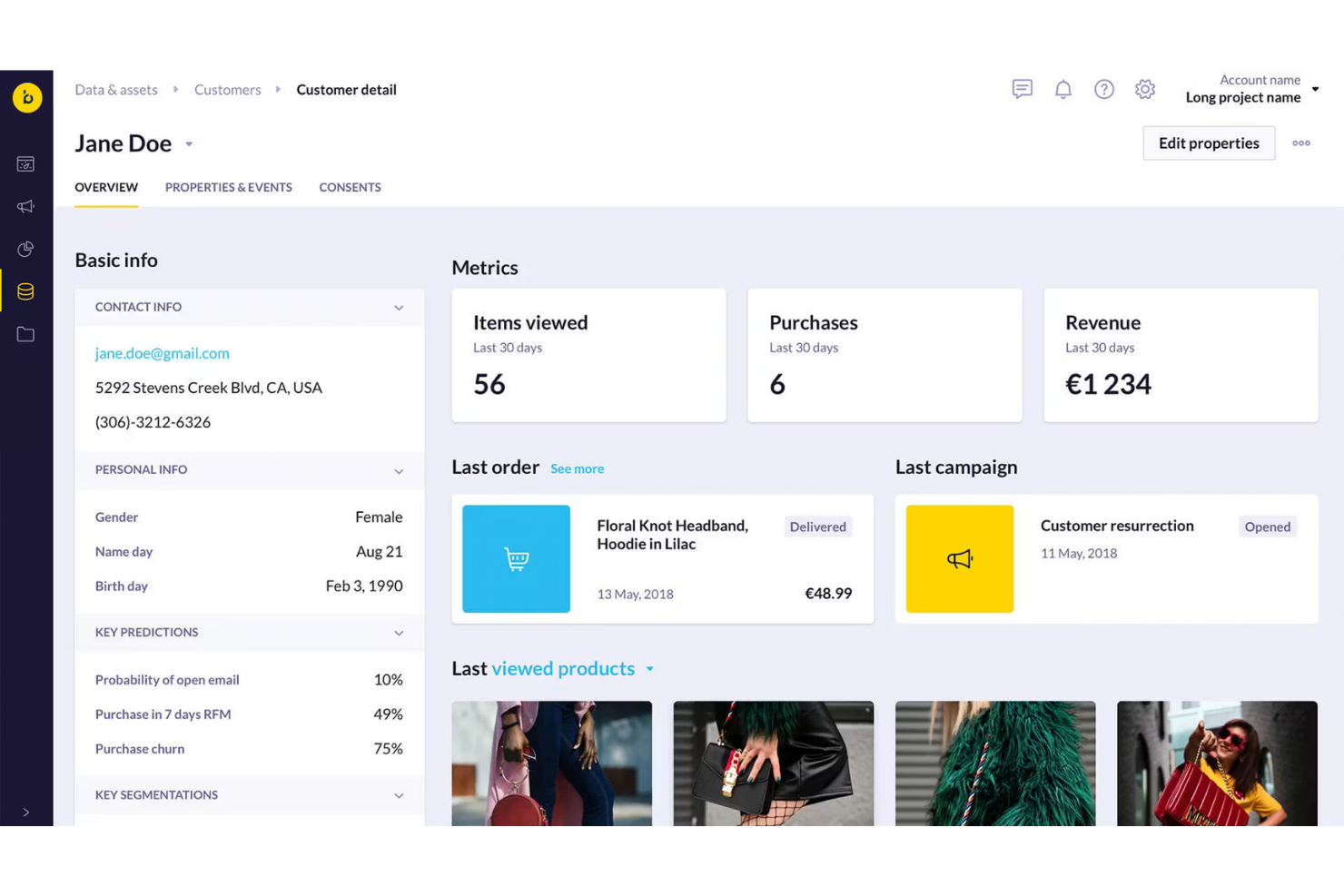
Bloomreach is an agentic personalization platform whose AI layer, Loomi, powers conversational shopping, site search, marketing automation, and product discovery.
Who Is Bloomreach Best For?
Bloomreach is a strong fit for mid-market and enterprise retailers with large catalogs and active email and SMS programs.
Why I Picked Bloomreach
I picked Bloomreach as one of the best because its Loomi Shopping Agent handles multi-constraint queries, such as "navy wool coat under $350 for NYC winters," and returns only in-stock results from the live catalog. I love that it remembers shopper preferences within a session and asks clarifying questions before recommending.
Bloomreach Key Features
- Loomi Marketing Agent: Builds an on-brand email workflow from a single plain-English prompt, then keeps optimizing it without manual intervention.
- Autonomous Search: Self-tunes site search results using real-time behavioral signals, reducing manual merchandising rules and search configuration.
- Visual search: Let shoppers upload a photo and AI extracts color, shape, and style to return visually similar, in-stock catalog products.
- Re-engagement journeys: Sends price-drop alerts, back-in-stock notifications, and abandoned-cart messages across email, SMS, WhatsApp, and push.
Bloomreach Integrations
Bloomreach offers 170+ integrations, including Shopify, BigCommerce, Snowflake, Databricks, Yotpo, and Bynder. It also offers REST APIs and MCP for custom agent workflows.
Pros and Cons
Pros:
- Connects search, marketing, and personalization context
- Scales efficiently with high sales volume
- AI answers are rooted in live inventory
Cons:
- Steep learning curve and long setup duration
- Shopping Agent limited to web
New Product Updates from Bloomreach
Bloomreach Adds Smart Triggers for Weblayers
Bloomreach introduces smart triggering for weblayers, enabling the Web SDK to evaluate real-time visitor conditions before display, along with performance and reliability improvements in Android SDK 5.3.0 and iOS SDK 4.3.0. For more information, visit Bloomreach's official site.
 .
.
Coveo
Best for enterprise catalog-grounded AI discovery
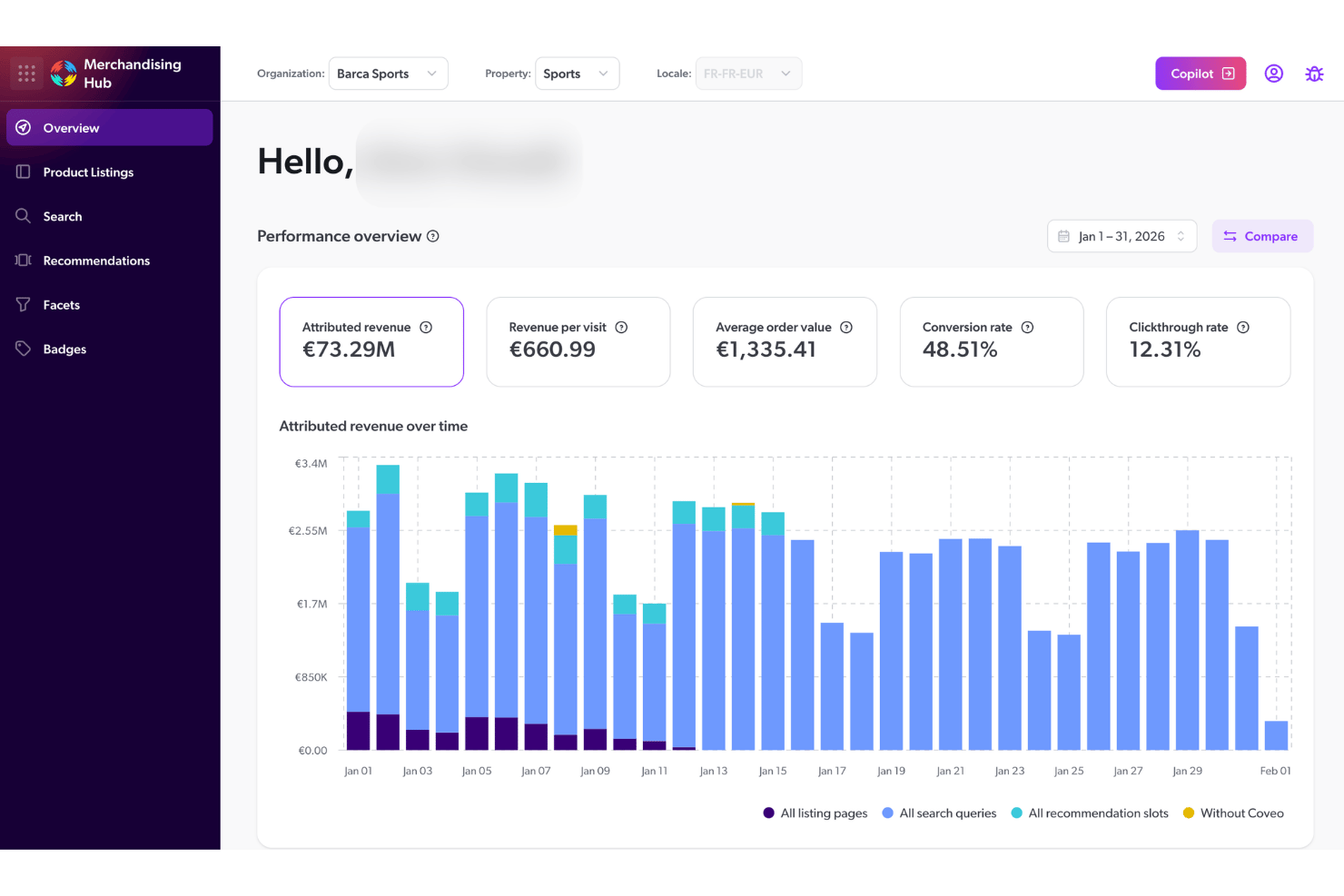
Coveo is an AI search and product discovery platform that combines conversational shopping, real-time catalog indexing, personalized recommendations, and a no-code merchandising hub.
Who Is Coveo Best For?
Coveo is built for enterprise retailers and B2B distributors whose catalogs carry many SKUs and detailed product attributes.
Why I Picked Coveo
Coveo earns its spot on my shortlist because its Discovery Agent is designed for complex B2B catalogs. I'm particularly impressed by its real-time catalog indexing, which supports millions of SKUs, customer-specific pricing, and fitment data in a single unified index. Its Adaptive Canvas switches the results layout from product grids to comparison tables based on what the shopper asks.
Coveo Key Features
- Merchandising Copilot: Surfaces natural-language insights and data-backed merchandising recommendations, requiring human approval before changes go live.
- Unified content index: Combines product data with support content, manuals, and guides in one index, so shoppers can find products and usage answers in one place.
- A/B testing for search and listings: Built-in experimentation tools let you test ranking strategies, facet configurations, and recommendation placements directly within the Merchandising Hub.
- Real-time 1:1 personalization: Uses behavioral embeddings and in-session signals to rank and recommend products for each shopper, even without a login or profile.
Coveo Integrations
Coveo integrates with Shopify, Salesforce, SAP, Box, Adobe Experience Manager, Optimizely, Sitecore, and AppDirect. An API for custom integrations is also available.
Pros and Cons
Pros:
- Provides transparent search ranking controls
- Personalizes results for anonymous shoppers
- Handles complex B2B catalog structures
Cons:
- Focuses on discovery rather than transactions
- Requires technical implementation expertise

Gorgias
Best for Shopify-native support and sales
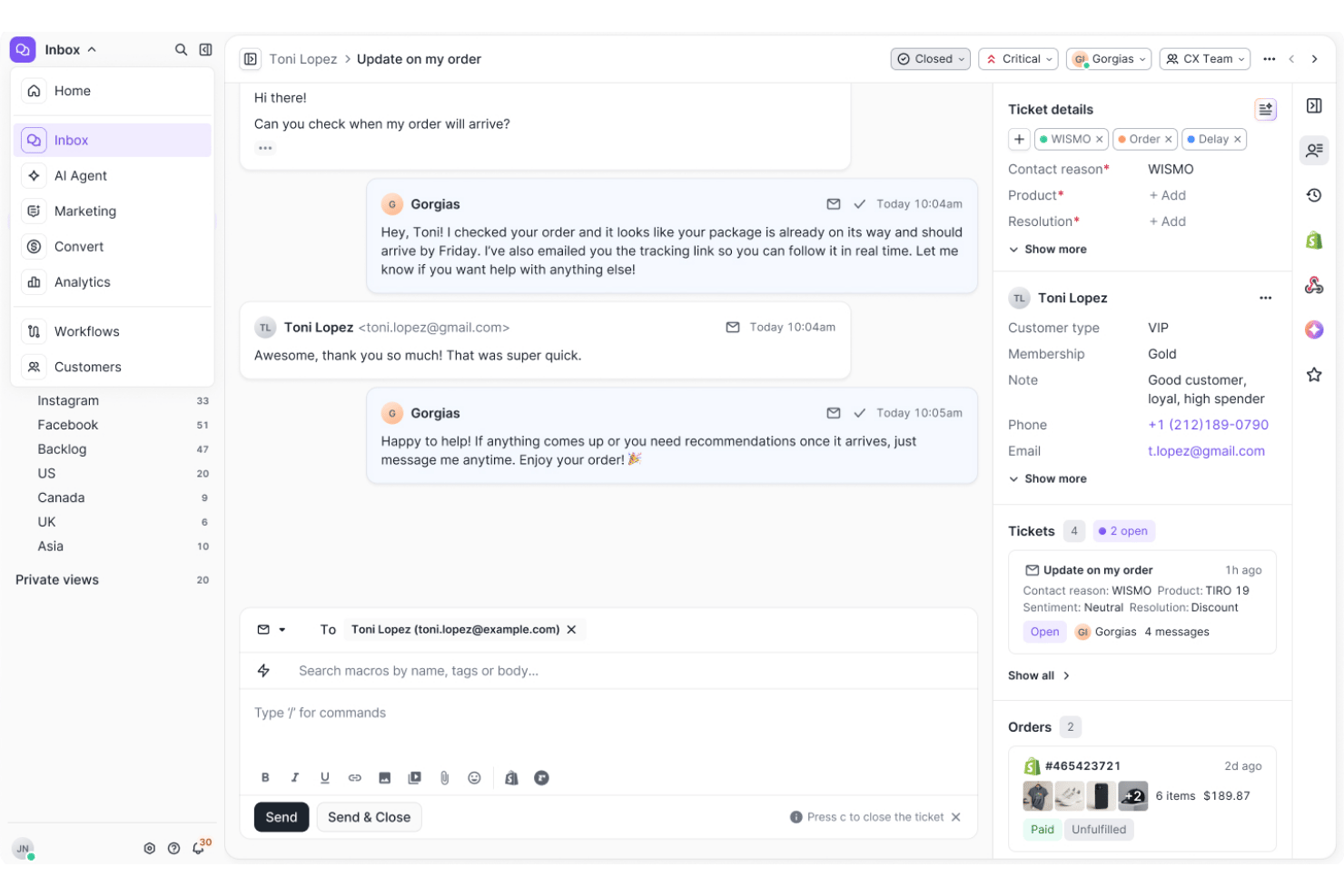
Gorgias is an ecommerce helpdesk and AI agent platform that combines automated ticket resolution, a conversational Shopping Assistant, and a multichannel inbox.
Who Is Gorgias Best For?
Gorgias is a strong fit for Shopify merchants who want pre-purchase and post-purchase conversations handled in one tool.
Why I Picked Gorgias
I picked Gorgias because it connects directly to Shopify, so order data, the product catalog, and customer history appear inside every ticket. Its AI Agent handles over 130 actions, like issuing refunds, editing shipping addresses, and processing returns, while the Shopping Assistant initiates proactive conversations to recommend products and trigger discounts at high-intent moments. That dual setup means one tool covers the full customer journey.
Gorgias Key Features
- Multi-channel unified inbox: Manage conversations across email, live chat, SMS, WhatsApp, Instagram, Facebook, and voice from a single inbox.
- Sandbox mode for AI testing: Test and validate AI responses in a safe environment before deploying them to live conversations.
- Revenue attribution reporting: Track which support and AI conversations directly contribute to revenue, AOV, and conversion on Pro and Advanced plans.
- Intent-based automation controls: Set approved intents that define which ticket types the AI handles on its own and which go to a human agent.
Gorgias Integrations
Gorgias lists 150+ app integrations, including Shopify, BigCommerce, Adobe Commerce, WooCommerce, PrestaShop, Recharge, and Loop Returns. It also offers a REST API for custom connections.
Pros and Cons
Pros:
- Provides sandbox testing and confidence controls
- Combines support automation with shopping assistance
- Resolves refunds, returns, and address changes
Cons:
- Reporting depth varies by plan
- AI responses often sound robotic

Fin
Best for outcome-based AI support
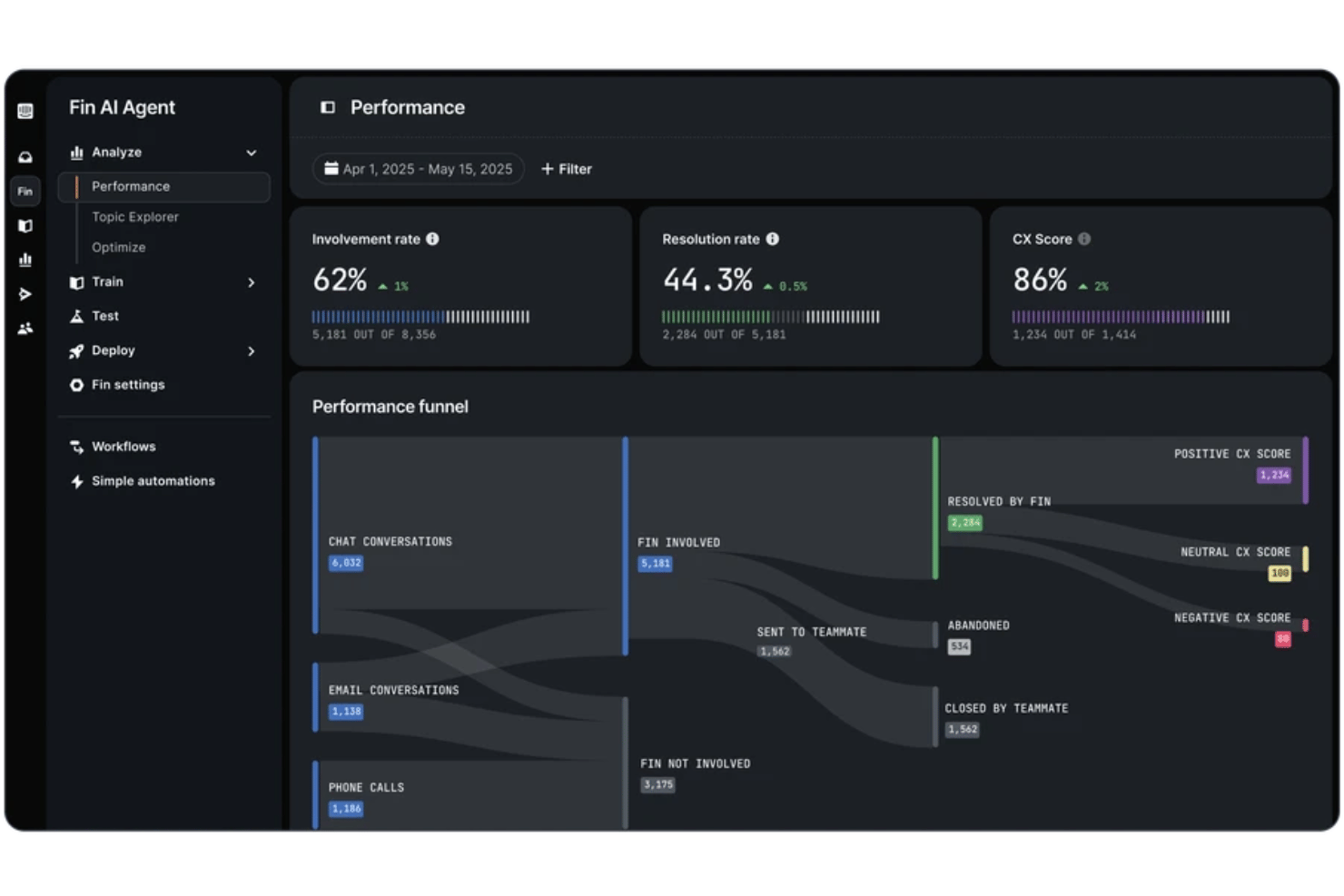
Fin by Salesforce is Intercom's AI customer agent. It handles product questions, order lookups, returns, exchanges, and multi-step actions like refunds and subscription changes across chat, email, voice, and social channels.
Who Is Fin Best For?
Fin is a strong fit for Shopify merchants with high volumes of repeat order and returns questions.
Why I Picked Fin
I picked Fin as one of the best because its outcome-based pricing charges only when Fin resolves a conversation, so spend scales with resolved conversations. I love that Fin pulls live order and refund status directly from Shopify, so it's acting on real data rather than scripted responses. For a Shopify merchant fielding hundreds of return requests daily, that combination of deterministic guardrails and live data access is hard to replicate.
Fin Key Features
- Fin Flywheel: A lifecycle system to train, test, deploy, and analyze Fin's performance, including one-click application of AI recommendations, without engineering support.
- Multi-channel deployment: Fin runs across chat, email, voice, WhatsApp, SMS, Instagram, Slack, Discord, and API with consistent conversation context across all channels.
- In-chat add-to-cart: Shoppers can add products to their cart from the Fin chat window without leaving the conversation.
- CX Score and Topics Explorer: Survey-free quality tracking and topic-trend analysis that surface conversation insights and flag emerging issues without manual tagging.
Fin Integrations
Fin integrates with Shopify, Stripe, Salesforce Service Cloud, HubSpot, Zendesk, Freshdesk, and Zapier. It also offers an API for custom connections.
Pros and Cons
Pros:
- Maintains context across customer channels
- Handles damaged-item claims from customer photos
- Offers multilingual support
Cons:
- Costs rise with resolution volume
- Quality depends heavily on knowledge-base structure

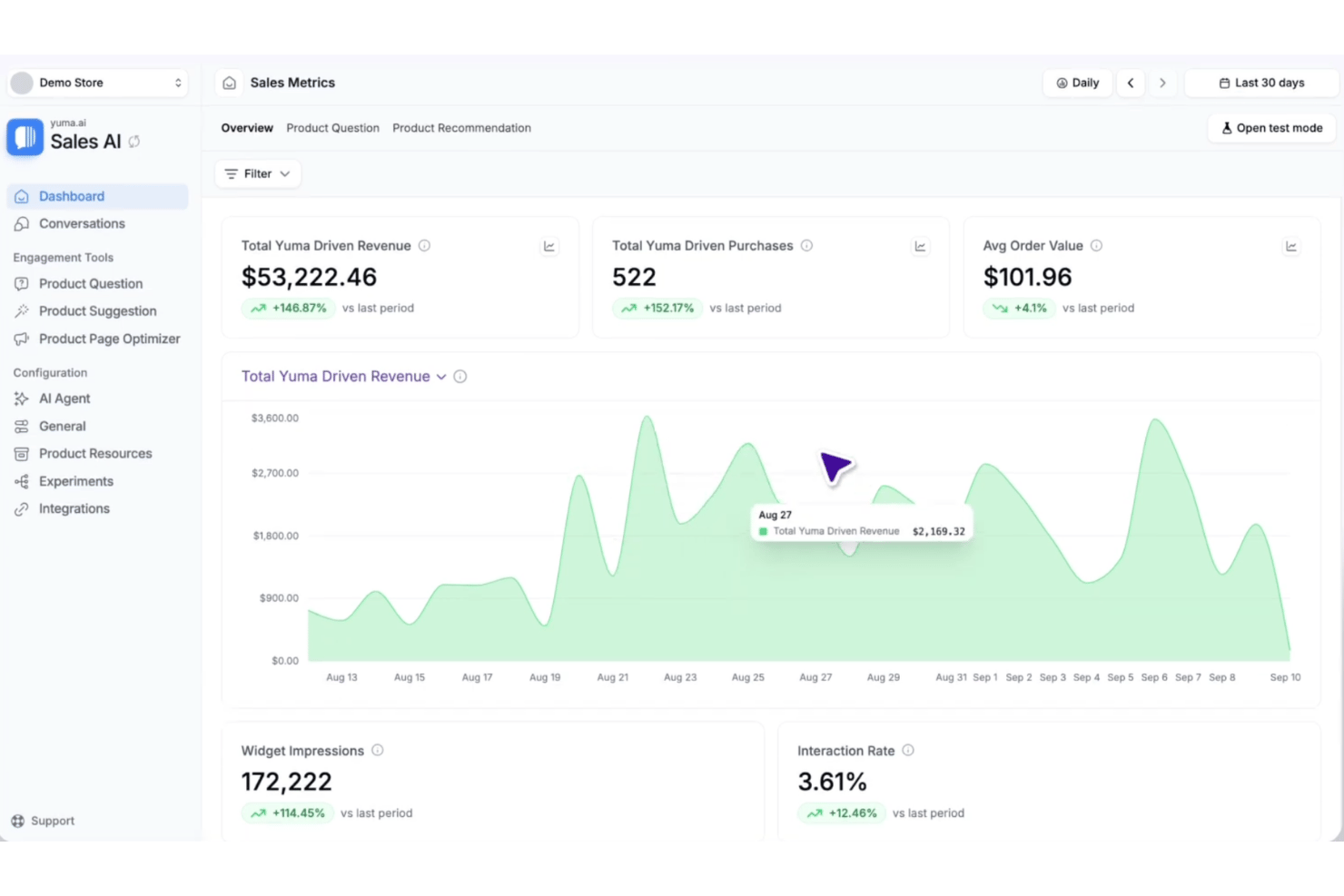
Yuma is an agentic AI platform for ecommerce that covers post-purchase support automation, storefront shopping assistance, social media moderation, and voice support.
Who Is Yuma Best For?
Yuma is a strong fit for Shopify store merchants handling high support volumes across many channels.
Why I Picked Yuma
I picked Yuma as one of the best because no other tool on my shortlist goes as deep on Shopify-native post-purchase actions, such as processing refunds, editing shipping addresses, pausing subscriptions, and reshipping orders, without a human in the loop. I also like its Process Builder, which lets you define multi-step order workflows in plain language, so no developer is needed to set up backend actions.
Yuma Key Features
- Multi-channel deployment: Yuma's Support AI spans 25+ channels, including email, WhatsApp, Instagram, TikTok Shop, and review platforms like Trustpilot.
- Voice AI agent: A phone-based agent that completes backend actions during the call, then confirms aloud, records, and transcribes every interaction.
- Sales AI storefront chat widget: A pre-purchase shopping agent that answers sizing, compatibility, and policy questions using live catalog data, in 180+ languages.
- Built-in A/B testing and revenue attribution: Split-tests Sales AI against a no-AI control group, with dashboards tracking conversion, revenue per session, AOV, and AI-driven purchases.
Yuma Integrations
Yuma offers 60+ standard integrations, including Shopify, Zendesk, WooCommerce, Recharge, Stripe, Loop Returns, and AfterShip. It provides an API for custom integrations.
Pros and Cons
Pros:
- Measures storefront revenue attribution directly
- Handles complex subscription changes
- Executes refunds and exchanges autonomously
Cons:
- Setup requires policy and workflow tuning
- Occasional hallucinations require output review

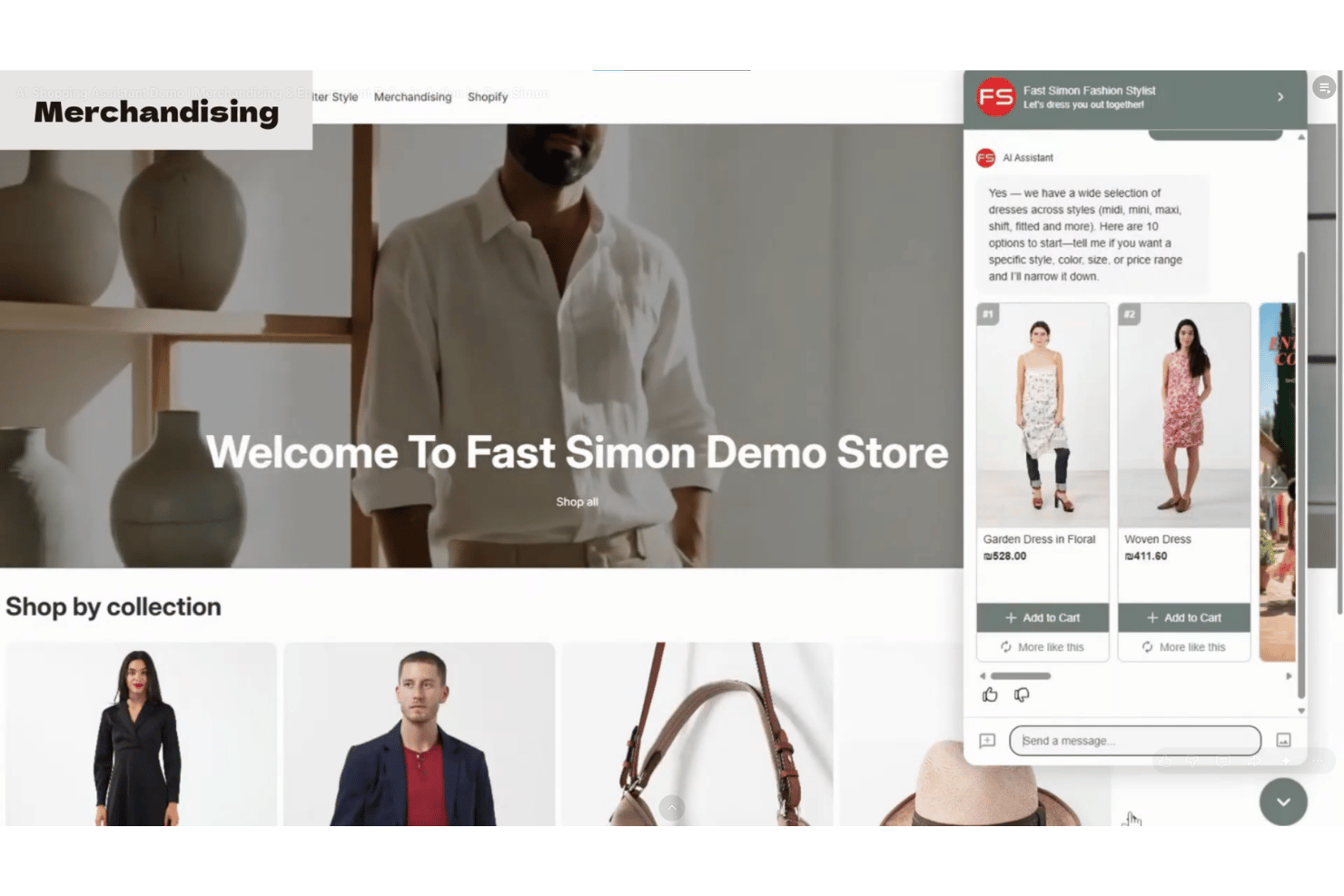
Fast Simon is an AI ecommerce search and product discovery platform that combines conversational shopping, visual search, AI merchandising, and personalization across search, collections, and recommendations.
Who Is Fast Simon Best For?
Fast Simon is a strong fit for merchandising and digital marketing teams managing large catalogs.
Why I Picked Fast Simon
Fast Simon earns its spot on my shortlist because it pairs visual search with conversational guidance. Visual Search lets shoppers upload a photo to find matching products, while Hyper Tagging enriches product data and generates shopper-friendly filters. The AI Shopping Agent adds conversational guidance on top, with recommendations grounded in live catalog data, active promotions, and your merchandising rules.
Fast Simon Key Features
- AI Merchandising Agent: Manages product assortment and display decisions, updating collection rankings and visibility based on merchant-defined goals.
- Managed Collections: Automatically generates and maintains native Shopify collections, keeping product membership current based on merchant-selected ranking strategies.
- Support deflection with live escalation: The AI Shopping Agent answers customer inquiries from merchant-approved documentation and hands off to a help desk when needed.
- Abandoned journey triggers: Detects when shoppers abandon a search or collection and sends those signals to Klaviyo or Attentive for email or SMS follow-up.
Fast Simon Integrations
Fast Simon offers native integrations with Shopify, Fuego, BigCommerce, Adobe Commerce, Zendesk, Wix, and Gladly. It also offers an API for custom connections.
Pros and Cons
Pros:
- Reviews praise responsive implementation support
- Catalog-aware answers reflect merchandising rules
- Visual discovery supports photo-led shopping
Cons:
- Agent autonomy stops short of transactions
- Page-speed complaints affect collection experiences

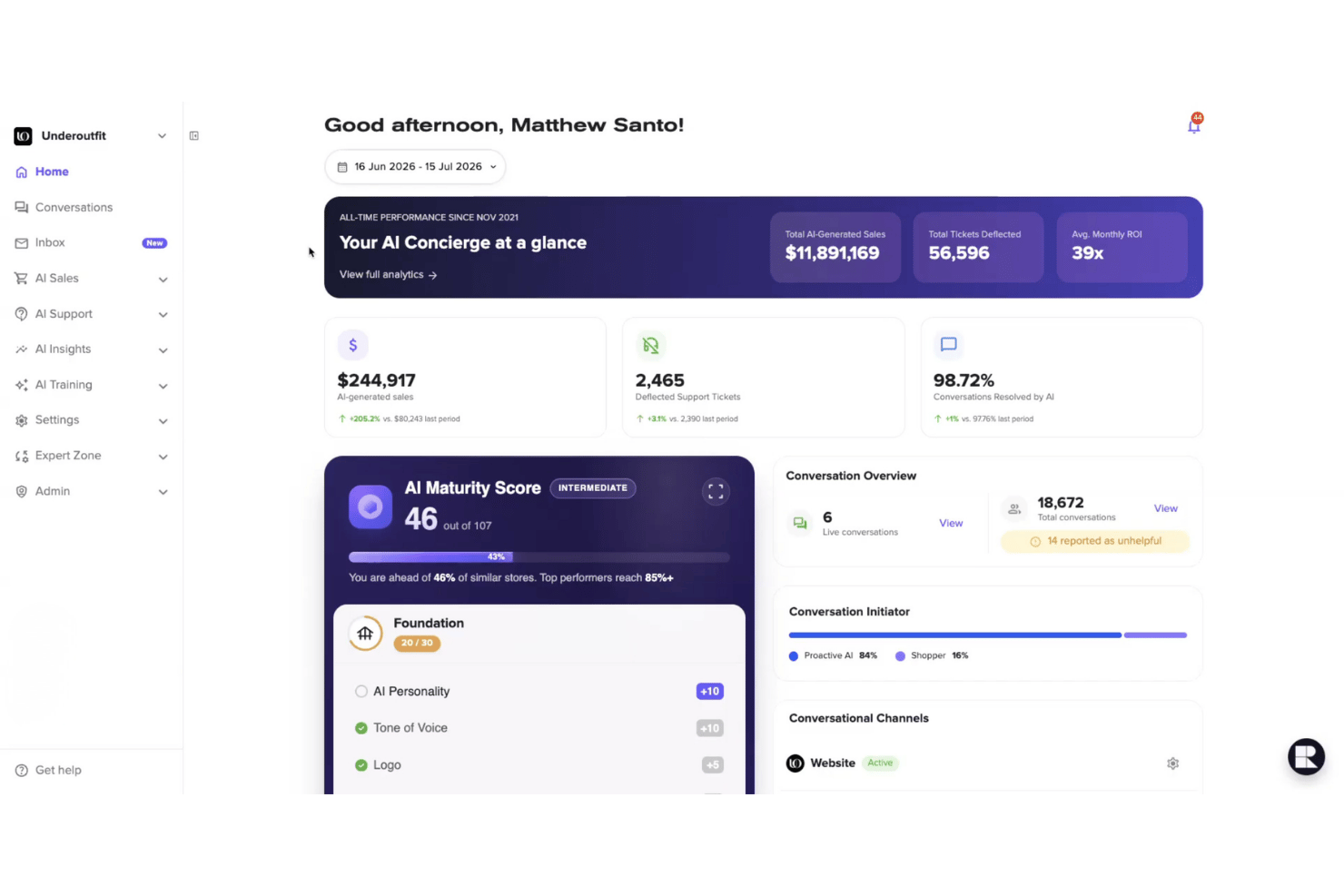
Rep AI is an ecommerce AI agent that combines proactive sales engagement, automated support, and behavior-triggered cart recovery across web, social, and messaging channels.
Who Is Rep AI Best For?
Rep AI is a strong fit for Shopify and Shopify Plus merchants who want one agent covering sales and support.
Why I Picked Rep AI
Rep AI earns its spot on my shortlist because of how it flips the script on cart recovery. Instead of waiting for a shopper to abandon and then chasing them with an email, it monitors behavioral signals like hesitation and exit risk in real time and opens a conversation before they leave. I love that this proactive engagement is trained on a dataset of 160M+ sessions, so the triggers aren't arbitrary.
Rep AI Key Features
- Guided product discovery: Natural-language chat narrows product options, surfaces comparisons, and triggers contextual upsells with in-conversation checkout.
- Multi-channel unified inbox: Manage conversations from web chat, email, Instagram, Facebook, WhatsApp, and Tapcart in a single dashboard.
- Missing information detection: Flags questions AI couldn't answer, surfacing catalog and knowledge gaps for your team to address.
- Shopper intelligence dashboard: Tracks drop-off reasons, competitor mentions, hesitation signals, and unanswered questions to surface actionable insights.
Rep AI Integrations
Rep AI documents 25+ integrations, including Shopify, Salesforce Commerce Cloud, WooCommerce, Postscript, Omnisend, Listrak, Loop Returns, and Slack. It also offers an API for custom integrations.
Pros and Cons
Pros:
- Support handoffs preserve full conversation context
- Product discovery includes comparisons and contextual upsells
- Low-cost entry plan available
Cons:
- Implementation can take longer than promised
- AI responses occasionally become irrelevant or circular
Other AI Agents for Ecommerce
Here are some additional platforms that didn’t make it onto my shortlist but are still worth checking out:
- Tidio
For multichannel AI support
- Alhena AI
For omnichannel voice and chat commerce
- Syte
For AI-enriched catalog tagging and search
- Attentive
For SMS re-engagement at scale
- Kustomer
For AI governance in retail CX ops
- Sierra
For peak-season retail agent scaling
- Ada
For enterprise post-purchase support
- Dynamic Yield
For enterprise catalog personalization
- Zowie
For policy-driven returns and order automation
- Siena
For DTC shopping and VoC in one


How I Evaluate AI Agents for Ecommerce
To make this list, a tool needs to deliver genuine AI value—whether that's guiding a shopper from discovery to checkout or autonomously resolving a return without a support ticket. I split my evaluation into core functionality every tool must cover and differentiating factors that separate the best from the rest.
Core Functionality (Table Stakes For This List)
When I'm selecting tools for my list, I score each one on a scale from 0 (does not offer the functionality) to 5 (excels in this area) for each core functionality listed below. I then convert the total into a percentage to help assess each tool's overall fit, with extra weight on any functionalities I've deemed essential.
- Autonomous Task Execution (Essential): I check whether the agent can complete multi-step workflows on its own, like resolving a return or updating an order status without a human approving each step.
- Conversational Shopping Interface (Essential): I evaluate how well the agent handles natural-language questions, follow-ups, and product comparisons during a shopping session.
- Product Catalog Integration: Real-time sync with product, pricing, and inventory data matters here. I look for agents that reflect stock changes and price updates without noticeable lag.
- Personalized Recommendations: I look at how each tool uses behavioral and purchase data to tailor suggestions, not just surface best-sellers or static rule-based picks.
- Ecommerce Platform Connectivity: Native integrations with platforms like Shopify, Magento, and BigCommerce are what I evaluate, along with how deep those connections go beyond basic read access.
- Multi-Channel Deployment: I consider whether the agent delivers a consistent experience across storefront, chat, email, and marketplace touchpoints without losing conversation context.
Once I have a list of tools that meet the criteria, I consider what sets each platform apart.
Differentiating Factors (What Sets Vendors Apart)
Here's how I compare and contrast different vendors:
Standout Features
I look for proactive cart recovery agents that detect abandoned sessions and trigger personalized outreach across chat, email, or SMS without manual setup. Rep AI and Tidio both offer versions of this, but I evaluate how well each agent tailors its messaging to the specific products left behind. Voice commerce support is another differentiator I check, since shoppers increasingly expect to search and buy through conversational voice interfaces. I also consider agent-to-agent transaction readiness, which prepares your store for AI shopping agents that negotiate and complete purchases on a buyer's behalf.
Beyond Features
I evaluate how fast a tool can go live with your actual catalog and brand voice, since pre-built connectors in platforms like Gorgias and Tidio can cut launch timelines from months to weeks. Data privacy controls matter just as much—I check how each vendor handles shopper data, opt-out flows, and compliance with regulations like GDPR. I also look for built-in analytics that tie agent actions directly to conversion and AOV, because without clear attribution, it's hard to justify ongoing spend.
How to Choose an AI Agent for Ecommerce
Choose an AI agent by testing how it handles your catalog, customer policies, and operational handoffs before signing a contract.
| If your priority is | Look for |
|---|---|
| Fewer incorrect product answers | A catalog-source test using 10 current SKUs |
| Fewer manual return decisions | A documented approval path for three return scenarios |
| Consistent answers across channels | A transcript comparison from storefront, email, and chat |
| Control over shopper data | Written retention, deletion, and opt-out terms |
| Predictable launch work | A catalog onboarding plan with named deliverables |
How to Vet Your Shortlist
- Run a catalog trial: Give each vendor 10 SKUs with variants, stock changes, and product restrictions, then review the answers within five business days.
- Test a post-purchase case: Submit one delayed order, one return request, and one damaged-item claim during a 14-day trial, recording every handoff.
- Request the data document: Ask for the vendor’s data-processing addendum, retention schedule, deletion process, and opt-out workflow before contract review.
- Open a support ticket: File a catalog correction ticket and request written confirmation of the change, its owner, and the expected resolution date.
- Choose the operating tradeoff: Decide whether you prefer a narrowly governed agent with tighter controls or a broader agent that handles more scenarios with greater review responsibility.
What Are AI Agents for Ecommerce?
AI agents for ecommerce are platforms that use artificial intelligence to guide shoppers, answer questions, and complete commerce tasks. They connect with product catalogs, customer service systems, and ecommerce platforms to support product discovery, recommendations, order updates, returns, and refunds. Some agents work across storefronts, chat, email, and voice channels while transferring complex requests to human teams.
Features of AI Agents for Ecommerce
When selecting an AI agent platform for your ecommerce business, keep an eye out for the following key features:
- Autonomous task execution: The agent completes multi-step tasks based on defined rules, permissions, and customer requests. It can update order details, initiate returns, or escalate exceptions without requiring manual approval at every step.
- Conversational shopping: The agent understands natural-language questions, follow-ups, and product comparisons. Shoppers can ask about fit, materials, availability, or use cases without navigating multiple product pages.
- Product catalog integration: The agent connects to product, pricing, variant, and inventory data. It uses current catalog information to answer questions and avoid recommending unavailable or restricted products.
- Personalized recommendations: The agent uses browsing activity, purchase history, preferences, and conversation context to suggest relevant products. This supports cross-selling, upselling, and product discovery beyond generic best-seller lists.
- Order and shipment support: The agent retrieves order details and provides updates about fulfillment, delivery, cancellations, or address changes. It can follow defined workflows when an order needs review or intervention.
- Returns and refunds automation: The agent applies your return policy to requests and gathers the information needed for resolution. Depending on your rules, it can create return requests, issue approved refunds, or route exceptions to customer service.
- Ecommerce platform connectivity: The agent connects with platforms such as Shopify, Magento, or BigCommerce through native integrations or APIs. These connections let it access commerce data and perform approved actions within your operating systems.
- Multi-channel deployment: The agent works across storefront chat, email, messaging, social channels, or voice interfaces. Shared conversation context helps customers receive consistent answers when they switch channels.
- Human handoff and governance: The agent transfers complex, sensitive, or low-confidence conversations to the right team member. Permission settings, escalation rules, conversation logs, and review tools help your team control automated workflows.
Benefits of AI Agents for Ecommerce
AI agents provide several benefits for your team and your business. Here are a few you can look forward to:
- Higher conversion: Conversational shopping interfaces answer product questions, compare options, and recommend relevant items during the buying journey.
- Lower support workload: Autonomous workflows handle order updates, return requests, and approved refunds without requiring manual action at every step.
- More relevant recommendations: Catalog data, browsing behavior, purchase history, and conversation context help agents suggest suitable products and cross-sells.
- Consistent customer service: Multi-channel deployment keeps product information, policies, and conversation context consistent across storefront chat, email, messaging, and voice.
- Fewer incorrect product answers: Real-time connections to product, pricing, variant, and inventory data help agents provide current catalog information.
- Faster issue escalation: Handoff rules route sensitive, complex, or low-confidence requests to the appropriate team member with conversation history attached.
- Better operational oversight: Permission settings, conversation logs, analytics, and governance controls help teams review agent actions and connect them with conversion and average order value.
Costs and Pricing of AI Agents for Ecommerce
Selecting the right AI ecommerce agent requires an understanding of the various pricing models and plans available. Costs vary based on features, team size, add-ons, usage, and support requirements. The table below summarizes common plans, their average prices, and typical features included.
Plan Comparison Table for AI Agents for Ecommerce
| Plan Type | Average Price | Common Features |
|---|---|---|
| Free Plan | $0/month | Basic chatbot, limited conversations, product FAQs, and community support. |
| Personal Plan | $20-$100/user/month | Catalog-based answers, conversational shopping, order tracking, and email support. |
| Business Plan | $100-$500/month | Automated returns, personalized recommendations, platform integrations, multi-channel deployment, and analytics. |
| Enterprise Plan | $500-$5,000+/month | Custom workflows, advanced permissions, dedicated support, extensive integrations, and governance controls. |
AI Agents for Ecommerce FAQs
Here are some answers to common questions about ecommerce AI agents:
How long does it take to implement an AI agent for ecommerce?
Implementation often takes several weeks, depending on catalog complexity, integrations, and workflow requirements. Start with a defined pilot, such as product questions and order-status requests. Prepare product data, brand guidelines, escalation rules, and test cases before configuration begins. Ask the vendor for a launch plan with milestones, owners, training tasks, and acceptance criteria. A smaller pilot gives your team a controlled way to review responses before expanding the agent to returns, refunds, recommendations, or additional channels.
How do retailers measure AI agent performance?
Retailers should connect agent activity with conversion rate, average order value, containment rate, escalation rate, and customer satisfaction. Define a baseline before launch, then compare results over a set reporting period. Review conversation transcripts alongside dashboard metrics because a high containment rate can hide poor answers. Ask vendors whether reports separate automated sessions from human-assisted sessions. A/B testing can help compare prompts, recommendation logic, and escalation thresholds while keeping the evaluation tied to measurable ecommerce outcomes.
How do AI agents protect ecommerce customer data?
AI agents keep customers’ data safe through access controls, retention rules, encryption practices, audit logs, and documented data-processing terms. Ask where conversation and order data are stored, how vendors use it for model improvement, and how your team can delete it. Confirm that the agent only accesses information required for its assigned tasks. Request written opt-out procedures and escalation rules for sensitive requests. Your legal and information security teams should review these documents before the agent handles customer accounts or payment-related cases.
Can AI agents handle peak shopping periods?
Yes, AI agents can support peak shopping periods when the vendor documents capacity planning and service commitments. Ask for recent load-test results, uptime terms, incident procedures, and a description of how the platform handles traffic spikes. Run a peak-period simulation with product questions, order lookups, and return requests before a major campaign. Review response delays, failed actions, queue behavior, and human handoffs. Confirm who owns incident communication when demand exceeds planned capacity.