

Gestionarea facturării recurente și a abonamentelor nu ar trebui să semene cu jonglarea cu foi de calcul la miezul nopții. Programele cu sursă deschisă pentru gestionarea abonamentelor există pentru a vă oferi flexibilitate, transparență și control — fără să plătiți sume exorbitante pentru funcții SaaS inutile sau modele de tarifare restrictive.
După mai bine de un deceniu în retail și comerț electronic, am văzut cât de repede pot erorile de facturare, lipsurile de integrare și analizele slabe să distrugă veniturile recurente.
Indiferent dacă administrați un startup suplu sau o operațiune complexă pe mai multe canale, aveți nevoie de instrumente care să automatizeze fluxurile de lucru, să permită raportarea în timp real și să funcționeze bine cu stiva tehnologică existentă.
Acest ghid face exact acest lucru. Am selectat și analizat cele mai bune platforme cu sursă deschisă pentru gestionarea abonamentelor — testate pentru automatizarea facturării, procesarea plăților, flexibilitatea API-ului și toate aspectele importante atunci când trebuie să reduceți rata de renunțare și să vă extindeți rapid.
Fără umplutură. Fără discurs de vânzări. Doar informații practice, de la nivel operațional, care să vă ajute să găsiți un sistem de facturare potrivit cu adevărat pentru nevoile afacerii dumneavoastră — fără problemele obișnuite.
Why Trust Our Software Recommendations
6,700+
Reviews
20
Industry experts
16+
Evaluation factors
14
Years
Our team has been testing and reviewing software since 2012. As retail leaders ourselves, we know how difficult—and important—it is to choose the right software.
For this guide, we evaluated tools using hands-on testing and independent research, scoring tools using our selection criteria.
Our reviews reflect our independent judgment—not a sales pitch.
Tabel comparativ al programelor cu sursă deschisă pentru gestionarea abonamentelor
Acest tabel comparativ prezintă prețurile, detaliile perioadelor de testare și cazurile de utilizare ideale pentru selecția mea de programe cu sursă deschisă pentru gestionarea abonamentelor.
Score legend (out of 5)
- Excellent4.5–5
- Good4–4.4
- Average3–3.9
- Below average2–2.9
- Poor1–1.9
Sorted by: Default
| Tool | Starting Price | Website | |||||||
|---|---|---|---|---|---|---|---|---|---|
Best for self-hosted recurring billing with ERP | 4.0 out of 5 | 4 | 2 | 5 | 3 | 5 | 5 | Pricing upon request Free plan available | Website |
Best for CRM-embedded subscription billing | 3.5 out of 5 | 4 | 3 | 4 | 2 | 5 | 3 | $19/user/month 15-day free trial | Website |
Best for no-fee multi-model billing via self-hosting | 4.3 out of 5 | 4 | 3 | 5 | 5 | 4 | 5 | $99/month Free plan + free trial + free demo available | Website |
Best for Ruby-built subscription storefronts | 3.8 out of 5 | 3 | 5 | 3 | 4 | 5 | 3 | Pricing upon request Free demo available | Website |
Best for content-driven subscription storefronts | 3.7 out of 5 | 3 | 5 | 4 | 3 | 5 | 2 | Pricing upon request Free demo available | Website |
Best for headless subscription commerce | 4.3 out of 5 | 4 | 5 | 4 | 4 | 5 | 4 | $4/user/month 30-day free trial | Website |
Best for API-first billing integrations | 4.7 out of 5 | 5 | 5 | 5 | 5 | 3 | 5 | Pricing upon request Free demo available | Website |
Best for billing automation | 4.8 out of 5 | 4 | 5 | 5 | 5 | 5 | 5 | Pricing upon request Free plan available | Website |
Best for metered API and AI token billing | 3.7 out of 5 | 2 | 5 | 5 | 5 | 1 | 4 | $249/month Free plan available | Website |
Best for telecom-scale subscription billing | 4.3 out of 5 | 5 | 3 | 5 | 5 | 3 | 5 | Pricing upon request Free demo available | Website |



Cele mai bune 10 programe cu sursă deschisă pentru gestionarea abonamentelor, analizate
Descoperiți mai jos recenziile mele concise pentru o privire mai atentă asupra funcțiilor remarcabile, avantajelor și dezavantajelor, precum și asupra tipului de afacere pentru care fiecare instrument este cel mai potrivit — direct din experiența acumulată într-un deceniu de retail și comerț electronic.
 Best for self-hosted recurring billing with ERP
- Free plan available
- Pricing upon request
Visit WebsiteCustomer Rating:4.2/5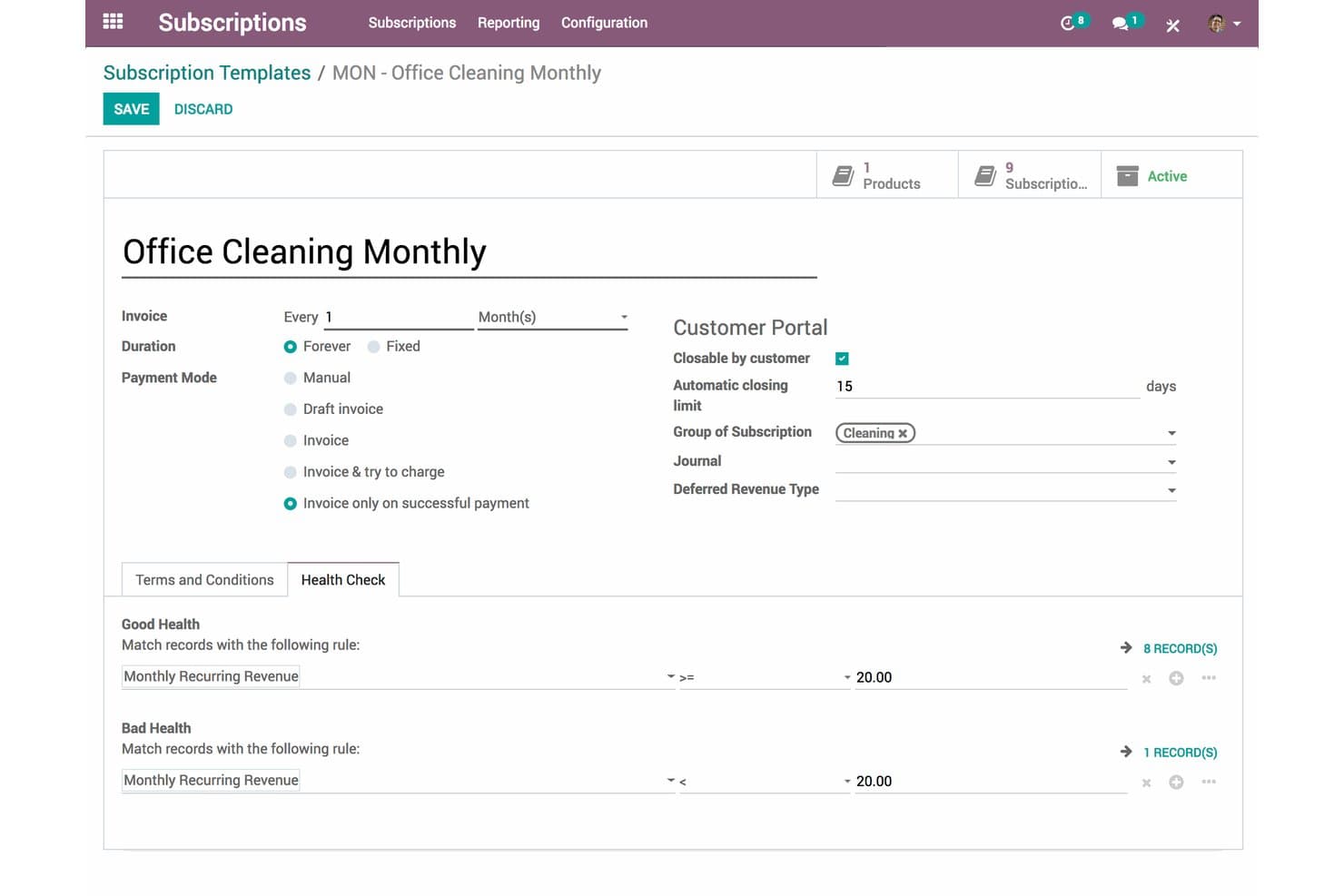
Odoo Subscriptions lets users configure billing cycles and health checks. Odoo Subscriptions is an open-core recurring billing and subscription lifecycle platform that combines automated invoicing, dunning, MRR/ARR analytics, a self-service customer portal, and 20+ payment provider integrations within a broader ERP suite.
Who Is Odoo Subscriptions Best For?
Odoo Subscriptions is a strong fit for retail and ecommerce businesses with in-house DevOps capacity that want to self-host their recurring billing and manage it within a single ERP environment.
Why I Picked Odoo Subscriptions
Odoo Subscriptions earns its spot on my shortlist because it's the only open-source-rooted platform that bundles subscription lifecycle management directly inside a full ERP, letting retail teams run billing, inventory, and POS from one system without middleware. I particularly like that self-hosted deployments on Docker or Kubernetes carry zero per-transaction fees, and that deferred revenue recognition is handled natively for GAAP/IFRS 15 compliance, which is rare at this price point.
Odoo Subscriptions Key Features
- MRR/ARR analytics dashboard: Tracks new, expansion, contraction, and churned MRR automatically from active subscription records, with ARR forecasting and cohort retention curves.
- Multi-level dunning workflows: Configurable payment follow-up sequences with custom email templates and escalation actions, from reminders to service suspension to write-off.
- 100+ country tax localization packages: Applies regional tax rules, including VAT, GST, and multi-state nexus, automatically across subscription invoices.
- Subscription health scores: Flags at-risk subscribers based on calculated health scores and triggers CRM-based retention workflows for account manager follow-up.
Odoo Subscriptions Integrations
Odoo Subscriptions offers native integrations across Odoo CRM, Accounting, Sales, eCommerce, POS, Inventory, and Helpdesk, plus 20+ payment providers including Stripe, Adyen, PayPal, and Mollie. Custom integrations use XML-RPC, JSON-RPC, or REST APIs, with external API access on the Custom plan.
Pros and Cons
Pros:
- Built-in GAAP/IFRS 15 revenue compliance
- No per-transaction SaaS fees if self-hosted
- Native ERP and POS integration for retail
Cons:
- Usage-based billing automation needs custom code
- Full subscriptions features require enterprise license
Learn more about Odoo Subscriptions: Best for CRM-embedded subscription billing
- 15-day free trial
- From $19/user/month
Visit WebsiteCustomer Rating:5/5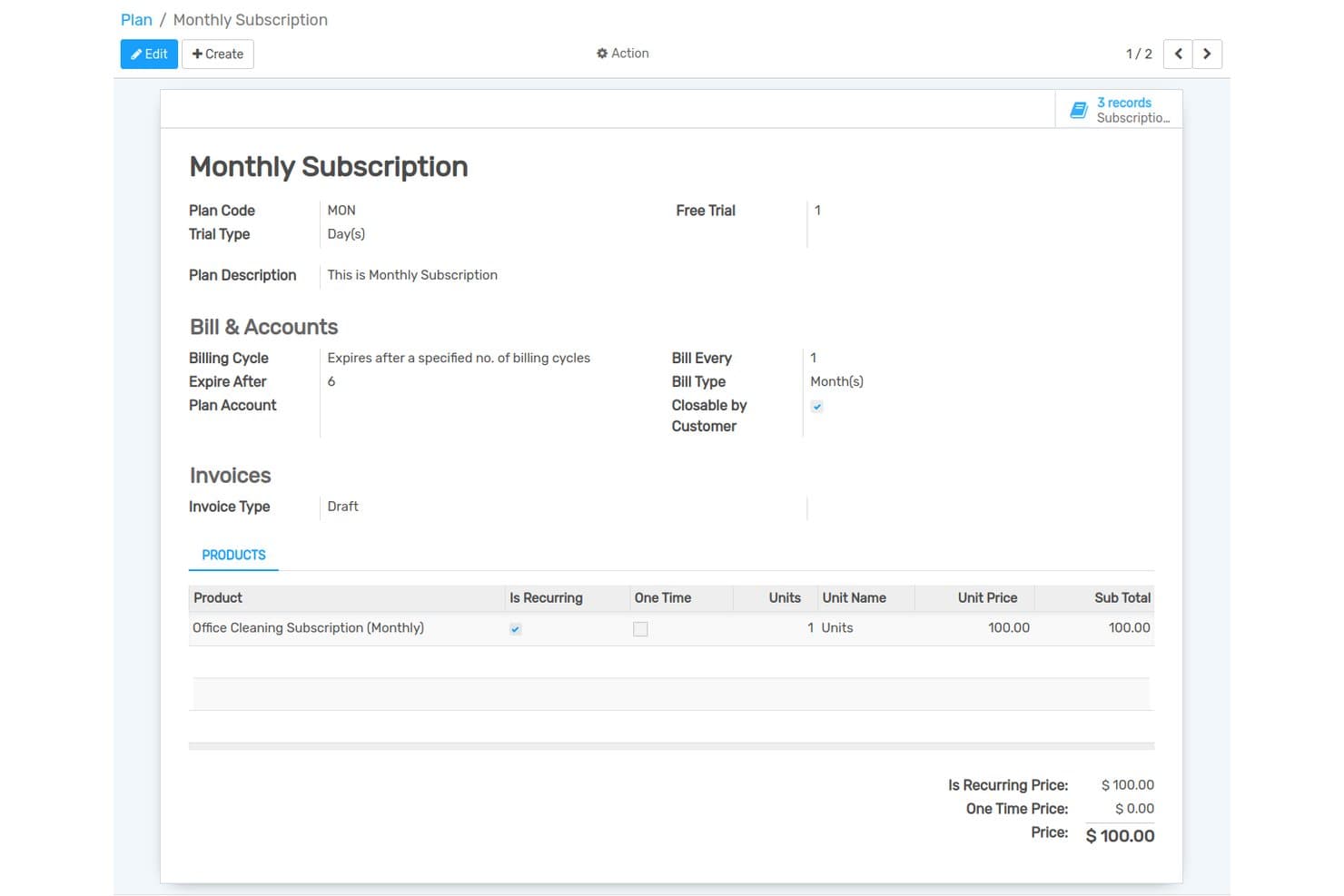
Flectra lets users configure billing cycles and pricing for subscription plans. Flectra is an open-source ERP platform with a built-in subscription management module that handles recurring billing, automated invoicing, dunning, plan management, and a self-service customer portal—all natively connected to its CRM, accounting, and ecommerce modules.
Who Is Flectra Best For?
Flectra is a strong fit for businesses that already run—or plan to run—their operations on a unified ERP stack and want subscription billing natively connected to CRM and invoicing without stitching together separate tools.
Why I Picked Flectra
Flectra earns its spot on my shortlist because subscription billing and CRM live in the same platform natively, with no connectors required. I like that when a subscriber upgrades a plan, that change surfaces immediately in the CRM pipeline alongside their full contact history and invoicing record. The self-service billing portal and automated invoicing with dunning management round out a billing engine that handles the full subscriber lifecycle without stitching together separate tools.
Flectra Key Features
- Multi-period recurring billing: Supports flexible billing cycles and frequencies with automated invoice generation and delivery to subscribers.
- 12 payment gateway integrations: Connects natively with Stripe, PayPal, Adyen, Authorize.Net, Razorpay, and eight additional providers, plus Google Pay and Apple Pay.
- Subscription plan management: Lets you create and manage multiple plan tiers with discount management and GST-compliant tax invoicing built in.
- No-Code Studio: A visual customization module that lets non-developers build and modify apps, forms, and workflows without writing code.
Flectra Integrations
Flectra offers 12 native payment integrations, including Stripe, PayPal, Adyen, Authorize.Net, Razorpay, and Mollie. Its XML-RPC external API and REST API references support custom connections.
Pros and Cons
Pros:
- Self-service portal for subscriber account management
- Offers 12 payment gateways with global coverage
- CRM and subscription billing are natively unified
Cons:
- API uses XML-RPC, not modern REST standards
- Does not connect natively to Shopify or WooCommerce
Learn more about Flectra: Best for no-fee multi-model billing via self-hosting
- Free plan + free trial + free demo available
- From $99/month
Visit WebsiteCustomer Rating:5/5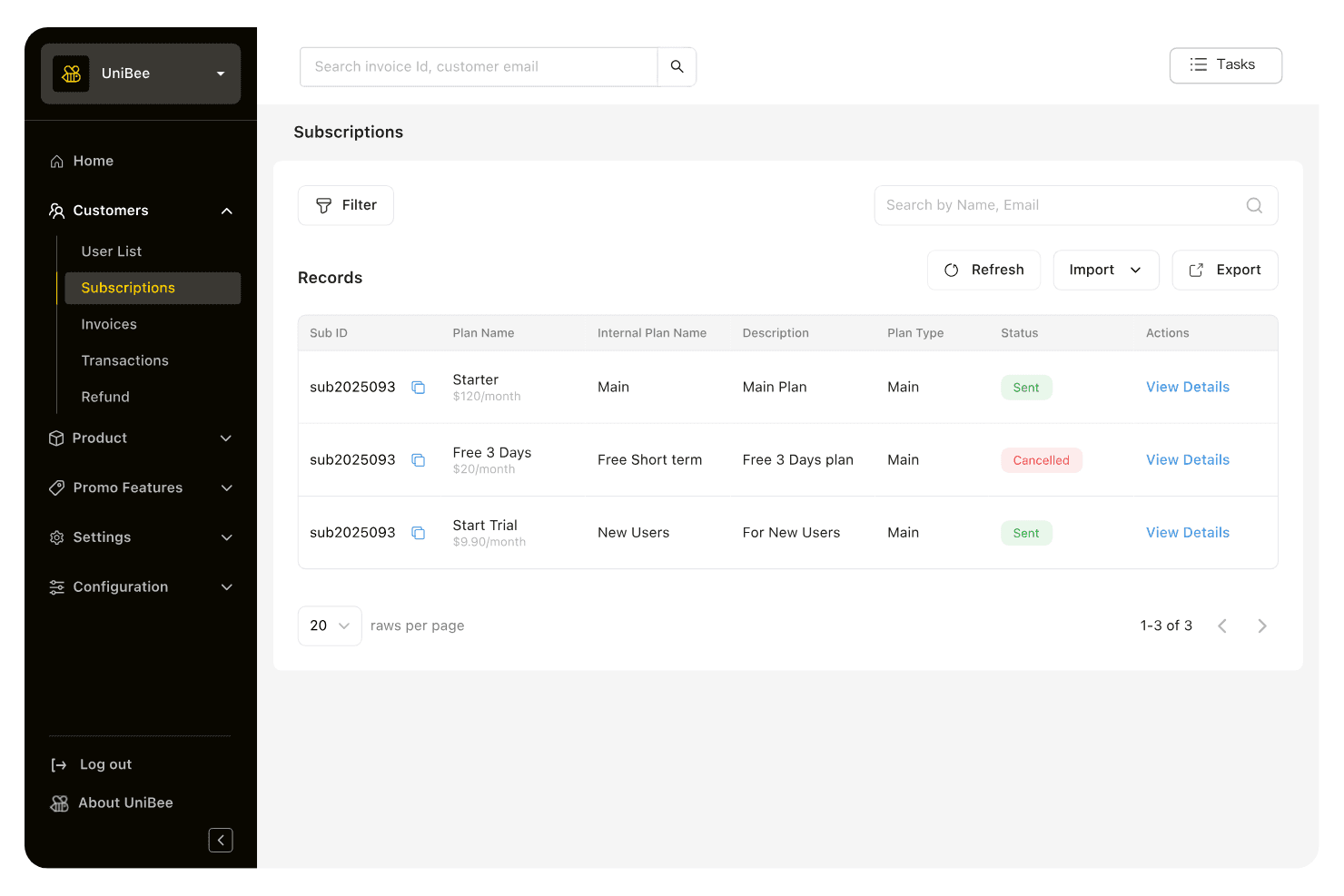
UniBee lets users track and manage customer subscriptions in one place. UniBee is an AGPLv3 open-source subscription management platform that supports recurring, usage-based, tiered, per-seat, and hybrid billing models alongside multi-gateway payment routing, smart dunning, and a developer-facing REST API.
Who Is UniBee Best For?
UniBee is a strong fit for technical teams and DevOps engineers who want full billing infrastructure control without paying per-transaction SaaS fees.
Why I Picked UniBee
I picked UniBee as one of the best because it's the only tool on my list where self-hosting completely eliminates transaction fees across every billing model. I love that you can run recurring, usage-based, tiered, and per-seat billing simultaneously under one AGPLv3 codebase, with smart dunning and multi-gateway routing built in. In practice, that means my team can recover failed payments automatically while routing transactions across Stripe, PayPal, and Alipay without paying a percentage of revenue to anyone.
UniBee Key Features
- Multi-currency pricing: Set and display prices in multiple currencies natively, supporting global subscriber bases without third-party workarounds.
- VATSense tax integration: Automates VAT and GST calculation on initial and recurring charges, with country tax rates refreshed weekly.
- Coupon and discount engine: Create percentage or fixed discounts with configurable cycle limits, expiration dates, usage caps, and plan-specific rules.
- OpenTelemetry observability hooks: Connect UniBee billing events to your existing monitoring stack for real-time infrastructure and performance visibility.
UniBee Integrations
UniBee lists 25+ native integrations, including Stripe, PayPal, QuickBooks, Xero, TaxJar, VATSense, Mixpanel, and HubSpot. Its REST API supports custom integrations, while Zapier is also available.
Pros and Cons
Pros:
- Advanced billing models supported natively
- Full control over billing infrastructure
- No per-transaction fees with self-hosting
Cons:
- AGPLv3 license may limit proprietary use
- No retail or eCommerce connectors included
Learn more about UniBee: Best for Ruby-built subscription storefronts
- Free demo available
- Pricing upon request
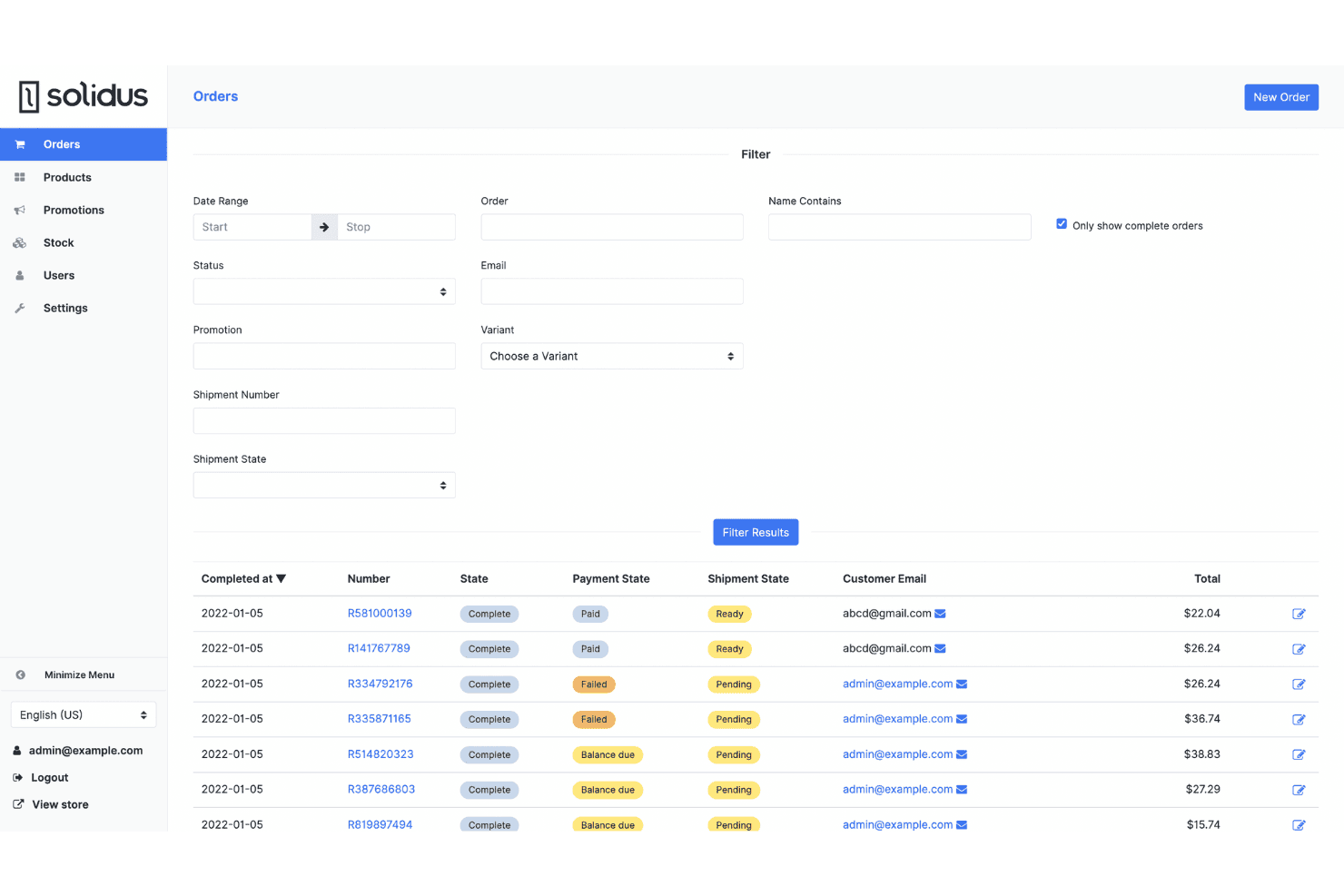
Solidus lets users filter and manage orders by status, payment, and shipment state. Solidus is a BSD-3-licensed open-source ecommerce platform built on Ruby on Rails that includes a native subscription engine supporting recurring billing, curated boxes, Build Your Own Box, and digital memberships.
Who Is Solidus Best For?
Solidus is a strong fit for DTC brands with in-house Ruby on Rails developers who want a fully self-hosted subscription storefront with no licensing fees or per-transaction costs.
Why I Picked Solidus
Solidus earns its spot on my list because it's one of the only open-source ecommerce platforms with a native subscription engine built directly into the codebase. I love that the
solidus_subscriptionsextension supports curated boxes, Build Your Own Box, and digital memberships out of the box, so Ruby on Rails teams aren't stitching together separate billing tools. Recurring billing intervals are configurable at the line-item level, meaning a store can run monthly replenishment and bimonthly curated boxes from a single checkout flow.Solidus Key Features
- BSD-3-Clause open source license: Solidus is freely self-hostable and redistributable under a permissive OSI-approved license with no per-transaction fees on any plan.
- PSP-agnostic payment gateway support: Native integrations with Stripe, Braintree, PayPal, Square, Razorpay, Affirm, Afterpay, and Klarna give merchants broad payment flexibility.
- REST and GraphQL APIs: Dual API access lets developer teams connect Solidus to headless frontends, ERPs, CRMs, and other retail tech stack components.
- Configurable dunning and retry logic: Failed subscription installments are automatically retried on each processor run, with optional Churn Buster integration for advanced payment recovery workflows.
Solidus Integrations
Solidus documents 10+ native payment gateway integrations, including Stripe, Braintree, PayPal Commerce Platform, Square, Razorpay, Klarna, and Afterpay. It also connects with Avalara, Klaviyo, EasyPost, ShipStation, Segment, and Churn Buster, with REST and GraphQL APIs for custom integrations.
Pros and Cons
Pros:
- Dual REST and GraphQL APIs available
- Native subscription engine supports curated boxes
- Truly free and open source model
Cons:
- Ruby on Rails expertise required for deployment
- No pre-built customer subscription portal
Learn more about Solidus: Best for content-driven subscription storefronts
- Free demo available
- Pricing upon request
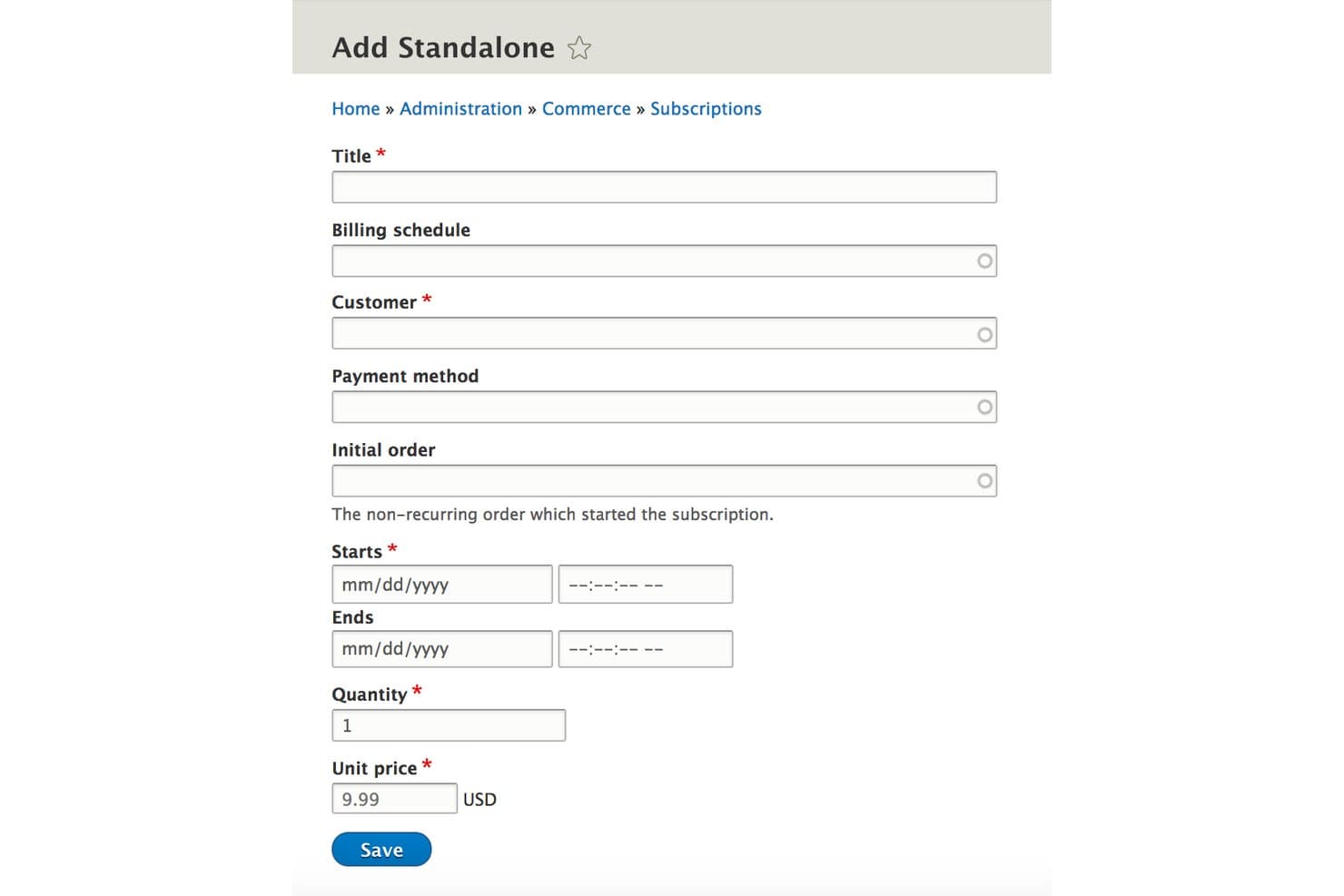
Drupal Commerce lets users manually create standalone subscriptions. Drupal Commerce is a GPL-licensed, self-hostable open-source e-commerce platform built on Drupal CMS that combines content management with recurring billing, configurable subscription types, and a 142-module payment gateway ecosystem.
Who Is Drupal Commerce Best For?
Drupal Commerce is a strong fit for development teams building content-heavy subscription storefronts where CMS and ecommerce need to live on the same platform.
Why I Picked Drupal Commerce
Drupal Commerce earns its spot on my shortlist because it's the only open-source subscription platform where content management and recurring billing share the same codebase. I love how fieldable subscription entities let you attach custom metadata directly to each subscriber record, which is genuinely useful when building content-gated membership tiers or curated box programs. The 142 contributed payment gateway modules, including GoCardless for direct debit and Stripe with Connect built in, cover recurring billing scenarios most platforms can't match without expensive add-ons.
Drupal Commerce Key Features
- Fieldable subscription entities: Attach custom fields and metadata directly to individual subscription records to support complex data models.
- Advanced Queue-powered renewal processing: Automates billing period closures and renewal jobs via Drupal Cron for reliable background processing.
- Multi-store and multi-currency support: Run multiple store entities with per-currency static pricing and CLDR-standard localization from a single installation.
- B2B customer groups: Assign shared addresses, payment methods, order history, and account-level price lists to business customer accounts.
Drupal Commerce Integrations
Drupal Commerce has a wide range of payment gateway integrations, including Stripe, PayPal, Braintree, GoCardless, Adyen, and Checkout.com, plus Avalara and ShipStation integrations. JSON:API and REST endpoints support custom connections.
Pros and Cons
Pros:
- Massive global payment gateway coverage
- Supports complex content-driven subscription storefronts
- Controls all subscription and ecommerce data
Cons:
- Subscription lifecycle upgrades require custom development
- No built-in subscriber self-service portal
Learn more about Drupal Commerce:
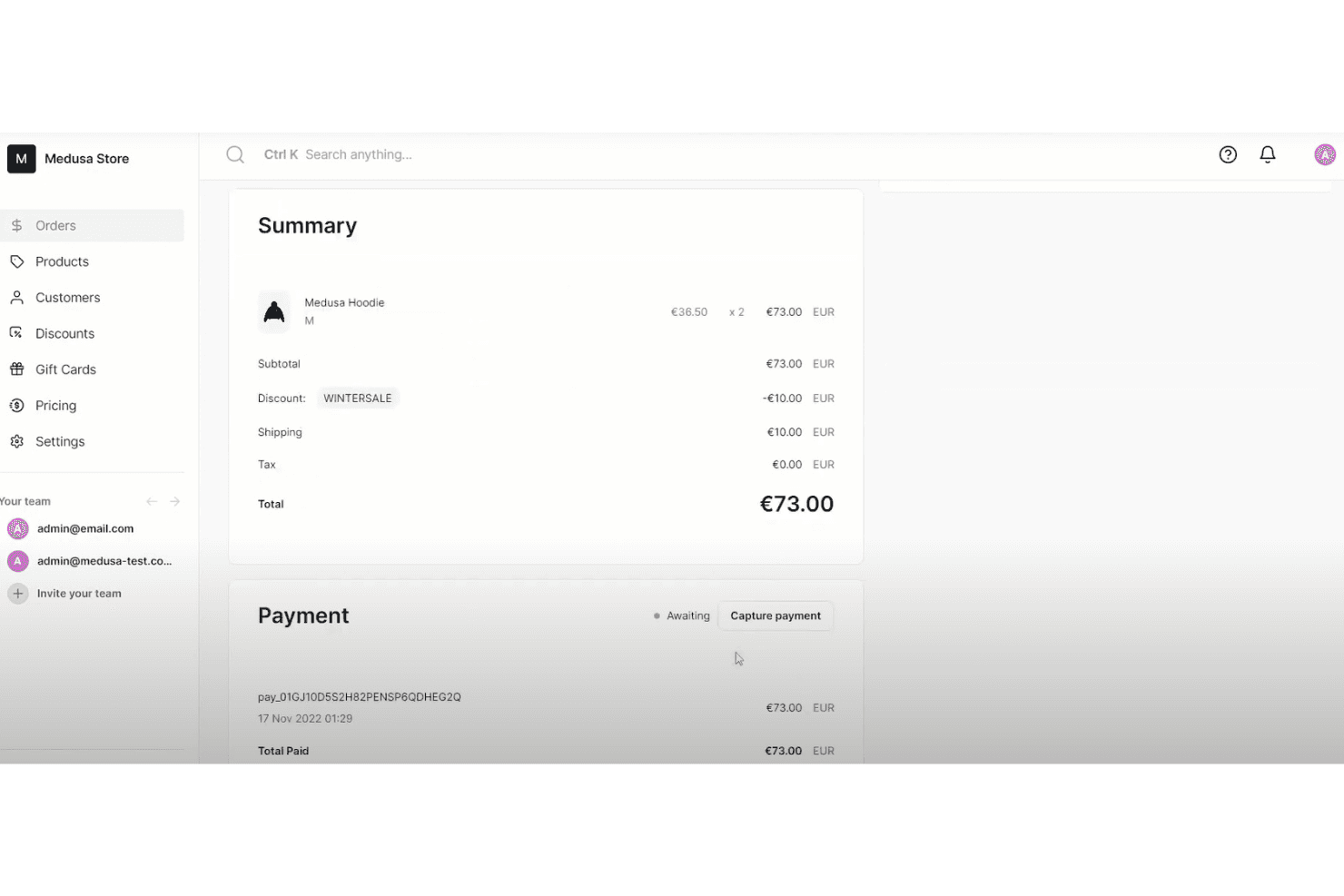
Medusa tracks order summaries, discounts, and payment capture in one view. Medusa is an open-source, headless commerce platform built on Node.js and TypeScript that covers product catalog management, multi-currency pricing, tax, payment processing, and subscription lifecycle management via its modular architecture and the MIT-licensed Reorder plugin.
Who Is Medusa Best For?
Medusa is a strong fit for engineering-led DTC brands and retail teams that want full control over their subscription stack without paying per-transaction SaaS fees.
Why I Picked Medusa
I picked Medusa as one of the best because it's the only open-source platform that lets you run a fully headless subscription commerce stack without paying per-transaction SaaS fees. The MIT-licensed Reorder plugin adds production-ready recurring billing, dunning with configurable retry intervals, and MRR/churn/LTV analytics directly inside the Medusa Admin. I also love that multi-currency pricing and tax are baked into the core, so cross-border subscription programs don't require bolted-on workarounds.
Medusa Key Features
- Self-service subscription API routes: Store-facing REST endpoints let customers skip deliveries, swap plans, and update payment methods without contacting support.
- Modular commerce architecture: Medusa's 17 independent modules let you adopt only the components you need—tax, inventory, pricing—without deploying a full monolith.
- Multi-region pricing engine: Define currency-specific prices, local tax rates, and region-scoped shipping rules natively within the open-source core.
- Scheduled workflow engine: Built-in scheduler triggers recurring jobs for renewal execution, retry logic, and subscription state transitions on configurable intervals.
Medusa Integrations
Medusa lists 100+ integrations, including Stripe, PayPal, Braintree, Authorize.net, Mollie, Odoo, ShipStation, Klaviyo, Algolia, and PostHog. Its Store and Admin REST APIs, webhooks, and Payment Module Provider SDK support custom integrations.
Pros and Cons
Pros:
- Modular architecture supports bespoke subscription logic
- Fully self-hosted with open-source license
- No GMV or per-transaction SaaS fees
Cons:
- No native GraphQL or POS integrations
- Subscription management requires plugin or custom build
Learn more about Medusa:
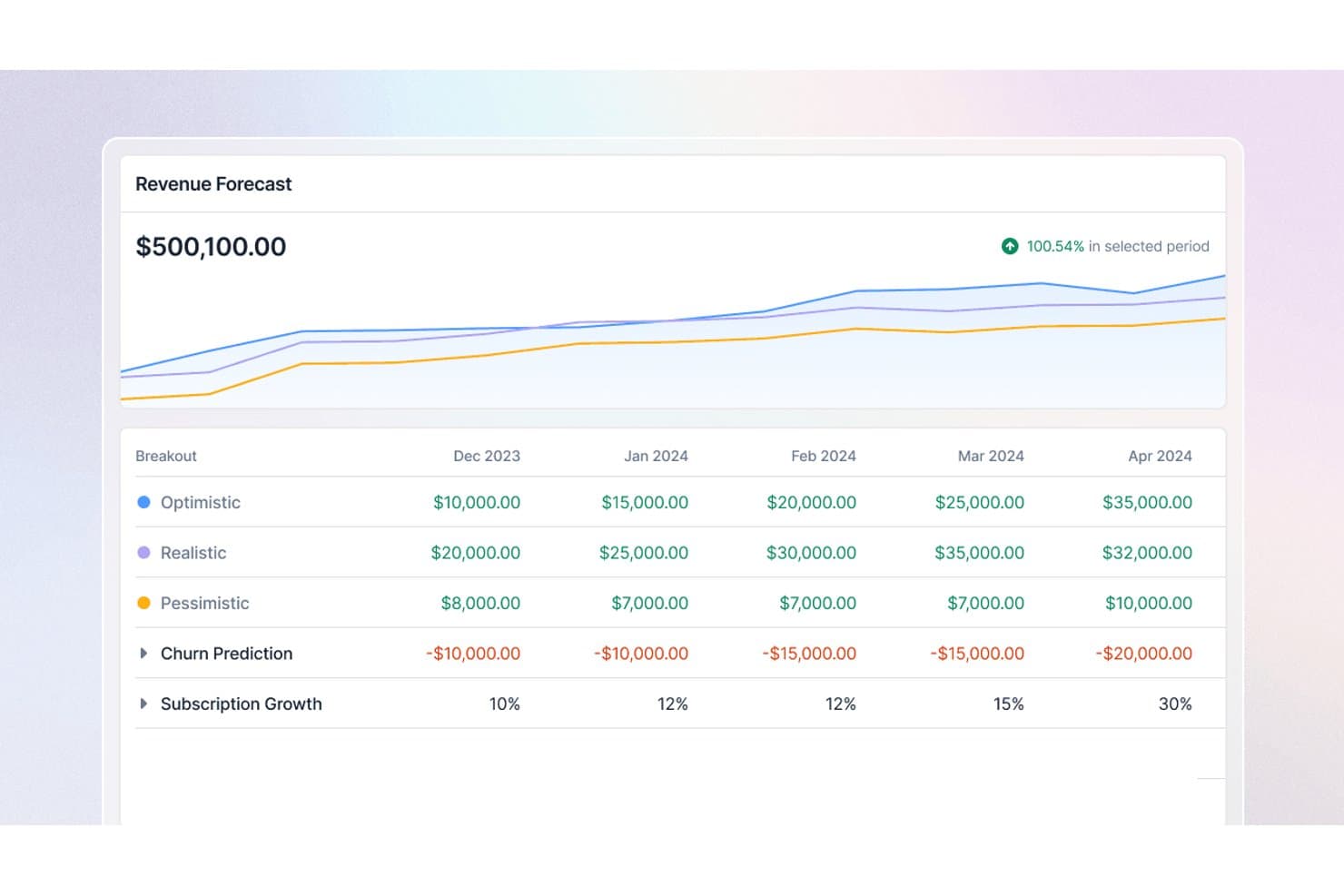
Lago forecasts subscription revenue across optimistic, realistic, and pessimistic scenarios. Lago is an open-source subscription management platform built on an API-first architecture, offering recurring billing, usage-based metering, hybrid pricing models, dunning automation, and native integrations with accounting, CRM, and payment providers.
Who Is Lago Best For?
Lago is a strong fit for engineering-led teams that need to build custom billing workflows on top of a flexible, API-first foundation they can self-host and fully control.
Why I Picked Lago
Lago earns its spot as one of the best on my shortlist because its API-first architecture is genuinely built for engineering teams that need to own their billing logic end to end. I love that it ships a full REST API with an OpenAPI spec, SDKs in four languages, signed webhooks across every billing event, and an MCP server for AI agent workflows. In practice, that means my team can pipe usage events at scale, trigger subscription changes programmatically, and wire Lago into any stack without waiting on a vendor's integration roadmap.
Lago Key Features
- Hybrid pricing model support: Lago lets you combine flat subscription fees and usage-based charges on a single invoice, across billing intervals from daily to yearly.
- Prepaid credit wallets: Customers can hold prepaid credit balances that Lago draws down automatically as usage accrues, with support for automatic top-ups.
- Multi-currency invoicing: Lago generates invoices in the customer's billed currency, supporting global billing without manual currency conversion workflows.
- Built-in revenue analytics: Lago includes dashboards covering MRR, subscription trends, cash collection, credit ledgers, and forecasted usage, all exportable via API or CSV.
Lago Integrations
Lago offers native integrations with Stripe, Adyen, GoCardless, NetSuite, Xero, QuickBooks, Salesforce, Anrok, and Avalara. Its REST API, SDKs, signed webhooks, and Zapier support custom connectivity.
Pros and Cons
Pros:
- Hybrid pricing and prepaid wallet support
- API-first with signed webhooks and SDKs
- Scales to one million events per second
Cons:
- Customer portal lacks plan management tools
- No ready-made ecommerce platform connectors
Learn more about Lago:
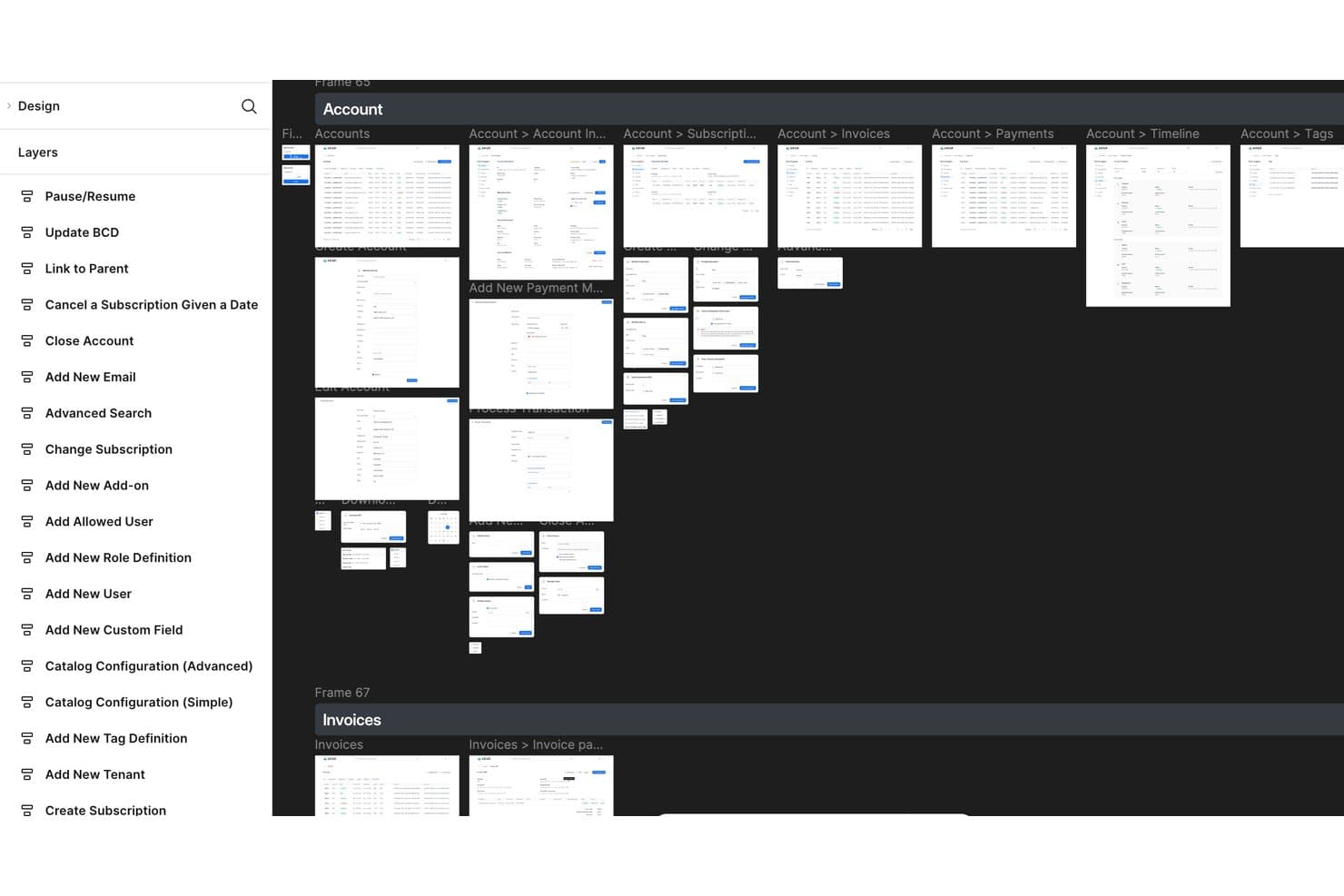
Kill Bill organizes subscription workflows across accounts, invoices, and payments. Kill Bill is an open-source subscription management and recurring billing platform built on a Java-based, API-first architecture that handles subscription lifecycle management, payment gateway integrations, dunning automation, usage-based billing, and multi-tenant catalog management.
Who Is Kill Bill Best For?
Kill Bill is best suited for engineering-led teams that need full control over their billing infrastructure without paying per-transaction SaaS fees.
Why I Picked Kill Bill
Kill Bill earns its spot on my shortlist because of how it handles billing automation at the infrastructure level. I love its dual dunning system: a configurable payment retry schedule runs alongside a separate overdue state machine that moves accounts through warning, blocked, and cancellation stages automatically. I've also used its evergreen plan configuration to handle automatic renewals without any manual intervention, which keeps revenue flowing even across complex multi-tenant deployments.
Kill Bill Key Features
- Multi-tenant catalog management: Manage separate product catalogs, pricing, and billing schedules for thousands of isolated tenants from a single deployment.
- OSGi plugin framework: Deploy, update, and roll back payment gateway or custom logic plugins independently without restarting the core billing engine.
- Usage-based billing: Ingest and rate usage events natively to support metered and consumption-based subscription models.
- Kaui admin UI: A web-based back-office interface that lets finance and operations teams manage accounts, invoices, and billing configurations without writing code.
Kill Bill Integrations
Kill Bill integrations include Stripe, Adyen, Braintree, PayPal, Authorize.Net, Qualpay, Avalara, NetSuite, SAP, QuickBooks, Salesforce, and HubSpot. The REST API supports custom Shopify, WooCommerce, POS, and ERP integrations.
Pros and Cons
Pros:
- Open source license with full data control
- Supports multi-tenant catalog management
- Offers dual dunning and overdue automation
Cons:
- Requires Java engineering for advanced customization
- No built-in customer self-service portal
Learn more about Kill Bill:
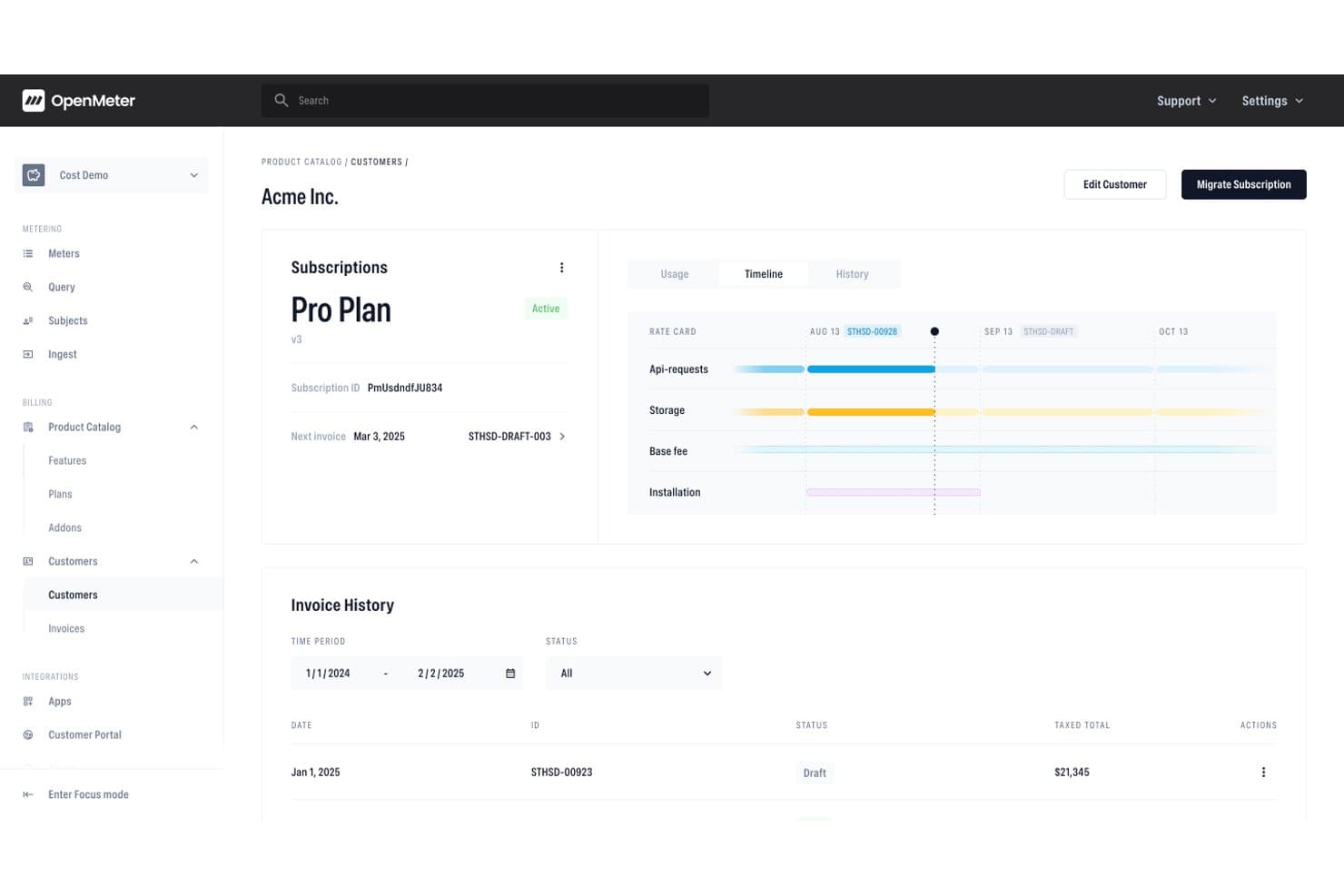
OpenMeter tracks subscription timelines, usage, and invoice history per customer. OpenMeter is an Apache 2.0 open source metering and billing platform built for usage-based pricing, offering a real-time event metering engine, a flexible product catalog, subscription lifecycle management, and entitlement tracking.
Who Is OpenMeter Best For?
OpenMeter is a strong fit for technical teams building AI or API products that need precise, high-volume usage metering and flexible billing without paying a cut of their revenue.
Why I Picked OpenMeter
I picked OpenMeter as one of the best because it's purpose-built for metered API and AI token billing in a way I haven't seen matched by other open source options. Its real-time metering engine, built on Kafka and ClickHouse, handles billions of events and supports per-unit pricing models like $0.01 per AI token, tiered graduated rates, and dynamic cost-plus pricing. I also like that it tracks entitlement and credit balances live, so teams billing for API access always know exactly where customers stand.
OpenMeter Key Features
- Apache 2.0 open source licensing: The full codebase is publicly available on GitHub with no feature-gating by license tier, so you can self-host without paying per-transaction fees.
- No-code product catalog: Business and finance teams can create and iterate on pricing plans or provision custom enterprise deals without writing any code.
- Subscription lifecycle API: Manages upgrades, downgrades, add-ons, prorations, and cancellations via API, with timing controls for immediate or next-billing-cycle changes.
- Svix-powered webhook delivery: Billing and usage events trigger webhooks through Svix, giving your team reliable, real-time event notifications for downstream workflow automation.
OpenMeter Integrations
OpenMeter offers marketplace integrations for Stripe and HubSpot, plus external invoicing support. It provides a REST API, Svix webhooks, CloudEvents, and Node.js, Python, and Go SDKs for custom integrations.
Pros and Cons
Pros:
- API-first design supports custom integrations
- No-code product catalog for pricing plans
- Real-time metering for usage-based billing
Cons:
- No built-in customer self-service portal
- Lacks native retail and ecommerce workflows
Learn more about OpenMeter: 10Best for telecom-scale subscription billing
Opencell
- Free demo available
- Pricing upon request
Visit WebsiteCustomer Rating:4.5/5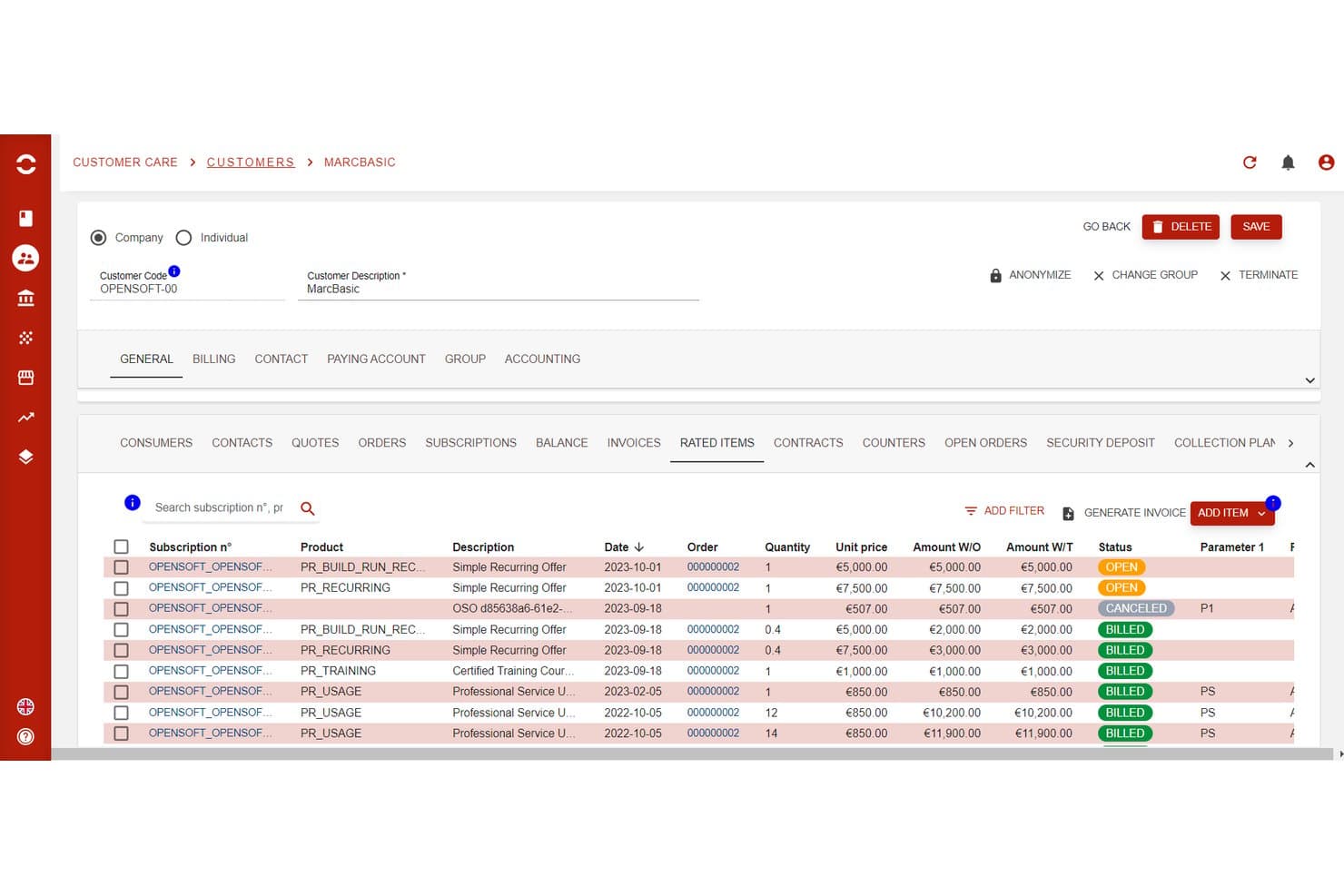
Opencell tracks rated items with billing status per subscription. Opencell is an open-source subscription billing platform built on an AGPLv3-licensed core that handles recurring billing, usage-based rating, subscription lifecycle management, dunning automation, and multi-currency invoicing across complex, high-volume environments.
Who Is Opencell Best For?
Opencell suits engineering-led teams at large enterprises that need to manage high-volume, complex subscription billing across multiple entities, currencies, or markets.
Why I Picked Opencell
Opencell earns its spot on my shortlist because its billing engine handles the kind of complexity that breaks lighter open-source tools, specifically real-time usage mediation, multi-seller environments, and granular customer hierarchies down to individual access points. I picked it for telecom-scale subscription billing because those same capabilities translate directly to high-volume, multi-entity retail deployments, like Fnac/Darty's DartyMax service with over one million subscribers. Its AGPLv3 core and 200+ REST APIs give engineering teams full code access and a complete quote-to-cash integration surface.
Opencell Key Features
- Self-care portal SDK: A React JS-based SDK lets customers manage their own subscriptions, view bills, and make payments directly from your website.
- Dynamic payment routing: Automatically selects the best payment provider based on customer location or payment method to reduce processing costs.
- Multi-seller billing environment: Supports marketplace and billing-as-a-service scenarios across multiple sellers within a single platform instance.
- Revenue analytics dashboard: Surfaces pre-calculated KPIs including MRR, ARR, churn rate, and LTV with connectors to BI tools like Microsoft Power BI.
Opencell Integrations
Native integrations include Stripe, Slimpay, Ingenico, Mangopay, PayPal, Avalara, Salesforce, Jaspersoft, and Microsoft Power BI. Opencell also provides 200+ REST APIs, webhooks, and TM Forum APIs for custom connections.
Pros and Cons
Pros:
- Supports granular automated dunning workflows
- Offers 200+ documented REST API endpoints
- Handles complex multi-entity subscription billing
Cons:
- No prebuilt Shopify or Magento connectors
- Admin portal UI not open source
Learn more about Opencell:
Alte programe cu sursă deschisă pentru gestionarea abonamentelor
Iată câteva opțiuni suplimentare de programe cu sursă deschisă pentru gestionarea abonamentelor care nu au ajuns pe lista mea scurtă, dar merită totuși analizate:
- 11BoxBillingBest for AI and SaaS usage-based billing
- 12OpenCartBest for small retailers selling subscription products
- 13Invoice NinjaBest for self-hosted invoicing with subscription plans
- 14SyliusBest for MIT-licensed custom storefront subscriptions
- 15jBillingBest for telecom-grade usage billing on-premise
- 16FlexpriceBest for credit-based open-source billing
- 17MeteroidBest for open-source usage-based billing
How I Evaluate Open Source Subscription Management Software
I look for two things: baseline capabilities like self-hosted recurring billing and dunning, and differentiators that actually matter to DTC ops leads running box or replenishment programs.
Core Functionality (Table Stakes For This List)
When I'm selecting tools for my list, I rank each one on a scale from 0 (does not offer the functionality) to 5 (excels in this area) for each core functionality listed below. Then, I calculate the tool's total score into a percentage. Each tool needs to achieve a minimum total score of 55% to be considered for inclusion.
- Open Source Licensing: I check the license type (MIT, Apache 2.0, AGPL, etc.), confirm the source code is publicly accessible, and look at whether the repo is actively maintained with recent commits.
- Recurring Billing Engine: The billing engine needs to handle varied pricing models, from flat-rate replenishment plans to tiered membership pricing with mid-cycle proration on upgrades.
- Subscription Lifecycle Management: I evaluate how each tool handles real retail scenarios like a subscriber pausing a monthly snack box, downgrading a membership tier, or reactivating a lapsed account.
- Payment Gateway Integrations: Multiple gateway options matter here. I look for tokenized support across processors like Stripe, Braintree, and PayPal so teams aren't locked into a single provider.
- Dunning & Failed-Payment Recovery: Retail subscriptions live and die by recovery rates. I evaluate retry scheduling, customer notification options, and whether the tool surfaces churn data from failed payments.
- Retail & eCommerce Extensibility: I look at the API surface, webhook coverage, and prebuilt connectors for platforms like WooCommerce, Magento, or Shopify, plus any ERP or POS integration paths.
Once I have a list of tools that meet this criteria, I consider what sets each platform apart.
Differentiating Factors (What Sets Vendors Apart)
Here's how I compare and contrast different vendors:
Standout Features
A self-service customer portal is a big differentiator. I look for portals that let subscribers swap products, skip shipments, or update payment details on their own—reducing support volume for teams managing thousands of active accounts. Headless, API-first architecture also matters when your engineering team needs to embed billing logic into a custom storefront or mobile app. I evaluate multi-currency and tax engine integrations too, since cross-border retail subscriptions add compliance complexity fast.
Beyond Features
Deployment flexibility is one of the first things I check. Some teams have DevOps resources for Docker or Kubernetes self-hosting, while others need a managed cloud option—so I look at whether vendors offer both paths. Community health tells you a lot, too. An active GitHub repo with frequent commits and a responsive forum signals long-term viability. Total cost of ownership rounds out my evaluation, especially whether a platform can handle peak traffic spikes like major sale events without requiring expensive infrastructure upgrades.
Ce sunt programele cu sursă deschisă pentru gestionarea abonamentelor?
Programele cu sursă deschisă pentru gestionarea abonamentelor sunt un set de instrumente care ajută companiile să automatizeze facturarea recurentă, emiterea facturilor și gestionarea abonaților — toate bazate pe cod disponibil gratuit, pe care îl puteți personaliza.
Aceste platforme vă permit să controlați totul, de la modelele de tarifare până la procesarea plăților în timp real, oferind flexibilitatea de a se adapta oricăror nevoi sau fluxuri de lucru ale afacerii.
Majoritatea echipelor folosesc soluții cu sursă deschisă pentru a reduce costurile, a îmbunătăți scalabilitatea și a evita dependența de un singur furnizor. Beneficiați de acces direct la API, de posibilitatea de a crea integrări personalizate și de un tablou de bord adaptat facturării în funcție de utilizare sau veniturilor recurente.
Indiferent dacă gestionați abonamente SaaS, produse digitale sau operațiuni complexe pe mai multe canale, opțiunile cu sursă deschisă vă oferă mai mult control asupra datelor și proceselor, fără a compromite securitatea sau creșterea.
Cum să alegeți programele cu sursă deschisă pentru gestionarea abonamentelor
Alegerea unui program cu sursă deschisă pentru gestionarea abonamentelor presupune să evaluați realist nevoile afacerii, dificultățile legate de integrări și realitățile facturării recurente. Iată un ghid pas cu pas care vă ajută să rămâneți concentrat și să evitați greșelile de începător:
| Pas | Ce trebuie luat în considerare | Sfat util |
|---|---|---|
| Pas1. Definiți cazurile de utilizare | Ce trebuie luat în considerareFacturați pentru SaaS, produse fizice, servicii sau pentru toate trei? Luați în considerare facturarea recurentă, plățile unice și perioadele de testare gratuite. | Sfat utilCu cât nevoile sunt mai specifice, cu atât puteți elimina mai rapid opțiunile nepotrivite. |
| Pas2. Stabiliți integrările necesare | Ce trebuie luat în considerareFaceți o listă cu conexiunile indispensabile: gateway-uri de plată (Stripe, PayPal), CRM-uri, instrumente de contabilitate, API-uri și platforme de comerț electronic. | Sfat utilTestați integrările din timp — problemele API sunt frecvente în cazul proiectelor cu sursă deschisă. |
| Pas3. Evaluați scalabilitatea și fiabilitatea | Ce trebuie luat în considerarePoate sistemul să gestioneze volumul actual — și viitor — de abonați, tranzacții și produse? | Sfat utilCăutați studii de caz din lumea reală sau activitate pe GitHub. Scalabilitatea nu este doar un cuvânt la modă. |
| Pas4. Evaluați experiența utilizatorului | Ce trebuie luat în considerareVerificați interfața utilizatorului, tablourile de bord în timp real și rapoartele. Cât de repede se poate familiariza echipa cu sistemul și poate depana problemele? | Sfat utilFaceți demonstrații folosind fluxuri de lucru reale. Un tablou de bord confuz va încetini facturarea și va frustra personalul. |
| Pas5. Analizați costul total de deținere | Ce trebuie luat în considerareIncludeți cheltuielile pentru găzduirea proprie, suplimente, opțiuni cloud, niveluri de asistență și upgrade-uri viitoare. | Sfat utilO soluție cu sursă deschisă „gratuită” poate deveni costisitoare. Atribuiți o valoare în bani timpului echipei și oricărui ajutor extern de care veți avea nevoie. |
| Pas6. Verificați asistența și soliditatea comunității | Ce trebuie luat în considerareAre software-ul forumuri active, documentație de încredere și remedieri rapide ale erorilor? | Sfat utilPrioritizați proiectele cu depozite GitHub active, actualizări frecvente și mentenanți receptivi. |
| Pas7. Verificați securitatea și conformitatea | Ce trebuie luat în considerareSunt datele criptate? Vă ajută software-ul să respectați GDPR sau PCI? | Sfat utilNu vă ocupați singur de securitate — folosiți platforme cu protocoale clare de protecție a datelor și actualizări regulate. |
Funcționalități
Nu căutați doar o listă de cuvinte la modă.
Cele mai bune platforme cu sursă deschisă de gestionare a abonamentelor vă oferă elementele de bază pentru automatizarea facturării, gestionarea prețurilor complexe și menținerea fiecărui abonament în stare de funcționare impecabilă — indiferent cât de rapid se extinde afacerea dvs.
Iată ce contează:
- Facturare recurentă automatizată pentru abonamente, calitatea de membru și prețuri bazate pe utilizare.
- Acces API pentru crearea de integrări personalizate cu soluțiile dvs. de comerț electronic, CRM sau financiare.
- Modele flexibile de facturare — acceptarea unor structuri de plată unice, recurente, pe consum sau hibride.
- Integrări cu gateway-uri de plată precum Stripe, PayPal, Braintree și altele.
- Planuri de abonament personalizabile pentru a corespunde exact nevoilor legate de produse, prețuri sau contracte.
- Analize și tablouri de bord în timp real pentru monitorizarea veniturilor, pierderii abonaților și abonaților activi.
- Facturare automatizată și fluxuri de lucru pentru recuperarea plăților restante pentru urmărirea plăților întârziate și reducerea pierderii abonaților.
- Acceptarea mai multor monede și localizarea pentru vânzări globale și afaceri prezente în mai multe regiuni.
- Gestionarea utilizatorilor pentru echipe și roluri, cu controale detaliate ale permisiunilor.
- Opțiuni de implementare cu găzduire proprie și în cloud pentru a corespunde cerințelor dvs. de IT și conformitate.
- Piață cu sursă deschisă de module și suplimente pentru funcționalități suplimentare și extindere rapidă.
- Raportare solidă și exporturi financiare pentru taxe, audituri și planificare financiară.
- Gestionarea securizată a datelor — criptare, asistență pentru conformitate și actualizări regulate.
Beneficii
Gestionarea cu sursă deschisă a abonamentelor înseamnă să vă recâștigați controlul. Cu sistemul potrivit, veți automatiza mai multe procese, vă veți extinde mai rapid și nu veți mai fi limitați de restricțiile unui furnizor.
Iată ce poate câștiga afacerea dvs.:
- Costuri mai mici și fără dependență de furnizor — evitați licențele costisitoare și păstrați controlul asupra sistemului.
- Flexibilitate maximă — personalizați sistemul de facturare, tablourile de bord și fluxurile de lucru pentru a se potrivi nevoilor afacerii dvs.
- Scalabilitate din prima zi — treceți de la câțiva abonați la mii de abonați fără să schimbați platforma.
- Automatizare mai rapidă și mai puține erori — automatizați totul, de la facturare la reîncercarea plăților.
- Integrări mai bune — conectați-vă direct la instrumentele, API-urile și gateway-urile de plată existente.
- Informații utile în timp real — folosiți analizele integrate pentru a optimiza veniturile recurente și a reduce pierderea abonaților.
- Experiență îmbunătățită pentru clienți — oferiți mai multe opțiuni de plată, facturi clare și portaluri de autoservire.
- Pregătire pentru viitor — accesați suplimente, integrări și inovații noi cu sursă deschisă pe măsură ce afacerea dvs. evoluează.
- Securitate și conformitate îmbunătățite — dețineți controlul asupra datelor, gestionați actualizările și respectați în permanență reglementările privind confidențialitatea.
Costuri și prețuri
Instrumentele cu sursă deschisă de gestionare a abonamentelor sunt de obicei mai ieftine la început, însă costurile reale depind de dimensiunea echipei, funcționalitățile necesare și nivelul de personalizare de care aveți nevoie.
Așteptați-vă să plătiți pentru suplimente, asistență premium sau găzduire în cloud dacă doriți mai puțină întreținere. Iată cum sunt structurate de obicei majoritatea planurilor:
| Tip de plan | Preț mediu | Funcții comune | Potrivit pentru |
|---|---|---|---|
| Tip de planPlan gratuit | Preț mediu$0/user/month | Funcții comuneFacturare de bază, integrări esențiale, asistență din partea comunității, rapoarte limitate | Potrivit pentruOperatori independenți, testare, utilizare pentru dezvoltare |
| Tip de planPlan personal | Preț mediu$5–$25/user/month | Funcții comunePlanuri personalizabile, mai multe monede, asistență prioritară, analize | Potrivit pentruFreelanceri, startupuri aflate la început |
| Tip de planPlan pentru afaceri | Preț mediu$30–$75/user/month | Funcții comuneRaportare avansată, API complet, mai multe gateway-uri, roluri pentru utilizatori | Potrivit pentruIMM-uri, echipe aflate în etapa de creștere |
| Tip de planPlan pentru întreprinderi | Preț mediu$100+/user/month | Funcții comunePersonalizare completă, asistență dedicată, SLA-uri, securitate avansată | Potrivit pentruOrganizații mari, facturare complexă |
Câteva aspecte de urmărit:
- Instrumentele open-source par adesea gratuite, dar pot genera costuri considerabile pentru găzduirea în cloud, module sau extensii de la terți.
- Nu toate funcțiile (precum analizele în timp real sau gestionarea avansată a plăților restante) sunt incluse în fiecare nivel — verifică lista funcțiilor înainte de a lua o decizie.
- Asistența dedicată și funcțiile de conformitate pot fi tarifate separat.
Related Reviews
Întrebări frecvente despre software-ul open-source de gestionare a abonamentelor
Iată câteva răspunsuri la întrebările frecvente despre software-ul open-source de gestionare a abonamentelor:
Care este principalul avantaj al utilizării software-ului open-source de gestionare a abonamentelor?
Cel mai mare avantaj este flexibilitatea și controlul. Îți deții datele, fluxurile de lucru și integrările — nu mai ești dependent de o platformă SaaS costisitoare și nu mai trebuie să aștepți luni întregi pentru o funcție solicitată.
Poți automatiza facturarea, te poți adapta la metode de plată noi și poți crește sau reduce volumul fără să plătești pentru funcții inutile pe care nu le vei folosi niciodată. În plus, beneficiezi de transparență în ceea ce privește securitatea și actualizările codului.
Pot instrumentele open-source de gestionare a abonamentelor să gestioneze facturarea recurentă pentru diferite modele de afaceri?
Desigur. Majoritatea platformelor open-source de top acceptă modele de facturare unică, recurentă, bazată pe utilizare și hibridă.
Indiferent dacă administrezi un SaaS, abonamente, produse digitale sau chiar o afacere cu produse fizice, poți personaliza fluxurile de lucru, nivelurile de preț și programele de facturare pentru a se potrivi exact nevoilor tale — mai ales dacă trebuie să integrezi mai multe gateway-uri de plată sau să oferi facturare în mai multe monede.
Cât de dificil este să integrez soluțiile open-source cu stiva mea tehnologică existentă?
Dacă ai cunoștințe tehnice sau ai la dispoziție un dezvoltator, integrarea este simplă cu majoritatea instrumentelor open-source importante. API-urile sunt de obicei bine documentate, iar modulele comunității acoperă sistemele CRM populare, platformele de comerț electronic și gateway-urile de plată precum Stripe și PayPal.
Adevărata provocare este să îți planifici fluxurile de lucru înainte de a începe — astfel încât să nu improvizezi remedieri de ultim moment după lansare.
Sunt platformele open-source de facturare suficient de sigure pentru gestionarea plăților și a datelor clienților?
Da — dacă le menții actualizate și urmezi cele mai bune practici. Software-ul open-source îți oferă control asupra protocoalelor de securitate, criptării și conformității cu standarde precum GDPR sau PCI.
Rămâi implicat în comunitate, remediază rapid vulnerabilitățile și nu implementa o soluție de facturare fără o evaluare de securitate. Concluzia: securitatea ta este la fel de solidă ca procesul echipei tale.
De câtă expertiză tehnică am nevoie pentru a rula și întreține software-ul open-source de gestionare a abonamentelor?
Vei avea nevoie de cineva familiarizat cu configurarea serverelor, gestionarea bazelor de date și depanarea de bază — mai ales pentru soluții găzduite pe propriile servere sau puternic personalizate.
Opțiunile open-source bazate pe cloud pot fi mai ușor de utilizat, dar nu te aștepta la o soluție pe care o configurezi și apoi o uiți. Planifică un buget pentru întreținere continuă, actualizări și ajutor ocazional din partea unui dezvoltator, mai ales pe măsură ce veniturile tale recurente cresc.
Ce opțiuni de asistență sunt disponibile pentru instrumentele open-source de facturare a abonamentelor?
Asistența variază. Cele mai bune proiecte au forumuri active, grupuri de chat în timp real și documentație detaliată — plus actualizări frecvente ale codului pe GitHub.
Unele oferă asistență plătită sau servicii de consultanță pentru nevoi avansate. Înainte de a lua o decizie, verifică cât de receptivă este comunitatea și dacă există o opțiune de escaladare a problemelor atunci când sistemul tău de facturare necesită atenție urgentă.