
Å drive en detaljhandelsvirksomhet innebærer å holde styr på stadig skiftende forhold – å holde lagerbeholdningen under kontroll, forutse hva kundene vil ønske seg neste gang og forbedre hvordan folk samhandler med butikken din. AI-verktøy for detaljhandel hjelper deg med å håndtere dette presset ved å gi deg tydeligere prognoser, mer presis innsikt og raskere måter å reagere på de daglige behovene.
Gjennom min erfaring med å teste og vurdere programvare vet jeg hvordan AI-funksjoner kan forvandle driften av detaljhandelen din. I denne artikkelen finner du min objektive og grundig undersøkte gjennomgang av de beste AI-løsningene for detaljhandel.
Jeg tar deg gjennom funksjonene, egenskapene og fordelene deres, slik at du kan ta en velinformert beslutning for teamet ditt.
Hvorfor du kan stole på våre programvareanbefalinger
6,700+
Reviews
20
Industry experts
16+
Evaluation factors
14
Years
Teamet vårt har testet og anmeldt programvare siden 2012. Vi er selv ledere i detaljhandelen, så vi vet hvor vanskelig og hvor viktig det er å velge riktig programvare.
I denne guiden har vi vurdert verktøyene gjennom praktisk testing og uavhengig research og gitt dem poeng ut fra våre utvelgelseskriterier.
Anmeldelsene våre bygger på vår uavhengige vurdering, ikke på salgsargumenter.
Sammenligningstabell for AI-løsninger i detaljhandelen
Denne sammenligningstabellen oppsummerer prisdetaljene for mine beste anbefalinger av AI-løsninger for detaljhandel:
| Tool | Best For | Trial Info | Price | ||
|---|---|---|---|---|---|
| 1 | Best for AI-driven PO procurement | 90-day free trial | From $100/month | Website | |
| 2 | Best for integrated business solutions | Free demo available | Pricing upon request | Website | |
| 3 | Best for cloud-based AI services | Free plan available + 30-day free trial | From $0.008/vCPU/hour | Website | |
| 4 | Best for customer relationship management | 30-day free trial | From $25/user/month | Website | |
| 5 | Best for AI-assisted ERP setup | Free demo available | Pricing upon request | Website | |
| 6 | Best for large-scale AI deployment | Free trial available | Contact AWS for pricing | Website | |
| 7 | Best for AI governance and hybrid cloud modernization | Free demo available | Pricing upon request | Website | |
| 8 | Best for in-store monitoring and video analytics | Free demo available | Pricing upon request | Website | |
| 9 | Best for enterprise resource planning | Free trial + free demo available | Pricing upon request | Website | |
| 10 | Best for predictive analytics | Free demo available | Pricing upon request | Website |


Anmeldelser av de beste AI-løsningene for detaljhandel
Nedenfor finner du mine detaljerte sammendrag av de beste AI-løsningene for detaljhandel som kom med på listen min. Anmeldelsene mine gir en detaljert gjennomgang av de viktigste funksjonene, fordelene & ulempene, integrasjonene og ideelle bruksområdene for hvert verktøy, slik at du kan finne det som passer best for deg.

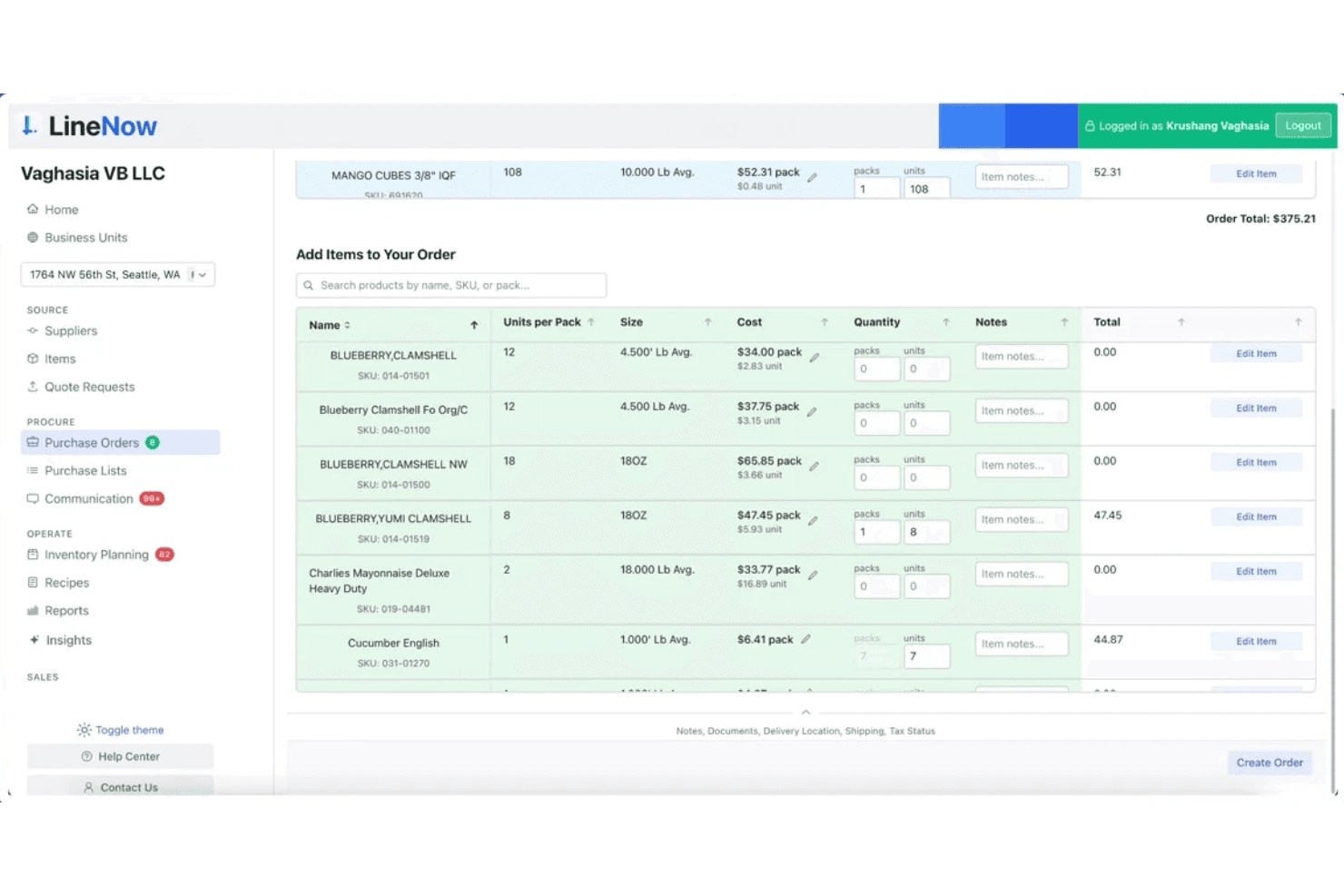
LineNow lets users build and manage purchase orders by item. LineNow is a purchase order and inventory management tool that automates procurement workflows for small and mid-sized retailers, covering PO creation, supplier communication, inventory tracking, and accounting sync.
Who Is LineNow Best For?
LineNow suits small and mid-sized retailers managing procurement manually, especially those running multiple locations or sales channels who need to automate PO creation and supplier communication.
Why I Picked LineNow
I picked LineNow as one of the best because its AI handles the most time-consuming part of procurement: building and managing POs without manual input. When stock dips below a reorder threshold, LineNow auto-drafts the PO. When a supplier replies with a backorder or substitution, the AI reads that email and updates the order record automatically. I find that combination, triggered ordering plus AI-parsed supplier communication, genuinely hard to replicate in other small-business procurement tools.
LineNow Key Features
- Sales velocity ranking: Sorts inventory by how quickly items sell, so you can prioritize reorders for your fastest-moving SKUs.
- Multi-location inventory visibility: Tracks stock levels across stores, warehouses, and sales channels in a single view.
- Supplier price change detection: Flags when a supplier updates their pricing so you can review cost impacts before confirming orders.
- Accounting sync: Pushes completed PO and receiving data directly to QuickBooks or Xero to close the procurement-to-payment loop.
LineNow Integrations
Integrations include Square, Toast, Clover, Lightspeed, Shopify, Amazon, Faire, QuickBooks, and Xero.
Pros and Cons
Pros:
- Hands-on onboarding and strong user support
- Interprets supplier replies and updates orders
- AI auto-drafts POs when stock runs low
Cons:
- Not recognized in major retail AI reports
- No AI-driven demand forecasting features
Learn more about LineNow: Best for integrated business solutions
- Free demo available
- Pricing upon request
Visit WebsiteCustomer Rating:4.6/5
Oracle improves cloud workflows with AI that automates tasks and sharpens decision-making Oracle offers a suite of cloud applications and platform services designed for businesses of all sizes, focusing on integrated business solutions. Its AI capabilities enhance decision-making, automate tasks, and provide valuable insights to users.
Why I picked Oracle: Oracle provides integrated business solutions with its cloud platform. Its AI features include machine learning and decision automation, which help your team improve ecommerce and in-store processes. Oracle's focus on integration allows for data flow across various business functions. This integrated approach makes it ideal for businesses seeking end-to-end solutions.
Standout Features & Integrations:
Features include advanced data analytics, decision automation, and machine learning capabilities. These help you gain insights and make informed decisions quickly. The platform's scalability supports businesses as they grow and adapt.
Integrations include Salesforce, Microsoft Azure, AWS, Google Cloud, SAP, IBM, Workday, NetSuite, Slack, and Tableau.
Pros and Cons
Pros:
- Strong omnichannel support
- Built-in AI for forecasting
- Unified retail suite
Cons:
- Complex setup and configuration
- High cost compared to competitors
Learn more about Oracle: Best for cloud-based AI services
- Free plan available + 30-day free trial
- From $0.008/vCPU/hour
Visit WebsiteCustomer Rating:4.3/5
Microsoft Azure supports building and deploying intelligent applications with AI services Microsoft Azure is a cloud computing platform that provides a wide range of services, including AI and machine learning tools, for businesses of all sizes. Its AI capabilities help users build, deploy, and manage intelligent applications across many industries.
Why I picked Microsoft Azure: Microsoft Azure offers cloud-based AI services that are scalable and versatile. Its AI tools include machine learning models and cognitive services, which support your team's ability to develop intelligent applications. The platform's flexibility allows you to tailor solutions to your specific business needs. Azure's focus on providing cloud services distinguishes it from other solutions.
Standout Features & Integrations:
Features include AI shopping assistants, campaign orchestrations, assortment optimization, and inventory optimization. These features can transform the shopper experience and drive supply chain agility. Azure's global network ensures reliable and fast service delivery.
Integrations include Microsoft 365, Copilot, OneLake, and Power BI.
Pros and Cons
Pros:
- Scalable cloud infrastructure
- Flexible service offerings
- Extensive AI toolset
Cons:
- Requires technical expertise for setup
- Complex pricing structure
Learn more about Microsoft Azure: Best for customer relationship management
- 30-day free trial
- From $25/user/month
Visit WebsiteCustomer Rating:4.4/5
Salesforce features CRM workflows with AI that personalizes interactions and automates sales Salesforce is a cloud-based customer relationship management (CRM) platform designed for businesses of all sizes to manage customer interactions and data. Its AI capabilities assist users in personalizing customer interactions and automating sales processes.
Why I picked Salesforce: Salesforce is renowned for its customer relationship management tools, supported by generative AI features like Einstein Analytics. These tools help your team personalize customer experiences and predict sales trends. The platform's automation capabilities simplify routine tasks, freeing up your time. This specialization in CRM makes Salesforce a preferred choice for managing customer relationships.
Standout Features & Integrations:
Features include customizable dashboards, automated workflows, and detailed reporting tools. These features give your team the flexibility to adapt the platform to specific needs. Real-time data access ensures you can make informed decisions quickly.
Integrations include Slack, Mailchimp, HubSpot, Google Workspace, QuickBooks, Dropbox, DocuSign, LinkedIn, and Jira.
Pros and Cons
Pros:
- Effective sales process automation
- Strong AI-driven analytics
- Highly customizable CRM platform
Cons:
- Requires ongoing maintenance and updates
- Can be complex for new users
Learn more about Salesforce : Best for AI-assisted ERP setup
- Free demo available
- Pricing upon request
Visit WebsiteCustomer Rating:4.1/5
Fulfil offers a comprehensive inventory management system. Fulfil is an ERP platform built for direct to consumer brands that need tighter control over inventory, fulfillment, and financial operations. It connects sales channels, warehouses, and accounting into a single system, helping retail teams manage growth without relying on disconnected tools. As a retail AI solution, Fulfil uses AI assisted configuration and automation to reduce manual setup and support more accurate operational workflows.
Why I Picked Fulfil
I picked Fulfil because it combines retail specific ERP functionality with AI assisted setup that can reduce the complexity of implementation. If you run a Shopify or DTC brand, you can centralize inventory, order management, and accounting in one system instead of stitching together multiple platforms. I was especially interested in its prebuilt connections to hundreds of third party logistics providers, which can help you coordinate fulfillment more efficiently as you scale. For growing retail brands that need operational visibility across channels, Fulfil offers structured control without sacrificing flexibility.
Fulfil Key Features
In addition to its robust AI capabilities, Fulfil offers several features that cater to retail businesses:
- Barcoding/Serial Tracking: This feature allows you to maintain accurate inventory records by tracking products through barcodes and serial numbers.
- Order Management: Streamline your order processing with tools that manage orders from multiple channels in one place.
- Real-Time Data: Access up-to-date information on inventory levels and sales to make informed decisions quickly.
- Customer Relationship Management: Improve customer interactions with tools designed to track and manage customer data.
Fulfil Integrations
Fulfil integrates with over 400 third-party logistics providers, Shopify, and other essential retail platforms, ensuring a seamless connection between various aspects of your business operations. Additionally, an open API is available for custom integrations, allowing further customization to meet specific business needs.
Pros and Cons
Pros:
- Extensive 3PL integration network
- Real time inventory visibility
- AI assisted workflow configuration
Cons:
- API customization requires technical expertise
- Pricing not publicly disclosed
Learn more about Fulfil: Best for large-scale AI deployment
- Free trial available
- Contact AWS for pricing

AWS powers developing, deploying, and scaling machine learning models with AI tools AWS is a cloud computing platform offering a wide range of services, including computing power, storage, and AI tools, for businesses of all sizes. For retail, it delivers cloud portfolio, analytics, and artificial intelligence technologies, decades of industry knowledge, and the largest partner ecosystem.
Why I picked AWS: Retail and consumer goods leaders use AWS's expertise for better customer experiences. AWS and Amazon provide a range of cloud, analytics, and AI capabilities, enabling industry players to maximize cloud potential. Additionally, AWS offers industry-leading security and reliability within the retail and consumer goods sectors.
Standout Features & Integrations:
Features include personalized product recommendations, optimized advertising and marketing campaigns, and personalized emails through GenAI.
Integrations are not publicly listed at this time.
Pros and Cons
Pros:
- Extensive range of cloud services
- Reliable global network
- Scalable infrastructure for growing businesses
Cons:
- Requires technical expertise for setup
- Complex pricing structure
Learn more about Amazon AWS:

IBM advances enterprise operations with AI for analytics, automation, and smarter decisions IBM offers a suite of AI-driven business tools designed for retail businesses looking to improve both online and in-store sales. Its AI capabilities include machine learning, natural language processing, and data analytics.
Why I picked IBM: IBM offers a suite of AI-driven business tools that identify automation opportunities, help increase omnichannel profitability, and improve sales. Its machine learning models help your team analyze data patterns and forecast outcomes. Natural language processing allows for improved customer interactions. These features make IBM a strong contender for businesses seeking AI technology solutions.
Standout Features & Integrations:
Features include advanced data analytics, machine learning models, and natural language processing. These are used to forecast customer behavior, assess risk management, and optimize financial performance throughout the planning and record-to-report processes.
Integrations are permitted through APIs over HTTPS for outbound calls and through IBM MQ and RESTful APIs for inbound calls.
Pros and Cons
Pros:
- Advanced AI for personalization and forecasting
- Strong integration with ERPs and trading partners
- Enterprise-grade order and fulfillment orchestration
Cons:
- Steeper learning curve for AI and assistant tools
- High implementation cost and complexity
Learn more about IBM: Best for in-store monitoring and video analytics
- Free demo available
- Pricing upon request

Nvidia accelerates retail AI with high-performance computing that powers in-store analytics, real-time monitoring, and intelligent video insights Nvidia provides the GPU infrastructure and AI frameworks that retailers use to analyze store traffic, detect patterns, and improve both customer experience and operational efficiency. Its platforms support a wide range of retail use cases, from computer vision at checkout to inventory tracking, loss prevention, and workforce analytics.
Why I picked Nvidia: Nvidia stands out because its technology powers the most advanced forms of retail intelligence. Its AI frameworks enable video analytics that can identify foot traffic patterns, monitor shelf availability, detect suspicious behavior, and even measure shopper engagement with displays. Retailers can use Nvidia to process camera feeds in real time, giving them instant insights into queue lengths, store congestion, or inventory issues.
Standout Features & Integrations:
Features include smart-store capabilities such as automated checkout systems, planogram compliance checks, and in-store heatmaps that help merchandisers understand how customers move through retail spaces. Combined with its GPU-driven performance for model training and inference, Nvidia enables retailers to deploy faster, more accurate AI applications that improve operations and enhance the customer experience.
Integrations include Microsoft Azure, AWS, Google Cloud, IBM Cloud, SAP, Oracle, MATLAB, TensorFlow, PyTorch, and Kubernetes.
Pros and Cons
Pros:
- High-quality graphics rendering
- Supports a wide range of AI-powered applications
- Exceptional processing power for AI tasks
Cons:
- Can have a steep learning curve
- Requires specialized hardware
Learn more about NVIDIA:

SAP supports enterprise operations with AI-driven automation and predictive insights SAP offers enterprise resource planning (ERP) software that helps large organizations manage business operations and customer relations. Its AI capabilities provide predictive insights and help with pricing strategies.
Why I picked SAP: SAP offers enterprise resource planning with its suite of AI-driven tools. Its machine learning algorithms help your team automate repetitive tasks and improve decision-making. Predictive analytics provide valuable insights into business trends. This focus on ERP and AI integration distinguishes SAP from other AI solutions aimed at the retail industry.
Standout Features & Integrations:
Features include predictive analytics, process automation, and real-time reporting. It can help to automate inventory management and data synchronization with suppliers, ensure consistent pricing and promotions across all channels, and monitor store performance through dashboards and real-time insights.
Integrations include Microsoft Azure, AWS, Google Cloud, Salesforce, Oracle, IBM, Workday, Adobe, Slack, and Tableau.
Pros and Cons
Pros:
- Scalable for large enterprises
- Strong predictive analytics offering
- Advanced ERP capabilities
Cons:
- Requires technical expertise for setup
- Complex implementation process
Learn more about SAP:

C3 AI delivers predictive insights to help organizations anticipate trends C3 AI is an enterprise AI platform primarily used by large organizations for predictive analytics and decision-making. It offers AI-driven insights that help businesses anticipate market trends and optimize operations.
Why I picked C3 AI: C3 AI specializes in predictive analytics with its AI capabilities. Its features include real-time data processing and advanced forecasting models. These tools enable your team to predict future trends and make data-driven decisions. This focus on predictive analytics differentiates C3 AI from other retail AI solutions.
Standout Features & Integrations:
Features include real-time data processing, demand forecasting, and workflow automation. These help you optimize inventory and orchestrate the supply chain. The platform's ability to handle large data sets ensures accurate and timely insights.
Integrations include Microsoft Azure, AWS, Google Cloud, SAP, Oracle, Microsoft Power BI and Tableau, as well as machine learning and AI systems.
Pros and Cons
Pros:
- Supports real-time data management
- Handles large data sets efficiently
- Strong predictive analytics capabilities
Cons:
- Requires technical expertise for full utilization
- Complex setup process
Learn more about C3 AI:
Andre AI-løsninger for detaljhandel
Her er noen flere AI-løsninger for detaljhandel som ikke kom med på listen min, men som likevel er verdt å se nærmere på:
- 11EDITEDBest for fashion retail insights
- 12TidioBest with AI agent trained on your knowledge base
- 13StacklineBest for retail analytics
- 14StreamlineBest for demand forecasting
- 15ToolioBest for inventory optimization
- 16KimonixBest for personalized merchandising
- 17ForecastSmartBest for retail demand prediction
How I Evaluate Retail AI Solutions
I look for platforms where AI delivers measurable lift—tighter inventory turns, smarter markdowns, real-time personalization—not just a chatbot bolted onto a dashboard. I split my evaluation into the core functionality a tool must have to make this list and the differentiating factors that set one vendor apart from another.
Core Functionality (Table Stakes For This List)
When I'm selecting tools for my list, I rank each one on a scale from 0 (does not offer the functionality) to 5 (excels in this area) for each core functionality listed below. Then, I calculate the tool's total score into a percentage. Each tool needs to achieve a minimum total score of 65% to be considered for inclusion.
- AI Demand Forecasting: I evaluate whether ML models forecast at the SKU and store level, factoring in signals like promotions, seasonality, and local events rather than just historical averages.
- Personalization Engine: Real-time product recommendations and tailored offers should adapt across web, app, and in-store touchpoints based on actual customer behavior and purchase history.
- Dynamic Pricing & Promotions: I look for algorithmic pricing that accounts for margin targets, competitor positioning, and elasticity—especially for markdown and end-of-season promo planning.
- Computer Vision for Retail: Shelf compliance, out-of-stock detection, and loss prevention are common use cases here, so I check whether CV runs autonomously or still depends on heavy manual review.
- Retail Data Unification: The platform should pull POS, e-commerce, CRM, and supply chain data into a shared retail data model that actually feeds the AI layer, not just sit in a separate dashboard.
- Prescriptive Retail Analytics: I want to see recommendations tied to action—like flagging an underperforming category with a suggested assortment change—rather than just charts and trend lines.
Once I have a list of tools that meet the criteria, I consider what sets each platform apart.
Differentiating Factors (What Sets Vendors Apart)
Here's how I compare and contrast different vendors:
Standout Features
Scenario simulation is a big differentiator for me—I want to see how a platform models the margin impact of a markdown event or a supplier disruption before decisions get locked in. Autonomous replenishment also stands out, where AI moves past forecasting into triggering purchase orders and store transfers on its own. I check for competitive intelligence too, since real-time visibility into rival pricing and assortment gaps gives merchandising teams a concrete edge during peak planning cycles.
Beyond Features
Integration depth matters a lot here. I check whether a platform has prebuilt connectors to major POS, e-commerce, and ERP systems, since a retail AI tool that can't pull live transaction data from your existing stack delays every insight it promises. Time-to-value is another key factor—platforms with pretrained retail AI models get teams to usable outputs in weeks, not quarters. I also evaluate data privacy posture, especially PCI DSS compliance and transparent model explainability, which become essential once personalization engines start processing customer-level data at scale.
Slik velger du AI-løsninger for detaljhandel
Det er lett å gå seg vill i lange funksjonslister og komplekse prismodeller. For å hjelpe deg med å holde fokus mens du går gjennom den unike programvarevalgsprosessen din, får du her en sjekkliste over faktorer du bør ha i bakhodet:
| Faktor | Hva du bør vurdere |
|---|---|
| FaktorSkalerbarhet | Hva du bør vurdereKan løsningen vokse med virksomheten din? Tenk på fremtidige behov og om verktøyet kan håndtere økte datamengder eller flere brukere uten ytelsesproblemer. |
| FaktorIntegrasjoner | Hva du bør vurdereFungerer den med de eksisterende verktøyene dine? Kontroller kompatibiliteten med dagens systemer for å unngå forstyrrelser i arbeidsflyten. |
| FaktorTilpasningsmuligheter | Hva du bør vurdereKan du tilpasse løsningen til behovene dine? Se etter alternativer for å tilpasse dashbord, rapporter og arbeidsflyter slik at løsningen passer til virksomhetens prosesser. |
| FaktorBrukervennlighet | Hva du bør vurdereEr grensesnittet intuitivt? Sørg for at teamet ditt enkelt kan navigere i verktøyet uten omfattende opplæring. En enkel brukeropplevelse kan øke adopsjonsraten |
| FaktorImplementering og innføring | Hva du bør vurdereHvor lang tid vil oppsettet ta? Vurder tiden og ressursene som kreves for å komme i gang. Se etter løsninger med tydelige prosesser for innføring og god brukerstøtte. |
| FaktorKostnad | Hva du bør vurderePasser den inn i budsjettet ditt? Sammenlign prisplaner og se etter skjulte gebyrer. Sørg for at løsningen gir god verdi for funksjonene du trenger. |
| FaktorSikkerhetstiltak | Hva du bør vurdereHvordan beskytter den dataene dine? Se etter kryptering, samsvar med standarder for databeskyttelse og regelmessige sikkerhetsoppdateringer for å holde informasjonen din trygg. |
| FaktorTilgjengelig brukerstøtte | Hva du bør vurdereNår kan du få hjelp? Vurder hvor tilgjengelig kundestøtten er, og om den tilbys i tidssonen din. Rask tilgang til hjelp kan løse problemer raskere. |
Hva er AI-løsninger for detaljhandel?
AI-løsninger for detaljhandel er programvareverktøy som bruker kunstig intelligens til å hjelpe detaljhandelsaktører med å optimalisere driften, forbedre kundeopplevelser og ta datadrevne beslutninger. Disse verktøyene brukes vanligvis av detaljhandelsledere, dataanalytikere og markedsføringsansvarlige for å forbedre effektiviteten og lønnsomheten.
Funksjoner som prediktiv analyse, lageroptimalisering og innsikt i kundeatferd bidrar til bedre beslutningstaking og driftseffektivitet. Samlet sett gir disse verktøyene detaljhandelsaktører mulighet til å tilpasse seg raskt til endringer i markedet og kundenes behov.
Funksjoner
Når du velger AI-løsninger for detaljhandel, bør du se etter følgende viktige funksjoner:
- Prediktiv analyse: Bruker historiske data til å forutsi fremtidige trender, slik at detaljhandelsaktører kan ta velinformerte beslutninger.
- Lageroptimalisering: Sørger for at lagernivåene er balanserte for å møte etterspørselen uten over- eller underbeholdning.
- Innsikt i kundeatferd: Analyserer kundedata for å gi innsikt i kjøpsmønstre og preferanser.
- Automatisert markedsføring: Effektiviserer markedsføringskampanjer ved å målrette personlige tilbud mot kunder.
- Databehandling i sanntid: Gir oppdatert informasjon, slik at strategier raskt kan justeres.
- Naturlig språkbehandling: Forbedrer kundeinteraksjoner ved å forstå og svare på kundehenvendelser.
- Avansert dataanalyse: Gir dyptgående innsikt i salgs- og resultatmålinger for strategisk planlegging.
- Maskinlæringsmodeller: Forbedrer kontinuerlig prognoser og anbefalinger basert på nye data.
- Tilpassbare instrumentbord: Lar brukere tilpasse datavisninger etter virksomhetens spesifikke behov.
- Integrasjonsmuligheter: Sørger for at løsningen fungerer sømløst med eksisterende systemer og verktøy.
Fordeler
Implementering av AI-løsninger for detaljhandel gir flere fordeler for teamet og virksomheten din. Her er noen av fordelene du kan se frem til:
- Bedre beslutningstaking: Prediktiv analyse og datainnsikt hjelper teamet ditt med å ta velinformerte valg om lagerbeholdning og markedsføring.
- Forbedrede kundeopplevelser: Innsikt i kundeatferd muliggjør personlige interaksjoner og bedre service.
- Økt effektivitet: Automatisert markedsføring og lagerstyring sparer tid og reduserer manuelle oppgaver.
- Bedre etterspørselsprognoser: KI-modeller forutsier fremtidige trender og hjelper deg med å forberede deg på endringer i kundenes etterspørsel.
- Kostnadsbesparelser: Optimalisering av lagernivåene reduserer svinn og minimerer kostnadene ved overbeholdning.
- Skalerbarhet: AI-løsninger vokser med virksomheten din og tilpasser seg økte datamengder og brukerbehov.
- Raskere responstider: Databehandling i sanntid sikrer rask tilpasning til endringer i markedet.
Kostnader og priser
Valg av AI-løsninger for detaljhandel krever en forståelse av de ulike prismodellene og abonnementene som er tilgjengelige. Kostnadene varierer basert på funksjoner, teamstørrelse, tillegg og mer. Tabellen nedenfor oppsummerer vanlige abonnementer, gjennomsnittsprisene deres og typiske funksjoner som er inkludert i AI-løsninger for detaljhandel:
Sammenligningstabell for AI-løsninger for detaljhandel
| Abonnementstype | Gjennomsnittspris | Vanlige funksjoner |
|---|---|---|
| AbonnementstypeGratisabonnement | Gjennomsnittspris$0 | Vanlige funksjonerGrunnleggende analyse, begrenset databehandling og grunnleggende kundeinnsikt. |
| AbonnementstypePersonlig abonnement | Gjennomsnittspris$10-$30/bruker/måned | Vanlige funksjonerAvansert analyse, personlige instrumentbord og grunnleggende automatiseringsverktøy. |
| AbonnementstypeBedriftsabonnement | Gjennomsnittspris$50-$100/bruker/måned | Vanlige funksjonerKomplett analysepakke, lageroptimalisering og avansert kundeinnsikt. |
| AbonnementstypeStorbedriftsabonnement | Gjennomsnittspris$150-$300/bruker/måned | Vanlige funksjonerTilpassede KI-modeller, ubegrenset databehandling og førsteklasses kundestøtte. |
Vanlige spørsmål om KI-løsninger for detaljhandel
Her er noen svar på vanlige spørsmål om KI-løsninger for detaljhandel: