
Programvare for klesadministrasjon er en digital plattform som hjelper motevirksomheter med å organisere lagerbeholdning, bestillinger, produksjon og samarbeid på ett sted. Hvis du sammenligner programvare for klesadministrasjon, ser du etter verktøy som kan håndtere dagens lave marginer, uforutsigbare etterspørsel og kompleksitet på tvers av flere kanaler. I denne veiledningen får du et innblikk i de beste alternativene for 2026 – inkludert hva hver løsning er best på, hva klesbransjeteam i praksis får ut av å bruke dem, og hvordan de håndterer utfordringene du møter hver dag innen design, innkjøp, salg og ordreoppfyllelse.
Hvorfor du kan stole på våre programvareanbefalinger
6,700+
Reviews
20
Industry experts
16+
Evaluation factors
14
Years
Teamet vårt har testet og anmeldt programvare siden 2012. Vi er selv ledere i detaljhandelen, så vi vet hvor vanskelig og hvor viktig det er å velge riktig programvare.
I denne guiden har vi vurdert verktøyene gjennom praktisk testing og uavhengig research og gitt dem poeng ut fra våre utvelgelseskriterier.
Anmeldelsene våre bygger på vår uavhengige vurdering, ikke på salgsargumenter.
Sammenligningstabell for programvare for klesadministrasjon
Denne sammenligningstabellen oppsummerer prisdetaljene for mine beste utvalgte løsninger for programvare for klesadministrasjon:
| Tool | Best For | Trial Info | Price | ||
|---|---|---|---|---|---|
| 1 | Best tailored solution for small brands | Free demo available | Pricing upon request | Website | |
| 2 | Best for multi-channel business management | Free demo available | Pricing upon request | Website | |
| 3 | Best for inventory and order management | Free demo available | From $337/month | Website | |
| 4 | Best for compliance management in sourcing | Free demo available | Pricing upon request | Website | |
| 5 | Best with built-in cloud platform | Free demo available | From $59/user/month | Website | |
| 6 | Best for supply chain visibility | Free demo available | Pricing upon request | Website | |
| 7 | Best for rapid product development cycles | Free demo available | Pricing upon request | Website | |
| 8 | Best for remote team collaboration | Free demo available | Pricing upon request | Website | |
| 9 | Best for end-to-end process automation | Free demo available | Pricing upon request | Website | |
| 10 | Best demand planning and forecasting | Free demo available | Pricing upon request | Website |


Anmeldelser av den beste programvaren for klesadministrasjon
Nedenfor finner du mine detaljerte sammendrag av den beste programvaren for klesadministrasjon som kom med på kortlisten. Anmeldelsene mine gir en grundig gjennomgang av funksjonene, integrasjonene og de beste bruksområdene for hver plattform, slik at du kan finne den som passer best for deg.
 Best tailored solution for small brands
- Free demo available
- Pricing upon request
Visit WebsiteCustomer Rating:4.9/5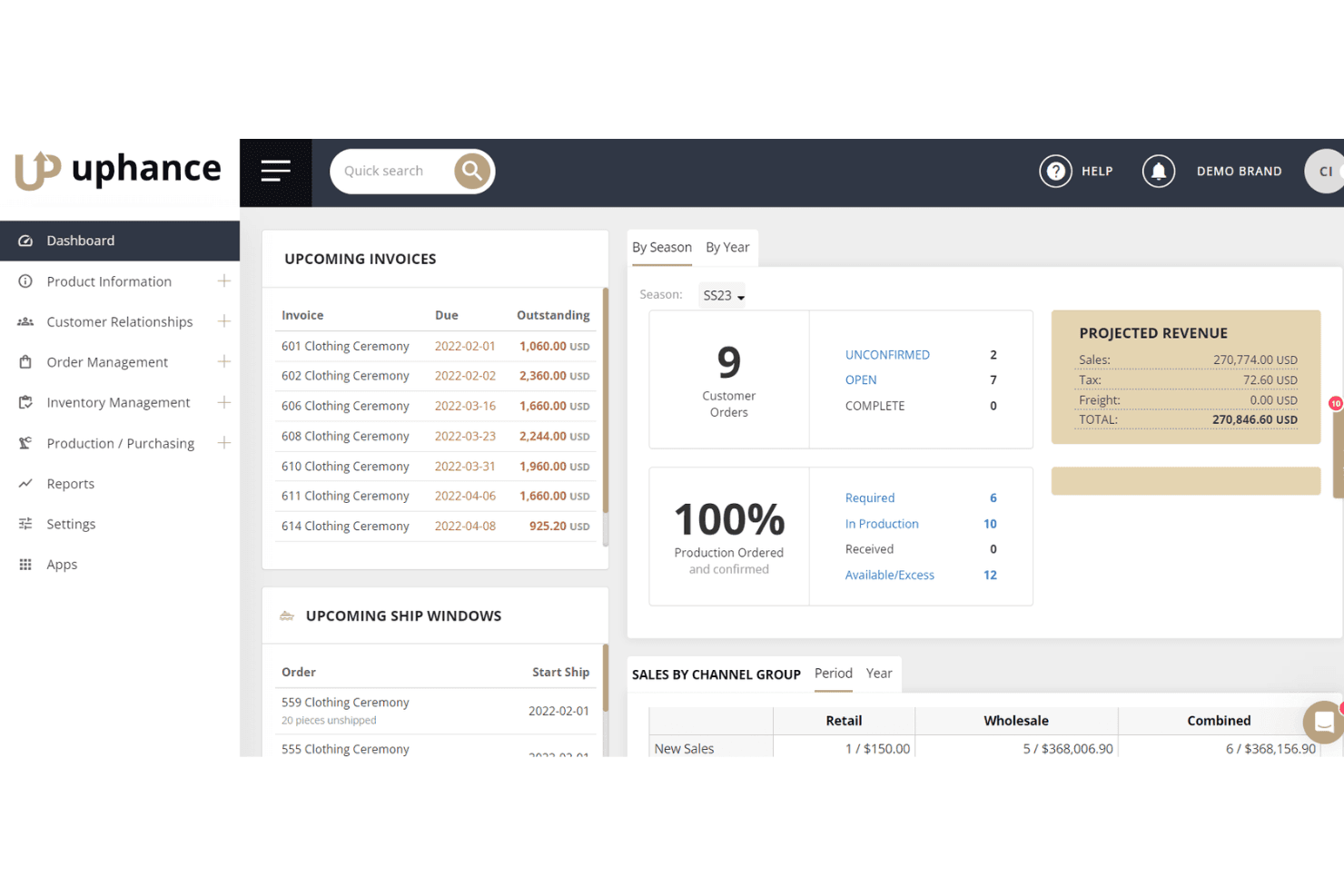
Uphance centralizes order, invoice, and revenue data in one dashboard. Uphance is an apparel management platform built natively around the fashion data model, covering PLM, production, inventory, wholesale B2B ordering, demand planning, and multichannel order management in one system.
Who Is Uphance Best For?
Uphance is a strong fit for growing apparel brands in the $5M–$100M revenue range that run wholesale and DTC channels side by side.
Why I Picked Uphance
I've included Uphance in my top picks because it's one of the few platforms built natively around the apparel data model from day one. I love how its size-curve forecasting works at the style, color, and size level, separating wholesale pre-book commitments from DTC actuals so small brands aren't overbuying into a single blended number. The B2B wholesale portal, with customer-specific pricing and live inventory visibility, handles real showroom and trade show complexity without bolt-ons.
Uphance Key Features
- Adobe Illustrator plugin: A bidirectional plugin syncs flats, artwork, colorways, and specs directly into tech packs within the PLM module.
- EDI compliance: Supports 850, 855, 856, and 810 EDI documents for retailer compliance, with GS1-128 compliant labeling built in.
- Multi-location stock transfers: Move inventory between warehouses or retail locations, with min/max thresholds triggering automatic replenishment orders.
- Landed cost calculation: Applies duty, freight, and tax costs per unit or shipment, reflecting true inventory valuation across purchase orders.
Uphance Integrations
Uphance offers native integrations with Shopify, WooCommerce, Amazon, ChannelEngine, JOOR, QuickBooks Online, Xero, ShipBob, and Shopify POS. An API supports custom integrations, while Adobe Illustrator connects to PLM through a bidirectional plugin.
Pros and Cons
Pros:
- Branded wholesale portal with real-time inventory
- Advanced demand planning with size curve forecasting
- Built natively for apparel variants and SKUs
Cons:
- Pricing not transparent on public website
- No native POS, only external integrations
Learn more about Uphance: Best for multi-channel business management
- Free demo available
- Pricing upon request
Visit WebsiteCustomer Rating:4.2/5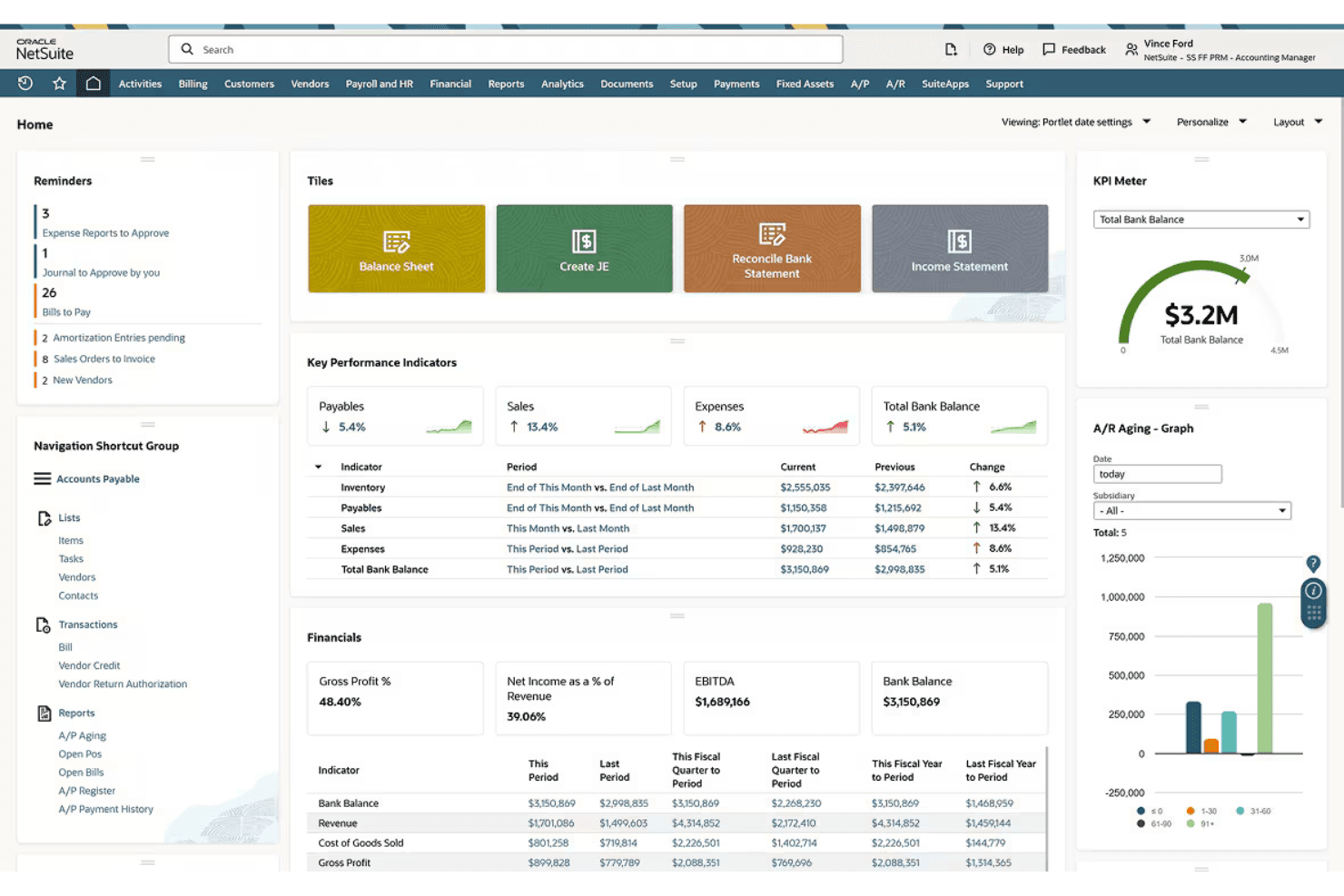
Oracle NetSuite centralizes financial KPIs, aging reports, and reminders in one dashboard. Oracle NetSuite is a cloud ERP platform that covers inventory management, order management, procurement, demand planning, and multi-channel commerce, with native support for style, size, and color matrix SKU structures built for apparel and footwear operations.
Who Is Oracle NetSuite Best For?
Oracle NetSuite fits mid-market and enterprise apparel brands managing DTC, wholesale, and international operations from a single platform.
Why I Picked Oracle NetSuite
Oracle NetSuite earns its spot on my shortlist because it's one of the few platforms that genuinely consolidates DTC, wholesale, and international operations without stitching together separate systems. I'm particularly impressed by its native Matrix Items framework, which tracks every style, size, and color combination as an independent child SKU across all channels in real time. Its procure-to-pay depth, including blanket POs, landed cost allocation, and multi-currency purchasing, handles the sourcing complexity that mid-market and enterprise apparel brands deal with daily.
Oracle NetSuite Key Features
- Demand planning module: Generates supply plans using linear regression and seasonal sales averages to trigger purchase orders and transfer orders automatically.
- NetSuite OneWorld: Manages multi-subsidiary, multi-currency operations across global entities from a single platform instance.
- SuiteCommerce B2B portal: Gives wholesale buyers a dedicated ordering experience with tailored catalogs, quote requests, and online invoice payments.
- Merchandise hierarchy: Organizes inventory by Department, Classification, and Sub-class to support category-level sales reporting and purchasing decisions.
Oracle NetSuite Integrations
Marketplace and partner integrations include Shopify through Celigo, Toolio, Envoy B2B, Lightspeed Retail, RF-SMART, CYBRA, ShipStation, and ShipBob. These connections cover ecommerce, merchandise planning, wholesale, POS, warehouse, RFID, and fulfillment workflows.
Pros and Cons
Pros:
- Strong demand planning and procurement workflows
- Handles matrix SKUs for style, size, color
- Supports multi-channel and international operations
Cons:
- Native POS ends support after January 2029
- No native open-to-buy planning tools
Learn more about Oracle NetSuite: Best for inventory and order management
- Free demo available
- From $337/month
Visit WebsiteCustomer Rating:4.8/5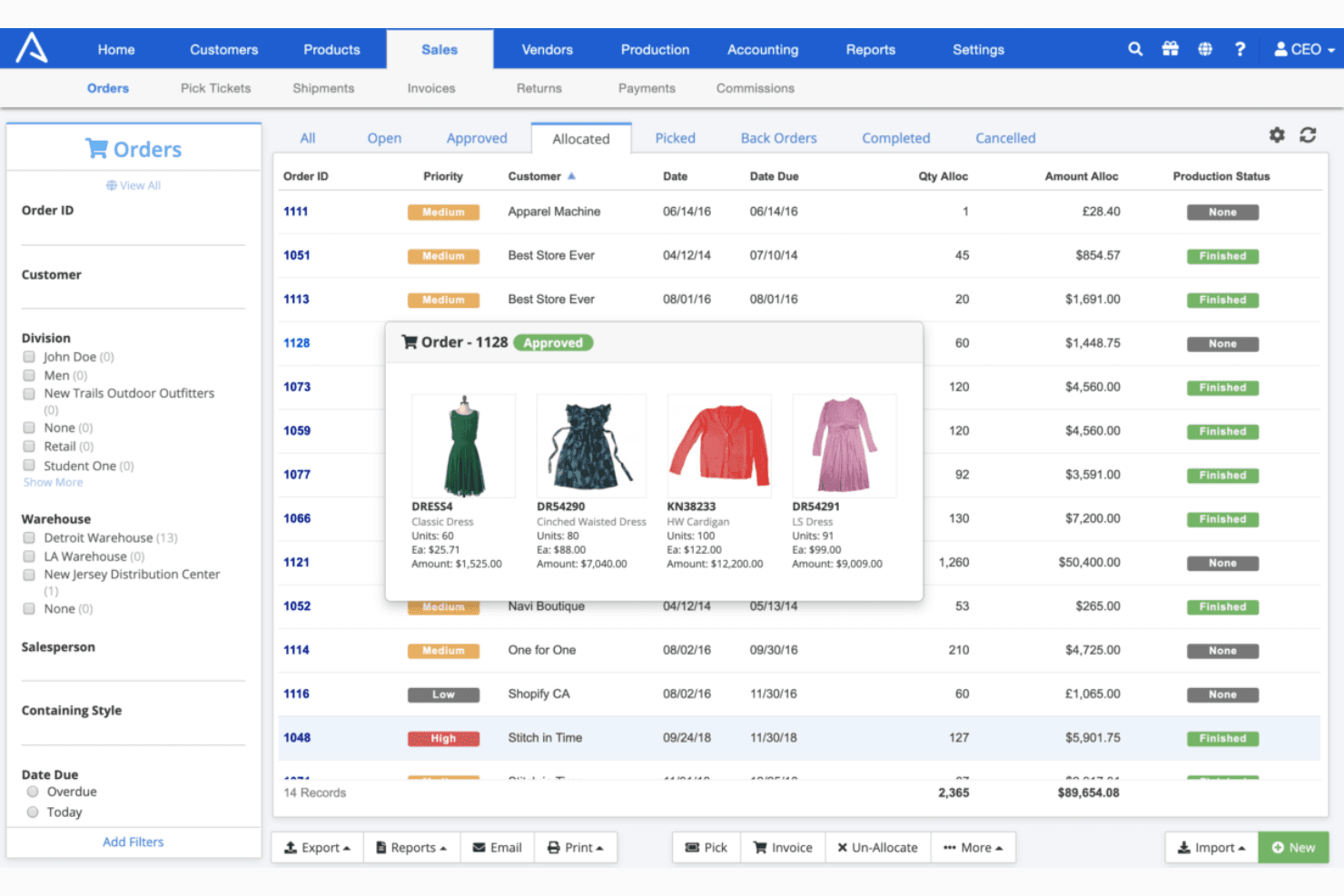
ApparelMagic lets users manage and track allocated sales orders with product previews. ApparelMagic is an apparel-native ERP that combines style/size/color matrix inventory, order management, PLM, B2B wholesale, and built-in demand forecasting in one platform.
Who Is ApparelMagic Best For?
ApparelMagic is a strong fit for apparel brands and manufacturers that need a single platform to manage complex SKU hierarchies, wholesale orders, and production workflows end to end.
Why I Picked ApparelMagic
ApparelMagic earns its spot on my shortlist because its entire architecture is built around the way apparel actually works: style, size, and color matrix inventory at the core, not bolted on as an afterthought. I picked it specifically for inventory and order management because the ML-powered demand forecasting goes well beyond basic reorder alerts, giving you sell-out predictions sorted by sales velocity so you can act before you're sitting on dead stock. The full PO lifecycle, including multi-stage WIP tracking and BOM-driven landed cost calculation, means production orders and purchase orders stay connected to your inventory numbers in real time.
ApparelMagic Key Features
- Built-in B2B wholesale portal: A native drag-and-drop wholesale storefront with password-protected pages, real-time inventory display, and pre-season ordering—no third-party integration needed.
- PLM with Adobe Illustrator extension: Tech packs, BOM management, and smart costing connect directly to Adobe Illustrator for design-to-production workflows within a single platform.
- Multi-channel inventory sync: Real-time inventory updates across Shopify, Amazon, BigCommerce, Etsy, eBay, JOOR, NuORDER, and multiple warehouses simultaneously.
- AI Copilot: An on-demand AI assistant that handles custom report generation and real-time operational queries using natural language commands inside the ERP.
ApparelMagic Integrations
ApparelMagic lists approximately 24 integrations, including Shopify, Amazon, BigCommerce, JOOR, NuORDER, QuickBooks Online, ShipStation, Square POS, Adobe Commerce, and EasyPost. Enterprise plans include API access for custom integrations; EDI requires third-party middleware.
Pros and Cons
Pros:
- Machine learning demand forecasting dashboards
- Built-in B2B wholesale portal included
- Manages style, size, and color matrix
Cons:
- Barcodes and reporting features have limitations
- EDI requires external middleware setup
Learn more about ApparelMagic: Best for compliance management in sourcing
- Free demo available
- Pricing upon request
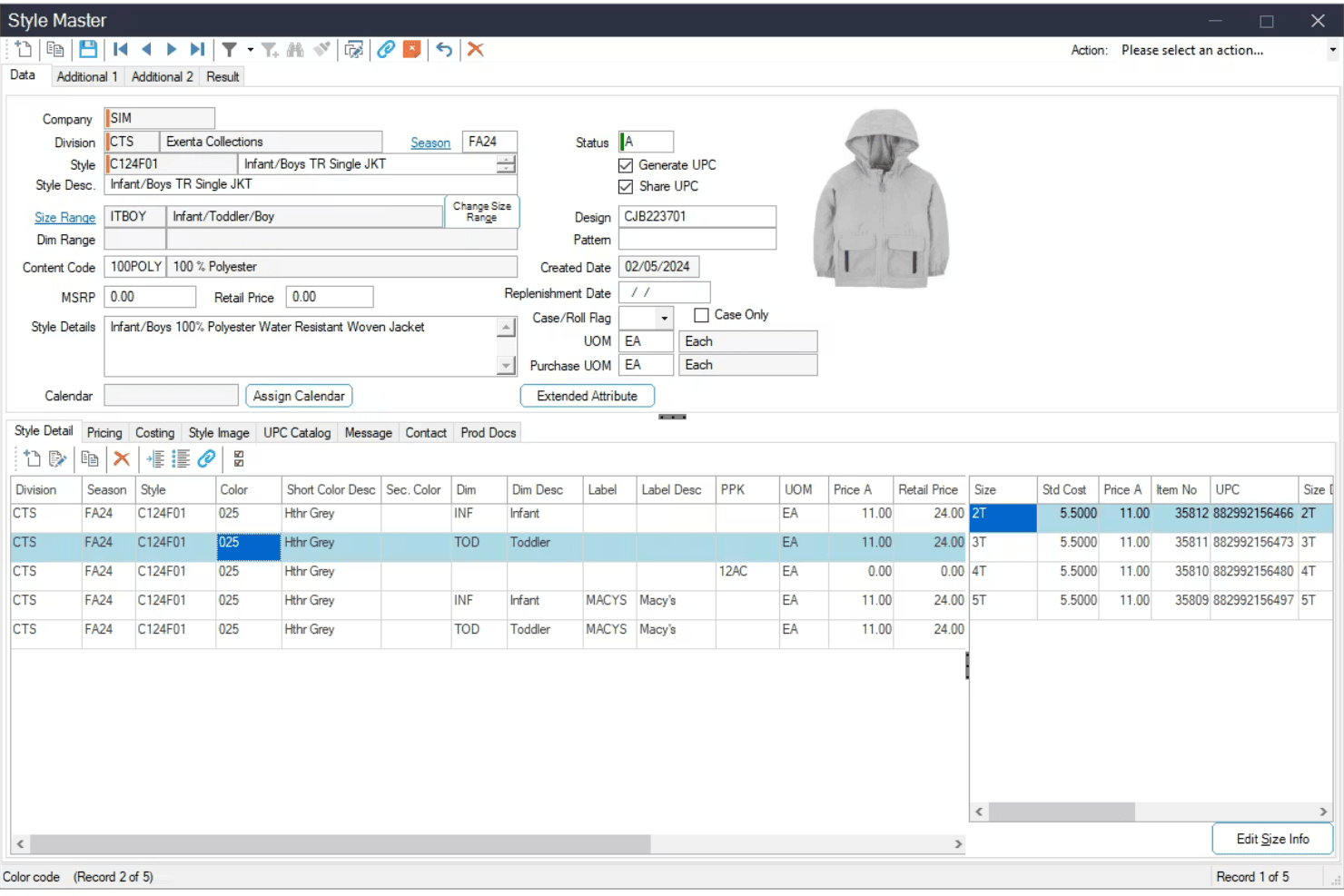
Aptean Apparel ERP centralizes style, pricing, and UPC data in one record. Aptean Apparel ERP is an industry-specific ERP platform built for apparel, footwear, and accessories brands, covering style/size/color matrix inventory, purchase order management, EDI compliance, PLM, warehouse management, and omnichannel order fulfillment.
Who Is Aptean Apparel ERP Best For?
Aptean Apparel ERP is a strong fit for mid-market and enterprise apparel brands managing complex supplier networks and major retail compliance requirements.
Why I Picked Aptean Apparel ERP
Aptean Apparel ERP earns its spot on my shortlist because its built-in EDI and compliance tooling is the most tightly integrated I've seen in an apparel ERP. I particularly like how the vendor portal centralizes tech packs, purchase orders, and ASN/UCC128 compliance in one place, so supplier communication doesn't fall apart across email chains. The integrated EDI module has a documented track record too: MindsInSync cut chargebacks by 90% after switching to it.
Aptean Apparel ERP Key Features
- Style/size/color matrix: Automatically generates individual SKUs for every color and size combination within a style, with season and division hierarchies for structured collection reporting.
- AI-powered order monitoring: AppCentral AI agents flag at-risk orders in real time, identify supply chain disruptions like container delays, and suggest substitute styles to keep fulfillment on track.
- Omnichannel inventory pool: Maintains a single shared inventory across wholesale, DTC ecommerce, marketplaces, retail POS, and 3PL partners simultaneously.
- Native PLM integration: Centralizes design libraries, tech pack creation, version control, and supplier collaboration within the same platform as the ERP.
Aptean Apparel ERP Integrations
Aptean Apparel ERP offers documented integrations with Shopify, Shopify POS, NuORDER, Joor, Salsify, Descartes Sellercloud, FedEx Ship Manager, and ShipStation, plus 3PL connectivity. This supports ecommerce, wholesale, product content, marketplace, shipping, and fulfillment workflows.
Pros and Cons
Pros:
- Native PLM integration with version control
- Single inventory pool across all sales channels
- Built-in EDI module slashes chargebacks
Cons:
- Multiple product editions can confuse buyers
- Reporting often requires third-party BI tools
Learn more about Aptean Apparel ERP:
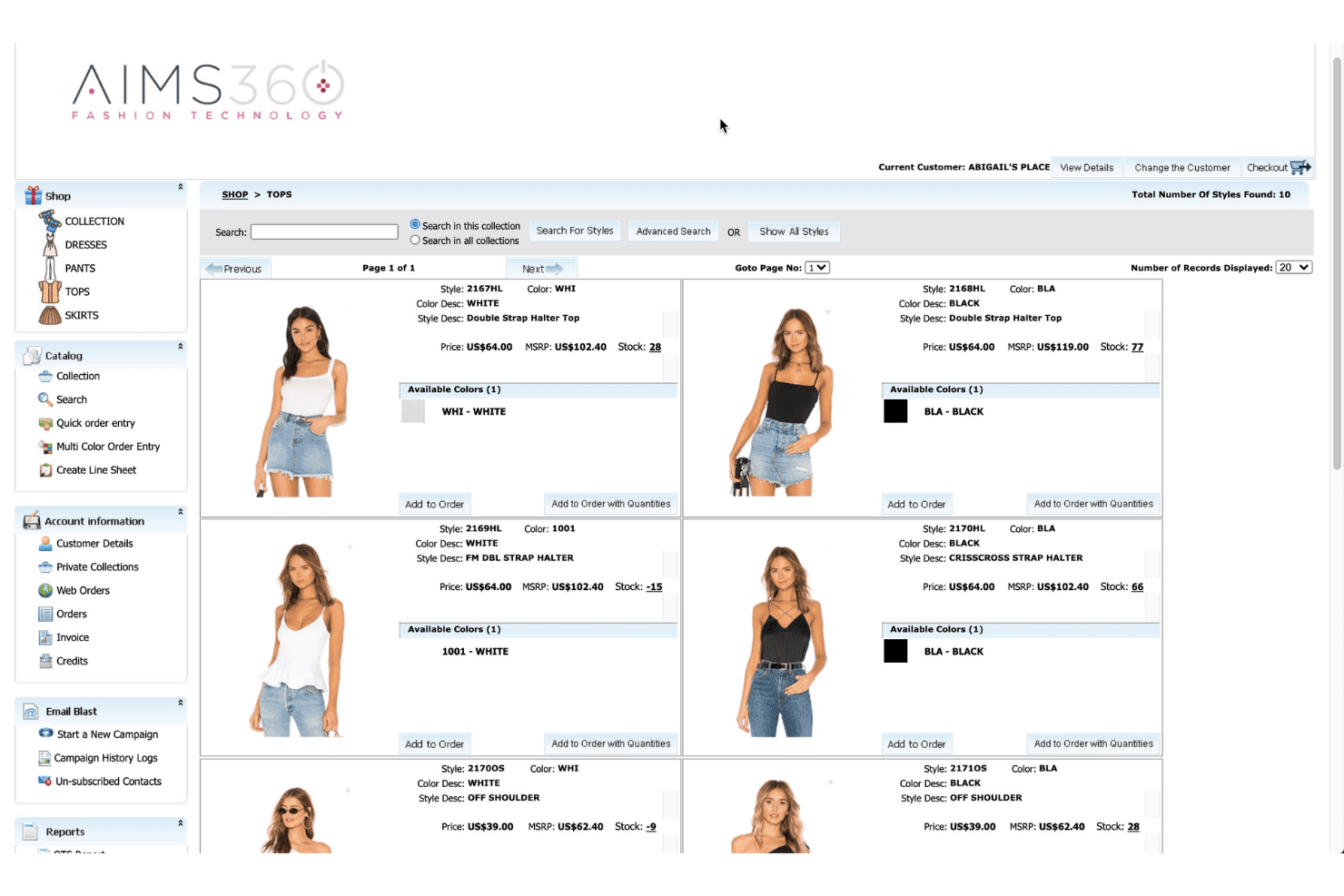
AIMS360 lets users browse and order wholesale tops by style and color. AIMS360 is an apparel ERP platform built around a native style-color-size matrix, with integrated inventory management, order management, warehouse operations, production tracking, and built-in EDI for wholesale retail fulfillment.
Who Is AIMS360 Best For?
AIMS360 is a strong fit for wholesale apparel brands managing multi-retailer EDI compliance alongside omnichannel inventory across production, warehousing, and direct-to-consumer channels.
Why I Picked AIMS360
AIMS360 earns its spot on my shortlist because it's one of the few apparel management platforms where the cloud infrastructure isn't bolted on—it's built in from the ground up on Microsoft Azure, with a 99.9% uptime SLA and no on-premise installation required. I particularly like its native style-color-size matrix, which treats one style across six colors and seven sizes as a single managed record rather than 42 disconnected SKUs. Its in-house EDI engine covering 350+ retail trading partners, with no third-party VAN or per-transaction fees, makes it a strong fit for wholesale brands managing compliance at scale.
AIMS360 Key Features
- Multi-channel order consolidation: A single order pool pulls in wholesale EDI, Shopify, marketplace, B2B portal, and retail POS orders with rules-based warehouse allocation.
- AI-powered demand forecasting: Automated replenishment and allocation use style-, color-, and size-level sales data, sell-through rates, and historical trends.
- Built-in PLM and production tracking: Tech packs, BOMs, WIP tracking, and contractor management are native to the platform across cut, sew, dye, and finishing stages.
- Pivot-grid reporting with apparel dimensions: Role-based dashboards and reports filter by style, color, size, season, division, and channel, with sell-through and margin tracking included.
AIMS360 Integrations
AIMS360 has native integrations with Shopify, Shopify POS, WooCommerce, BigCommerce, Amazon, TikTok Shop, JOOR, NuOrder, Faire, and QuickBooks, plus EDI connections to 350+ retailers. A REST API supports custom integrations.
Pros and Cons
Pros:
- Native production and PLM capabilities
- In-house EDI for 350+ retailers
- Built-in style-color-size apparel matrix
Cons:
- No automated markdown or promotion engine
- Dated and clunky user interface
Learn more about AIMS360:
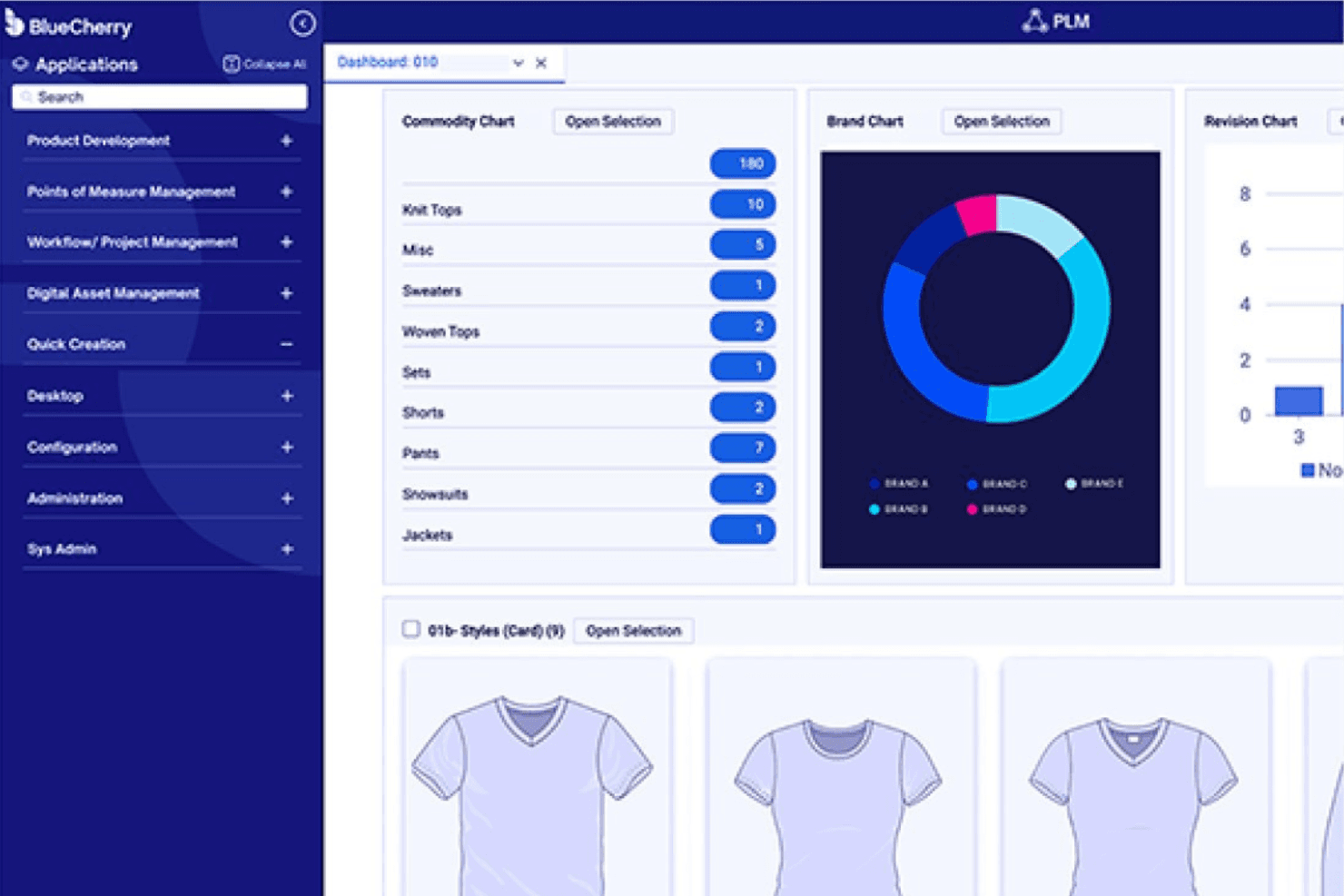
BlueCherry centralizes product styles and brand data in one dashboard. BlueCherry is a modular, cloud-native apparel management platform by CGS that covers the full product lifecycle—from PLM and ERP to AI-driven demand forecasting, B2B wholesale, warehouse management, and omnichannel inventory across ecommerce and marketplace channels.
Who Is BlueCherry Best For?
BlueCherry is a strong fit for mid-to-large apparel and fashion brands that manage complex supply chains across wholesale, ecommerce, and manufacturing.
Why I Picked BlueCherry
BlueCherry earns its spot on my shortlist because its supply chain visibility goes deeper than most platforms I've reviewed. I love how the AI Planning module ingests real retailer POS data, weather signals, and market trends to generate fashion-specific demand forecasts, then automatically triggers replenishment orders. The real-time "available-to-sell" vs. "obligated-to-sell" inventory logic across wholesale, ecommerce, and marketplace channels means you always know exactly what stock you can commit to.
BlueCherry Key Features
- B2B wholesale portal: A branded digital marketplace where buyers can browse customizable catalogs, place bulk orders with tiered pricing, and access real-time inventory data around the clock.
- PLM integration: Tech pack management, BOM tracking, costing, and sample management connect directly with ERP to unify design and operations in one platform.
- EDI module: Native EDI maps and consulting services connect BlueCherry with 1,000+ trading partners, automating data exchange and reducing manual entry errors.
- Quality audit management: Standardized inspection templates, mobile-enabled offline inspections, and real-time alerts keep quality control visible across your entire supply chain.
BlueCherry Integrations
BlueCherry offers documented integrations with Shopify, Magento, BigCommerce, Amazon, Walmart, NuOrder, Joor, Salsify, Adobe Illustrator, and 3D rendering platforms. Its EDI module connects with 1,000+ trading partners, while an open API supports custom integrations.
Pros and Cons
Pros:
- Powerful B2B wholesale sales portal
- AI forecasting tailored for fashion merchandising
- Deep apparel-industry feature specialization
Cons:
- High implementation and customization costs
- No proprietary POS system available
Learn more about BlueCherry: Best for rapid product development cycles
- Free demo available
- Pricing upon request
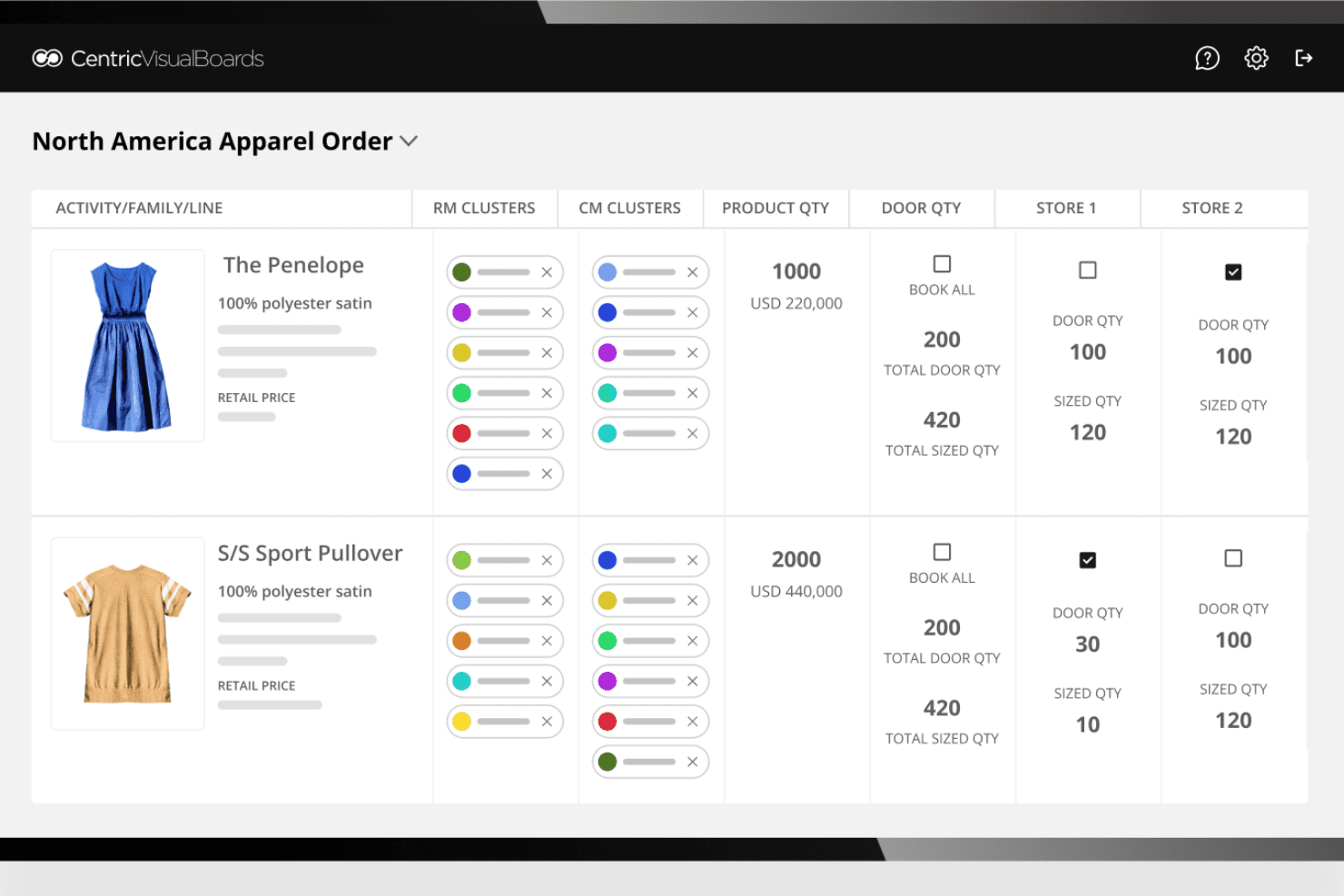
Centric PLM lets users manage apparel orders by store, cluster, and quantity. Centric PLM is a product lifecycle management platform built for fashion and apparel brands that covers product development, assortment and merchandise planning, demand forecasting, supplier collaboration, and multichannel product syndication.
Who Is Centric PLM Best For?
Centric PLM is a strong fit for apparel brand owners and fashion planners who manage their own product development, sourcing, and assortment planning from concept through sell-through.
Why I Picked Centric PLM
Centric PLM earns its spot on my shortlist because no other platform compresses the concept-to-market timeline quite like it does for apparel brands. I'm particularly impressed by its AI Fashion Inspiration tool, which accelerates collection ideation, and its Visual Boards feature, which keeps design, merchandising, and planning teams aligned without endless back-and-forth. Brands like Wildfang scaled SKU management by 50–70% without adding headcount, which tells me the platform genuinely delivers where rapid development cycles are concerned.
Centric PLM Key Features
- Assortment and merchandise financial planning: Connects top-level financial planning to in-season execution with OTB budgeting, line planning, and AI-powered demand forecasting across pre-season and in-season periods.
- Centric Market Intelligence: Tracks competitor assortment, pricing, and promotions across 760,000+ brands in 100+ countries, with 12 years of historical data updated every 24 hours.
- Supplier collaboration and vendor scorecards: Lets you issue design briefs to multiple suppliers simultaneously and track vendor performance, factory audits, and compliance in one place.
- Multichannel product syndication via Centric PXM: Distributes product data and syncs real-time pricing and inventory across 1,000+ channels, including Shopify, WooCommerce, TikTok Shop, and in-store kiosks.
Centric PLM Integrations
Centric PLM integrates with AIMS360, Shopify, SAP, Salesforce, Adobe Illustrator, CLO 3D, Browzwear, and Bynder. Open REST APIs and Connector Hub support custom connections with ERP, ecommerce, design, and PIM systems.
Pros and Cons
Pros:
- AI-driven demand forecasting and replenishment
- Enables real-time competitor pricing intelligence
- Optimizes assortment planning and OTB budgeting
Cons:
- Total cost is high for some brands
- No native retail inventory or POS
Learn more about Centric PLM: Best for remote team collaboration
- Free demo available
- Pricing upon request
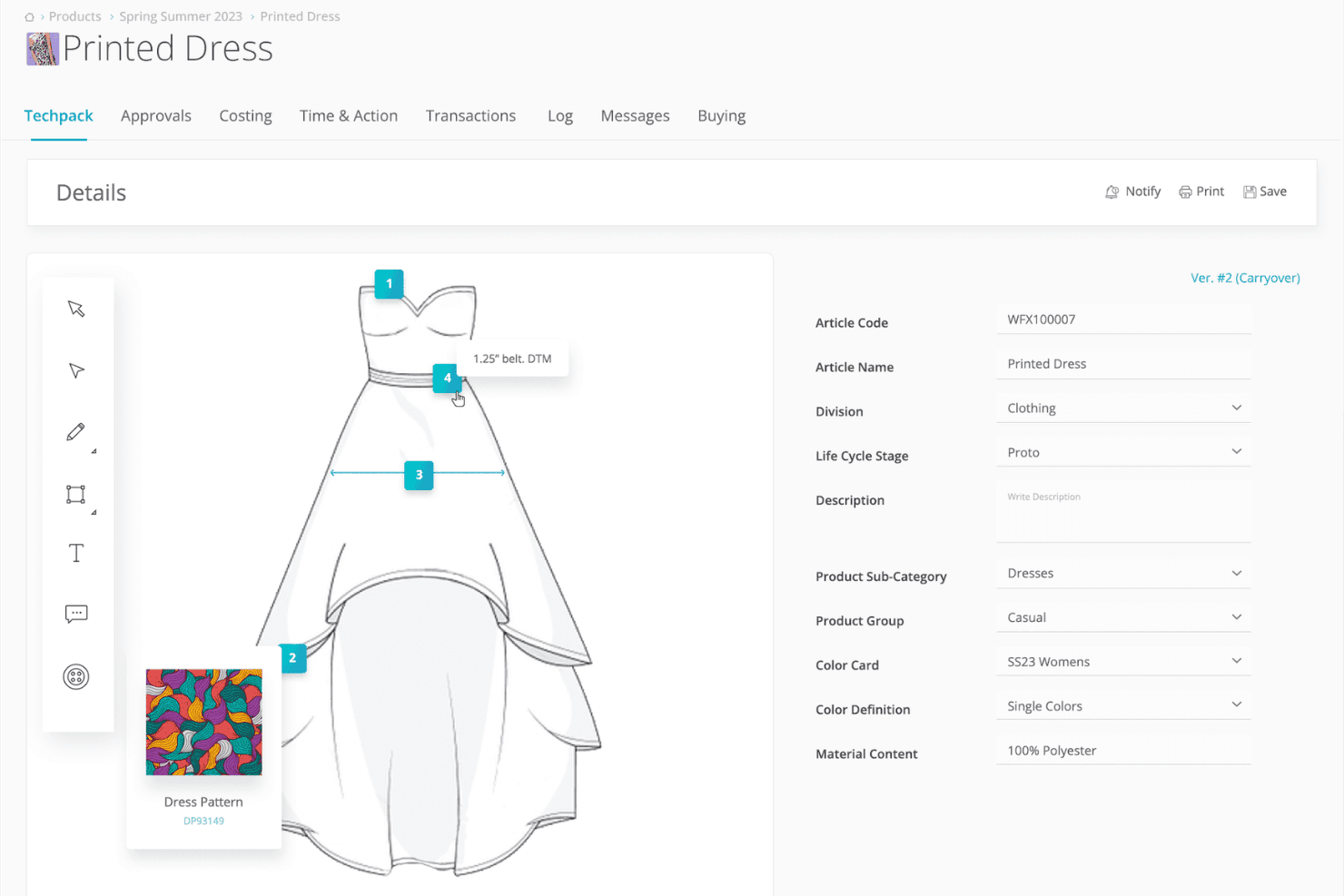
WFX lets users build detailed techpacks with annotations and product specs. WFX (World Fashion Exchange) is a cloud-native fashion PLM and apparel ERP platform that covers product development, tech packs, costing, vendor collaboration, merchandise planning, and purchase order management in one system.
Who Is WFX (World Fashion Exchange) Best For?
WFX is a strong fit for fashion brands and apparel manufacturers managing product development, sourcing, and vendor relationships across distributed global teams.
Why I Picked WFX (World Fashion Exchange)
I've included WFX in my top picks because it's purpose-built for fashion teams spread across time zones, sourcing markets, and supplier networks. Its centralized vendor portal lets design, buying, and production teams share tech packs, sample feedback, and PO revisions in one place, replacing the email chains that slow cross-border collaboration to a crawl. I especially like the buying plan module, which auto-syncs quantity changes directly to purchase orders and breaks buys down by size curve, colorway, and sales channel simultaneously.
WFX (World Fashion Exchange) Key Features
- Tech pack management: Create, store, and share detailed tech packs with trim sheets, BOM, points of measure, and artwork in a centralized product library.
- Vendor compliance workflows: Track supplier approvals, sample feedback, and quality inspections with milestone alerts and automated escalation reminders.
- Virtual Showroom: Share password-protected digital catalogs with B2B buyers, including 2D/3D product views, in-platform messaging, and promotion analytics.
- NetSuite certified connector: Sync product data, styles, materials, and purchase orders bi-directionally between WFX and Oracle NetSuite via a "Built for NetSuite" certified integration.
WFX (World Fashion Exchange) Integrations
Documented integrations include Oracle NetSuite, Adobe Illustrator, AIMS360, GT Nexus, Fast React, SAP, and Microsoft Dynamics. WFX offers a REST API for custom connections, while Shopify is listed as an integration by Capterra.
Pros and Cons
Pros:
- B2B virtual showroom for wholesale buyers
- Fashion-native style, size, and color matrix
- Built for remote design and sourcing teams
Cons:
- Inventory tools focused on manufacturing, not stores
- No built-in retail POS features
Learn more about WFX (World Fashion Exchange): Best for end-to-end process automation
- Free demo available
- Pricing upon request
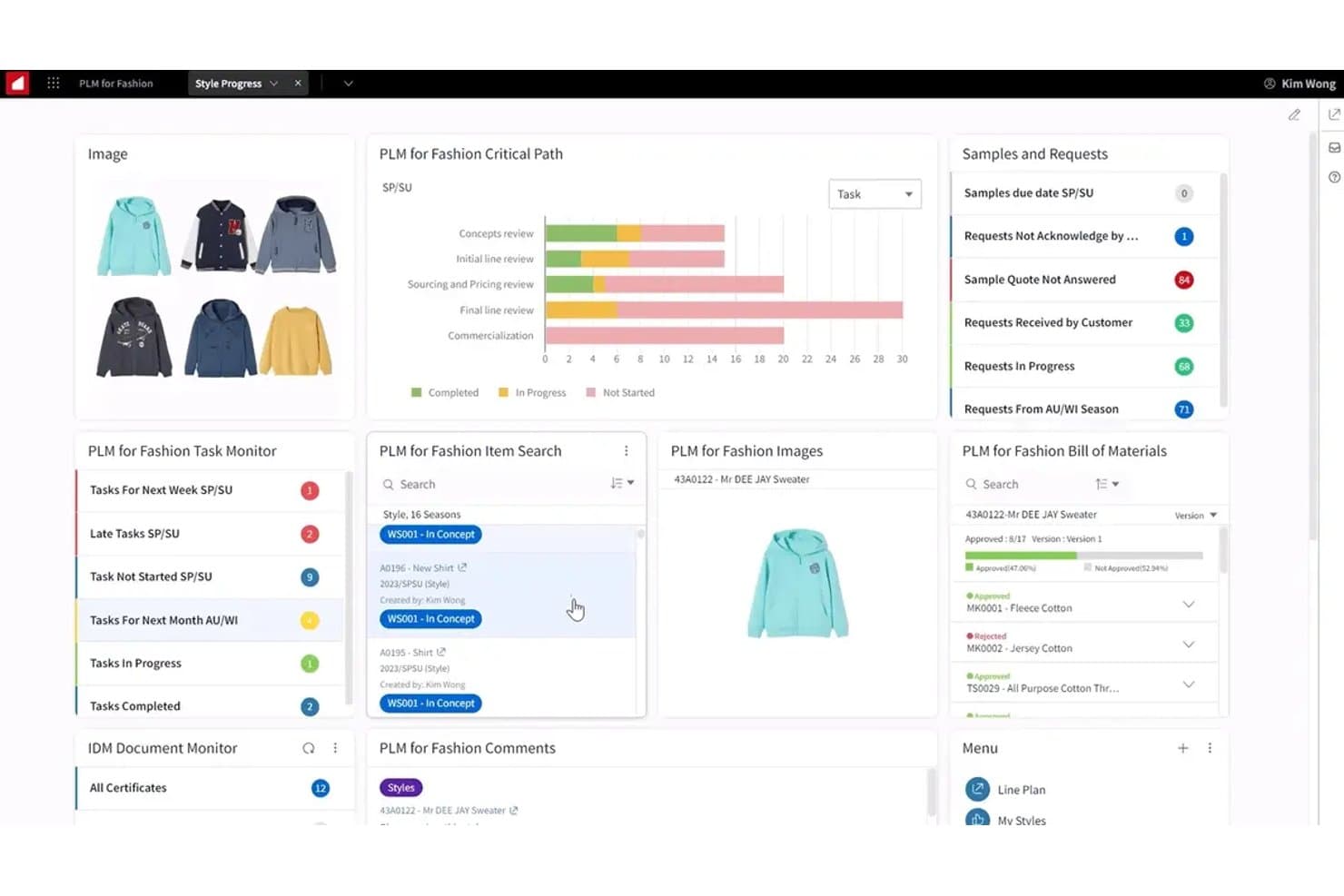
Infor CloudSuite Fashion centralizes style progress, tasks, and BOM tracking. Infor CloudSuite Fashion is an enterprise ERP built specifically for apparel, footwear, and accessories brands, with native style/color/size matrix management, seasonal planning, supply chain visibility, and omnichannel inventory built into a single SaaS platform.
Who Is Infor CloudSuite Fashion Best For?
Infor CloudSuite Fashion is built for mid-market to enterprise apparel, footwear, and accessories brands that need a single platform to manage everything from product design and sourcing through warehousing, wholesale, and omnichannel sales.
Why I Picked Infor CloudSuite Fashion
Infor CloudSuite Fashion earns its spot on my shortlist because it's one of the few ERPs where the style/color/size matrix is a native data structure, not a bolt-on. I picked it specifically for end-to-end process automation because it connects every stage of the fashion value chain, from PLM and sourcing through demand forecasting, warehouse execution, and omnichannel fulfillment, in a single SaaS environment. The Demand Planning add-on uses ML-driven size curves and seasonality signals to automate replenishment, while Infor Nexus gives visibility across 94,000+ supply chain partners from PO issuance through delivery.
Infor CloudSuite Fashion Key Features
- Infor Nexus supply chain network: Connects your team to 94,000+ suppliers, manufacturers, and logistics providers for real-time PO visibility from issuance through delivery.
- Infor PLM for Fashion: Manages tech packs, sample tracking, quality control, and supplier collaboration from initial design through final production.
- Coleman AI analytics: Delivers predictive, prescriptive, and generative analytics embedded across forecasting, exception management, and replenishment workflows.
- Textile compliance and ESG tracking: Provides audit trails and configurable workflows for textile labeling regulations, REACH compliance, and CO₂/water/waste measurement by product.
Infor CloudSuite Fashion Integrations
Marketplace integrations include Shopify, while native connections support Infor Nexus, Infor WMS, Infor PLM for Fashion, and Rhythm for Commerce. Infor OS, ION, and APIs support custom connections to third-party applications.
Pros and Cons
Pros:
- Integrated PLM, merchandising, and supply chain tools
- AI-driven demand forecasting with size curves
- Native fashion matrix for style and size
Cons:
- Long rollout time for large deployments
- Not designed for small apparel companies
Learn more about Infor CloudSuite Fashion: Best demand planning and forecasting
- Free demo available
- Pricing upon request
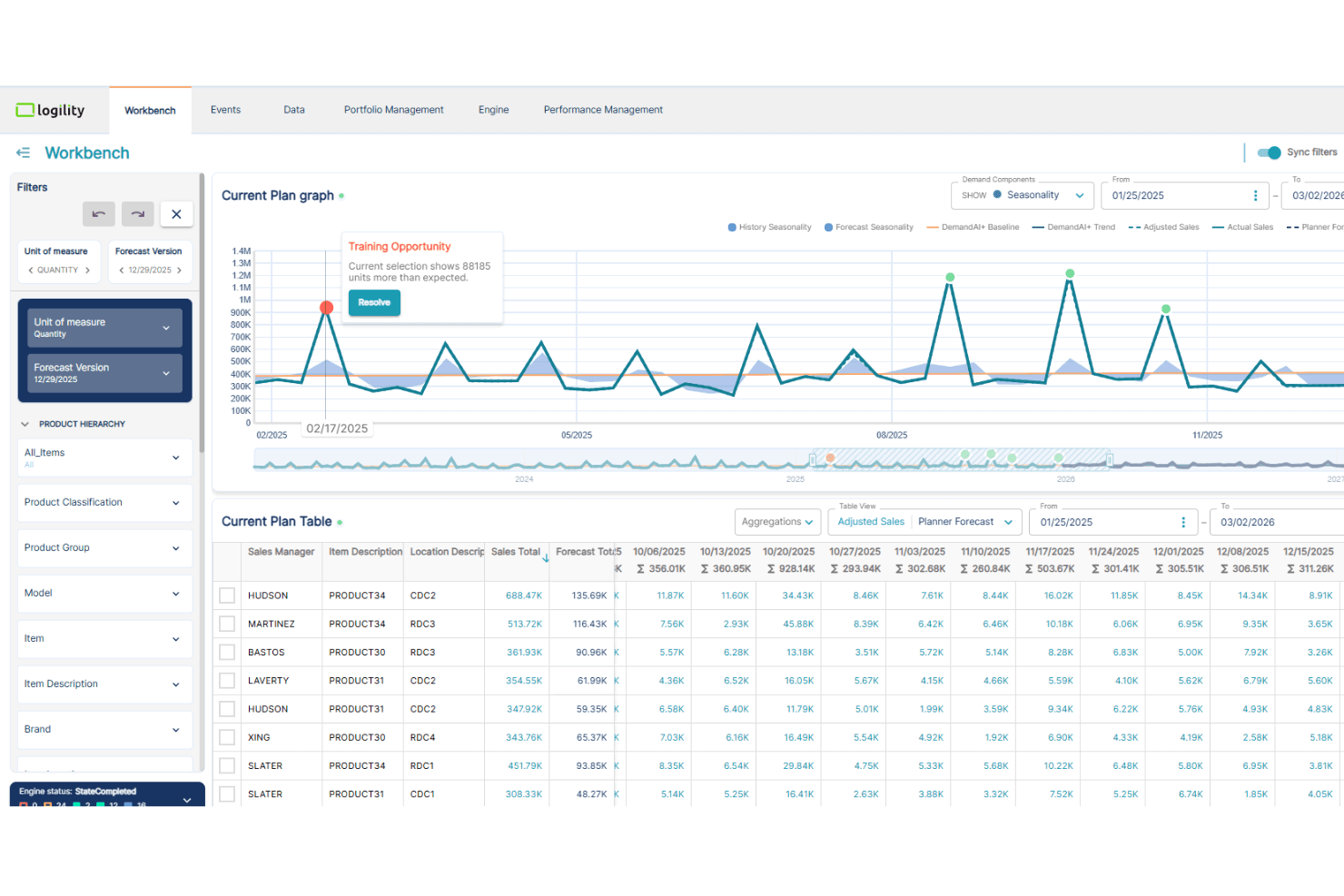
Logility NGC Andromeda surfaces demand forecast anomalies for planners to resolve. Logility (NGC Andromeda) is an AI-first supply chain planning platform built for apparel, fashion, and footwear brands, combining demand forecasting, merchandise planning, PLM, sourcing, vendor compliance, and inventory management in a single system.
Who Is Logility (NGC Andromeda) Best For?
Logility is built for mid-market to enterprise apparel and fashion brands that need AI-driven demand forecasting and end-to-end supply chain planning across complex, multi-channel operations.
Why I Picked Logility (NGC Andromeda)
I picked Logility as one of the best because its DemandAI+ module handles the kind of forecasting complexity that apparel genuinely demands: style-level forecasts automatically exploded down to size-level projections using size curves, with ML-based anomaly detection cleaning messy historical sell data before it skews your plan. Groupe Dynamite used it to build accurate replenishment plans for 6-to-8-week fashion seasons across its Dynamite and Garage brands. Haggar cut excess inventory by 70% managing omnichannel complexity across outsourced global production.
Logility (NGC Andromeda) Key Features
- Vendor compliance dashboard: Tracks supplier sustainability performance, certificate management, at-risk PO identification, and legal violations across your global supply base.
- Product lifecycle management (PLM): Manages the full concept-to-customer workflow, including tech pack creation, material development, costing, sampling, and critical path management.
- Supply chain traceability: Generates compliance certificates that document every material and product exchange from fiber origin to finished good.
- Sales and operations planning (S&OP): Aligns financial, item-level, and distribution-point plans across brands and functions in a single cross-functional workflow.
Logility (NGC Andromeda) Integrations
Documented integrations include SAP, Oracle Fusion Cloud, Microsoft Dynamics 365, Infor, NuOrder, Shopify, Adobe Illustrator, Browzwear, and CLO3D. API access supports custom integrations, including connections to POS and other commerce systems.
Pros and Cons
Pros:
- End-to-end apparel supply chain coverage
- AI demand forecasting reduces forecast errors
- Native size-curve and style matrix planning
Cons:
- Configuration and setup require vendor involvement
- No built-in point-of-sale module
Learn more about Logility (NGC Andromeda):
Annen programvare for klesadministrasjon
Her er noen flere alternativer for programvare for klesadministrasjon som ikke kom med på kortlisten min, men som likevel er verdt å undersøke:
- 11Microsoft Dynamics 365Best for integration with Microsoft 365 tools
- 12Blue Link ERPBest for grid-based wholesale order entry
- 13PolyPMBest for unified ERP and PLM
- 14TukatechBest for digital pattern making for startups
- 15Onbrand PLMBest for rapid tech pack creation
- 16DeSLBest for digital supply chain transformation
- 17LectraBest for advanced 2D/3D pattern making
- 18ForbytesBest for custom analytics and dashboards
- 19PTC FlexPLMBest for enterprise-scale visual merchandising
- 20Lifecycle PLMBest for AI-powered sample collaboration
How I Evaluate Apparel Management Software
I split my evaluation into baseline criteria—like size/color matrix inventory and seasonal PO management—and differentiators that separate the right tool for your operation from the rest.
Core Functionality (Table Stakes For This List)
When I'm selecting tools for my list, I rank each one on a scale from 0 (does not offer the functionality) to 5 (excels in this area) for each core functionality listed below. Then, I calculate the tool's total score into a percentage. Each tool needs to achieve a minimum total score of 65% to be considered for inclusion.
- Style/Size/Color Matrix: I check whether a tool lets you build and manage SKUs across a full style-size-color grid, including bulk entry for large seasonal drops with dozens of colorways.
- Multi-Channel Inventory Sync: Real-time stock accuracy across POS, ecommerce, and marketplaces matters here—I look at how each tool handles oversell prevention during flash sales.
- Assortment & Merchandise Planning: I evaluate whether the platform supports seasonal buy planning and open-to-buy budgets, especially for teams managing multiple product lines per season.
- Purchase Order Management: Each tool should handle the full PO lifecycle—from matrix-based ordering by size run to partial receiving when a vendor ships split deliveries ahead of a launch.
- Apparel POS Integration: I look for POS workflows built around apparel retail, like variant-level returns, barcode and hang-tag printing, and the ability to look up stock at other locations.
- Demand Forecasting & Replenishment: Size-curve sell-through analysis and seasonal trend data should inform reorder recommendations, so I evaluate how each tool turns sales history into buying signals.
Once I have a list of tools that meet the criteria, I consider what sets each platform apart.
Differentiating Factors (What Sets Vendors Apart)
Here's how I compare and contrast different vendors:
Standout Features
A B2B wholesale portal is a major differentiator for brands that sell to boutiques—I look for digital linesheet creation and pre-season ordering workflows. Markdown and promotion engines also stand out when they let merchandisers automate markdowns based on sell-through targets instead of manually adjusting prices at each end-of-season clearance. I evaluate clienteling tools too, especially ones that capture size preferences and purchase history to give store associates the context they need to drive repeat visits.
Beyond Features
Ecosystem integrations matter a lot here—I check whether a platform connects to your ecommerce storefront, accounting system, and shipping tools without requiring middleware or manual CSV imports. Reporting is another area I evaluate closely, especially apparel-specific KPIs like sell-through rate, GMROI, and weeks-of-supply that buyers and planners actually use to make next-season decisions. I also consider pricing structure, since per-store or per-location models can scale very differently than per-user pricing as a retailer grows from two locations to twenty.
Slik velger du programvare for klesadministrasjon
Det er lett å gå seg vill i lange funksjonslister og kompliserte prismodeller. For å hjelpe deg med å holde fokus mens du arbeider deg gjennom din unike prosess for programvarevalg, får du her en sjekkliste over faktorer du bør ha i tankene:
| Faktor | Hva du bør vurdere |
|---|---|
| FaktorSkalerbarhet | Hva du bør vurdereVil systemet vokse med antallet produkter, SKU-er og salgskanaler? Sjekk om det gjelder begrensninger eller gebyrer når du utvider til nye merkevarer, butikker eller regioner. |
| FaktorIntegrasjoner | Hva du bør vurdereKan det kobles direkte til e-handels-, ERP- eller regnskapsplattformene dine? Bekreft integrasjoner med viktige partnere – unngå om mulig kompliserte omveier via mellomvare. |
| FaktorTilpasningsmuligheter | Hva du bør vurdereKan arbeidsflyter, rapporter eller roller tilpasses slik at de passer måten teamet ditt presenterer varer eller organiserer data på? Vurder støtten for felt, profilering og unike prosessbehov. |
| FaktorBrukervennlighet | Hva du bør vurdereEr grensesnittet intuitivt for ikke-tekniske brukere? Be om en demonstrasjon av de viktigste arbeidsflytene, og la ansatte fra vareutvalg, lager og ordreoppfyllelse prøve å utføre de daglige oppgavene. |
| FaktorImplementering og opplæring | Hva du bør vurdereHvilke ressurser tilbyr leverandøren for datamigrering, oppsett og opplæring av ansatte? Se etter veiledet oppstart, ikke bare en lenke til dokumentasjon – særlig for store team. |
| FaktorKostnad | Hva du bør vurdereAvklar mer enn bare månedlige kostnader: undersøk gebyrer for oppstart, integrasjoner og fremtidige tillegg. Sørg for at de totale eierkostnadene passer budsjettet, og at kontraktslengden samsvarer med behovene dine. |
| FaktorSikkerhetstiltak | Hva du bør vurdereHvilken kryptering, tilgangskontroll og hvilke revisjonslogger tilbys? Spør om samsvar med standarder som GDPR, og sørg for at tillatelsene samsvarer med teamets sensitive data. |
| FaktorTilgjengelig kundestøtte | Hva du bør vurdereTilbys direkte kundestøtte eller kundestøtte utenom arbeidstid ved akutte problemer? Finn ut hvilke svartider og eskaleringsmuligheter som gjelder, særlig hvis forsyningskjeden din opererer utenfor lokal arbeidstid. |
Hva er programvare for bekledningsstyring?
Programvare for bekledningsstyring er digitale plattformer som hjelper detaljhandels- og moteteam med å administrere produktdesign, lagerbeholdning, produksjon, leverandører og salg på tvers av kanaler. Disse verktøyene sentraliserer arbeidsflyter for lansering av nye kolleksjoner, lageroppfølging, koordinering av produksjon og overvåking av bestillinger, slik at teamene deres kan opprettholde nøyaktighet, overholde leveringsfrister og reagere raskt på markedstrender – alt fra ett system.
Funksjoner
Når du velger programvare for bekledningsstyring, bør du se etter følgende nøkkelfunksjoner:
- Administrasjon av tekniske produktark: Lagre, rediger og del produktspesifikasjoner, design og mål i ett enkelt digitalt arbeidsområde, slik at designteam og leverandører har tilgang til den samme informasjonen.
- Lageroppfølging: Overvåk lagernivåene for råmaterialer og ferdigvarer i sanntid på tvers av lagre, butikker og netthandelskanaler for å unngå tomme lagre eller overfylte lagre.
- Leverandørstyring: Vedlikehold detaljerte leverandørprofiler, kommunikasjonshistorikk, sertifiseringer og kontraktsvilkår, slik at det blir enkelt å følge opp leverandørenes resultater og samsvar.
- Oppfølging av produksjonsarbeidsflyt: Visualiser og administrer hvert trinn i produksjonsprosessen, fra prøver og godkjenninger til endelig levering, slik at du kan oppdage flaskehalser og forsinkelser på et tidlig tidspunkt.
- Ordreadministrasjon: Behandle grossist-, detaljhandels- og netthandelsordrer fra flere kanaler i ett system, med verktøy for å automatisere trinn i ordreoppfyllelsen og overvåke ordrestatus.
- BOM-administrasjon (materialliste): Opprett og oppdater materiallister for hver modell, slik at produksjonspartnerne arbeider ut fra den nyeste versjonen og materialsvinnet reduseres.
- Kostnadsberegning og marginanalyse: Beregn enhetskostnader, overvåk målmarginer og kjør lønnsomhetsrapporter for hver modell og ordre ved hjelp av data fra innkjøp, arbeidskraft og frakt.
- Planlegging av sesongkolleksjoner: Utvikle nye kolleksjoner ved å planlegge sortimenter, fargevarianter og leveringsvinduer, slik at varehandels- og designteamene holder seg samkjørte.
- Oppfølging av returer og kvalitetskontroll: Registrer returårsaker og feilrater, slik at teamet ditt kan oppdage tilbakevendende problemer med produkter, leverandører eller logistikkpartnere.
- Dokumenthåndtering: Organiser og søk i viktige filer, grafisk materiale, sertifikater, kontrakter og kommunikasjon, slik at ingenting blir borte i travle produktforløp.
Vanlige AI-funksjoner i programvare for bekledningsstyring
I tillegg til standardfunksjonene i programvare for bekledningsstyring som er nevnt ovenfor, tar mange av disse løsningene i bruk AI med funksjoner som:
- Etterspørselsprognoser: Bruker AI-modeller til å analysere historisk salg, eksterne trender og signaler i sanntid for å forutsi fremtidig etterspørsel ned på SKU-, region- eller kanalnivå, slik at du kan optimalisere produksjon og lagerfordeling.
- Automatisk avviksdeteksjon: Bruker AI til å flagge uvanlige ordremønstre, lageravvik eller problemer med kvalitetskontrollen, slik at teamene oppdager potensielle forstyrrelser raskere og reduserer behovet for manuell oppfølging.
- AI-drevet sortimentsplanlegging: Vurderer resultatene fra nåværende og tidligere sortimenter, sesongtrender og kundeatferd for å anbefale optimale produktsammensetninger for kommende kolleksjoner.
- Automatiserte forslag til etterfylling: Bruker prediktiv analyse til å anbefale når og hvor mye du bør bestille på nytt for hver SKU, basert på salgshastighet, leveringstider og leverandørresultater.
- Analyse av leverandørrisiko: Bruker AI på leverandør- og logistikkdata for å avdekke risikoer – som leveringsforsinkelser, mangelfull kvalitet eller økonomisk ustabilitet – slik at innkjøpsteamene kan handle før problemene eskalerer.
Fordeler
Implementering av programvare for bekledningsstyring gir flere fordeler for teamet og virksomheten din. Her er noen av fordelene du kan se frem til:
- Bedre oversikt over lagerbeholdningen: Sporing i sanntid av råvarer og ferdigvarer hjelper teamene med å styre lagernivåene, slik at både utsolgte varer og overfylte lagre reduseres.
- Raskere produktlanseringer: Sentraliserte verktøy for PLM (produktlivssyklusstyring), administrasjon av tekniske pakker og linjeplanlegging forkorter tiden fra idé til butikkhylle.
- Smidigere produksjonsflyter: Bruk systemet til å automatisere arbeidsflyter for sporing og godkjenning, slik at forsinkelser og flaskehalser oppdages tidlig i produksjonsprosessen.
- Nøyaktig etterspørselsprognostisering: Datadrevet prognostisering bidrar til å forutsi fremtidige detaljhandelstrender, slik at produksjonsplanleggingen og innkjøpsbeslutningene dine er basert på data.
- Bedre samarbeid med leverandører: Innebygde funksjoner for styring av forsyningskjeden samler kommunikasjon, samsvar og ordrestatus på ett organisert sted for hele klesbransjen.
- Smartere ordrebehandling: Ordrestyring på tvers av kanaler gjør det mulig å behandle ordrer raskere i ulike salgskanaler og unngå kostbare feil.
- Bedre kostnadskontroll: Kalkuleringsverktøy, marginanalyse og retursporing gjennom ERP-programvaren din gir deg god oversikt over lønnsomhet og produkteffektivitet.
Kostnader og priser
Valg av programvare for klesbransjen krever en forståelse av de ulike prismodellene og abonnementene som er tilgjengelige. Kostnadene varierer basert på funksjoner, teamstørrelse, tillegg og mer. Tabellen nedenfor oppsummerer vanlige abonnementer, gjennomsnittsprisene deres og typiske funksjoner som er inkludert i programvareløsninger for klesbransjen:
Sammenligningstabell for programvare for klesbransjen
| Abonnementstype | Gjennomsnittspris | Vanlige funksjoner |
|---|---|---|
| AbonnementstypeGratisabonnement | Gjennomsnittspris$0 | Vanlige funksjonerGrunnleggende lagerstyring, begrenset lagring av tekniske pakker, grunnleggende ordrebehandling og tilgang for én eller to brukere. |
| AbonnementstypePersonlig abonnement | Gjennomsnittspris$30-$80/bruker/måned | Vanlige funksjonerGrunnleggende lager- og ordrebehandling, oppretting av tekniske pakker, støtte for én kanal, begrenset leverandørstyring og e-poststøtte. |
| AbonnementstypeBedriftsabonnement | Gjennomsnittspris$100-$250/bruker/måned | Vanlige funksjonerFlerkanalssalg, avansert lagerstyring, styring av leverandører og produksjonsflyter, retursporing og egendefinerte felt. |
| AbonnementstypeForetaksabonnement | Gjennomsnittspris$400-$1,000+/måned | Vanlige funksjonerUbegrenset antall brukere, avansert automatisering, egendefinerte integrasjoner, KI-drevet analyse, dedikert kundestøtte og verktøy for samsvar. |
Vanlige spørsmål om programvare for styring av klesbransjen
Her er noen svar på vanlige spørsmål om programvare for styring av klesbransjen:
Hvilke typer virksomheter trenger programvare for styring av klesbransjen?
Denne typen ERP-løsning er nyttig for motemerker, produsenter, grossister og importører. Den er spesielt fordelaktig for omnikanalforhandlere som trenger en bransjespesifikk måte å koordinere lagerstyring, produksjonsstyring og produktdata på tvers av team. Enten du driver en liten oppstartsbedrift eller en stor klesvirksomhet, bidrar disse programvareløsningene til å tilpasse driften etter spesifikke forretningsbehov.
Kan programvare for styring av klesbransjen håndtere både råvarer og ferdigvarer?
Ja, de fleste ERP-systemer for klesbransjen lar deg administrere råvarer, tilbehør og ferdigvarer på én samlet plattform. Dette hjelper innkjøpere og produksjonsteam med å følge med på lagernivåer og hva som trengs til kommende bestillinger, noe som er avgjørende for å opprettholde lønnsomheten og unngå overlagring i forsyningskjeden.
Hvordan støtter programvare for styring av klesbransjen produksjonssporing?
Disse verktøyene lar deg angi milepæler, overvåke godkjenninger og loggføre problemer i hvert trinn av produksjonsprosessen. For aktører i tekstilbransjen gir denne synligheten teamet mulighet til å se hvor hver stil befinner seg i produksjonssyklusen. Forbedring av denne funksjonaliteten bidrar til å forkorte tiden til markedslansering og gir bedre beslutningsgrunnlag når det oppstår hindringer.
Er det mulig å integrere programvare for styring av klesbransjen med regnskaps- eller e-handelsplattformer?
Ja, mange systemer tilbyr integrasjoner med e-handelsplattformer, EDI og regnskapsverktøy. Når salgskanalene dine kobles til et skybasert ERP-system, sikrer det at data flyter riktig mellom CRM-systemet og WMS-et. Denne tilkoblingen bidrar til å optimalisere arbeidsflytene, forbedrer den endelige kundeopplevelsen og reduserer behovet for manuell dataregistrering.
Hva er de første stegene for å ta i bruk programvare for styring av klesbransjen?
Vanlige første steg omfatter å kartlegge prosessene for virksomhetsstyring og forsyningskjedestyring, klargjøre data for migrering og konfigurere kjernebrukere. De fleste leverandører tilbyr ressurser for innføring, for eksempel opplæring, produktomvisninger og dokumentasjon, for å fremskynde implementeringen og hjelpe motemerker med å holde tritt med skiftende markedstrender.