

Den beste AI-agenten for netthandel håndterer spørsmål om shopping, produktoppdagelse, kundestøtte og oppgaver etter kjøpet. Disse verktøyene kobler seg til produktkataloger, handelsplattformer og arbeidsflyter for kundeservice for å veilede kunder, samtidig som komplekse saker sendes videre til teamet ditt.
Jeg vurderte alternativene ut fra katalognøyaktighet, salgsstøtte, returer, integrasjoner, styring og kanaldekning, slik at du kan velge en agent som passer butikkens drift og vekstplaner.
Why Trust Our Software Recommendations
6,700+
Reviews
20
Industry experts
16+
Evaluation factors
14
Years
Our team has been testing and reviewing software since 2012. As retail leaders ourselves, we know how difficult—and important—it is to choose the right software.
For this guide, we evaluated tools using hands-on testing and independent research, scoring tools using our selection criteria.
Our reviews reflect our independent judgment—not a sales pitch.
Sammenligningstabell: AI-agenter for netthandel
Sammenlign priser og spesifikasjoner side ved side for AI-agenter for netthandel som kom med på kortlisten min.
| Tool | Best For | Trial Info | Price | ||
|---|---|---|---|---|---|
| 1 | Best for live catalog-grounded agent deployment | Free plan + free demo available | From $1/month | Website | |
| 2 | Best for multichannel AI support | Free plan available; 7-day free trial | From $24.17/month (billed annually) | Website | |
| 3 | Best for enterprise catalog-grounded AI discovery | Free trial available | Pricing upon request | Website | |
| 4 | Best for product personalization at scale | Free demo available | Pricing upon request | Website | |
| 5 | Best for merchant- and shopper-facing agents | Free demo available | Pricing upon request | Website | |
| 6 | Best for Shopify-native support and sales | Free demo + 30-day free trial available | From $40/month | Website | |
| 7 | Best for outcome-based AI support | 14-day free trial | From $49.50/month | Website | |
| 8 | Best for post-purchase actions | Free demo + 30-day free trial available | From $1.20/resolution | Website | |
| 9 | Best for visual and conversational product discovery | Free demo + 14-day free trial available | Pricing upon request | Website | |
| 10 | Best for proactive cart recovery | Free demo + 14-day free trial available | From $10/3000 sessions/month (billed annually) | Website |


Anmeldelser av AI-agenter for netthandel
Nedenfor finner du mine sammendrag av de beste AI-agentene for netthandel som kom med på kortlisten min. I disse anmeldelsene ser jeg nærmere på funksjonene, egenskapene og integrasjonene til hvert verktøy for å hjelpe deg med å finne det som passer best.
 Best for live catalog-grounded agent deployment
- Free plan + free demo available
- From $1/month
Visit WebsiteCustomer Rating:4.6/5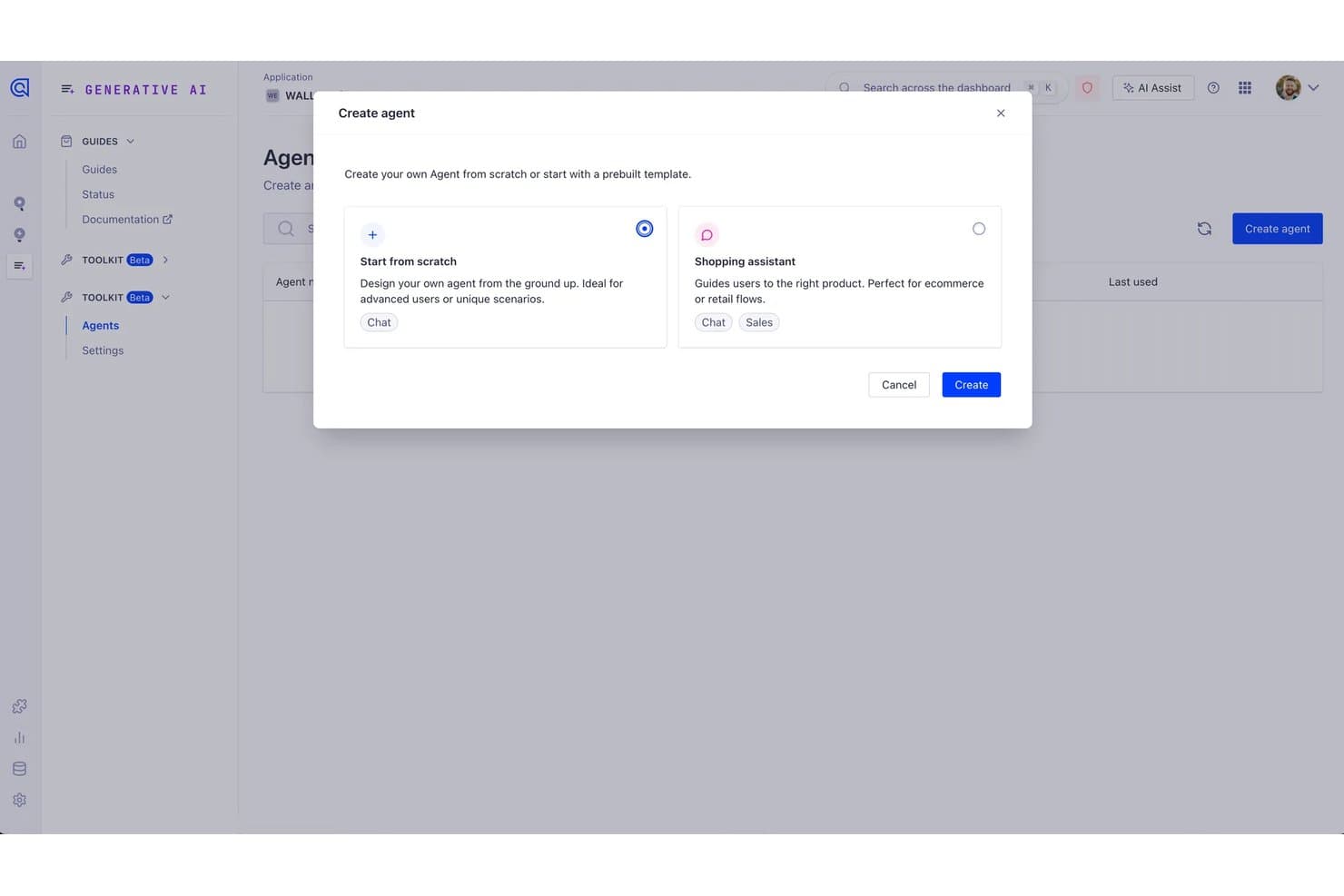
Algolia lets users build AI agents from scratch or via templates. Algolia is a search and discovery platform for ecommerce that adds conversational search, product Q&A, real-time personalization, and recommendations to storefronts.
Who Is Algolia Best For?
Algolia is a strong fit for ecommerce teams that already run search-driven storefronts and want control over how their AI agents are built.
Why I Picked Algolia
I picked Algolia because Agent Studio lets teams build their own shopping agents on top of an existing Algolia product index, which is the key reason agent answers about pricing, inventory, and compatibility stay accurate. Teams can set up an agentic search bar that suggests conversational prompts as shoppers type, or guided selling flows for compatibility and fitment questions. The MCP Server also exposes the catalog to external agents such as ChatGPT and Claude.
Algolia Key Features
- AI Recommendation models: Choose from five recommendation models—Frequently Bought Together, Related Items, Looking Similar, Trending Items, and Personalized Recommendations—each retraining on fresh interaction data.
- Merchandising Studio: Configure search ranking, campaign rules, and promote/demote logic in the dashboard without writing code.
- Bring-your-own-LLM support: Connect Agent Studio to OpenAI, Anthropic, Google Gemini, AWS Bedrock, or Azure OpenAI.
- Agent governance controls: Set input/output guardrails, token limits, per-IP request caps, conversation-depth limits, and approved-domain lists.
Algolia Integrations
Algolia offers integrations with Salesforce Commerce Cloud, Adobe Commerce, Shopify, BigCommerce, WordPress, Zendesk, and Commercetools. It also offers an API for custom connections.
Pros and Cons
Pros:
- Real-time personalization improves product discovery
- Configurable guardrails control agent responses
- Catalog-grounded answers reduce hallucinations
Cons:
- Recommendations require event tracking setup
- Agents cannot place orders
Learn more about Algolia: Best for multichannel AI support
- Free plan available; 7-day free trial
- From $24.17/month (billed annually)
Visit WebsiteCustomer Rating:4.7/5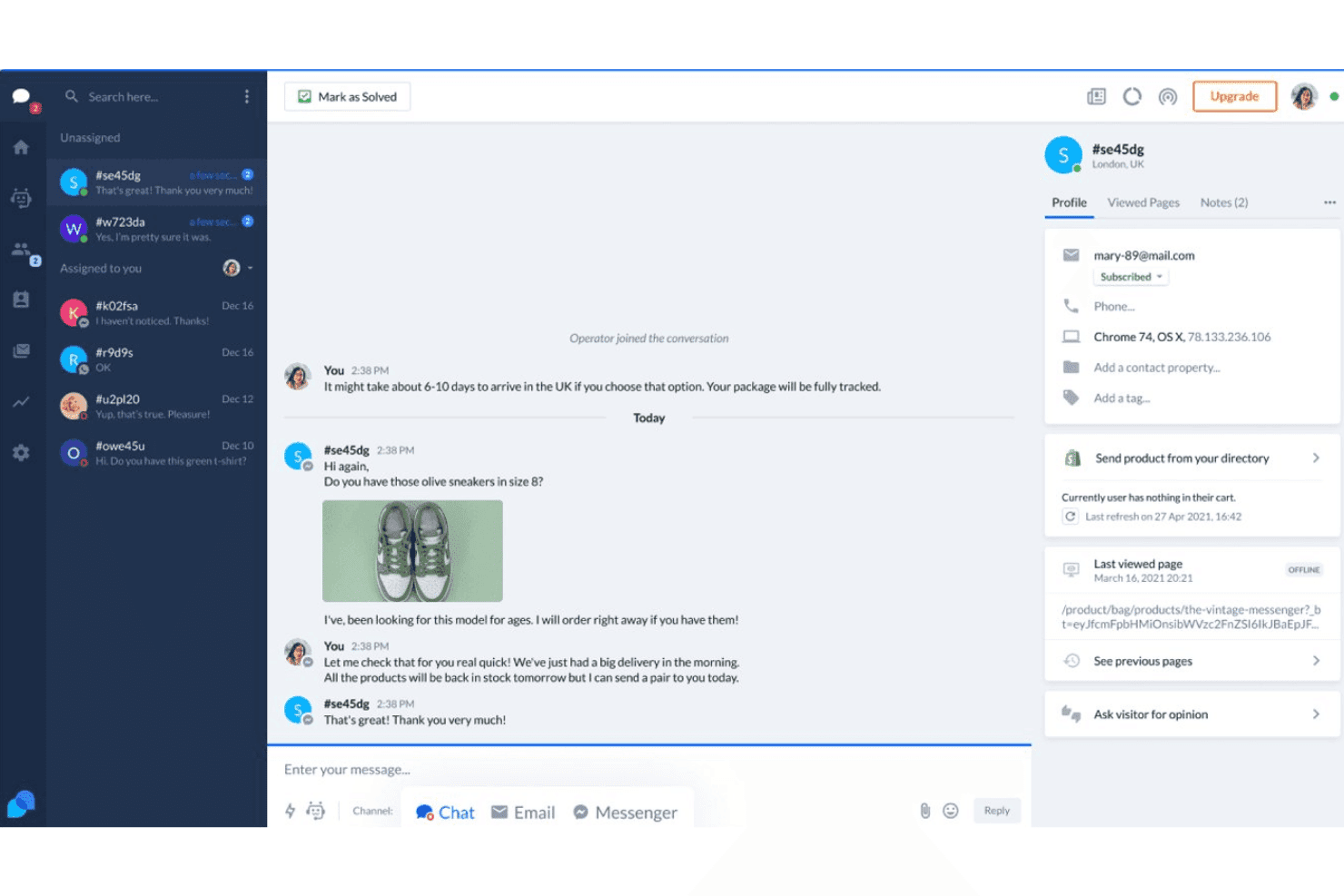
Tidio lets agents handle customer chats with visitor profiles side by side. Tidio is an AI customer service platform for ecommerce that combines a conversational AI agent (Lyro), rule-based automation flows, and a multichannel inbox.
Who Is Tidio Best For?
Tidio is a strong fit for ecommerce managers and customer experience teams at small to mid-sized online stores who need AI support across several channels.
Why I Picked Tidio
I picked Tidio because Lyro, its AI agent, runs across website chat, email, Instagram, Messenger, and WhatsApp from one inbox, so a small team doesn't need a separate tool per channel. The AI trains itself by scraping your existing FAQs and help content, so there's no manual intent mapping before you go live. Once it's running, Lyro Smart Actions handle the repetitive stuff autonomously: pulling order status, sending discount codes, and checking product availability without a human in the loop.
Tidio Key Features
- Lyro Connect: Deploy Lyro AI on top of existing help desk platforms like Zendesk, Intercom, and Salesforce without migrating your support stack.
- No-code Flows builder: A drag-and-drop automation editor with 40+ ecommerce templates for cart recovery, cross-sell triggers, discount delivery, and post-purchase messaging.
- Lyro Guidance: Set custom rules for Lyro's tone, escalation behavior, and response boundaries.
- AI Reply Assistant: Draft and refine agent responses on-brand using GPT-4 technology inside the support inbox.
Tidio Integrations
Tidio integrates with BigCommerce, Shopify, Adobe Commerce, PrestaShop, Zendesk, Intercom, Zapier, and Salesforce. Tidio also offers an OpenAPI for custom integrations.
Pros and Cons
Pros:
- Multichannel context supports consistent customer conversations
- Smart Actions complete routine support tasks
- Live-inventory recommendations guide product discovery
Cons:
- Merchandising and pricing autonomy remain limited
- Complex queries can challenge AI accuracy
Learn more about Tidio: Best for enterprise catalog-grounded AI discovery
- Free trial available
- Pricing upon request
Visit WebsiteCustomer Rating:4.7/5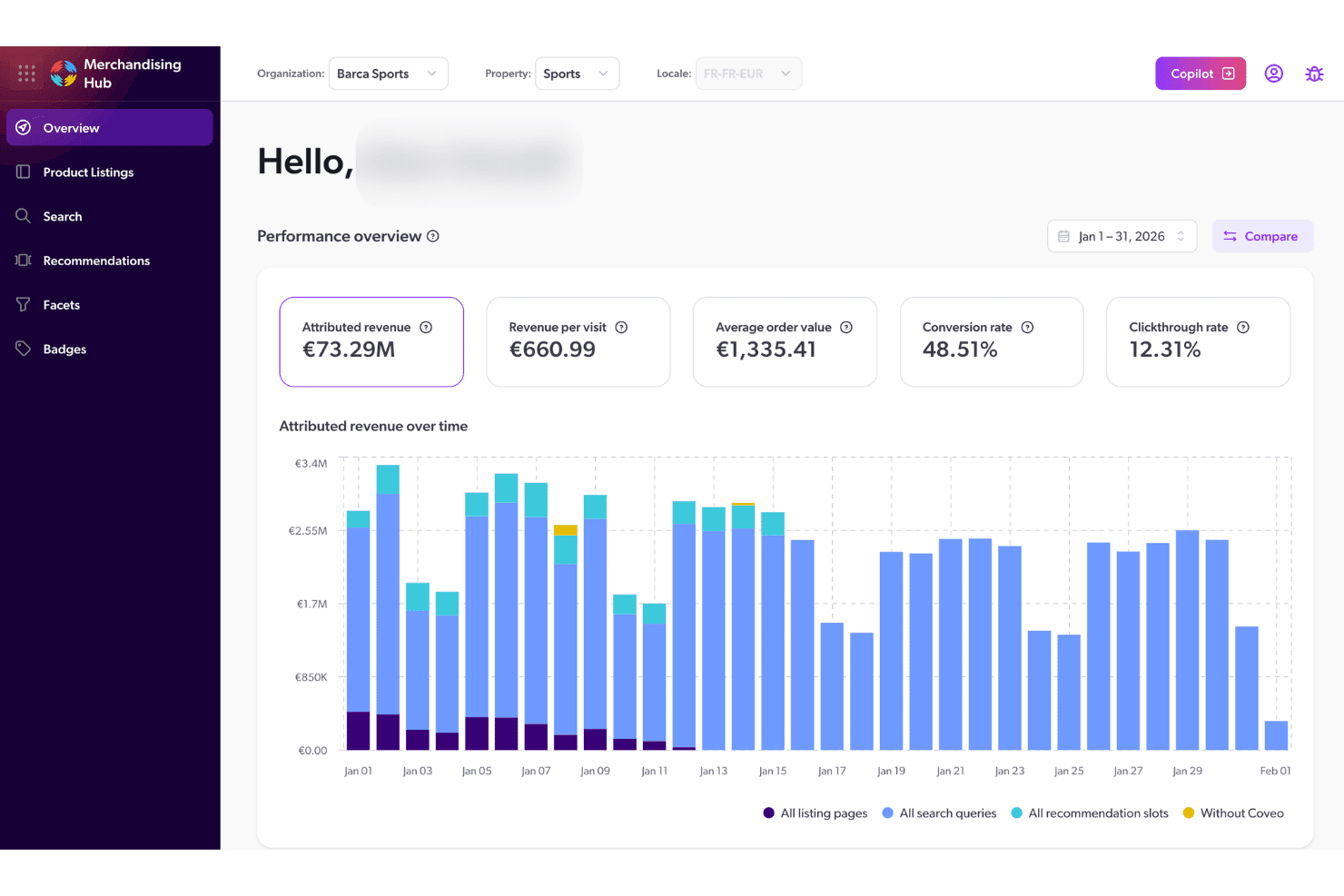
Coveo tracks attributed revenue and conversion metrics on a dashboard. Coveo is an AI search and product discovery platform that combines conversational shopping, real-time catalog indexing, personalized recommendations, and a no-code merchandising hub.
Who Is Coveo Best For?
Coveo is built for enterprise retailers and B2B distributors whose catalogs carry many SKUs and detailed product attributes.
Why I Picked Coveo
Coveo earns its spot on my shortlist because its Discovery Agent is designed for complex B2B catalogs. I'm particularly impressed by its real-time catalog indexing, which supports millions of SKUs, customer-specific pricing, and fitment data in a single unified index. Its Adaptive Canvas switches the results layout from product grids to comparison tables based on what the shopper asks.
Coveo Key Features
- Merchandising Copilot: Surfaces natural-language insights and data-backed merchandising recommendations, requiring human approval before changes go live.
- Unified content index: Combines product data with support content, manuals, and guides in one index, so shoppers can find products and usage answers in one place.
- A/B testing for search and listings: Built-in experimentation tools let you test ranking strategies, facet configurations, and recommendation placements directly within the Merchandising Hub.
- Real-time 1:1 personalization: Uses behavioral embeddings and in-session signals to rank and recommend products for each shopper, even without a login or profile.
Coveo Integrations
Coveo integrates with Shopify, Salesforce, SAP, Box, Adobe Experience Manager, Optimizely, Sitecore, and AppDirect. An API for custom integrations is also available.
Pros and Cons
Pros:
- Provides transparent search ranking controls
- Personalizes results for anonymous shoppers
- Handles complex B2B catalog structures
Cons:
- Focuses on discovery rather than transactions
- Requires technical implementation expertise
Learn more about Coveo:
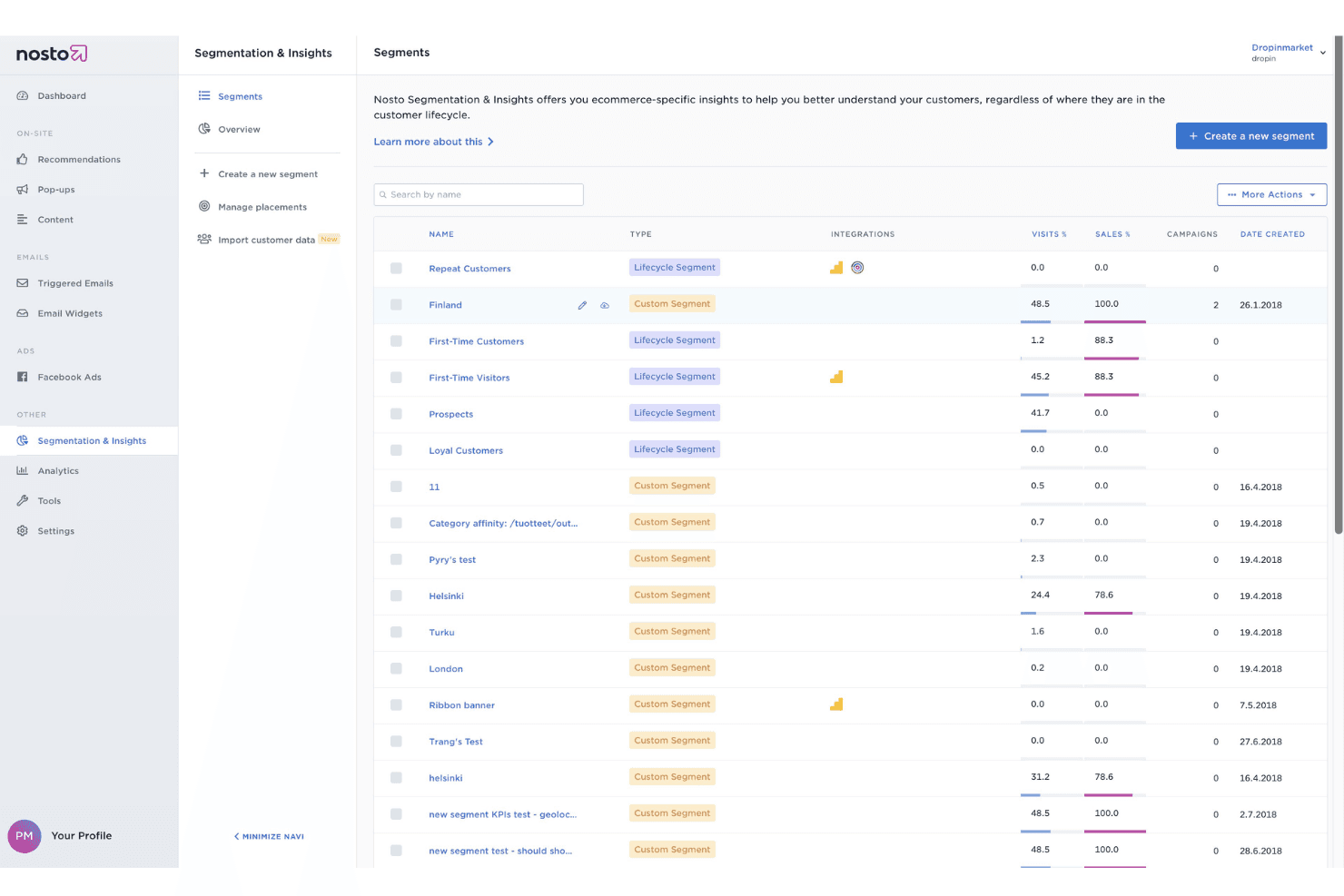
Nosto lets users segment customers by lifecycle stage and custom rules. Nosto is a commerce experience platform with an AI agent layer, Huginn, that spans personalized search, product recommendations, category merchandising, and behavioral analytics across your storefront, email, and content channels.
Who Is Nosto Best For?
Nosto is a strong fit for mid-market and enterprise ecommerce teams that rely on behavioral data to merchandise large catalogs.
Why I Picked Nosto
I've included Nosto in my top picks because its Large Intent Model, trained on billions of behavioral and transactional data points, powers real-time personalization across product recommendations and category pages. I particularly like how AI Reveals proactively surfaces untapped customer segments and intelligent product bundles without you having to ask. Its vector-based Personalized Search also factors in stock levels, profit margin, and seasonality to merchandise results automatically.
Nosto Key Features
- Ask Huginn: Allows you to query conversion trends, customer segments, and experiment ideas directly.
- Category merchandising: Ranks category pages using real-time signals like stock levels, profit margin, seasonality, and conversion rate.
- Huginn Connect: An API and MCP integration layer that links Huginn to external AI tools like Shopify Sidekick.
- Shoppable UGC: Turns user-generated content into shoppable storefronts, so shoppers can buy from customer photos and social content.
Nosto Integrations
Nosto offers integrations with Shopify, Adobe Commerce, BigCommerce, Salesforce Commerce Cloud, Shopware, VTEX, Tapcart, and Google Analytics. An API is also available for custom integrations.
Pros and Cons
Pros:
- Conversational and image search aid discovery
- Huginn supports approval-gated merchandising decisions
- Real-time personalization handles large catalogs
Cons:
- AI Search availability remains limited
- Huginn requires approval before changes launch
Learn more about Nosto: Best for merchant- and shopper-facing agents
- Free demo available
- Pricing upon request
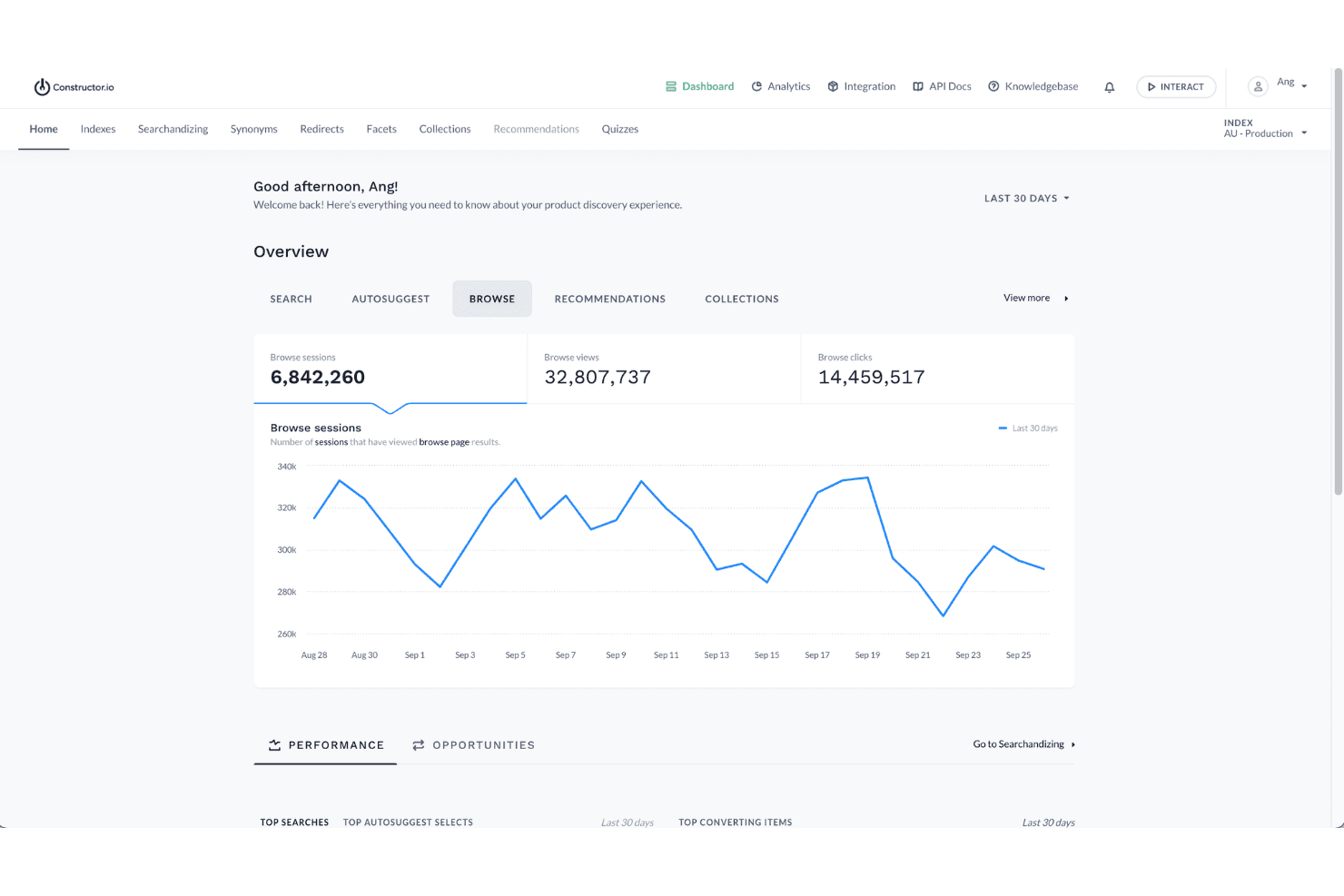
Constructor tracks browse sessions, views, and clicks in one dashboard. Constructor is an AI-native product discovery platform that powers personalized search, browse, and recommendation experiences.
Who Is Constructor Best For?
Constructor is a strong fit for enterprise retailers with dedicated merchandising teams and large product catalogs.
Why I Picked Constructor
I've included Constructor in my top picks because it runs separate AI agents for shoppers and merchandisers on one discovery engine. The AI Shopping Agent guides shoppers through natural-language discovery, while the Merchant Intelligence Agent gives merchandisers explainable, approvable control over search rankings and browse rules. What I also like is that the Product Insights Agent (PIA) answers sizing, compatibility, and returns questions on product pages, drawing on specs, reviews, and support content.
Constructor Key Features
- Personalized search and browse: Optimizes search and browse rankings based on real shopper behavior, tuning results toward conversion and revenue signals.
- Image search: Shoppers can upload a photo into the search field on the web or mobile to find visually similar products.
- Attribute enrichment: Automatically generates and corrects product attributes in your catalog, filling gaps and fixing inconsistencies without manual data entry.
- Cross-channel product recommendations: Deliver personalized product content across email, SMS, and mobile push via integrations with partners like Braze and Movable Ink.
Constructor Integrations
Constructor offers integrations with Shopify, Stripe, Movable Ink, BigCommerce, Commercetools, VTEX, Elastic Path, Fabric, and Braze. It also offers an API for custom integrations.
Pros and Cons
Pros:
- Behavioral signals refine personalized discovery
- Contextual product answers draw from multiple sources
- Shared intelligence across shopper and merchant agents
Cons:
- Agent scope excludes orders and returns support
- Merchant changes still require manual approval
Learn more about Constructor: Best for Shopify-native support and sales
- Free demo + 30-day free trial available
- From $40/month
Visit WebsiteCustomer Rating:4.6/5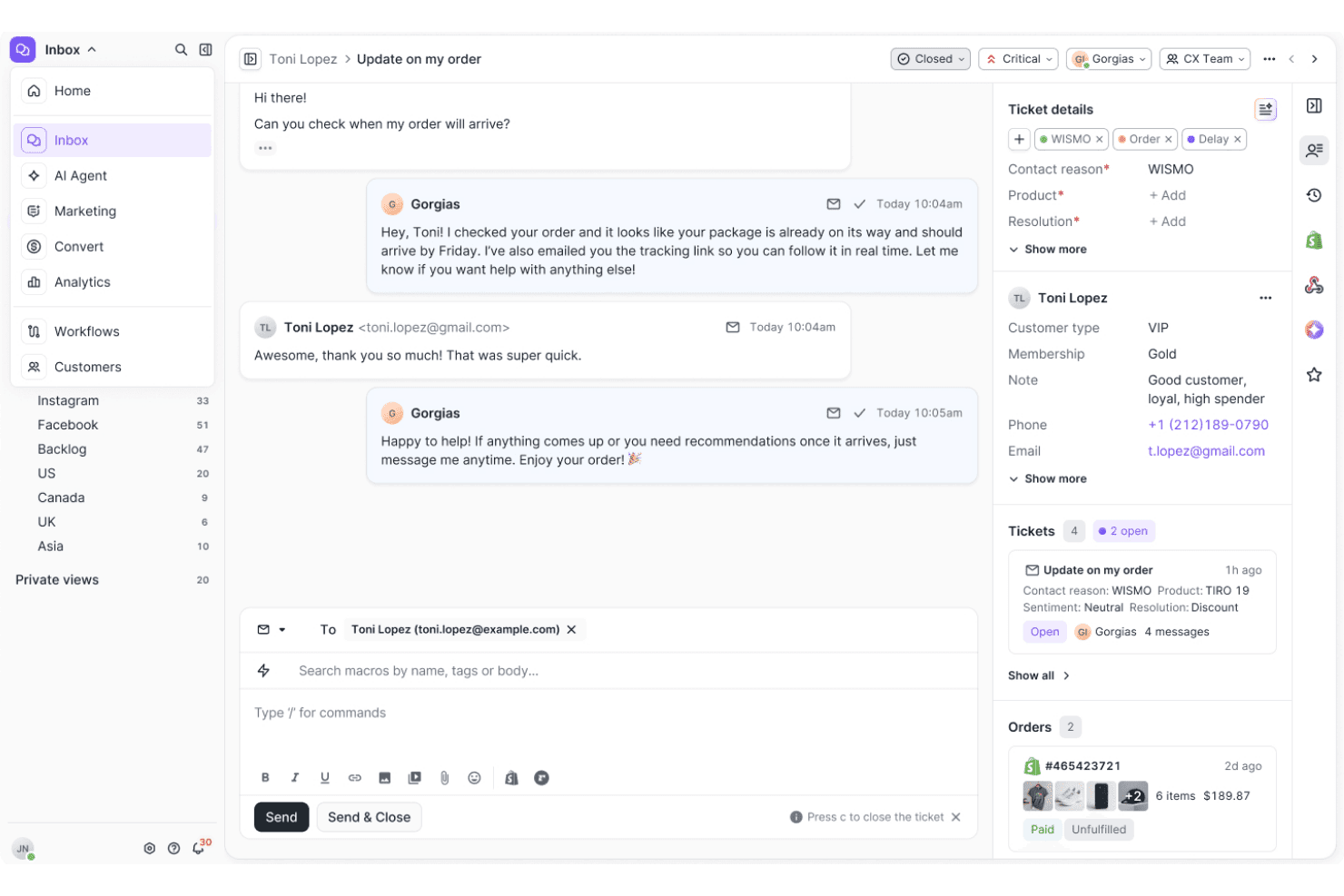
Gorgias centralizes customer conversations with full order and ticket context. Gorgias is an ecommerce helpdesk and AI agent platform that combines automated ticket resolution, a conversational Shopping Assistant, and a multichannel inbox.
Who Is Gorgias Best For?
Gorgias is a strong fit for Shopify merchants who want pre-purchase and post-purchase conversations handled in one tool.
Why I Picked Gorgias
I picked Gorgias because it connects directly to Shopify, so order data, the product catalog, and customer history appear inside every ticket. Its AI Agent handles over 130 actions, like issuing refunds, editing shipping addresses, and processing returns, while the Shopping Assistant initiates proactive conversations to recommend products and trigger discounts at high-intent moments. That dual setup means one tool covers the full customer journey.
Gorgias Key Features
- Multi-channel unified inbox: Manage conversations across email, live chat, SMS, WhatsApp, Instagram, Facebook, and voice from a single inbox.
- Sandbox mode for AI testing: Test and validate AI responses in a safe environment before deploying them to live conversations.
- Revenue attribution reporting: Track which support and AI conversations directly contribute to revenue, AOV, and conversion on Pro and Advanced plans.
- Intent-based automation controls: Set approved intents that define which ticket types the AI handles on its own and which go to a human agent.
Gorgias Integrations
Gorgias lists 150+ app integrations, including Shopify, BigCommerce, Adobe Commerce, WooCommerce, PrestaShop, Recharge, and Loop Returns. It also offers a REST API for custom connections.
Pros and Cons
Pros:
- Provides sandbox testing and confidence controls
- Combines support automation with shopping assistance
- Resolves refunds, returns, and address changes
Cons:
- Reporting depth varies by plan
- AI responses often sound robotic
Learn more about Gorgias: 7Best for outcome-based AI support
Fin
- 14-day free trial
- From $49.50/month
Visit WebsiteCustomer Rating:4.5/5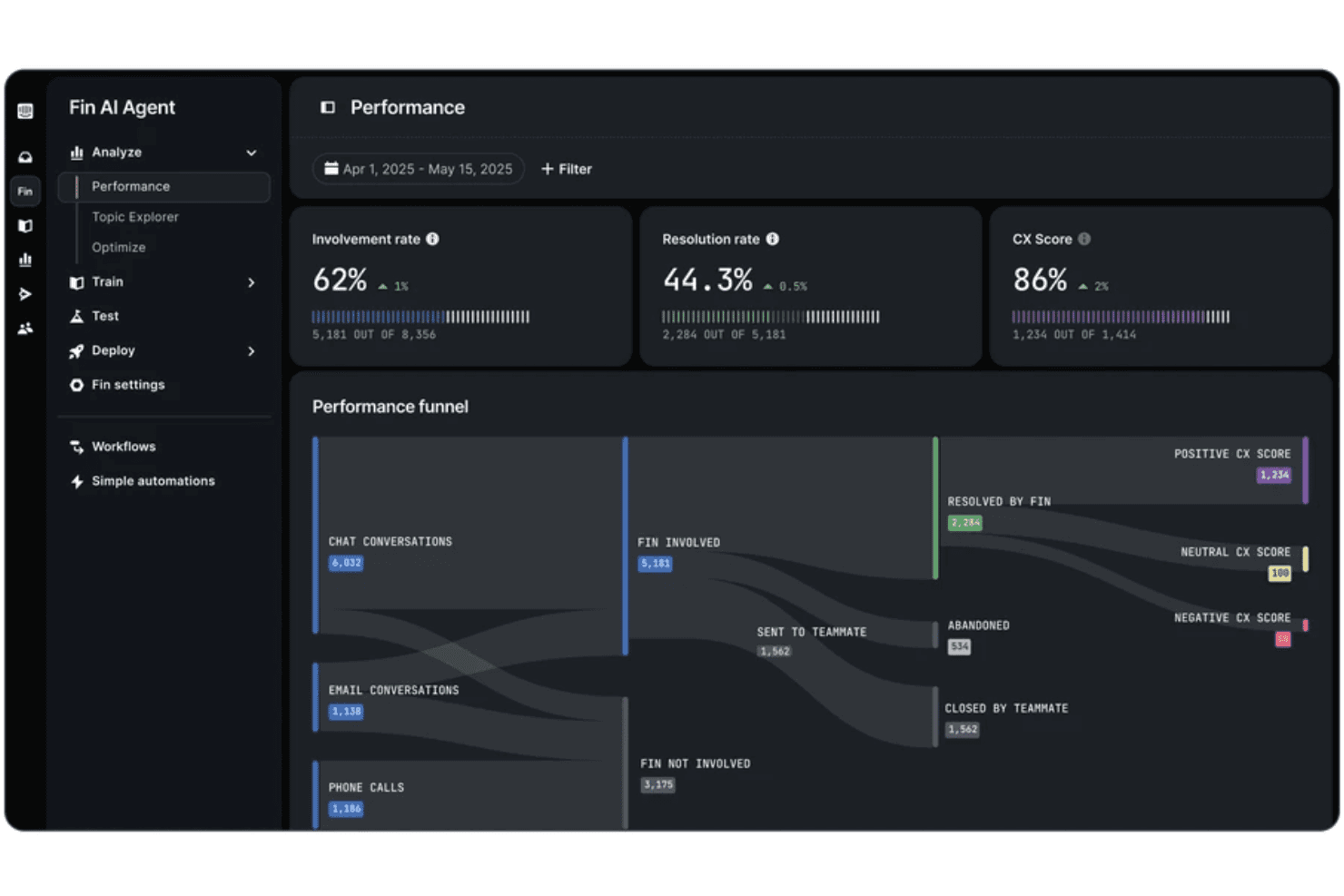
Fin automates customer support with AI-powered conversations. Fin by Salesforce is Intercom's AI customer agent. It handles product questions, order lookups, returns, exchanges, and multi-step actions like refunds and subscription changes across chat, email, voice, and social channels.
Who Is Fin Best For?
Fin is a strong fit for Shopify merchants with high volumes of repeat order and returns questions.
Why I Picked Fin
I picked Fin as one of the best because its outcome-based pricing charges only when Fin resolves a conversation, so spend scales with resolved conversations. I love that Fin pulls live order and refund status directly from Shopify, so it's acting on real data rather than scripted responses. For a Shopify merchant fielding hundreds of return requests daily, that combination of deterministic guardrails and live data access is hard to replicate.
Fin Key Features
- Fin Flywheel: A lifecycle system to train, test, deploy, and analyze Fin's performance, including one-click application of AI recommendations, without engineering support.
- Multi-channel deployment: Fin runs across chat, email, voice, WhatsApp, SMS, Instagram, Slack, Discord, and API with consistent conversation context across all channels.
- In-chat add-to-cart: Shoppers can add products to their cart from the Fin chat window without leaving the conversation.
- CX Score and Topics Explorer: Survey-free quality tracking and topic-trend analysis that surface conversation insights and flag emerging issues without manual tagging.
Fin Integrations
Fin integrates with Shopify, Stripe, Salesforce Service Cloud, HubSpot, Zendesk, Freshdesk, and Zapier. It also offers an API for custom connections.
Pros and Cons
Pros:
- Maintains context across customer channels
- Handles damaged-item claims from customer photos
- Offers multilingual support
Cons:
- Costs rise with resolution volume
- Quality depends heavily on knowledge-base structure
Learn more about Fin:
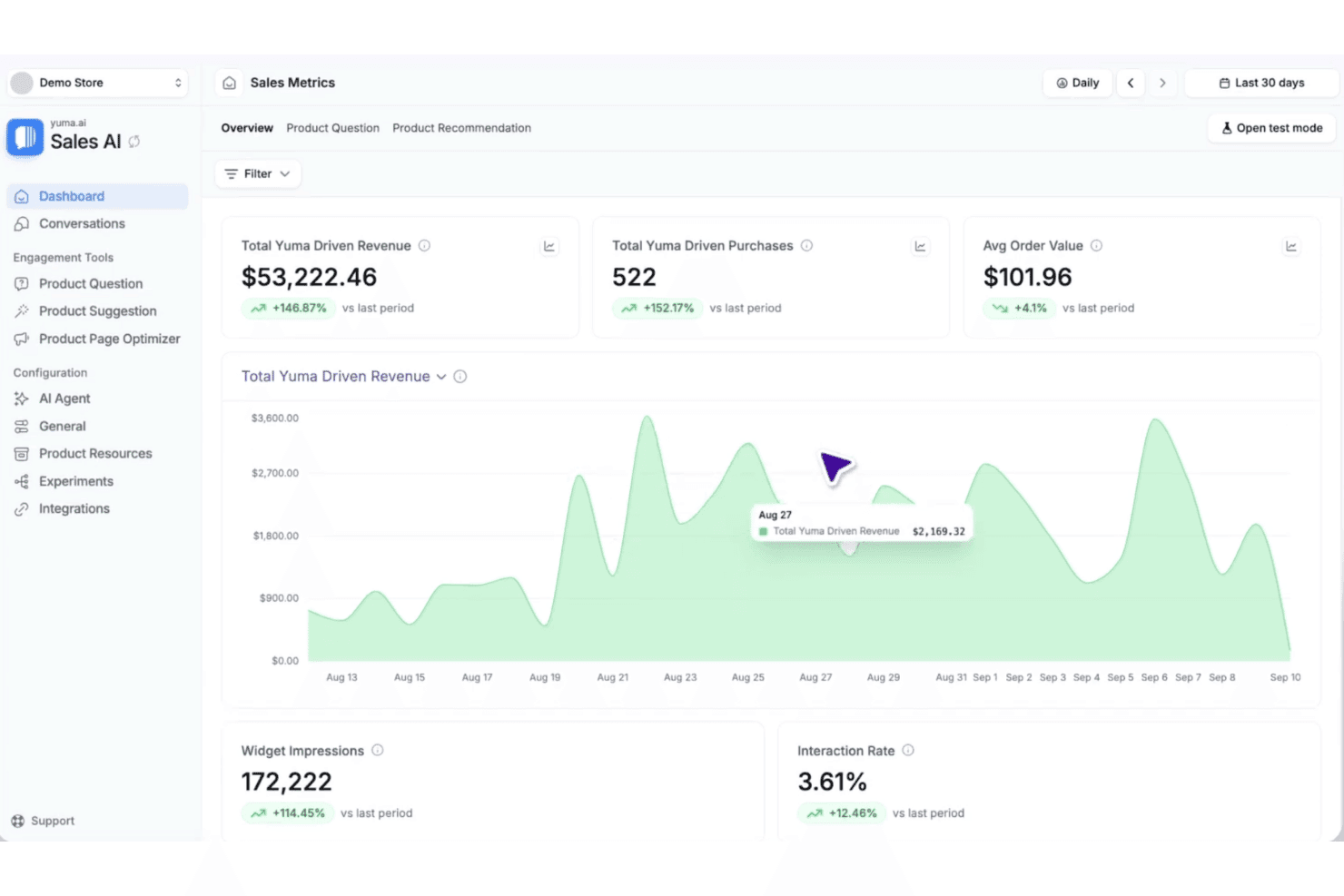
Yuma tracks AI-driven revenue, purchases, and order value over time. Yuma is an agentic AI platform for ecommerce that covers post-purchase support automation, storefront shopping assistance, social media moderation, and voice support.
Who Is Yuma Best For?
Yuma is a strong fit for Shopify store merchants handling high support volumes across many channels.
Why I Picked Yuma
I picked Yuma as one of the best because no other tool on my shortlist goes as deep on Shopify-native post-purchase actions, such as processing refunds, editing shipping addresses, pausing subscriptions, and reshipping orders, without a human in the loop. I also like its Process Builder, which lets you define multi-step order workflows in plain language, so no developer is needed to set up backend actions.
Yuma Key Features
- Multi-channel deployment: Yuma's Support AI spans 25+ channels, including email, WhatsApp, Instagram, TikTok Shop, and review platforms like Trustpilot.
- Voice AI agent: A phone-based agent that completes backend actions during the call, then confirms aloud, records, and transcribes every interaction.
- Sales AI storefront chat widget: A pre-purchase shopping agent that answers sizing, compatibility, and policy questions using live catalog data, in 180+ languages.
- Built-in A/B testing and revenue attribution: Split-tests Sales AI against a no-AI control group, with dashboards tracking conversion, revenue per session, AOV, and AI-driven purchases.
Yuma Integrations
Yuma offers 60+ standard integrations, including Shopify, Zendesk, WooCommerce, Recharge, Stripe, Loop Returns, and AfterShip. It provides an API for custom integrations.
Pros and Cons
Pros:
- Measures storefront revenue attribution directly
- Handles complex subscription changes
- Executes refunds and exchanges autonomously
Cons:
- Setup requires policy and workflow tuning
- Occasional hallucinations require output review
Learn more about Yuma: Best for visual and conversational product discovery
- Free demo + 14-day free trial available
- Pricing upon request
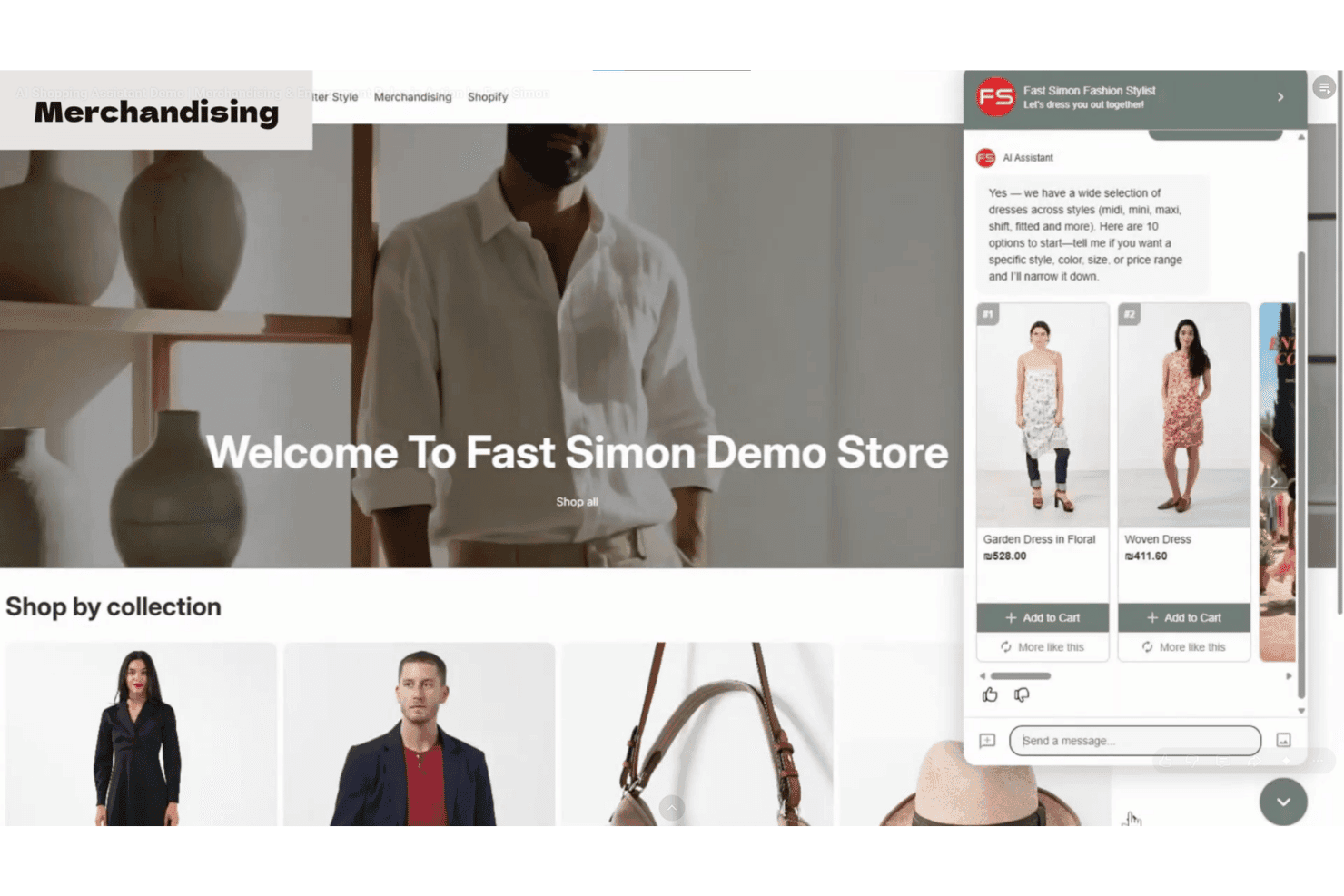
Fast Simon's AI stylist chat helps shoppers find dresses instantly. Fast Simon is an AI ecommerce search and product discovery platform that combines conversational shopping, visual search, AI merchandising, and personalization across search, collections, and recommendations.
Who Is Fast Simon Best For?
Fast Simon is a strong fit for merchandising and digital marketing teams managing large catalogs.
Why I Picked Fast Simon
Fast Simon earns its spot on my shortlist because it pairs visual search with conversational guidance. Visual Search lets shoppers upload a photo to find matching products, while Hyper Tagging enriches product data and generates shopper-friendly filters. The AI Shopping Agent adds conversational guidance on top, with recommendations grounded in live catalog data, active promotions, and your merchandising rules.
Fast Simon Key Features
- AI Merchandising Agent: Manages product assortment and display decisions, updating collection rankings and visibility based on merchant-defined goals.
- Managed Collections: Automatically generates and maintains native Shopify collections, keeping product membership current based on merchant-selected ranking strategies.
- Support deflection with live escalation: The AI Shopping Agent answers customer inquiries from merchant-approved documentation and hands off to a help desk when needed.
- Abandoned journey triggers: Detects when shoppers abandon a search or collection and sends those signals to Klaviyo or Attentive for email or SMS follow-up.
Fast Simon Integrations
Fast Simon offers native integrations with Shopify, Fuego, BigCommerce, Adobe Commerce, Zendesk, Wix, and Gladly. It also offers an API for custom connections.
Pros and Cons
Pros:
- Reviews praise responsive implementation support
- Catalog-aware answers reflect merchandising rules
- Visual discovery supports photo-led shopping
Cons:
- Agent autonomy stops short of transactions
- Page-speed complaints affect collection experiences
Learn more about Fast Simon: 10Best for proactive cart recovery
Rep AI
- Free demo + 14-day free trial available
- From $10/3000 sessions/month (billed annually)
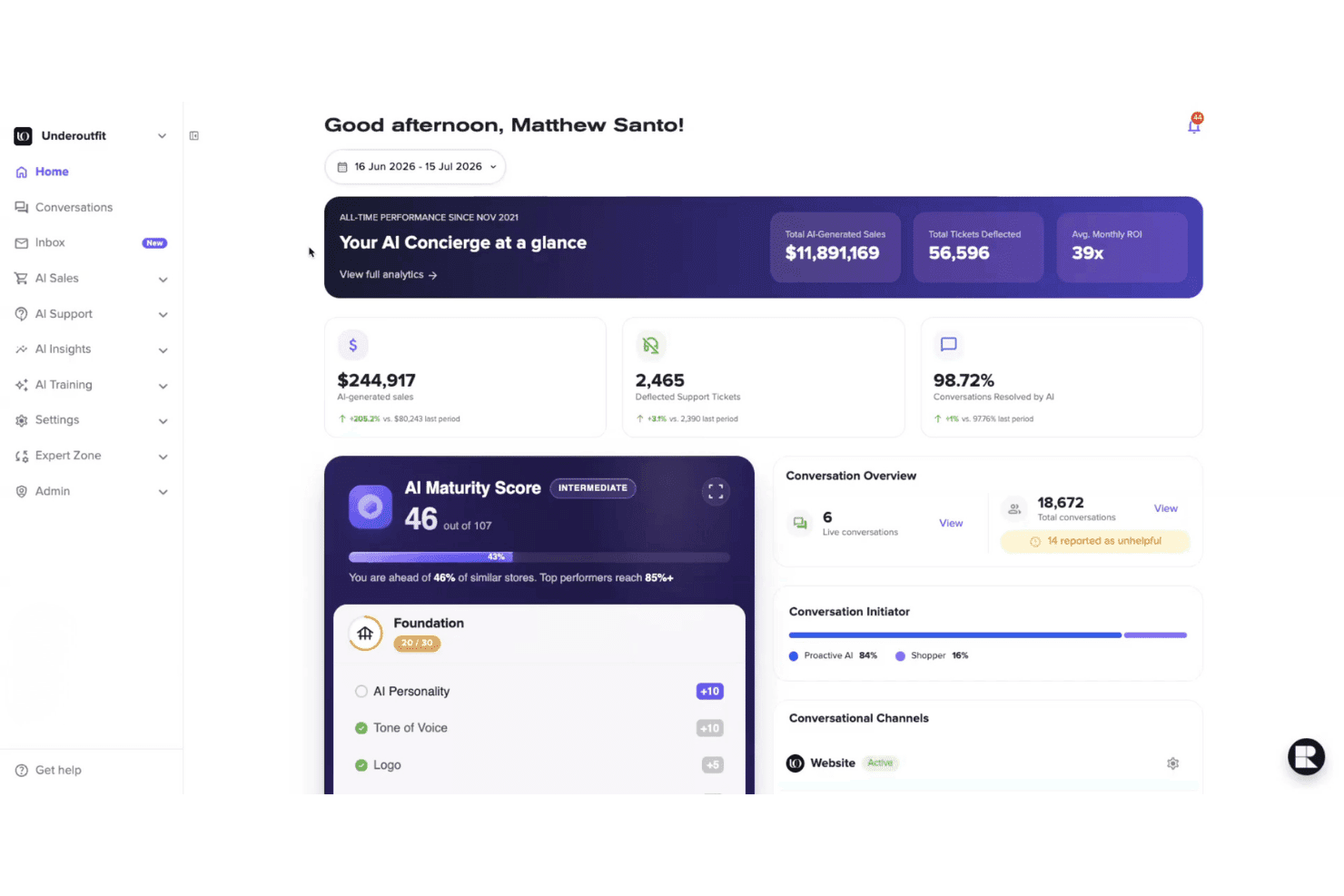
Rep AI surfaces real-time AI sales and support performance at a glance. Rep AI is an ecommerce AI agent that combines proactive sales engagement, automated support, and behavior-triggered cart recovery across web, social, and messaging channels.
Who Is Rep AI Best For?
Rep AI is a strong fit for Shopify and Shopify Plus merchants who want one agent covering sales and support.
Why I Picked Rep AI
Rep AI earns its spot on my shortlist because of how it flips the script on cart recovery. Instead of waiting for a shopper to abandon and then chasing them with an email, it monitors behavioral signals like hesitation and exit risk in real time and opens a conversation before they leave. I love that this proactive engagement is trained on a dataset of 160M+ sessions, so the triggers aren't arbitrary.
Rep AI Key Features
- Guided product discovery: Natural-language chat narrows product options, surfaces comparisons, and triggers contextual upsells with in-conversation checkout.
- Multi-channel unified inbox: Manage conversations from web chat, email, Instagram, Facebook, WhatsApp, and Tapcart in a single dashboard.
- Missing information detection: Flags questions AI couldn't answer, surfacing catalog and knowledge gaps for your team to address.
- Shopper intelligence dashboard: Tracks drop-off reasons, competitor mentions, hesitation signals, and unanswered questions to surface actionable insights.
Rep AI Integrations
Rep AI documents 25+ integrations, including Shopify, Salesforce Commerce Cloud, WooCommerce, Postscript, Omnisend, Listrak, Loop Returns, and Slack. It also offers an API for custom integrations.
Pros and Cons
Pros:
- Support handoffs preserve full conversation context
- Product discovery includes comparisons and contextual upsells
- Low-cost entry plan available
Cons:
- Implementation can take longer than promised
- AI responses occasionally become irrelevant or circular
Learn more about Rep AI:
Andre AI-agenter for netthandel
Her er noen flere plattformer som ikke kom med på kortlisten min, men som likevel er verdt å undersøke:
- 11BloomreachBest for conversational shopping
- 12Alhena AIBest for omnichannel voice and chat commerce
- 13SyteBest for AI-enriched catalog tagging and search
- 14AttentiveBest for SMS re-engagement at scale
- 15KustomerBest for AI governance in retail CX ops
- 16SierraBest for peak-season retail agent scaling
- 17AdaBest for enterprise post-purchase support
- 18Dynamic YieldBest for enterprise catalog personalization
- 19ZowieBest for policy-driven returns and order automation
- 20SienaBest for DTC shopping and VoC in one
How I Evaluate AI Agents for Ecommerce
To make this list, a tool needs to deliver genuine AI value—whether that's guiding a shopper from discovery to checkout or autonomously resolving a return without a support ticket. I split my evaluation into core functionality every tool must cover and differentiating factors that separate the best from the rest.
Core Functionality (Table Stakes For This List)
When I'm selecting tools for my list, I score each one on a scale from 0 (does not offer the functionality) to 5 (excels in this area) for each core functionality listed below. I then convert the total into a percentage to help assess each tool's overall fit, with extra weight on any functionalities I've deemed essential.
- Autonomous Task Execution (Essential): I check whether the agent can complete multi-step workflows on its own, like resolving a return or updating an order status without a human approving each step.
- Conversational Shopping Interface (Essential): I evaluate how well the agent handles natural-language questions, follow-ups, and product comparisons during a shopping session.
- Product Catalog Integration: Real-time sync with product, pricing, and inventory data matters here. I look for agents that reflect stock changes and price updates without noticeable lag.
- Personalized Recommendations: I look at how each tool uses behavioral and purchase data to tailor suggestions, not just surface best-sellers or static rule-based picks.
- Ecommerce Platform Connectivity: Native integrations with platforms like Shopify, Magento, and BigCommerce are what I evaluate, along with how deep those connections go beyond basic read access.
- Multi-Channel Deployment: I consider whether the agent delivers a consistent experience across storefront, chat, email, and marketplace touchpoints without losing conversation context.
Once I have a list of tools that meet the criteria, I consider what sets each platform apart.
Differentiating Factors (What Sets Vendors Apart)
Here's how I compare and contrast different vendors:
Standout Features
I look for proactive cart recovery agents that detect abandoned sessions and trigger personalized outreach across chat, email, or SMS without manual setup. Rep AI and Tidio both offer versions of this, but I evaluate how well each agent tailors its messaging to the specific products left behind. Voice commerce support is another differentiator I check, since shoppers increasingly expect to search and buy through conversational voice interfaces. I also consider agent-to-agent transaction readiness, which prepares your store for AI shopping agents that negotiate and complete purchases on a buyer's behalf.
Beyond Features
I evaluate how fast a tool can go live with your actual catalog and brand voice, since pre-built connectors in platforms like Gorgias and Tidio can cut launch timelines from months to weeks. Data privacy controls matter just as much—I check how each vendor handles shopper data, opt-out flows, and compliance with regulations like GDPR. I also look for built-in analytics that tie agent actions directly to conversion and AOV, because without clear attribution, it's hard to justify ongoing spend.
Slik velger du en AI-agent for netthandel
Velg en AI-agent ved å teste hvordan den håndterer produktkatalogen, kundepolicyene og overleveringen av oppgaver til driftsorganisasjonen før du signerer en kontrakt.
| Hvis prioriteten din er | Se etter |
|---|---|
| Hvis prioriteten din erFærre feilaktige produktsvar | Se etterEn test av katalogkilden med 10 aktuelle SKU-er |
| Hvis prioriteten din erFærre manuelle returavgjørelser | Se etterEn dokumentert godkjenningsprosess for tre returscenarioer |
| Hvis prioriteten din erEnsartede svar på tvers av kanaler | Se etterEn sammenligning av samtaleutskrifter fra nettbutikk, e-post og chat |
| Hvis prioriteten din erKontroll over kundedata | Se etterSkriftlige vilkår for lagring, sletting og reservasjon |
| Hvis prioriteten din erForutsigbart lanseringsarbeid | Se etterEn plan for innføring av katalogen med navngitte leveranser |
Slik vurderer du kortlisten
- Gjennomfør en katalogtest: Gi hver leverandør 10 SKU-er med varianter, lagerendringer og produktbegrensninger, og gå deretter gjennom svarene innen fem virkedager.
- Test en sak etter kjøpet: Send inn én forsinket bestilling, én returforespørsel og én reklamasjon på en skadet vare i løpet av en 14-dagers prøveperiode, og registrer hver overlevering.
- Be om datadokumentasjonen: Be om leverandørens tillegg for databehandling, lagringsplan, sletteprosess og arbeidsflyt for reservasjon før kontrakten gjennomgås.
- Opprett en supportsak: Registrer en sak om korrigering av katalogen og be om skriftlig bekreftelse på endringen, hvem som er ansvarlig for den, og forventet dato for løsning.
- Velg driftsmessig avveining: Bestem om du foretrekker en snevert styrt agent med strengere kontroller, eller en bredere agent som håndterer flere scenarioer med større ansvar for gjennomgang.
Hva er AI-agenter for netthandel?
AI-agenter for netthandel er plattformer som bruker kunstig intelligens til å veilede kunder, svare på spørsmål og utføre handelsoppgaver. De kobles til produktkataloger, kundeservicesystemer og netthandelsplattformer for å støtte produktoppdagelse, anbefalinger, ordreoppdateringer, returer og refusjoner. Noen agenter fungerer på tvers av nettbutikker, chat, e-post og talekanaler, samtidig som de overfører komplekse forespørsler til menneskelige team.
Funksjoner i AI-agenter for netthandel
Når du velger en AI-agentplattform for netthandelsvirksomheten din, bør du se etter følgende viktige funksjoner:
- Autonom utførelse av oppgaver: Agenten fullfører oppgaver i flere trinn basert på definerte regler, tillatelser og kundeforespørsler. Den kan oppdatere ordreopplysninger, starte returer eller eskalere unntak uten at det kreves manuell godkjenning på hvert trinn.
- Samtalebasert handel: Agenten forstår spørsmål, oppfølgingsspørsmål og produktsammenligninger formulert i naturlig språk. Kunder kan spørre om passform, materialer, tilgjengelighet eller bruksområder uten å måtte navigere gjennom flere produktsider.
- Integrasjon med produktkatalog: Agenten kobles til data om produkter, priser, varianter og lagerbeholdning. Den bruker oppdatert kataloginformasjon til å svare på spørsmål og unngå å anbefale utilgjengelige eller begrensede produkter.
- Personlige anbefalinger: Agenten bruker surfeaktivitet, kjøpshistorikk, preferanser og samtalekontekst til å foreslå relevante produkter. Dette støtter kryssalg, mersalg og produktoppdagelse utover generiske lister over bestselgere.
- Støtte for ordre og forsendelser: Agenten henter ordreopplysninger og gir oppdateringer om ordrebehandling, levering, kanselleringer eller adresseendringer. Den kan følge definerte arbeidsflyter når en ordre trenger gjennomgang eller inngripen.
- Automatisering av returer og refusjoner: Agenten bruker returvilkårene dine på forespørsler og samler inn informasjonen som trengs for å løse saken. Avhengig av reglene dine kan den opprette returanmodninger, utstede godkjente refusjoner eller sende unntak videre til kundeservice.
- Tilkobling til netthandelsplattformer: Agenten kobles til plattformer som Shopify, Magento eller BigCommerce gjennom integrasjoner eller API-er. Disse tilkoblingene gjør det mulig for agenten å få tilgang til handelsdata og utføre godkjente handlinger i driftssystemene dine.
- Distribusjon på flere kanaler: Agenten fungerer på tvers av chat i nettbutikken, e-post, meldingstjenester, sosiale kanaler eller talegrensesnitt. En delt samtalekontekst hjelper kundene med å få konsekvente svar når de bytter kanal.
- Overføring til mennesker og styring: Agenten overfører komplekse, sensitive samtaler eller samtaler med lav sikkerhet til riktig medarbeider. Innstillinger for tillatelser, eskaleringsregler, samtalelogger og gjennomgangsverktøy hjelper teamet med å kontrollere automatiserte arbeidsflyter.
Fordeler med AI-agenter for netthandel
AI-agenter gir flere fordeler for teamet og virksomheten din. Her er noen av fordelene du kan se frem til:
- Høyere konvertering: Samtalebaserte handelsgrensesnitt svarer på produktspørsmål, sammenligner alternativer og anbefaler relevante varer under kjøpsreisen.
- Mindre arbeidsbelastning for kundestøtte: Autonome arbeidsflyter håndterer ordreoppdateringer, returanmodninger og godkjente refusjoner uten at det kreves manuell handling på hvert trinn.
- Mer relevante anbefalinger: Katalogdata, surfeatferd, kjøpshistorikk og samtalekontekst hjelper agentene med å foreslå passende produkter og kryssalg.
- Konsekvent kundeservice: Distribusjon på flere kanaler sørger for at produktinformasjon, retningslinjer og samtalekontekst er konsekvente på tvers av chat i nettbutikken, e-post, meldingstjenester og tale.
- Færre feilaktige produktsvar: Sanntidstilkoblinger til data om produkter, priser, varianter og lagerbeholdning hjelper agentene med å gi oppdatert kataloginformasjon.
- Raskere eskalering av problemer: Regler for overføring sender sensitive, komplekse forespørsler eller forespørsler med lav sikkerhet til riktig medarbeider, med samtalehistorikken vedlagt.
- Bedre operasjonell oversikt: Innstillinger for tillatelser, samtalelogger, analyser og styringskontroller hjelper teamene med å gjennomgå agentenes handlinger og knytte dem til konvertering og gjennomsnittlig ordreverdi.
Kostnader og priser for AI-agenter for netthandel
For å velge riktig AI-agent for netthandel må du forstå de ulike prismodellene og abonnementene som er tilgjengelige. Kostnadene varierer basert på funksjoner, teamstørrelse, tillegg, bruk og behov for kundestøtte. Tabellen nedenfor oppsummerer vanlige abonnementer, gjennomsnittsprisene deres og typiske inkluderte funksjoner.
Sammenligningstabell for AI-agenter for netthandel
| Plantype | Gjennomsnittspris | Vanlige funksjoner |
|---|---|---|
| PlantypeGratisabonnement | Gjennomsnittspris$0/måned | Vanlige funksjonerGrunnleggende chatbot, begrensede samtaler, vanlige spørsmål om produkter og brukerstøtte fra fellesskapet. |
| PlantypePersonlig abonnement | Gjennomsnittspris$20-$100/bruker/måned | Vanlige funksjonerKatalogbaserte svar, samtalebasert shopping, ordresporing og kundestøtte via e-post. |
| PlantypeBedriftsabonnement | Gjennomsnittspris$100-$500/måned | Vanlige funksjonerAutomatiserte returer, personlige anbefalinger, plattformintegrasjoner, distribusjon på flere kanaler og analyse. |
| PlantypeVirksomhetsabonnement | Gjennomsnittspris$500-$5,000+/måned | Vanlige funksjonerTilpassede arbeidsflyter, avanserte tillatelser, dedikert kundestøtte, omfattende integrasjoner og styringskontroller. |
AI-agenter for netthandel – vanlige spørsmål
Her er noen svar på vanlige spørsmål om AI-agenter for netthandel:
Hvor lang tid tar det å implementere en AI-agent for netthandel?
Implementeringen tar ofte flere uker, avhengig av katalogens kompleksitet, integrasjoner og krav til arbeidsflyt. Start med et tydelig pilotprosjekt, for eksempel produktspørsmål og forespørsler om ordrestatus. Klargjør produktdata, retningslinjer for merkevaren, regler for eskalering og testtilfeller før konfigureringen begynner. Be leverandøren om en lanseringsplan med milepæler, ansvarlige, opplæringsoppgaver og akseptansekriterier. Et mindre pilotprosjekt gir teamet en kontrollert måte å gjennomgå svarene på før agenten utvides til returer, refusjoner, anbefalinger eller flere kanaler.
Hvordan måler forhandlere AI-agentens ytelse?
Forhandlere bør koble agentaktivitet til konverteringsfrekvens, gjennomsnittlig ordreverdi, andel saker som håndteres uten menneskelig inngripen, eskaleringsfrekvens og kundetilfredshet. Fastsett et utgangspunkt før lansering, og sammenlign deretter resultatene over en bestemt rapporteringsperiode. Gjennomgå samtaletranskripsjoner sammen med måltallene i kontrollpanelet, fordi en høy andel saker som håndteres automatisk, kan skjule dårlige svar. Spør leverandørene om rapportene skiller mellom automatiserte økter og økter med menneskelig bistand. A/B-testing kan bidra til å sammenligne instruksjoner, logikk for anbefalinger og terskler for eskalering, samtidig som evalueringen knyttes til målbare resultater for netthandelen.
Hvordan beskytter AI-agenter kundedata i netthandelen?
AI-agenter holder kundenes data sikre gjennom tilgangskontroller, regler for oppbevaring, krypteringsrutiner, revisjonslogger og dokumenterte vilkår for databehandling. Spør hvor samtale- og ordredata lagres, hvordan leverandørene bruker dem til å forbedre modeller, og hvordan teamet ditt kan slette dem. Bekreft at agenten bare får tilgang til informasjonen som kreves for de tildelte oppgavene. Be om skriftlige prosedyrer for å reservere seg og regler for eskalering av sensitive forespørsler. De juridiske teamene og informasjonssikkerhetsteamene dine bør gjennomgå disse dokumentene før agenten håndterer kundekontoer eller saker knyttet til betaling.
Kan AI-agenter håndtere perioder med stor shoppingaktivitet?
Ja, AI-agenter kan støtte perioder med stor shoppingaktivitet når leverandøren dokumenterer kapasitetsplanlegging og tjenesteforpliktelser. Be om nylige resultater fra belastningstester, vilkår for oppetid, prosedyrer ved hendelser og en beskrivelse av hvordan plattformen håndterer trafikkøkninger. Gjennomfør en simulering av en periode med høy belastning med produktspørsmål, oppslag av ordre og returforspørsler før en større kampanje. Gå gjennom svarforsinkelser, mislykkede handlinger, køatferd og overføringer til menneskelige medarbeidere. Bekreft hvem som har ansvaret for kommunikasjon under hendelser når etterspørselen overstiger den planlagte kapasiteten.