

El software de atribución de marketing resuelve por fin el mayor quebradero de cabeza del comercio electrónico: entender exactamente qué anuncios, correos electrónicos y campañas generan ventas (y cuáles simplemente dilapidan tu presupuesto).
Para los profesionales del marketing de comercio electrónico, una buena atribución es como la última Pringle de la lata: la ves, la quieres, pero está fuera de tu alcance (y además no quieres volver a lidiar con sacar la mano atascada).
Sin una atribución adecuada, estás lanzando ideas contra una diana con los ojos vendados.
Lo que está en juego no podría ser mayor: gastar de más en canales ineficaces, invertir menos en los ganadores y sudar la gota gorda explicando resultados confusos a tu jefe.
Por suerte, hemos probado todas las herramientas de atribución para encontrar las mejores para tu tienda. Estas son nuestras mejores opciones para ayudar a que tu negocio de comercio electrónico crezca como la mala hierba.
Por qué confiar en nuestras recomendaciones de software
6,700+
Reviews
20
Industry experts
16+
Evaluation factors
14
Years
Nuestro equipo lleva probando y evaluando software desde 2012. Como líderes del sector retail, sabemos lo difícil —y lo importante— que es elegir el software adecuado.
Para esta guía, evaluamos las herramientas mediante pruebas prácticas e investigación independiente, puntuando las herramientas según nuestros criterios de selección.
Nuestras reseñas reflejan nuestro criterio independiente, no un discurso de ventas.
Tabla comparativa de software de atribución de marketing
A continuación, encontrarás primero la comparativa de precios de estas principales soluciones de atribución de marketing:
| Tool | Best For | Trial Info | Price | ||
|---|---|---|---|---|---|
| 1 | La mejor opción para una configuración flexible de la atribución | Plan gratuito disponible | Desde $20/mes | Website | |
| 2 | El mejor software de marketing gratuito | Plan gratuito disponible | Precio bajo solicitud | Website | |
| 3 | Ideal para crear reglas de atribución personalizadas | Prueba gratuita de 14 días | Desde $139/mes | Website | |
| 4 | La mejor opción para prevenir el fraude en campañas | Prueba gratuita de 30 días | Precio bajo solicitud | Website | |
| 5 | Mejor atribución de marketing de software B2B | Demostración gratuita disponible | Precios bajo solicitud | Website | |
| 6 | La mejor opción para el seguimiento de conversiones fuera de internet | No disponible | Desde $400/mes | Website | |
| 7 | Mejor software de atribución omnicanal | Plan gratuito disponible | Desde $500/mes | Website | |
| 8 | Ideal para modelos de atribución avanzados | Demostración gratuita disponible | Precio bajo consulta | Website | |
| 9 | El mejor software integral de marketing empresarial | No disponible | Precio bajo solicitud | Website | |
| 10 | La mejor opción para la atribución y el modelado de la combinación de medios en el ecosistema de Google | No disponible | Precio bajo solicitud | Website |


Consejo profesional: No te comprometas a ciegas. Prueba tus opciones favoritas con una prueba gratuita o una demostración. No hay nada como explorar para comprobar si encajan con tu flujo de trabajo.
El mejor software de atribución de marketing que deberías utilizar
Te damos la bienvenida a las reseñas. Para cada una de estas excelentes herramientas de atribución de marketing, explicamos qué hacen, por qué las hemos elegido, sus funciones destacadas, sus integraciones más interesantes, además de sus ventajas y desventajas para facilitarte la decisión.
 La mejor opción para una configuración flexible de la atribución
- Plan gratuito disponible
- Desde $20/mes
Visit WebsiteCustomer Rating:4.6/5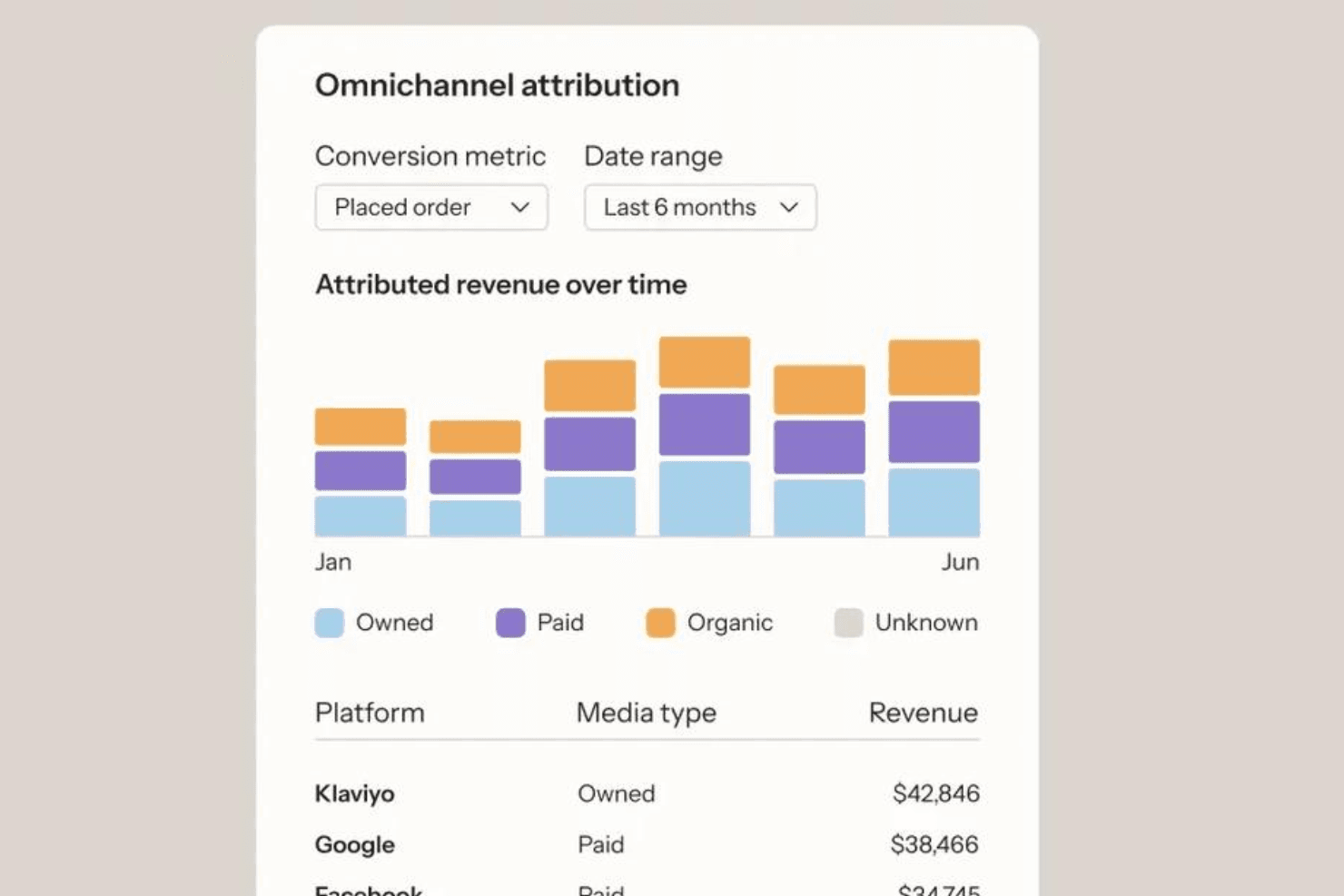
Klaviyo realiza un seguimiento de los ingresos atribuidos en canales propios, pagados y orgánicos. Klaviyo es una plataforma de datos de clientes y una herramienta de análisis de marketing que unifica los datos de canales propios (correo electrónico, SMS, notificaciones push) con el rendimiento de los anuncios pagados en Meta, Google y TikTok, y ofrece modelos personalizables de atribución multitáctil e informes de ingresos multicanal.
¿Para quién es más adecuado Klaviyo?
Klaviyo es una opción excelente para marcas de comercio electrónico y DTC que ejecutan campañas de correo electrónico, SMS y redes sociales de pago, y necesitan un control detallado sobre cómo se atribuyen los ingresos entre esos canales.
Por qué elegí Klaviyo
Klaviyo ocupa un lugar destacado en mi lista porque ofrece un gran control sobre la configuración de la atribución. Puedes establecer ventanas de análisis retrospectivo personalizadas para cada punto de contacto (apertura de correo electrónico, clic en SMS, notificación push entregada) y cambiar entre modelos lineales multitáctiles de último contacto y omnicanal, aplicando los cambios retroactivamente a todos los datos históricos. También me gusta que puedas previsualizar el valor atribuido por Klaviyo antes de adoptar un modelo nuevo, para no probar distintas configuraciones a ciegas.
Características principales de Klaviyo
- Panel de atribución omnicanal: Una vista unificada que consolida la atribución de ingresos en los canales propios de Klaviyo y las plataformas de anuncios pagados (Meta, Google y TikTok) sin contabilizar dos veces las conversiones.
- Controles de filtrado de ruido: Configuraciones integradas para excluir los clics de bots y las aperturas de Protección de la privacidad de Mail de Apple de los cálculos de atribución, manteniendo precisos los datos de ingresos.
- Sincronización de audiencias: Sincroniza directamente los segmentos propios de Klaviyo con Meta, Google, TikTok, Pinterest y Criteo para campañas de remarketing y segmentación de anuncios similares.
- Modelado predictivo del CLV: Se crea y se vuelve a entrenar automáticamente cada semana utilizando tus propios datos de clientes, con resultados que pueden usarse para segmentar por valor del ciclo de vida previsto.
Integraciones de Klaviyo
Klaviyo ofrece más de 350 integraciones nativas, incluidas Shopify, Square POS, Shopify POS, Lightspeed Retail, Meta, Google Ads, TikTok, Snowflake y BigQuery. Su API de eventos admite datos personalizados de POS y establecimientos físicos, pero no hay documentación sobre conectores nativos para redes de medios minoristas.
Pros and Cons
Pros:
- Ventanas de atribución personalizables para cada punto de contacto
- Admite cambios retroactivos en el modelo de atribución
- El panel omnicanal evita contabilizar dos veces los ingresos
Cons:
- No ofrece modelado de incrementalidad ni de combinación de medios
- Los resultados pueden diferir de los de las plataformas de análisis
Learn more about Klaviyo: El mejor software de marketing gratuito
- Plan gratuito disponible
- Precio bajo solicitud
Visit WebsiteCustomer Rating:4.6/5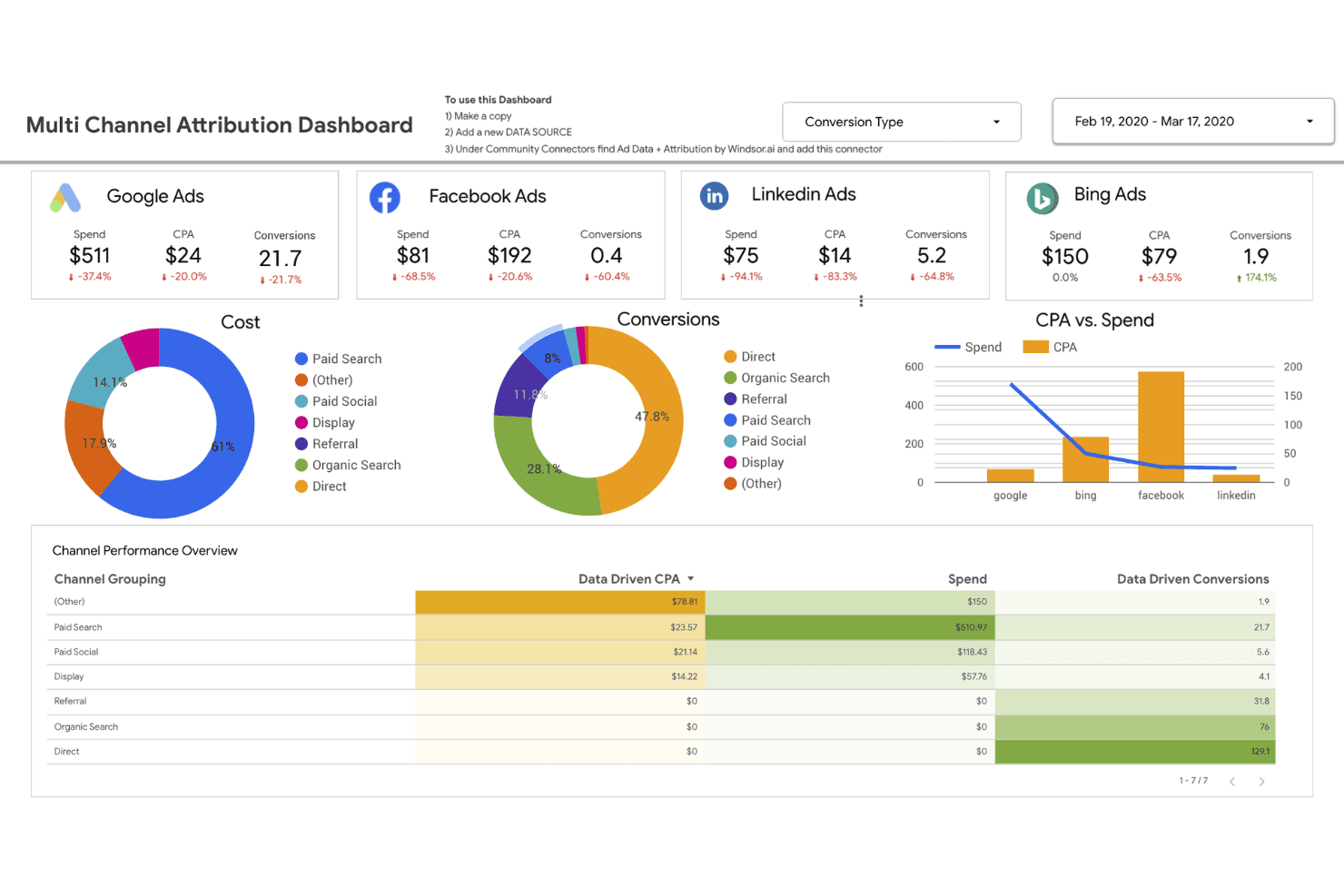
Este panel realiza un seguimiento de la inversión publicitaria, el CPA y las conversiones en distintos canales. Google Analytics es una plataforma de análisis web y atribución que realiza un seguimiento del comportamiento de los usuarios en distintos canales digitales y ofrece modelos de atribución basados en datos, informes de rutas de conversión entre canales y optimización de la combinación de medios.
¿Para quién es más adecuado Google Analytics?
Google Analytics es una opción excelente para responsables del crecimiento del comercio electrónico y equipos de marketing minorista que trabajan principalmente con el conjunto de herramientas publicitarias de Google y necesitan una atribución digital sólida sin presupuesto para software.
Por qué elegí Google Analytics
Google Analytics ocupa un lugar en mi lista de favoritos porque es la única herramienta de atribución que ofrece atribución basada en datos sin coste para la mayoría de las empresas. Me encanta cómo la atribución basada en datos de GA4 utiliza un enfoque de aprendizaje automático contrafactual, comparando las rutas de los usuarios que convierten con las de aquellos que no convierten para asignar crédito fraccionado a los distintos puntos de contacto. El informe de rutas de conversión facilita ver exactamente qué secuencias de canales generan compras, ya sea Display a Búsqueda orgánica a Directo o una interacción de apoyo de las redes sociales de pago que, de otro modo, pasarías por alto.
Funciones clave de Google Analytics
- Informe de rutas de conversión: Visualiza la secuencia completa de canales con los que interactúa un usuario antes de realizar una conversión, para que puedas ver exactamente qué combinaciones de canales generan compras.
- Modo de consentimiento v2 con modelado del comportamiento: Utiliza aprendizaje automático para modelar las conversiones de los usuarios que rechazan el consentimiento de seguimiento, ayudándote a mantener la precisión de las mediciones en el marco de las restricciones del RGPD y la CCPA.
- Exportación nativa a BigQuery: Envía directamente a BigQuery datos sin muestrear y sin procesar a nivel de evento, donde puedes ejecutar consultas SQL personalizadas o crear tus propios modelos de atribución.
- Audiencias predictivas: Los modelos de aprendizaje automático de GA4 identifican a los usuarios con una alta probabilidad de compra o abandono, lo que te permite priorizar la inversión publicitaria en los segmentos de mayor valor.
Integraciones de Google Analytics
Google Analytics cuenta con integraciones nativas con Google Ads, Search Ads 360, Display & Video 360, Google Search Console, BigQuery, Salesforce Marketing Cloud, Shopify y Firebase. El Protocolo de medición y la importación de datos permiten establecer conexiones personalizadas con datos sin conexión y de CRM.
Pros and Cons
Pros:
- Ofrece modelos de atribución basados en datos de forma gratuita
- Se conecta sin problemas con los canales digitales de Google
- Permite crear audiencias predictivas avanzadas basadas en aprendizaje automático
Cons:
- Medición limitada de las redes de medios minoristas
- Los modelos de atribución carecen de transparencia para su auditoría
Learn more about Google Analytics: Ideal para crear reglas de atribución personalizadas
- Prueba gratuita de 14 días
- Desde $139/mes
Visit WebsiteCustomer Rating:4.5/5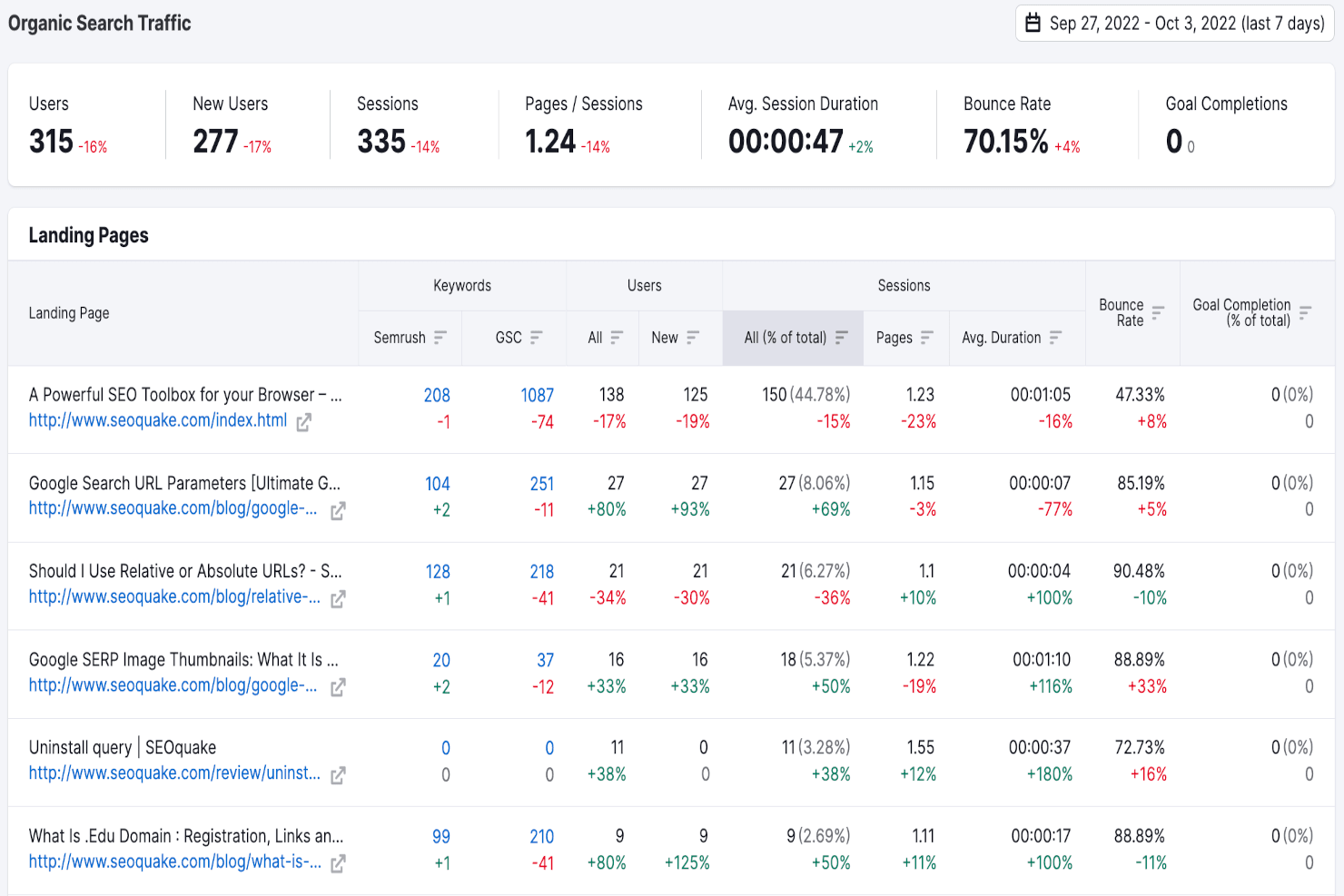
Semrush realiza un seguimiento del tráfico de búsqueda orgánica y de las métricas de rendimiento de las páginas de destino. Semrush es una plataforma de análisis de marketing digital que abarca SEO, medios de pago, inteligencia competitiva e informes multicanal, con herramientas para realizar un seguimiento de las fuentes de tráfico, el rendimiento de las campañas y la visibilidad de marketing en los canales de búsqueda, redes sociales y correo electrónico.
¿Para quién es más adecuado Semrush?
Semrush es adecuado para equipos de marketing digital que necesitan una única plataforma para realizar un seguimiento del rendimiento de SEO, medios de pago, redes sociales y correo electrónico, junto con inteligencia competitiva.
Por qué elegí Semrush
He incluido Semrush entre mis principales opciones porque permite crear reglas de atribución personalizadas que reflejan cómo funcionan realmente en conjunto tus canales, en lugar de obligarte a utilizar un modelo rígido. Me gusta especialmente el creador de informes My Reports, que reúne datos de más de 20 fuentes, incluidos Google Ads, Meta Ads, Klaviyo (con atribución de ingresos) y HubSpot CRM, en un único panel que puedes configurar según tu propia lógica de atribución. El desglose de canales de Traffic Analytics, que abarca el tráfico orgánico, de pago, de redes sociales, de correo electrónico e incluso el tráfico referido por AI, te proporciona los datos detallados que necesitas para definir y perfeccionar esas reglas con confianza.
Funciones principales de Semrush
- Kit de herramientas de visibilidad de AI: Realiza un seguimiento de cómo se menciona y cita tu marca en plataformas de AI como ChatGPT, Gemini y Perplexity, e incluye comparativas con la competencia.
- Desglose de canales de Traffic Analytics: Muestra el volumen de tráfico y las métricas de interacción segmentadas por fuentes orgánicas, de pago, de redes sociales, de correo electrónico, de referencia y referidas por AI.
- Seguimiento de posiciones: Supervisa diariamente las posiciones de las palabras clave en Google, Bing y entornos de búsqueda mediante AI para mostrar cómo cambia la visibilidad con el tiempo.
- Semrush Copilot: Un asistente de AI que analiza datos de seis herramientas principales de la plataforma para detectar problemas, señalar movimientos de la competencia y recomendar los siguientes pasos.
Integraciones de Semrush
Semrush ofrece más de 20 integraciones nativas, incluidas Google Analytics 4, Google Search Console, Google Ads, Meta Ads, Klaviyo, HubSpot CRM y CallRail. Los planes Advanced y Enterprise incluyen acceso a la API para integraciones personalizadas y conectividad con almacenes de datos.
Pros and Cons
Pros:
- Agrega datos de más de 20 canales digitales
- Muestra desgloses del tráfico y los ingresos por canal
- Ofrece herramientas propias de seguimiento de la visibilidad en AI
Cons:
- No dispone de un motor de modelado de atribución multitáctil
- Carece de funciones de atribución para canales offline y tiendas físicas
Learn more about Semrush: La mejor opción para prevenir el fraude en campañas
- Prueba gratuita de 30 días
- Precio bajo solicitud
Visit WebsiteCustomer Rating:4.4/5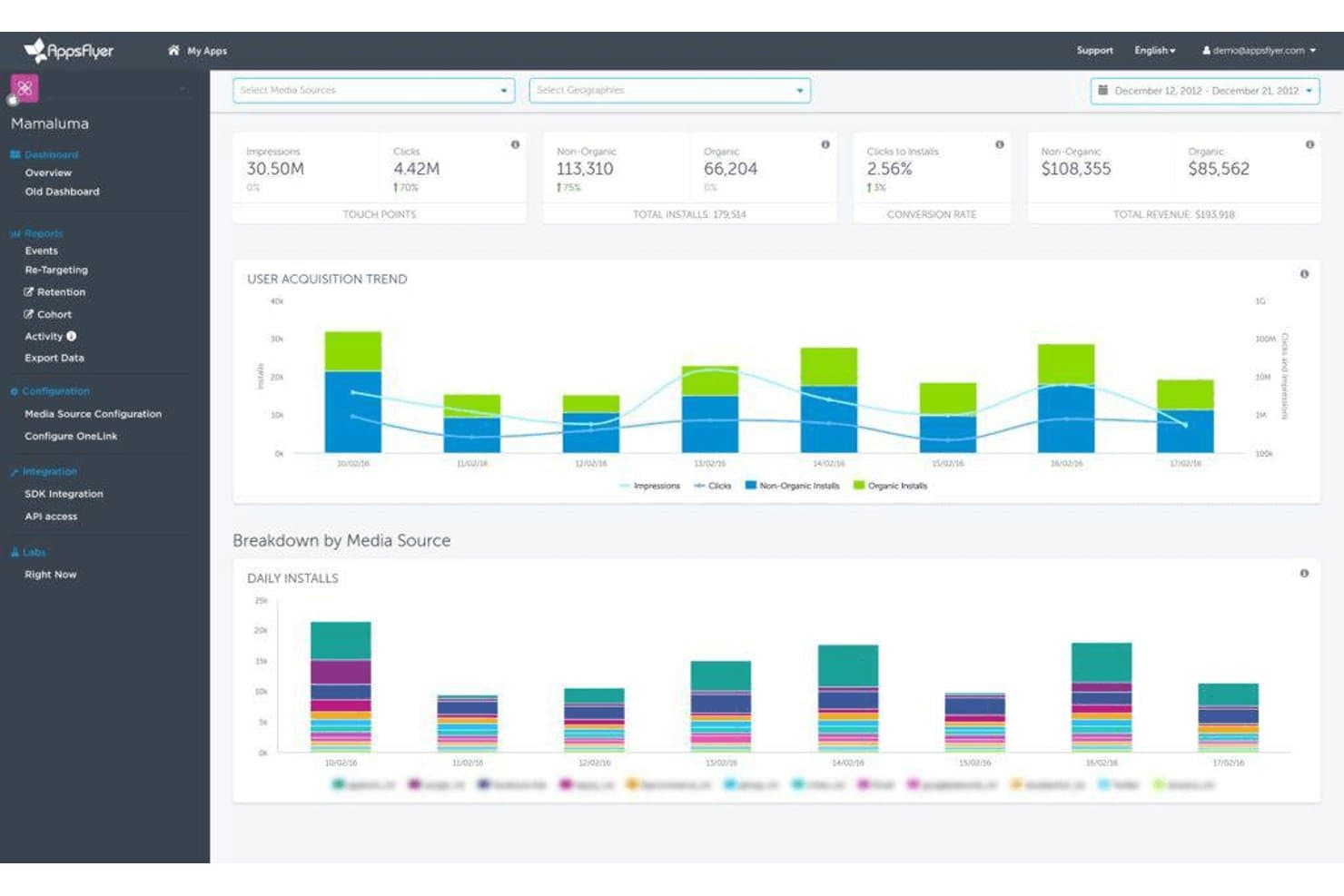
AppsFlyer realiza un seguimiento de las instalaciones, los ingresos y las tendencias de adquisición de usuarios por fuente de medios. AppsFlyer es una plataforma de atribución de marketing centrada en dispositivos móviles que mide el rendimiento de las campañas en canales de pago, propios y obtenidos, incluidas las aplicaciones móviles, los sitios web, la CTV y las redes de medios minoristas, con protección contra el fraude, pruebas de incrementalidad e informes del ROI entre canales integrados.
¿Para quién es más adecuado AppsFlyer?
AppsFlyer es una opción ideal para marcas minoristas y de comercio electrónico centradas en dispositivos móviles que ejecutan campañas de pago para aplicaciones y necesitan proteger su inversión publicitaria frente a instalaciones fraudulentas y tráfico no válido.
Por qué elegí AppsFlyer
AppsFlyer merece estar en mi lista de opciones principales porque Protect360 es la defensa contra el fraude más exhaustiva que he visto integrada en una plataforma de atribución. Detecta instalaciones fraudulentas en tiempo real mediante biometría del comportamiento y bloquea tácticas como la suplantación del SDK y la saturación de clics antes de que inflen tus cifras; después, ejecuta una conciliación posterior a la atribución para señalar cualquier actividad que haya logrado pasar inadvertida. También me gusta que el producto de pruebas de incrementalidad permite validar el incremento real de las campañas con grupos de control en varias redes simultáneamente, por lo que no solo detectas el fraude, sino que también confirmas qué está impulsando realmente las conversiones.
Funciones principales de AppsFlyer
- Modelado de atribución multitáctil: Admite un conjunto completo de modelos de atribución, incluidos los basados en el primer contacto, el último contacto, el modelo lineal, la reducción temporal, la posición, el modelo en forma de W y la atribución basada en aprendizaje automático y datos, en dispositivos móviles, sitios web y CTV.
- Informes de costes e ingresos de ROI360: Agrega datos de costes de más de 100 redes publicitarias y los compara en tiempo real con las compras dentro de la aplicación, las suscripciones y los ingresos publicitarios para ofrecer informes unificados del ROAS.
- Sala limpia de datos: Permite la colaboración segura con respecto a la privacidad entre los datos propios de las marcas y las redes de medios minoristas mediante procesamiento federado y privacidad diferencial, con integración nativa con Snowflake y BigQuery.
- Enlaces profundos: Dirige a los usuarios desde cualquier canal —correo electrónico, SMS, códigos QR, redes sociales o sitios web— hasta contenido específico dentro de la aplicación, con compatibilidad con enlaces profundos diferidos para mantener la continuidad del recorrido incluso antes de instalar la aplicación.
Integraciones de AppsFlyer
AppsFlyer ofrece integraciones de Marketplace con Google Ads, Meta, TikTok, Amazon Ads, Walmart Connect, Braze, Snowflake, BigQuery y Amazon S3, además de más de 10.000 integraciones con redes publicitarias. Las API Push y Pull, la API de costes y Data Locker permiten establecer conexiones personalizadas.
Pros and Cons
Pros:
- Prevención del fraude en campañas líder del sector
- Pruebas de incrementalidad específicas incluidas en la plataforma
- Compatibilidad con la atribución de redes de medios minoristas y códigos QR
Cons:
- No incluye una herramienta integrada de modelado de la combinación de medios
- Las funciones de atribución web todavía son relativamente nuevas
Learn more about AppsFlyer: Mejor atribución de marketing de software B2B
- Demostración gratuita disponible
- Precios bajo solicitud
Visit WebsiteCustomer Rating:4.4/5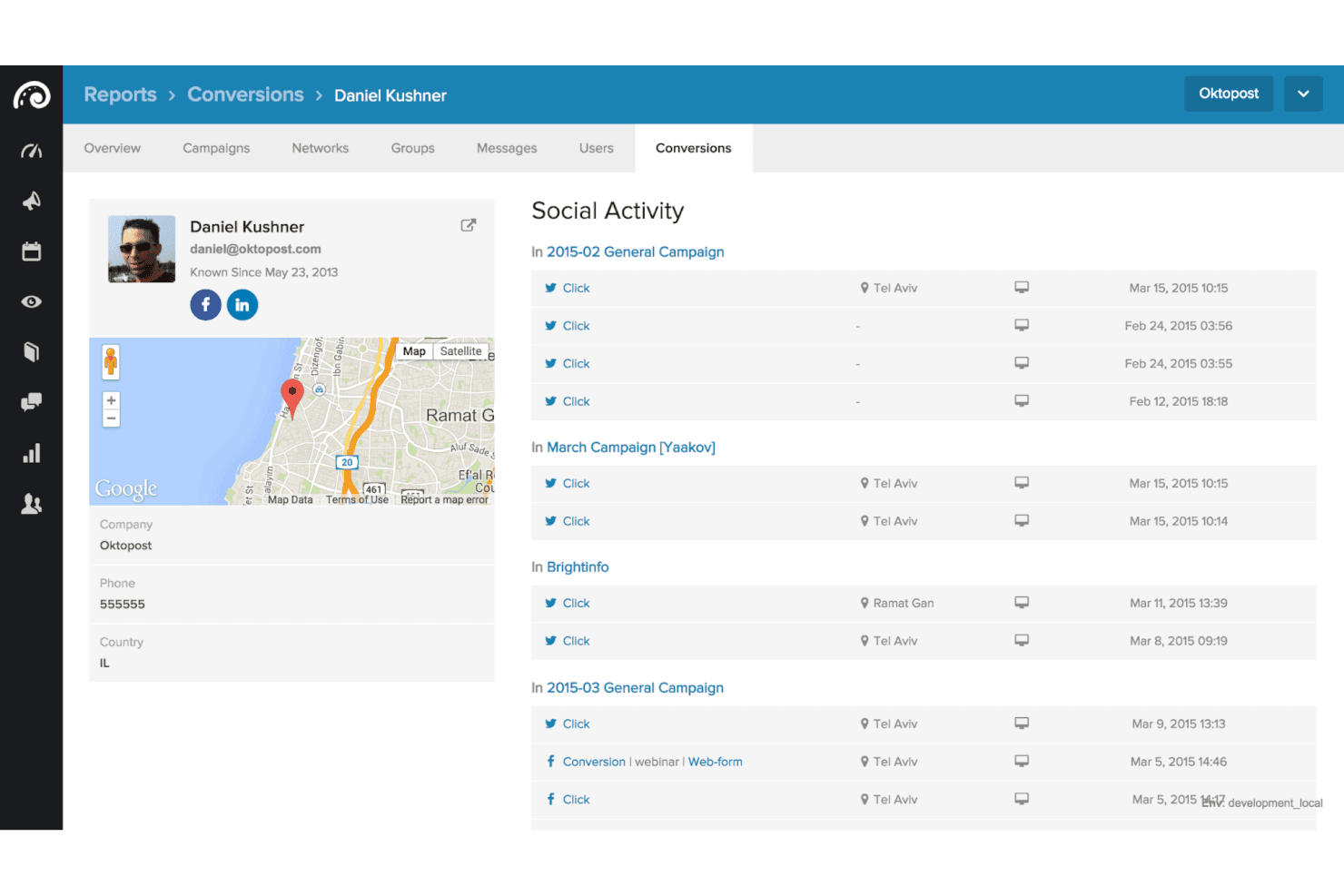
Oktopost realiza un seguimiento de la actividad social individual de los clientes potenciales en todas las campañas. Oktopost es una plataforma de atribución de redes sociales B2B que realiza un seguimiento de los puntos de contacto sociales en LinkedIn, Facebook, X, Instagram y TikTok, conectándolos con los datos del canal de ventas del CRM mediante integraciones con Salesforce, HubSpot, Marketo y Microsoft Dynamics 365.
¿Para quién es más adecuado Oktopost?
Oktopost es una opción muy adecuada para los equipos de marketing B2B y generación de demanda que necesitan conectar la actividad en redes sociales con los datos del canal de ventas del CRM en Salesforce, HubSpot o Marketo.
Por qué elegí Oktopost
Elegí Oktopost como una de las mejores opciones porque hace algo que la mayoría de las plataformas de atribución no hace: conecta directamente la actividad en redes sociales con los datos del canal de ventas del CRM, por lo que está diseñado específicamente para la atribución social B2B. Me gusta que aplique automáticamente etiquetas UTM únicas a cada publicación de la empresa y a cada contenido compartido por los empleados, rastreando los ingresos hasta una publicación o un promotor específico en Salesforce. También asigna los puntos de contacto sociales a los registros de contactos a medida que avanzan las oportunidades, para que puedas ver exactamente qué interacciones sociales influyeron en el cierre de una oportunidad.
Características principales de Oktopost
- Integración de puntuación de clientes potenciales sociales: Envía los datos de interacción social directamente a los modelos de puntuación de clientes potenciales de Marketo y HubSpot para ajustar la calificación de MQL en función de las señales de intención social.
- Atribución de la promoción por parte de los empleados: Asigna etiquetas UTM únicas a las publicaciones compartidas por cada promotor y realiza un seguimiento de qué empleados están generando oportunidades y acuerdos cerrados.
- Seguimiento del tráfico social oscuro: Captura la atribución de las interacciones sociales que generan conversiones a través de rutas indirectas, como enlaces seleccionados de terceros compartidos en redes sociales que convierten posteriormente mediante búsquedas.
- Ventanas retrospectivas de atribución configurables: Permite establecer ventanas retrospectivas de 24 a 90 días según la duración del ciclo de ventas, con requisitos mínimos de avance en la etapa de la oportunidad para evitar una atribución excesiva.
Integraciones de Oktopost
Oktopost ofrece más de 10 integraciones documentadas, entre ellas Salesforce, HubSpot, Marketo, Microsoft Dynamics 365, Oracle Eloqua, Adobe Marketo Measure, Power BI, Looker Studio, Outreach y Zapier. Su API admite integraciones personalizadas.
Pros and Cons
Pros:
- Atribuye la interacción social directamente a los ingresos de acuerdos cerrados
- Realiza un seguimiento del impacto individual de la promoción por parte de los empleados en el canal de ventas
- Inyecta datos sociales en los informes del recorrido del CRM
Cons:
- No ofrece atribución más allá de los puntos de contacto de las redes sociales
- Carece de capacidades de lo digital a lo físico y para el comercio minorista
Learn more about Oktopost: La mejor opción para el seguimiento de conversiones fuera de internet
- No disponible
- Desde $400/mes
Visit WebsiteCustomer Rating:4.6/5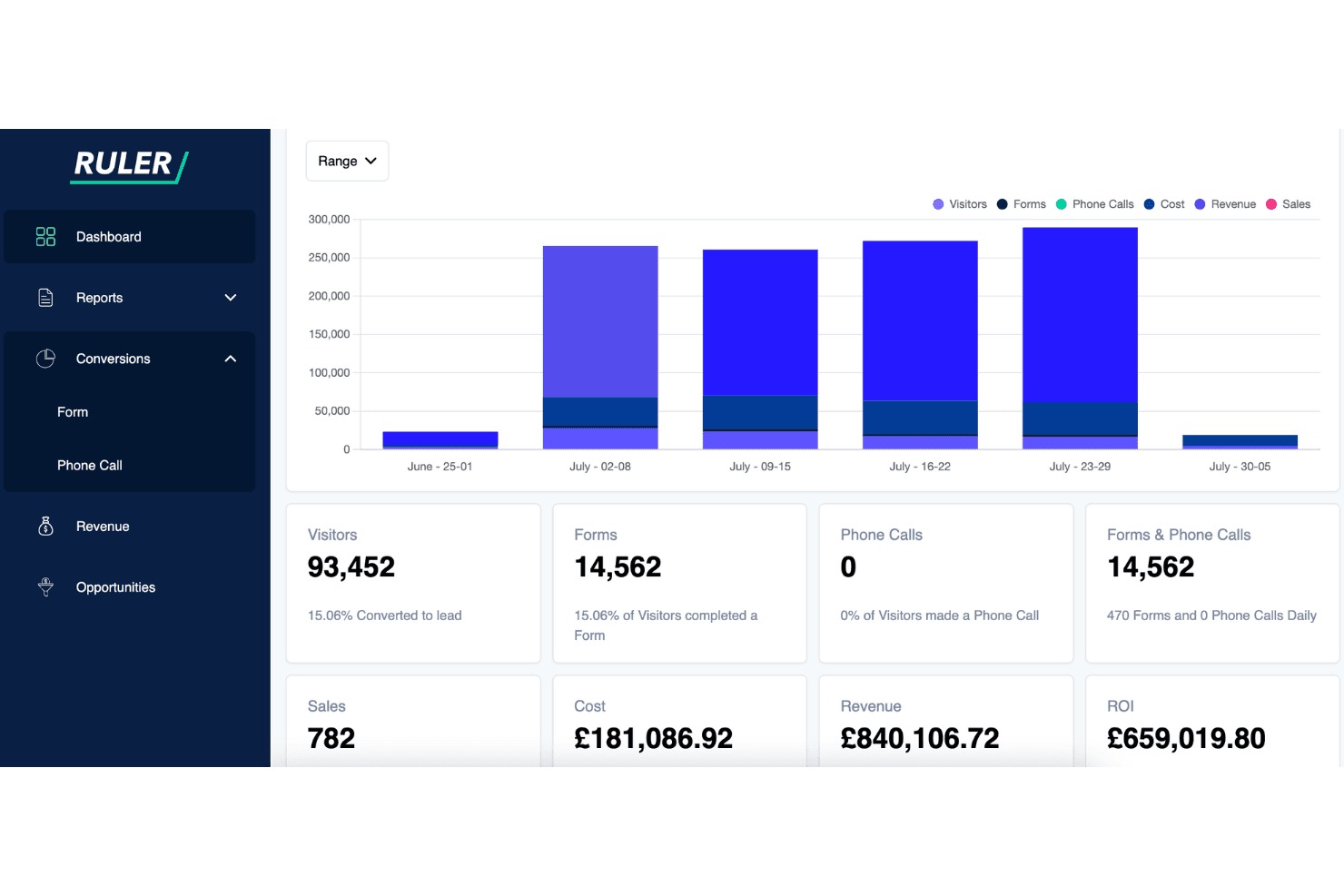
Ruler Analytics realiza un seguimiento de visitantes, formularios, llamadas, ingresos y ROI en un solo panel. Ruler Analytics es una plataforma de atribución de marketing que rastrea llamadas telefónicas, envíos de formularios, chats en vivo y datos de ingresos del CRM a lo largo de todo el recorrido del cliente, combinando la atribución multitáctil, la atribución basada en datos y la modelización de la combinación de marketing en una sola herramienta.
¿Para quién es más adecuado Ruler Analytics?
Ruler Analytics es una opción ideal para equipos de marketing de sectores con un alto volumen de llamadas o centrados en la generación de clientes potenciales, como los servicios financieros, los servicios jurídicos y los servicios para el hogar, donde los ingresos se generan fuera de internet y la prioridad es vincular la inversión publicitaria con los acuerdos cerrados.
Por qué elegí Ruler Analytics
Ruler Analytics ocupa un lugar en mi lista de opciones porque conecta la inversión publicitaria en internet con los ingresos fuera de internet de una forma que la mayoría de las herramientas de atribución sencillamente no consigue. Me gusta especialmente su inserción dinámica de números para el seguimiento de llamadas, que vincula una llamada telefónica concreta con la palabra clave o campaña exacta que la generó. Cuando se cierra un acuerdo en el CRM, Ruler recupera automáticamente esos ingresos y los atribuye a cada punto de contacto anterior, lo que proporciona datos reales de ROAS en lugar de una estimación del coste por cliente potencial.
Características principales de Ruler Analytics
- Modelo de atribución basado en datos: Un modelo respaldado por aprendizaje automático que redistribuye el crédito de las conversiones entre canales según un análisis estadístico, incluido el peso de las impresiones para la actividad de la parte superior del embudo.
- Planificador de escenarios presupuestarios: Modela el impacto en los ingresos de reasignar la inversión entre canales, utilizando curvas de rendimientos decrecientes para identificar dónde generará más rendimiento un presupuesto adicional.
- Agente analista de AI: Supervisa continuamente el rendimiento de las campañas y los canales, y ofrece explicaciones en lenguaje sencillo sobre los cambios, incluidas alertas tempranas sobre un rendimiento inferior al esperado.
- Seguimiento entre dispositivos y dominios: Captura más de 60 variables por visitante, incluidos parámetros UTM, identificadores de clic y datos del dispositivo, en múltiples sesiones, dominios y dispositivos dentro de una única vista del cliente.
Integraciones de Ruler Analytics
Ruler Analytics ofrece más de 1.000 integraciones, incluidas Google Ads, Meta Ads, TikTok Ads, Amazon Ads, Salesforce, HubSpot, Shopify, BigCommerce y Tableau. También admite conexiones personalizadas mediante webhooks, CSV/FTP, SQL y Zapier.
Pros and Cons
Pros:
- Realiza un seguimiento de las conversiones fuera de internet procedentes de llamadas y formularios
- Proporciona atribución de ingresos de ciclo cerrado a los acuerdos del CRM
- Ofrece atribución basada en datos y en impresiones
Cons:
- Requiere un compromiso contractual anual y no ofrece prueba
- No cuenta con conectores nativos para sistemas POS ni medios minoristas
Learn more about Ruler Analytics: Mejor software de atribución omnicanal
- Plan gratuito disponible
- Desde $500/mes
Visit WebsiteCustomer Rating:4.1/5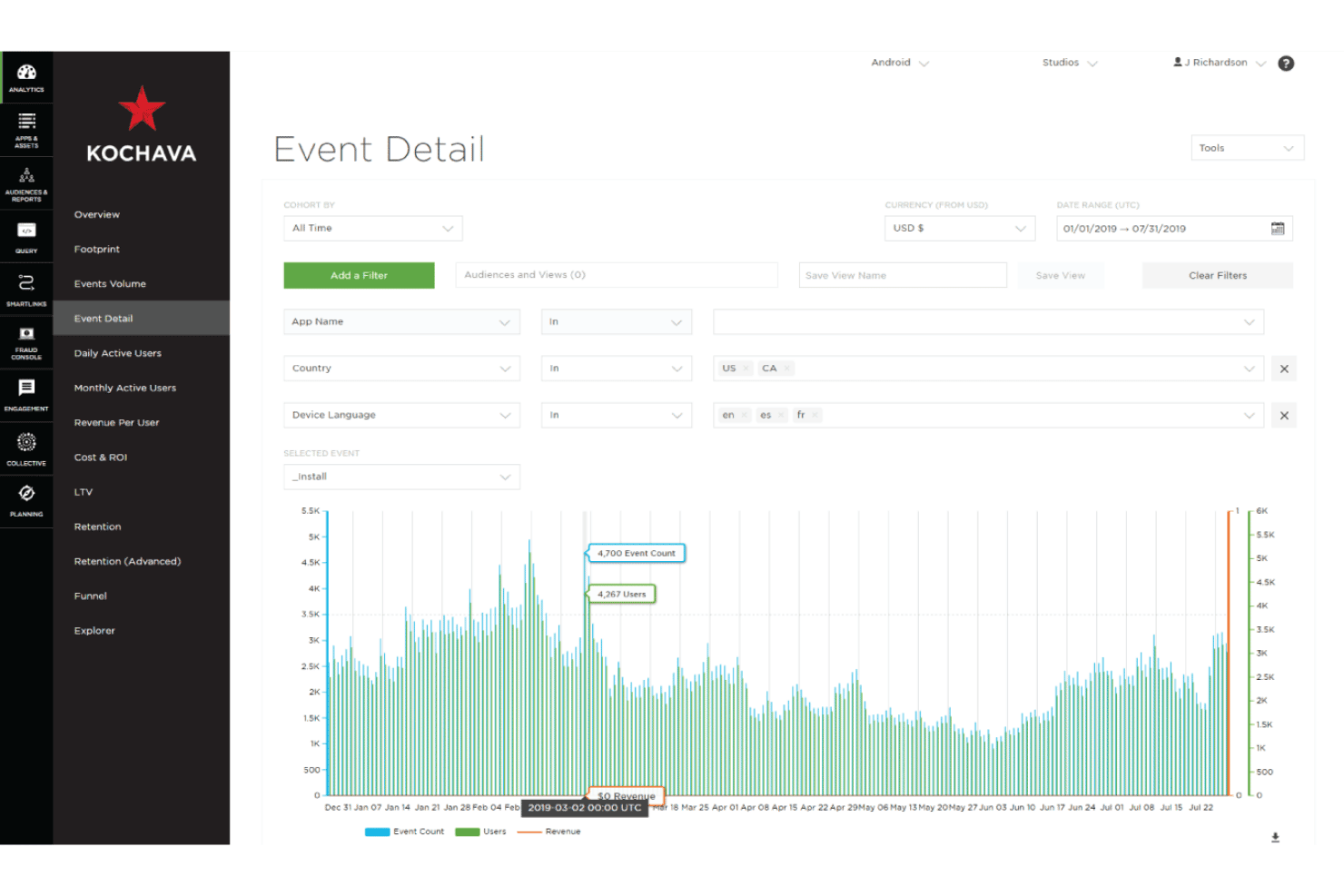
Kochava permite a los usuarios analizar eventos de instalación por país, idioma y rango de fechas. Kochava es una plataforma de atribución de mercadotecnia que unifica la medición móvil, web, CTV, OOH/DOOH y de medios minoristas con atribución multitáctil, resolución de identidad y modelado de la combinación de mercadotecnia.
¿Para quién es mejor Kochava?
Kochava es una excelente opción para equipos de mercadotecnia omnicanal que necesitan unificar la atribución de dispositivos móviles, CTV, OOH/DOOH y medios minoristas en una sola plataforma.
Por qué elegí Kochava
Kochava merece estar entre las mejores opciones de mi lista final porque ninguna otra plataforma iguala su amplitud de atribución omnicanal en un solo panel. Me impresiona especialmente IdentityLink®, que conecta más de 10 mil millones de perfiles de dispositivos con consentimiento para vincular dispositivos móviles, CTV, OOH/DOOH y visitas a tiendas físicas en una única visión continua del cliente. Además, el modelado de la combinación de mercadotecnia de AIM, que funciona de forma continua, se actualiza a diario, así que nunca trabajo con un modelo trimestral obsoleto al reasignar el presupuesto entre canales.
Características principales de Kochava
- Modelado predictivo de abandono: Un algoritmo de AI puntúa la probabilidad de abandono de cada usuario con una precisión del 90 % y, después, envía automáticamente los segmentos de alto riesgo a socios de reactivación.
- Pruebas de incrementalidad de autoservicio: Los profesionales de la mercadotecnia pueden crear, programar y ejecutar pruebas de pulso para redes, campañas o regiones específicas directamente desde el panel de AIM.
- Asociación de medición con Walmart Connect: Kochava mide las campañas de Walmart Connect —que abarcan búsquedas patrocinadas, publicidad gráfica, pantallas en tiendas y CTV— junto con el resto de tu combinación de medios en tiempo real.
- Compatibilidad con SKAdNetwork y AdAttributionKit: Kochava gestiona la atribución conforme a las normas de privacidad de iOS mediante SKAN y AAK, sin depender de identificadores a nivel de usuario.
Integraciones de Kochava
Kochava informa de más de 5.000 socios de medios integrados, incluidos Meta, Google Ads, TikTok, Apple Search Ads, Roku, Spotify y Walmart Connect. Los planes empresariales añaden ETL personalizado, devoluciones de datos y conectividad de servidor a servidor para integraciones con CRM, POS y almacenes de datos.
Pros and Cons
Pros:
- Unifica la atribución en línea, fuera de línea y de CTV
- Modelado predictivo de abandono para la activación de audiencias
- Reasignación del presupuesto en tiempo real con AIM MMM
Cons:
- El seguimiento de transacciones fuera de línea requiere una incorporación manual de datos
- Sin integración nativa lista para usar con POS minoristas
Learn more about Kochava: Ideal para modelos de atribución avanzados
- Demostración gratuita disponible
- Precio bajo consulta
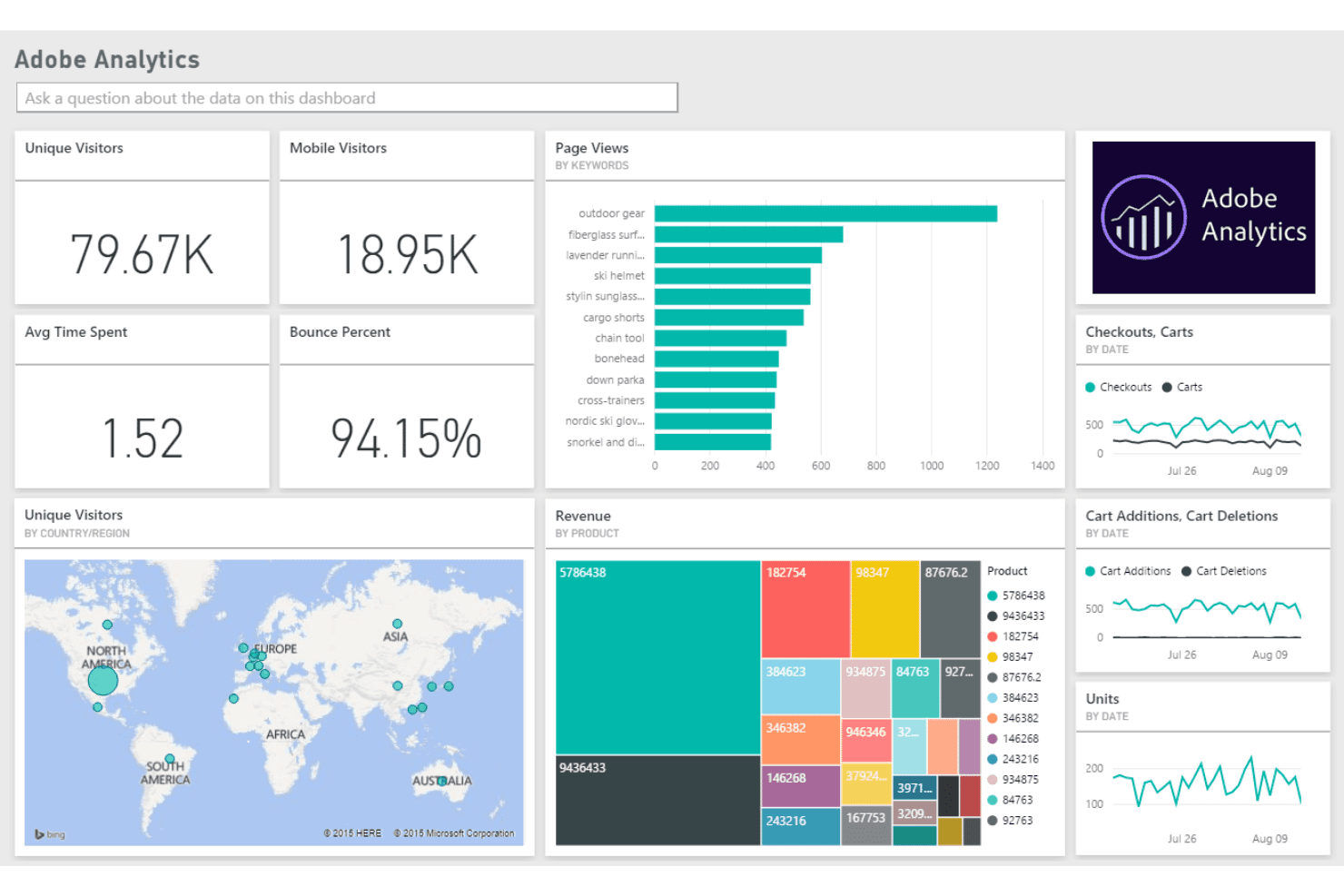
Adobe Analytics centraliza los datos de visitantes, ingresos y palabras clave en un solo panel. Adobe Analytics es una plataforma de analítica empresarial que combina el modelado de atribución multitáctil, la integración de datos entre canales, el mapeo del recorrido del cliente y la optimización de la combinación de medios mediante sus soluciones Attribution IQ, Customer Journey Analytics y Marketing Campaign Analytics.
¿Para quién es más adecuado Adobe Analytics?
Adobe Analytics es adecuado para equipos empresariales de marketing y analítica que necesitan comparar varios modelos de atribución en paralelo y conectar datos fuera de línea con el rendimiento de las campañas digitales.
Por qué elegí Adobe Analytics
Adobe Analytics está en mi lista de finalistas porque su solución Attribution IQ realmente establece el estándar en cuanto a profundidad del modelado de atribución. Puedo comparar los 11 modelos en paralelo y en tiempo real, incluido un modelo algorítmico de valor de Shapley que calcula la contribución incremental real de cada punto de contacto, sin necesidad de volver a implementarlo. Lo que me resulta más atractivo es Marketing Campaign Analytics, que combina MMM y MTA mediante aprendizaje por transferencia basado en inteligencia artificial, de modo que puedo planificar escenarios entre canales y detectar rendimientos decrecientes antes de que afecten a mi presupuesto.
Características principales de Adobe Analytics
- Unificación de identidades entre dispositivos: Vincula múltiples identificadores—correos electrónicos, identificadores de CRM, tarjetas de fidelización e identificadores de dispositivos—en un perfil de cliente unificado mediante el grafo de identidades de Adobe Experience Platform.
- Journey Canvas: Una herramienta de secuenciación de eventos basada en nodos que permite visualizar y analizar las rutas de los clientes y los puntos de abandono en distintos puntos de contacto en línea y fuera de línea.
- Medición de la incrementalidad: Mide el impacto causal de la inversión en marketing en distintos canales y separa el incremento real de las conversiones de las conversiones de referencia.
- Informes de formato libre de Analysis Workspace: Permite crear informes totalmente personalizables con métricas ajustadas por atribución, tablas de cohortes, detección de anomalías y análisis de embudos sin modificar el código.
Integraciones de Adobe Analytics
Adobe Analytics ofrece integraciones documentadas con Adobe Experience Platform, Real-Time CDP, Journey Optimizer, Target, Campaign, Marketo Engage, Snowflake, BigQuery, Azure, Google Ads y Microsoft Advertising. También admite conexiones con el marketplace de Adobe Exchange y la API Analytics 2.0 para integraciones personalizadas.
Pros and Cons
Pros:
- Ofrece 11 modelos de atribución en paralelo
- Realiza un seguimiento conjunto de los recorridos en línea y fuera de línea
- Ofrece herramientas de medición de la incrementalidad basadas en inteligencia artificial
Cons:
- No incluye reproducción de sesiones ni mapas de calor
- Carece de conectores nativos para redes de medios minoristas
Learn more about Adobe Analytics: El mejor software integral de marketing empresarial
- No disponible
- Precio bajo solicitud
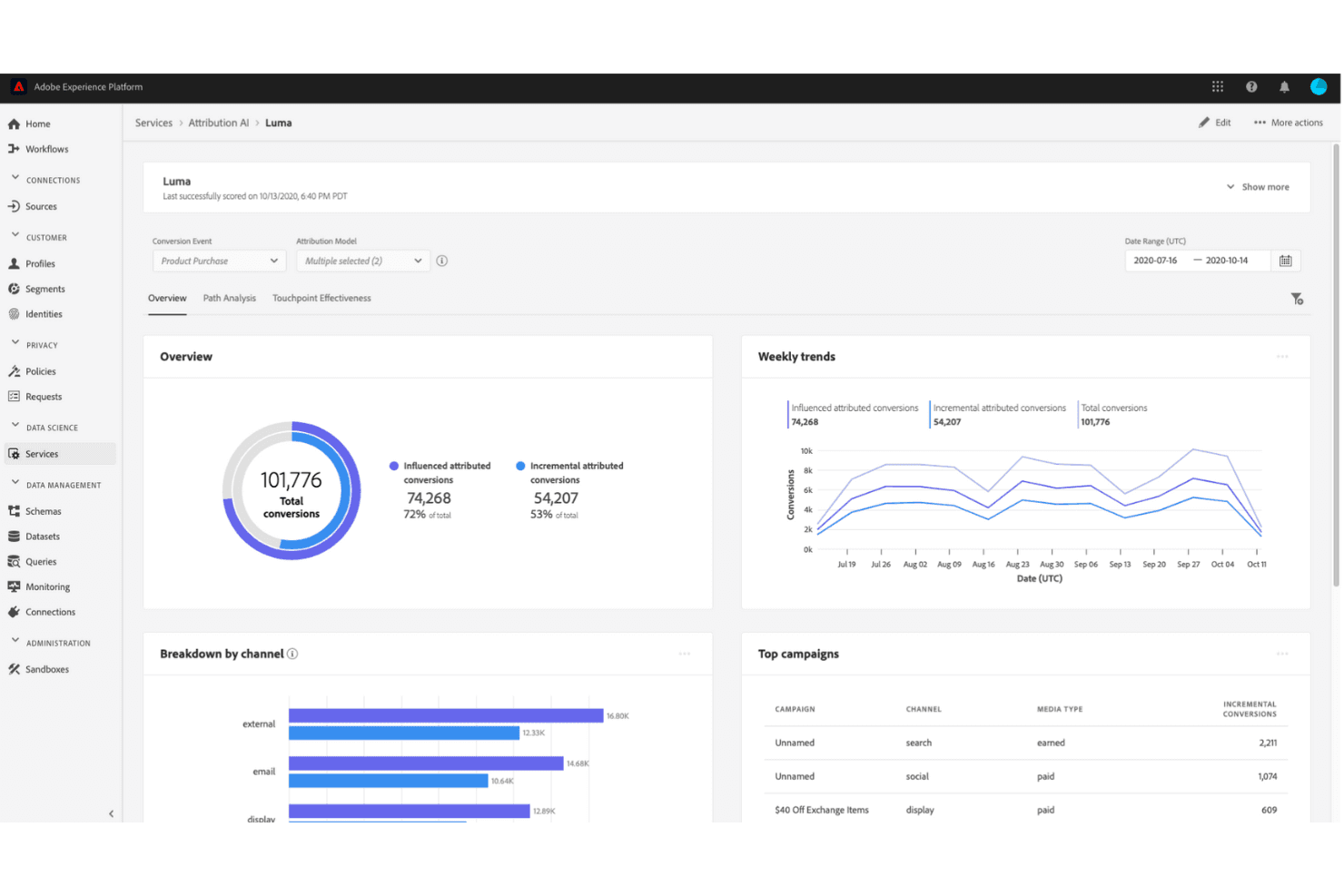
Attribution AI de Adobe Experience Platform realiza un seguimiento del rendimiento de las conversiones en distintos canales. Adobe Experience Manager es una plataforma empresarial de CMS y gestión de activos digitales que, junto con Adobe Analytics, Customer Journey Analytics y Mix Modeler, ofrece modelos de atribución multitáctil, optimización de la combinación de medios e informes del ROI de campañas en distintos canales.
¿Para quién es más adecuado Adobe Experience Manager?
Adobe Experience Manager está diseñado para minoristas de Fortune 500 y equipos de marketing empresariales que necesitan que la gestión de contenidos, la gestión de activos digitales y la atribución funcionen conjuntamente dentro de un mismo ecosistema.
Por qué elegí Adobe Experience Manager
Adobe Experience Manager ocupa un lugar en mi lista de favoritos porque ninguna otra plataforma conecta la entrega de contenidos, los modelos de atribución y la optimización de la combinación de medios dentro de un único ecosistema como lo hace Adobe. Me impresiona especialmente Attribution IQ, que permite ejecutar modelos de primer contacto, de decaimiento temporal y algorítmicos en paralelo en Analysis Workspace, así como Adobe Mix Modeler, que utiliza inferencia bayesiana y valores de Shapley para pronosticar el impacto del presupuesto en distintos canales antes de gastar un solo dólar. Esta combinación es realmente poco común en el ámbito empresarial.
Características principales de Adobe Experience Manager
- Integración de datos entre canales: Adobe Experience Platform incorpora datos de fuentes web, móviles, correo electrónico, puntos de venta, programas de fidelización y CRM en una vista unificada para el análisis de atribución.
- Etiquetado de contenidos basado en IA: Adobe Sensei aplica automáticamente Smart Tags, Smart Crop y enriquecimiento de metadatos a los activos digitales de las campañas.
- Visualización omnicanal del recorrido: Customer Journey Analytics representa los recorridos individuales y agregados de los clientes en los puntos de contacto de la web, la aplicación, el correo electrónico, el centro de llamadas y las tiendas físicas.
- Paneles de campañas en tiempo real: Analysis Workspace ofrece informes personalizables por canal, campaña, contenido creativo, audiencia y nivel de tienda, con detección de anomalías asistida por IA.
Integraciones de Adobe Experience Manager
Adobe Experience Manager cuenta con integraciones nativas en todo Adobe Experience Cloud, incluidas Adobe Analytics, Customer Journey Analytics, Mix Modeler, Experience Platform, Salesforce, Google BigQuery, Azure, Snowflake y Databricks. Admite la activación de audiencias en Google Ads y Meta, además de API para conexiones de datos personalizadas.
Pros and Cons
Pros:
- Modelado nativo de la combinación de medios con planificación de escenarios mediante IA
- Atribución basada en reglas y algorítmica en paralelo
- Datos en línea y sin conexión unificados para la atribución
Cons:
- Las funciones de atribución requieren varias licencias independientes
- Carece de conectores nativos para redes de medios minoristas
Learn more about Adobe Experience Manager: La mejor opción para la atribución y el modelado de la combinación de medios en el ecosistema de Google
- No disponible
- Precio bajo solicitud
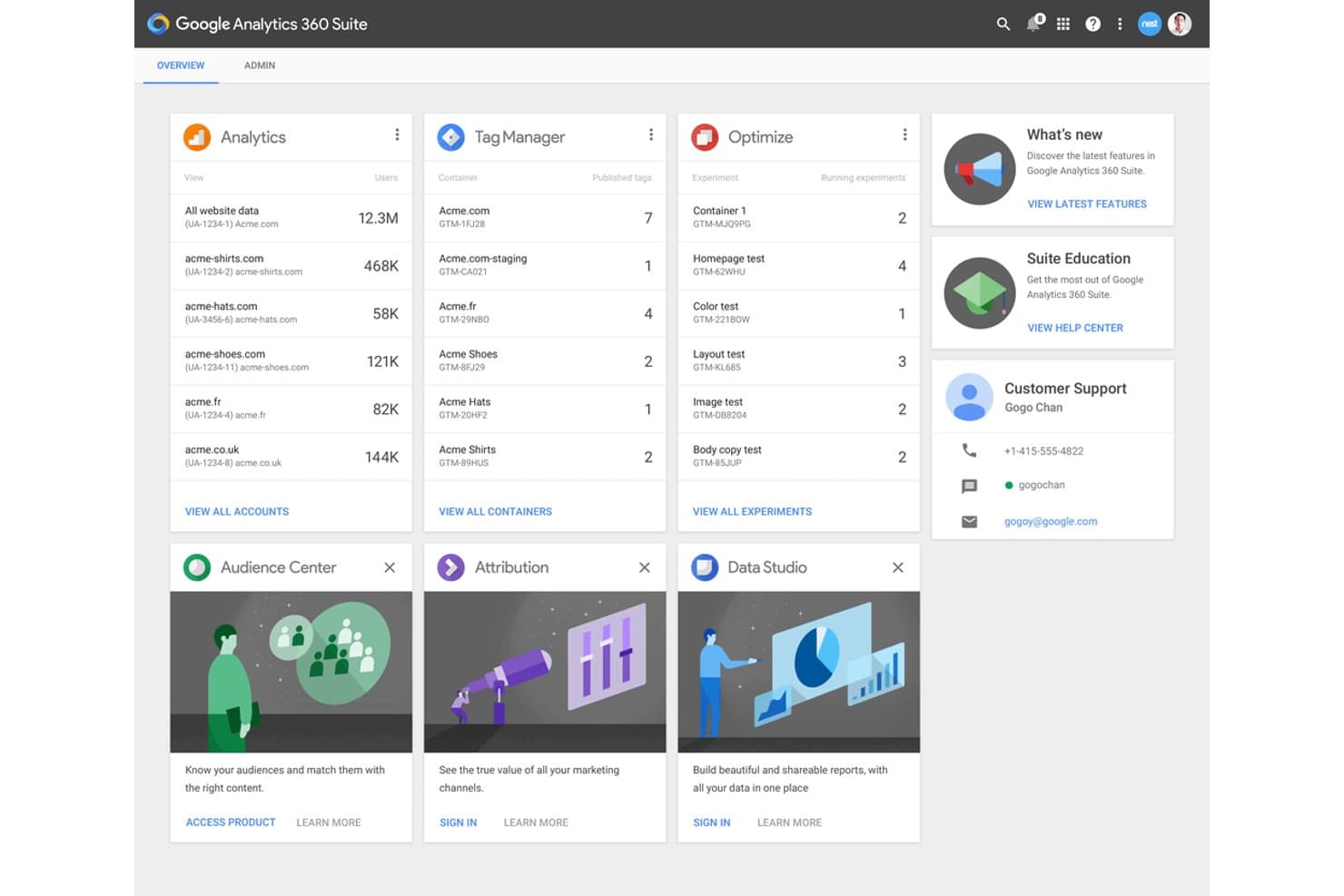
Google Attribution 360 se encuentra dentro de un panel más amplio de un conjunto de herramientas de marketing. Google Analytics 360 es una plataforma empresarial de análisis y atribución que combina la atribución basada en datos, informes multicanal, modelado de la combinación de medios mediante Meridian e integraciones profundas con el ecosistema de Google en Google Ads, DV360, SA360 y BigQuery.
¿Para quién es más adecuado Google Analytics 360?
Google Analytics 360 es una opción muy adecuada para equipos de comercio electrónico que ejecutan programas de medios centrados en Google y necesitan atribución a escala empresarial, informes sin muestreo y modelado de la combinación de medios en una sola plataforma.
Por qué elegí Google Analytics 360
Elegí Google Analytics 360 como una de las mejores opciones porque su modelo de atribución basada en datos hace algo que la mayoría de las herramientas no hace: utiliza un enfoque de aprendizaje automático contrafactual para calcular cómo cada punto de contacto modifica realmente la probabilidad de conversión, en lugar de limitarse a identificar qué clic se produjo al final. Además, la nueva integración de Meridian para el modelado de la combinación de medios incorpora directamente a la plataforma el modelado bayesiano de la combinación de medios, de modo que puedes prever los resultados de la inversión y medir la incrementalidad sin tener que conectar herramientas independientes.
Funciones principales de Google Analytics 360
- Informes de datos sin muestreo: Accede a conjuntos de datos completos y sin muestreo de hasta 50.000 millones de eventos al día para obtener informes totalmente precisos a escala empresarial.
- Propiedades secundarias y acumuladas: Segmenta y consolida datos de distintas marcas, regiones o unidades de negocio dentro de una sola cuenta de Analytics 360.
- Informe de rutas de conversión: Visualiza la secuencia completa de puntos de contacto que conduce a una conversión, con una comparación integrada de los modelos de atribución en el espacio de trabajo de Publicidad.
- Audiencias predictivas: Los modelos de aprendizaje automático identifican usuarios con una alta probabilidad de compra o riesgo de abandono, que puedes activar directamente en campañas de Google Ads.
Integraciones de Google Analytics 360
Google Analytics 360 ofrece más de 10 integraciones nativas, entre ellas Google Ads, DV360, SA360, CM360, BigQuery, Google Search Console, Salesforce Marketing Cloud, Google Ad Manager, Google AdMob, Google Play y Tag Manager. Sus API de administración y de datos, junto con el Protocolo de medición, permiten crear integraciones personalizadas.
Pros and Cons
Pros:
- Gestiona hasta 50.000 millones de eventos diarios
- La atribución basada en datos utiliza aprendizaje automático
- La integración de Meridian permite modelar la combinación de medios
Cons:
- No ofrece atribución nativa para puntos de venta ni tiendas físicas
- Ha dejado obsoletos muchos modelos de atribución basados en reglas
Learn more about Google Attribution 360:
Otros programas de atribución de marketing
Y aquí tienes algunas opciones más por si ninguna de las opciones de software de atribución de marketing de las diez primeras consigue convencerte:
- 11InvocaIdeal para métricas de marketing basadas en llamadas telefónicas
- 12StatcounterMejor software gratuito de atribución de marketing
- 13NeustarLa mejor solución de análisis y atribución televisiva
- 14Nielsen Visual IQMejor software de atribución de marketing para empresas
- 15InsightlyMejor activación e informes de eventos personalizados
- 16SingularMejor software de atribución de marketing minorista
- 17MatomoEl mejor software de atribución de marketing de código abierto
- 18ConversionLogicIdeal para un método de ensamble de árboles
Cómo evalúo el software de atribución de marketing
Evalúo las herramientas de atribución de marketing en dos niveles: los requisitos básicos—como el seguimiento O2O y la integración de datos entre canales—y los diferenciadores que determinan el mejor ajuste para los equipos de retail.
Funcionalidad básica (requisitos imprescindibles para esta lista)
Cuando selecciono herramientas para mi lista, clasifico cada una en una escala de 0 (no ofrece la funcionalidad) a 5 (sobresale en esta área) para cada funcionalidad básica listada a continuación. Luego, calculo el puntaje total de la herramienta como un porcentaje. Cada herramienta necesita alcanzar un puntaje total mínimo del 65% para ser considerada para inclusión.
- Modelado de atribución multi-touch: Verifico si una plataforma soporta modelos basados en reglas como lineal y decaimiento en el tiempo, además de modelos algorítmicos o impulsados por datos para comparar cómo se distribuye el crédito entre los puntos de contacto.
- Integración de datos entre canales: Cada herramienta debe extraer datos de búsqueda paga, redes sociales, display, email y, de manera ideal, fuentes offline como sistemas POS y CRM en una vista unificada.
- Seguimiento online a offline: Los equipos de retail necesitan conectar la exposición a anuncios digitales con compras en tienda física, por lo que evalúo cómo cada herramienta ingiere datos de POS y los conecta con puntos de contacto online.
- Informes de ROI de campañas: Busco paneles de control que desglosen el ROAS a nivel de canal, campaña y creatividad—los profesionales de marketing retail necesitan ver qué promoción de temporada o anuncio específico realmente generó ingresos.
- Mapeo del recorrido del cliente: Una buena herramienta de atribución debe visualizar toda la ruta desde el primer clic hasta la compra, incluyendo el ensamblaje entre dispositivos para compradores que navegan en móvil y compran en escritorio o en tienda.
- Optimización del mix de medios: Más allá de solo informar lo que sucedió, evalúo si una herramienta ofrece recomendaciones de reasignación de presupuesto o planificación de escenarios para ayudar a redirigir la inversión hacia los canales de mejor desempeño.
Una vez que tengo una lista de herramientas que cumplen estos criterios, considero qué distingue a cada plataforma.
Factores diferenciales (lo que distingue a los proveedores)
Así es como comparo y contrasto diferentes proveedores:
Características destacadas
Las pruebas de incrementalidad son un gran diferenciador. Busco herramientas que realicen experimentos geo-lift o pruebas de retención para demostrar que una campaña realmente generó ventas y no solo capturó demanda existente. La integración con redes de medios minoristas también es relevante, especialmente para marcas que publicitan en Amazon Ads, Walmart Connect o Instacart. También evalúo las capacidades de resolución de identidad, ya que los compradores retail suelen navegar en móvil, hacer clic en un email en escritorio y comprar en tienda. Las herramientas que integran esas interacciones te dan una visión mucho más clara de lo que funciona.
Más allá de las características
Las integraciones con el stack tecnológico de retail son una de las primeras cosas que reviso. Una herramienta que se conecta de forma nativa con tu POS, plataforma de ecommerce y CDP ahorra semanas de configuración frente a un trabajo de API personalizado. El cumplimiento en privacidad de datos es igualmente importante—evalúo si una plataforma soporta estrategias de datos propios y cumple normas como GDPR y CCPA, ya que la atribución depende de datos a nivel de cliente. También considero la accesibilidad de los informes, porque los directores de marketing y líderes de merchandising necesitan paneles que puedan entender sin tener que pedir a un analista de datos que extraiga los números.
¿Qué es el software de atribución de marketing?
El software de atribución de marketing es una herramienta basada en datos que asigna el mérito a cada punto de contacto de marketing (anuncios, correos electrónicos, publicaciones en redes sociales y mucho más) para revelar qué canales generan más ventas.
Realiza un seguimiento de métricas en tiempo real, como el periodo de recuperación del CAC y las proporciones LTV:CAC, para que sepas exactamente qué campañas son heroínas de los beneficios y cuáles consumen el presupuesto.
Al combinar la atribución multitáctil, la modelización de la combinación de marketing y las pruebas de incrementalidad, te ofrece un único panel integral en lugar de tres paneles desconectados. Se acabaron las suposiciones a ciegas: solo información clara para optimizar la inversión, ampliar los canales ganadores y alcanzar tus objetivos de ROI.
Cómo elegir un software de atribución de marketing
Elegir un software de atribución de marketing puede resultar abrumador: hay muchas funciones, promesas y términos sofisticados circulando. Pero no tiene por qué ser complicado.
Utiliza la tabla siguiente para identificar rápidamente los criterios esenciales que necesitas al elegir la herramienta de atribución adecuada para tu negocio de comercio electrónico:
| Consideración clave | Qué buscar y por qué importa |
|---|---|
| Consideración claveInformación específica de cada canal | Qué buscar y por qué importaEl software debe mostrar claramente qué canales de marketing ofrecen el CAC más bajo y el ROI más alto, algo fundamental para elaborar presupuestos inteligentes. |
| Consideración claveSeguimiento de métricas en tiempo real | Qué buscar y por qué importaBusca herramientas que ofrezcan seguimiento en tiempo real del periodo de recuperación del CAC y de la relación LTV:CAC, para poder ajustar rápidamente tu estrategia de marketing. |
| Consideración claveIntegración de métodos de atribución | Qué buscar y por qué importaBusca plataformas que integren MTA, MMM y pruebas de incrementalidad para obtener una visión completa del rendimiento de tu marketing. |
| Consideración claveModelos de atribución flexibles | Qué buscar y por qué importaElige un software compatible con varios modelos (primer clic, último clic, lineal y personalizado) para garantizar que se ajuste a tus objetivos. |
| Consideración claveSeguimiento entre dispositivos y múltiples canales | Qué buscar y por qué importaConfirma que ofrezca un seguimiento sólido en todos los dispositivos y canales, para que ninguna interacción del cliente pase desapercibida. |
| Consideración claveInformes personalizables | Qué buscar y por qué importaOpta por herramientas con paneles fáciles de adaptar, para que tu equipo acceda rápidamente a las métricas más importantes. |
| Consideración claveAnálisis predictivo | Qué buscar y por qué importaConsidera un software que utilice información basada en IA para identificar oportunidades de forma proactiva, prever tendencias y orientar la estrategia. |
| Consideración claveIntegraciones sencillas | Qué buscar y por qué importaAsegúrate de que el software se conecte sin problemas con plataformas de comercio electrónico (Shopify, WooCommerce) y con tu CRM para obtener una visión unificada. |
| Consideración clavePruebas de incrementalidad | Qué buscar y por qué importaSelecciona herramientas que ofrezcan pruebas de incrementalidad para medir con precisión el impacto real e incremental de tu inversión en marketing. |
| Consideración claveAsistencia y facilidad de uso | Qué buscar y por qué importaDa prioridad a herramientas fáciles de usar y respaldadas por excelentes recursos de asistencia: ninguna herramienta resulta útil si tu equipo tiene dificultades para utilizarla. |
Con estos criterios en mente, elegirás el software de atribución que ayudará a tu marca de comercio electrónico a prosperar, no solo a sobrevivir.
Tendencias del software de atribución de marketing
El mundo del software de atribución de marketing está evolucionando rápidamente, especialmente en el comercio electrónico. Esto es lo que debes tener en cuenta:
- La atribución basada en IA ha llegado para quedarse. Las herramientas son cada vez más inteligentes y utilizan la IA para analizar en profundidad el comportamiento de los clientes y ofrecerte información que ni siquiera sabías que necesitabas.
- Los modelos centrados en la privacidad son la nueva norma. A medida que se endurecen las leyes de privacidad de datos, el software está adoptando métodos de seguimiento más éticos y basados en el consentimiento, que mantienen a los clientes satisfechos y garantizan el cumplimiento de la normativa.
- La medición entre canales es imprescindible. Los clientes no se limitan a una sola plataforma, y tu atribución tampoco debería hacerlo. Las herramientas se centran en ofrecerte una visión unificada de todos los canales.
- La información en tiempo real no es negociable. ¿Esperar días para que se actualicen los datos? Olvídalo. La atribución en tiempo real te permite ajustar tu estrategia mientras la campaña aún está activa.
- Los dispositivos conectados están añadiendo nuevos puntos de contacto. Los altavoces inteligentes, los dispositivos ponibles y otros dispositivos del IoT se están convirtiendo en elementos clave del recorrido del cliente. Las herramientas de atribución se están poniendo al día para realizar un seguimiento de estas interacciones.
- Los modelos de atribución mejorados están alcanzando un nuevo nivel. Se acabaron los días de depender únicamente del primer clic o del último clic. Los modelos avanzados captan ahora mejor todo el recorrido del cliente.
- La experiencia del cliente está cobrando protagonismo. La atribución ya no consiste solo en analizar métricas, sino en comprender qué quieren los clientes y ofrecérselo en cada punto de contacto.
Funciones del software de atribución de marketing
Un excelente software de atribución de marketing no se limita a procesar números: ofrece información práctica para perfeccionar tu estrategia de comercio electrónico. Esto es lo que incluyen las mejores herramientas:
- Seguimiento multicanal. Realiza un seguimiento y analiza las interacciones en el correo electrónico, las redes sociales, los anuncios de pago y tu sitio de comercio electrónico, mostrando exactamente el rendimiento de cada canal.
- Análisis en tiempo real y seguimiento de métricas. Mide al instante métricas fundamentales como el periodo de recuperación del CAC, el valor del tiempo de vida del cliente (LTV) y las proporciones LTV:CAC para ajustar rápidamente las campañas y los presupuestos.
- Atribución entre dispositivos. Realiza un seguimiento preciso de los clientes cuando pasan de dispositivos de escritorio a móviles y tabletas, garantizando que ninguna interacción clave quede sin registrar.
- Modelos avanzados de atribución multitáctil. Asigna fácilmente el mérito mediante modelos de primer contacto, último contacto, lineales o personalizados, para encontrar la opción adecuada para tu negocio y optimizar el gasto en consecuencia.
- MMM, MTA y pruebas de incrementalidad integradas. Combina la atribución multitáctil (MTA), los modelos de combinación de marketing (MMM) y las pruebas de incrementalidad en una sola plataforma para obtener una visión integral de la eficacia de tu marketing, sin más herramientas desconectadas y aisladas.
- Información basada en modelos de combinación de marketing. Cuantifica el impacto real de tus acciones de marketing tanto sin conexión como digitales, ayudándote a comprender estrategias más amplias que van más allá de los puntos de contacto digitales inmediatos.
- Capacidad para realizar pruebas de incrementalidad. Ve más allá de las métricas estándar aislando actividades de marketing específicas para observar su verdadero impacto incremental en las ventas y garantizar que tu presupuesto no se limite a desplazar los resultados.
- Análisis predictivo e información basada en IA. Aprovecha el aprendizaje automático para descubrir oportunidades ocultas, anticiparte a las tendencias y ajustar proactivamente tus estrategias de marketing antes que tus competidores.
- Paneles de informes personalizables. Crea paneles que destaquen las métricas exactas que más interesan a tu equipo, simplificando la toma de decisiones y la elaboración de informes.
- Potentes capacidades de integración. Conecta fácilmente con plataformas como Shopify, BigCommerce, WooCommerce, Google Ads, Facebook y tu CRM, manteniendo los datos sincronizados sin interrupciones.
Con estas funciones, el software de atribución de marketing te permite tomar decisiones más inteligentes y rápidas, y apostar en serio por el crecimiento de tu negocio de comercio electrónico.
Ventajas del software de atribución de marketing
El software de atribución de marketing no es solo otro panel sofisticado: es tu arma secreta para lograr un crecimiento más inteligente del comercio electrónico. Estas son las razones por las que te encantará:
- Identifica los canales de marketing con mejor rendimiento. Determina rápidamente qué canales (correo electrónico, redes sociales y anuncios de pago) generan los costes de adquisición de clientes (CAC) más bajos y el ROI más alto, para saber exactamente dónde redoblar tus esfuerzos.
- Realiza un seguimiento de métricas en tiempo real, como el periodo de recuperación del CAC y el LTV:CAC. Consulta datos inmediatos sobre la eficiencia de tu inversión en marketing. No esperes: toma decisiones mientras las campañas están activas, no semanas después.
- Obtén una visión integral con modelos de atribución integrados. Al combinar la atribución multitáctil (MTA), los modelos de combinación de marketing (MMM) y las pruebas de incrementalidad, obtienes una imagen completa del rendimiento del marketing, sin lagunas ni suposiciones.
- Optimiza todo el recorrido del cliente. Identifica fácilmente los puntos de contacto clave que influyen en las conversiones, desde el conocimiento inicial hasta el pago final, para mejorar la interacción y reducir el abandono.
- Mide la incrementalidad, no las métricas vanidosas. Las pruebas de incrementalidad aíslan qué campañas impulsan realmente las ventas, para que inviertas en resultados que de verdad importan.
- Mejora la coordinación y la claridad del equipo. Pon fin a los debates y la confusión sobre la eficacia de las campañas proporcionando una única fuente de información fiable para los equipos de marketing y ventas.
- Maximiza el ROI del marketing. Destina los presupuestos con precisión a las campañas de mayor rendimiento y reduce el gasto innecesario, garantizando que cada euro invertido tenga un propósito y un impacto claros.
- Adapta las campañas sobre la marcha. La información en tiempo real te permite cambiar rápidamente las estrategias de marketing y mantenerte por delante de los competidores que dependen de informes lentos y desactualizados.
Coste y precios del software de atribución de marketing
El software de atribución de marketing está disponible en diversas modalidades, cada una con su propio precio y conjunto de funciones.
Tanto si eres una empresa emergente con un presupuesto muy limitado como una empresa con necesidades complejas, encontrarás una opción adecuada para ti.
Este es un resumen de los niveles de precios habituales y lo que ofrecen:
| Tipo de plan | Precio medio | Funciones habituales | Ideal para |
|---|---|---|---|
| Tipo de planGratuito | Precio medio$0 al mes | Funciones habitualesModelos de atribución básicos, seguimiento limitado de canales, informes de nivel inicial | Ideal paraEmpresas emergentes y pequeñas empresas que están poniendo a prueba el mercado |
| Tipo de planBásico | Precio medio$50 - $200 al mes | Funciones habitualesSeguimiento multicanal, modelos de atribución estándar, integraciones básicas con plataformas de comercio electrónico, usuarios limitados | Ideal paraPequeñas y medianas empresas que buscan información a un precio asequible |
| Tipo de planProfesional | Precio medio$200 - $1,000 al mes | Funciones habitualesModelos de atribución avanzados, información en tiempo real, análisis predictivo, paneles personalizados, seguimiento entre dispositivos | Ideal paraEmpresas en crecimiento que necesitan información más detallada |
| Tipo de planEmpresarial | Precio medio$1,000+ al mes | Funciones habitualesModelos de atribución personalizados, usuarios ilimitados, integraciones avanzadas, análisis basados en IA, gestión de cuentas especializada | Ideal paraGrandes empresas con requisitos complejos |
Costes adicionales que debes tener en cuenta
Además de las tarifas de suscripción, presta atención a estos posibles extras:
- Tarifas de incorporación y formación. Algunas plataformas cobran por la configuración y la formación, lo que puede oscilar entre $500 y $5,000 en función de tu plan y de la complejidad de tu empresa.
- Complementos y funciones avanzadas. ¿Necesitas extras como información basada en IA o integraciones adicionales? Suelen conllevar tarifas adicionales, a partir de $10 a $50 al mes por función.
- Precios por usuario. Algunos programas cobran por usuario, por lo que los costes pueden aumentar rápidamente a medida que crece tu equipo.
- Facturación anual frente a mensual. Muchas herramientas ofrecen descuentos para los planes anuales —hasta un 20% de ahorro—, así que considera pagar por adelantado si tu presupuesto lo permite.
- Costes de ampliación. A medida que tu empresa crece, es posible que necesites funciones más avanzadas o planes de niveles superiores. Tenlo en cuenta en tu presupuesto a largo plazo.
Si tienes en cuenta estos factores, podrás elegir un software de atribución de marketing que se ajuste a las necesidades y al presupuesto de tu empresa de comercio electrónico, sin sorpresas desagradables más adelante.
Preguntas frecuentes sobre el software de atribución de marketing
Ha llegado ese momento, señoras y señores: el momento de las preguntas. Vosotros las hacéis y nosotros las respondemos. (Aunque, en realidad, este no es un espacio en directo para preguntas y respuestas, así que he escogido algunas preguntas relevantes y las he respondido por vosotros). Vamos allá.
¿Qué es el modelado de atribución?
El modelado de atribución consiste en determinar qué acciones de marketing merecen el reconocimiento por una venta. Es como repartir el mérito en un trabajo en grupo: quién hizo el trabajo pesado y quién simplemente apareció. Entre los modelos habituales se incluyen:
- Atribución de primer clic: Todo el mérito se atribuye a la primera interacción del cliente con tu marca.
- Atribución de último clic: El último punto de contacto antes de la compra se lleva toda la gloria.
- Atribución lineal: Cada punto de contacto recibe la misma parte del mérito.
- Atribución por decrecimiento temporal: Las interacciones recientes reciben más mérito porque están «más cerca» de la venta.
- Atribución en forma de U: Los primeros y últimos puntos de contacto reciben el mayor mérito, con un poco de reconocimiento también para los intermedios.
- Atribución algorítmica: El aprendizaje automático analiza todos los puntos de contacto y asigna el mérito según su impacto real.
El modelo adecuado depende de tus objetivos y de cómo avanzan tus clientes por su proceso de compra.
¿Cuál es la diferencia entre modelos de atribución como el primer clic, el último clic y los múltiples puntos de contacto?
Los modelos de atribución se diferencian en cómo asignan el mérito a los puntos de contacto durante el recorrido del cliente:
- Primer clic atribuye el mérito a la primera interacción, lo que resulta ideal para comprender las estrategias de la parte superior del embudo.
- Último clic se centra en el último punto de contacto, por lo que es perfecto para evaluar campañas de respuesta directa.
- Múltiples puntos de contacto distribuye el mérito entre varias interacciones y ofrece una visión más completa de lo que influyó en la venta.
Piensa en ello como acercar o alejar el zoom: cada modelo destaca una parte diferente del recorrido, mientras que los múltiples puntos de contacto te permiten ver la imagen completa.
¿Cómo gestiona el software de atribución de marketing los canales sin conexión, como las compras en tienda?
Las herramientas de atribución no sirven solo para lo digital: también pueden incluir datos sin conexión. Muchas se integran con sistemas de punto de venta o utilizan métodos de seguimiento, como tarjetas de fidelización y códigos QR, para vincular las acciones en tienda con las campañas digitales. Esto te ofrece una visión completa del recorrido del cliente, tanto si hace clic en «comprar ahora» en línea como si pasa su tarjeta en tu tienda.
¿Merece la pena pagar más por información basada en IA en un software de atribución de marketing?
Sin duda, especialmente si tu empresa gestiona muchos datos o lleva a cabo campañas complejas en varios canales. La IA no se limita a procesar cifras: encuentra patrones y oportunidades que podrías pasar por alto. Por ejemplo, puede predecir qué canales ofrecerán mejores resultados, ahorrarte tiempo y hacer que tu presupuesto de marketing rinda más. Si el crecimiento y la optimización son prioridades, la IA es una inversión que merece la pena.
Cómo elegir un software de atribución de marketing
Elegir un software de atribución de marketing puede resultar abrumador: hay demasiadas funciones y demasiadas promesas. Pero no temas.
Así puedes separar el ruido y encontrar la herramienta adecuada para tu negocio de comercio electrónico:
-
- Intégralo en tu ecosistema. Asegúrate de que el software se conecta con tu plataforma de comercio electrónico (Shopify, WooCommerce, BigCommerce) y con todas tus herramientas de marketing. Si no se integra, no merece la pena dedicarle tiempo.
-
- Exige modelos flexibles. Elige un software compatible con distintos modelos de atribución: primer clic, último clic, lineal o incluso configuraciones personalizadas. Necesitarás opciones que se adapten a tus campañas y objetivos.
-
- Mantenlo sencillo. Escoge una herramienta que tu equipo pueda utilizar de verdad. Si parece que necesitas un doctorado para generar un informe, sigue buscando. Es mejor dedicar tu tiempo a gestionar campañas que a descifrar manuales de usuario.
-
- Insiste en obtener información en tiempo real. Apuesta por herramientas que proporcionen datos a medida que se producen. En el comercio electrónico, esperar una semana para recibir actualizaciones es como vender jerséis navideños en enero: no sirve de nada.
-
- Personalízalo para ti. Tu negocio es único y tu software también debería serlo. Busca herramientas que te permitan ajustar la configuración y los informes para adaptarlos exactamente a tus necesidades.
-
- Pide ayuda. ¡No hay nada de malo en necesitar asistencia! Busca un proveedor con buenos recursos de formación y un servicio de atención al cliente rápido y eficaz. Un mal soporte puede convertir un software excelente en una pesadilla.