
10 Best Ecommerce Delivery Management Software 2026

The Top 10 Ecommerce Delivery Management Software


Getting packages from warehouse to doorstep should be simple. But any ecommerce manager knows the reality: driver no-shows, missing tracking updates, customer complaints that feel like déjà vu.
Delivery is where your brand promises meet real-world logistics—and where things often fall apart.
That’s why we’re here. Delivery management software is built to take the chaos out of your last mile.
We’ve tested the tools that matter most—ones that help you optimize routes, keep customers in the loop, and stop playing whack-a-mole with failed deliveries.
In this guide, we’ll break down the top ecommerce delivery management platforms on the market. You’ll get expert insights into features, pricing, pros, cons, and what makes each tool shine—so you can pick the one that keeps your deliveries (and your team’s sanity) on track.
Why Trust Our Software Recommendations
Our team has been testing and reviewing software since 2012. As retail leaders ourselves, we know how difficult—and important—it is to choose the right software.
For this guide, we evaluated tools using hands-on testing and independent research, scoring tools using our selection criteria.
Our reviews reflect our independent judgment—not a sales pitch.
Ecommerce Delivery Management Software Comparison Table
Now a handy table to compare our top ecommerce delivery management software selections.
| Tool | Best For | Trial Info | Price | ||
|---|---|---|---|---|---|
| 1 | Best for multichannel inventory sync | Free trial + free plan available | From $19/month | Website | |
| 2 | Best for real-time updates | 14-day free trial | From $29/driver/month | Website | |
| 3 | Best for route planning | 30-day free trial | From $35.10/driver/month (billed annually) | Website | |
| 4 | Best for driver management | Free demo available | From $239/month | Website | |
| 5 | Best for route optimization | Free trial available | Pricing upon request | Website | |
| 6 | Best for small teams | 7-day free trial available | From $40/user/month (billed annually) | Website | |
| 7 | Best for global shipping | Free demo available | Pricing upon request | Website | |
| 8 | Best for delivery tracking | Free trial available | From $619/month | Website | |
| 9 | Best for same-day delivery | Free demo available | Pricing upon request | Website | |
| 10 | Best for carrier integration | Free demo available | Pricing upon request | Website |
The Best Ecommerce Delivery Management Software, Reviewed
We’ve made it to the reviews, where we get into the little details of it all. Check out each ecommerce delivery management solution to learn what it’s all about, why we picked it, features, integrations, and pros/cons.
Veeqo
Best for multichannel inventory sync
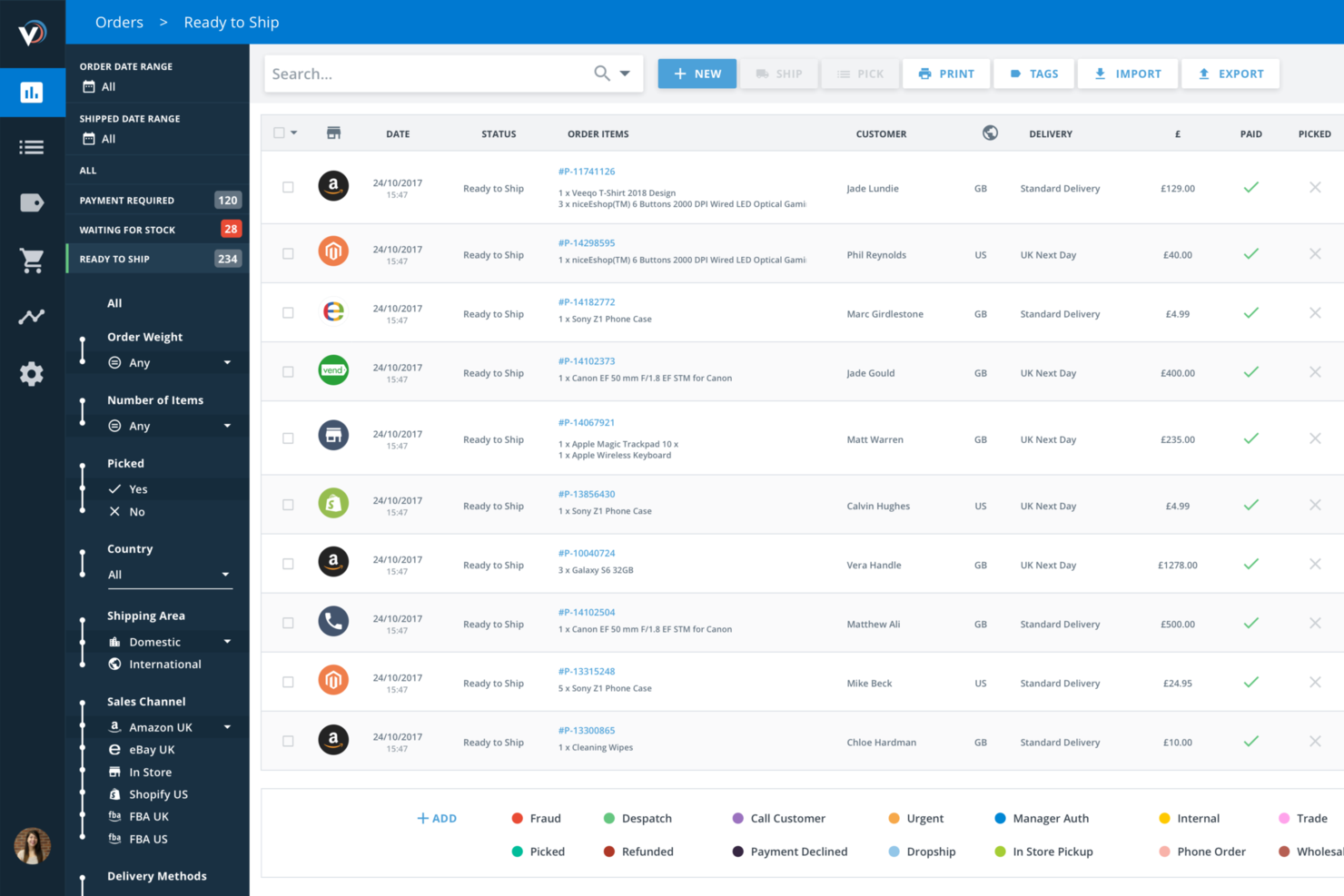
Veeqo is a shipping and fulfillment platform for ecommerce sellers that centralizes order management, carrier rate shopping, label printing, warehouse picking, and inventory tracking across multiple sales channels.
Who Is Veeqo Best For?
Veeqo is a strong fit for small to mid-sized ecommerce sellers managing orders across multiple marketplaces like Amazon, Shopify, eBay, and Walmart who need a single place to handle shipping and stock.
Why I Picked Veeqo
I've included Veeqo in my top picks because of how well its real-time inventory sync handles the chaos of selling across multiple channels at once. When a sale comes in on Amazon, stock levels update instantly across Shopify, eBay, Walmart, and anywhere else you're selling, so overselling isn't something you're constantly firefighting. I also like the stock automation layer on top of that: you can set reorder points so Veeqo restocks items automatically when levels dip below a threshold you define.
Veeqo Key Features
- Carrier rate shopping: Compare live rates from UPS, USPS, FedEx, DHL, and OnTrac side by side before buying a label.
- Bulk label printing: Purchase and print up to 100 shipping labels in one click directly from the order dashboard.
- Digital picking: Optimize warehouse pick lists with routing that reduces the physical distance pickers travel per order.
- Returns management: Process returns with condition logging, restocking, and refund workflows in one place.
Pros and Cons
Pros:
- Automated order routing based on custom rules
- Bulk shipping label printing for multiple carriers
- Native Amazon Buy Shipping integration
Cons:
- No built-in customer communication tools
- Occasional syncing delays with some marketplaces
New Product Updates from Veeqo
Veeqo Adds Wix Integration for US and UK Users
Veeqo now integrates with Wix for US and UK users, letting you connect your Wix account and manage orders and inventory from a single place. For more information, visit Veeqo's official site.
 .
.
Detrack
Best for real-time updates
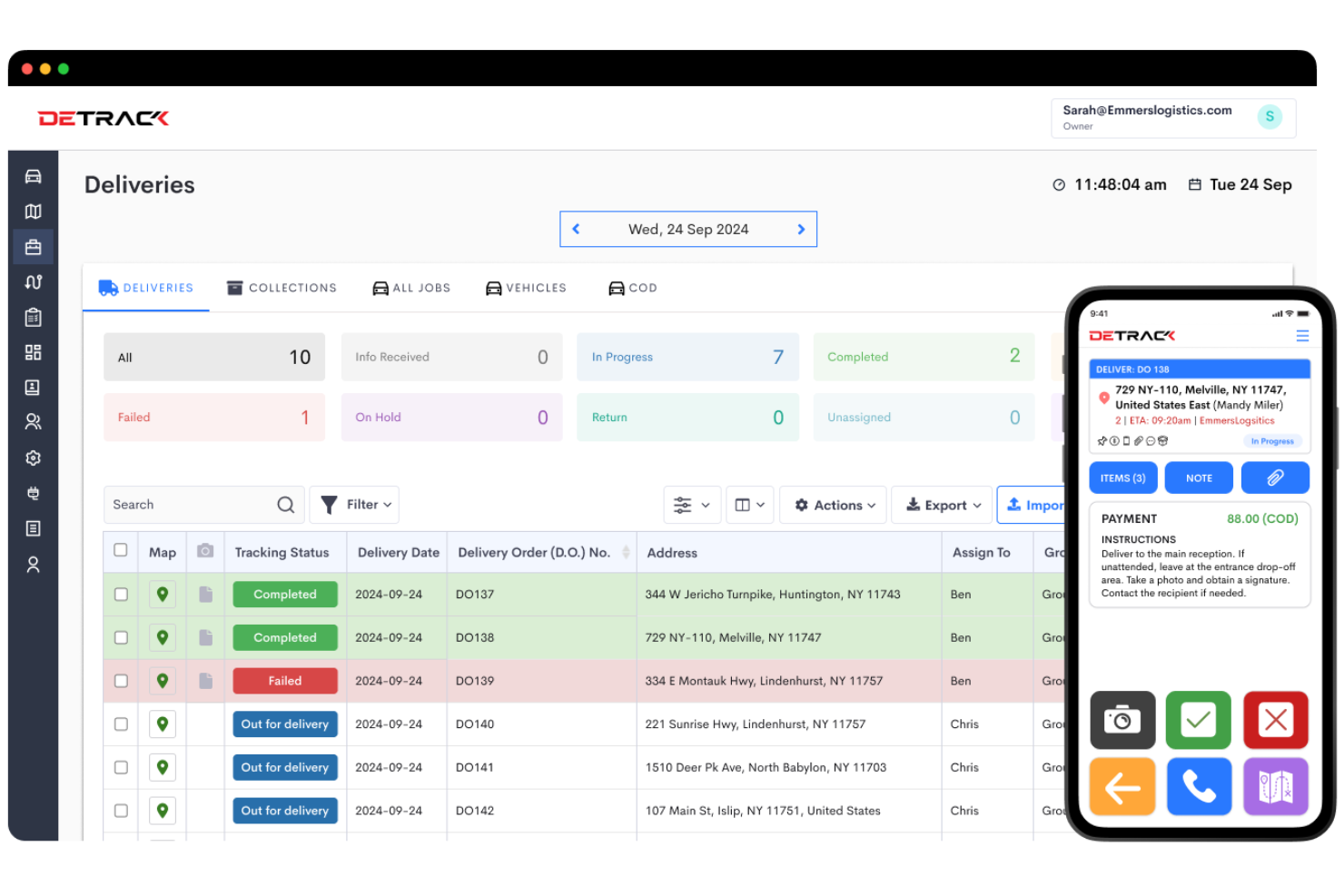
Detrack is a last-mile delivery management platform that combines real-time GPS driver tracking, electronic proof of delivery, route optimization, and automated customer notifications in one system.
Who Is Detrack Best For?
Detrack is a good fit for logistics companies, courier services, and ecommerce retailers that manage their own delivery fleets and need visibility into daily driver operations.
Why I Picked Detrack
I picked Detrack as one of the best because its real-time tracking goes deeper than a simple location pin. The live driver tracking map shows each driver's exact GPS location alongside job-level milestones, so you can see not just where a driver is but which stop they're on and whether they're running behind. I also like the customer-facing tracking widget, which gives recipients an Uber-style live map with a delivery ETA—cutting down on "where's my order?" inquiries without any manual effort from your team.
Detrack Key Features
- Electronic proof of delivery: Capture customer signatures, photos, and timestamps directly through the driver app to confirm successful deliveries.
- Route optimization: Automatically sequence stops based on time windows, location, and vehicle capacity to plan efficient daily routes.
- Automated SMS and email notifications: Send customers delivery status alerts at key milestones without any manual input from your dispatch team.
- Delivery performance reports: Track on-time rates, failed deliveries, and driver activity across your fleet from a centralized dashboard.
Pros and Cons
Pros:
- User-friendly driver app
- Customizable notifications
- Provides electronic proof of delivery
- Offers real-time GPS tracking
Cons:
- Can be overwhelming for new users
- May require initial setup time
- Limited offline capabilities

Best for route planning
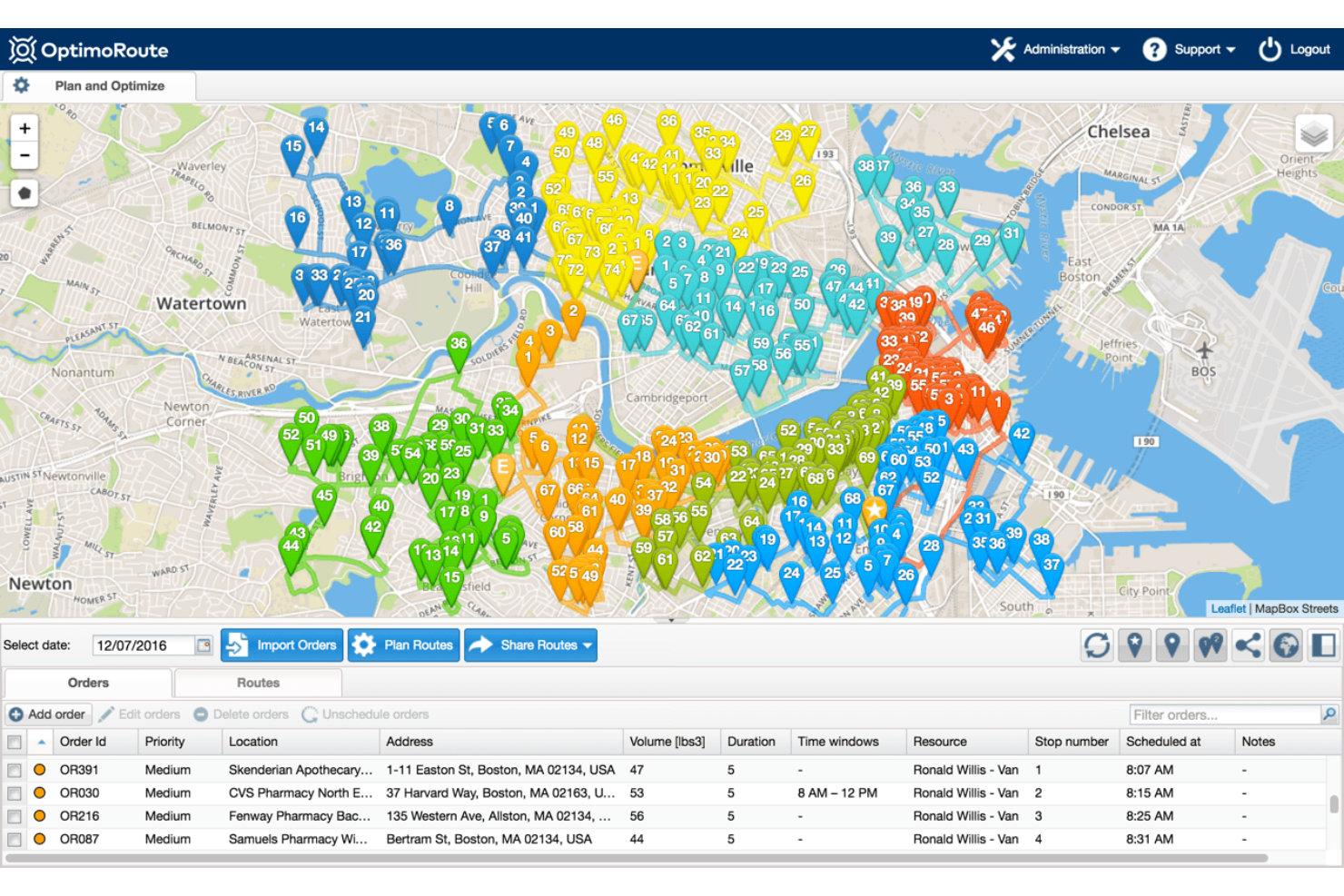
OptimoRoute is a delivery management platform that handles route optimization, driver dispatch, real-time order tracking, customer notifications, and proof of delivery for last-mile operations.
Who Is OptimoRoute Best For?
OptimoRoute is a good fit for small to mid-sized ecommerce and delivery businesses managing multi-driver fleets across local or regional routes.
Why I Picked OptimoRoute
I picked OptimoRoute as one of the best because its route planning engine handles the kind of complexity that trips up simpler tools. When you're running a multi-driver operation with hundreds of stops, it accounts for time windows, vehicle capacity, driver availability, and order priority all at once. I also like the weekly planning feature, which lets you schedule up to five weeks of deliveries in one click. And when things change mid-day, the drag-and-drop route modification tool lets you insert last-minute orders or replan around a sick driver without rebuilding everything from scratch.
OptimoRoute Key Features
- Proof of delivery: Collect digital signatures, photos, and barcode scans directly in the driver app to confirm completed deliveries.
- Real-time order tracking: Share a live tracking link with customers showing their driver's location and estimated arrival time.
- Customer notifications: Send automated SMS and email alerts to update customers on delivery status and ETAs.
- Analytics dashboard: Review delivery performance metrics like on-time rates, failed deliveries, and driver efficiency by route.
Pros and Cons
Pros:
- Offers automated reporting
- Supports delivery priorities
- Dynamic route adjustments
- Handles multiple drivers effortlessly
Cons:
- Requires stable internet connection
- Learning curve for advanced features
- Can be complex for new users

Onro
Best for driver management
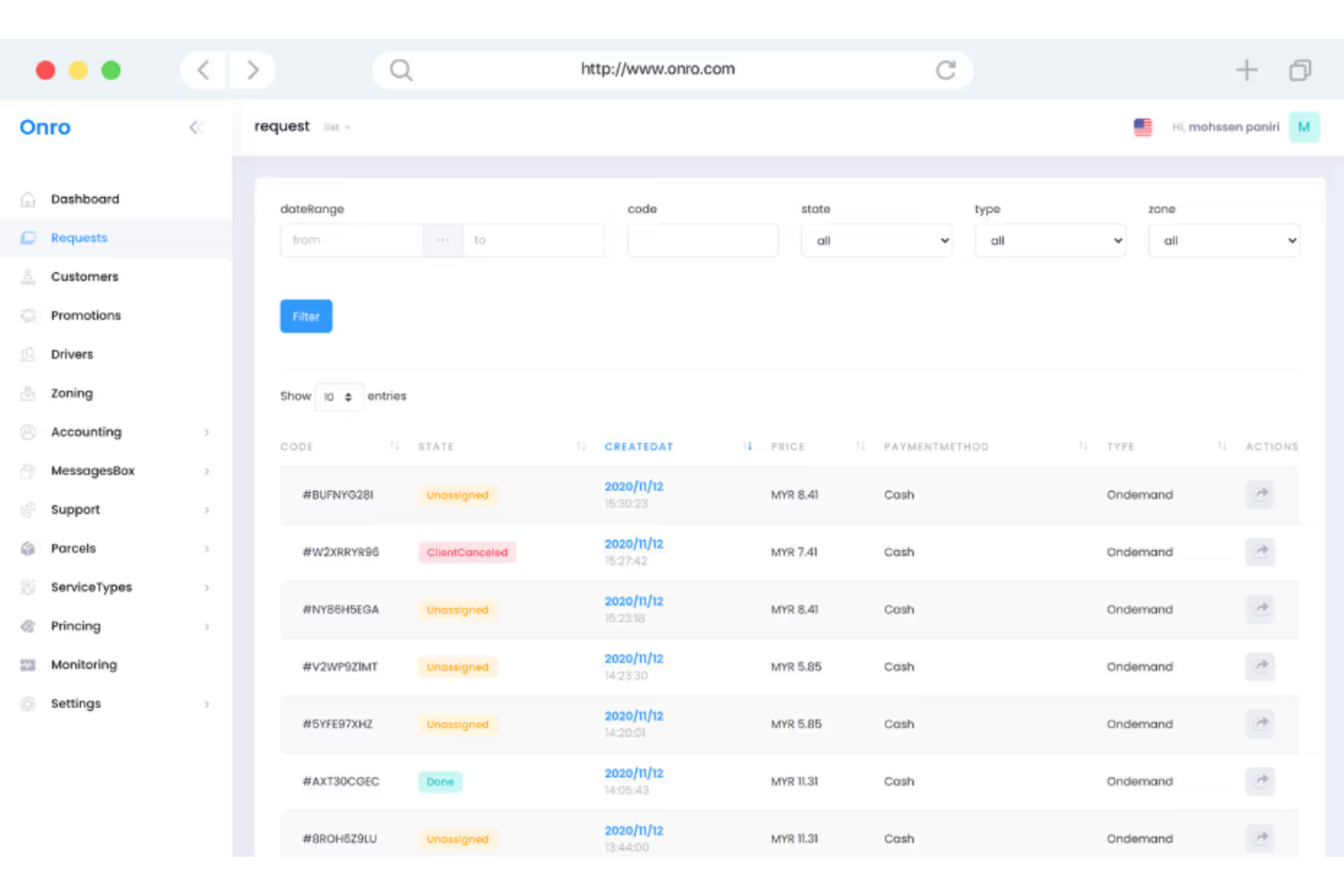
Onro is a delivery management platform that covers order dispatching, route optimization, real-time tracking, driver management, and proof of delivery for courier and ecommerce operations.
Who Is Onro Best For?
Onro is a good fit for courier businesses, last-mile delivery operators, and ecommerce brands that manage their own delivery fleets.
Why I Picked Onro
I've included Onro in my top picks because its driver management features go well beyond basic fleet visibility. In the admin dashboard, you can configure working types for each driver, choosing between commission-based, per-order, or fixed earning models, and controlling exactly what financial data each driver sees in their app. I also like the driver registration tools, which let you collect licenses and documents directly in the platform and track performance statistics per driver. Combined with real-time dispatcher monitoring that shows every active driver on a live map alongside their assigned orders, you get a level of fleet oversight that's genuinely hard to replicate with general-purpose delivery tools.
Onro Key Features
- Route optimization: Automatically calculates the most efficient delivery routes across multiple stops to reduce travel time per order.
- Proof of delivery: Drivers can collect photo, signature, or barcode confirmation at the point of delivery, with each record stored against the order.
- Customer tracking page: Generates a live, shareable tracking link per order so customers can follow their delivery in real time.
- Bulk order import: Upload multiple orders at once via CSV, so you can import large batches of ecommerce orders into the dispatch queue.
Pros and Cons
Pros:
- Offers driver performance analytics
- Customizable dispatch settings
- Real-time driver tracking
- Efficient driver task assignments
Cons:
- Limited offline capabilities
- Learning curve for advanced features
- Requires initial setup time

Best for route optimization

WorkWave Route Manager is a route management and GPS platform built for delivery operations, covering route planning, optimization, driver dispatching, real-time fleet tracking, and customer notifications.
Who Is WorkWave Route Manager Best For?
WorkWave Route Manager is a strong fit for small to mid-sized delivery businesses managing a fleet of drivers with daily multi-stop routes.
Why I Picked WorkWave Route Manager
I picked WorkWave Route Manager as one of the best because its route optimization algorithm is the core of everything the platform does. Dispatchers can plan multi-stop routes in seconds, and the route simulations feature lets you model different scenarios before committing to a schedule. I also like the route performance dashboard, which tracks how planned routes compare to actual driver performance so you can fine-tune future planning.
WorkWave Route Manager Key Features
- Proof of delivery: Drivers can capture photos, signatures, notes, and audio directly in the mobile app to confirm completed deliveries.
- Customer notifications: Send automated SMS and email updates to customers with real-time order status changes as drivers progress through their route.
- GPS tracking: Monitor driver locations live and access Live ETA updates to keep dispatchers informed of progress across the fleet.
- Order import wizard: Pull orders directly into the platform from your CRM or order management system to build routes without manual data entry.
Pros and Cons
Pros:
- Facilitates easy driver communication
- Provides real-time GPS tracking
- Includes route simulation
- Offers predictive ETAs
Cons:
- Limited offline capabilities
- Learning curve for complex features
- May require initial setup time


Upper Route Planner is a last-mile delivery management platform built around route optimization, proof of delivery, live driver tracking, and customer delivery notifications.
Who Is Upper Route Planner Best For?
Upper Route Planner is a strong fit for small ecommerce businesses and independent delivery operations managing a handful of drivers and daily local or regional routes.
Why I Picked Upper Route Planner
I've included Upper Route Planner in my top picks because it's built with small delivery operations in mind, where one person often plans routes, dispatches drivers, and monitors deliveries all at once. I like that you can import a full stop list and get an optimized multi-driver route in seconds, then dispatch everything with one click. The proof of delivery feature, which captures photo, signature, and barcode confirmation, gives small teams the same accountability tools that larger operations rely on, without needing a dedicated ops team to manage it.
Upper Route Planner Key Features
- Live GPS driver tracking: Monitor all active drivers on a real-time map during deliveries.
- Customer delivery notifications: Send automated SMS or email alerts with live tracking links as drivers approach each stop.
- Delivery time windows: Assign specific arrival time preferences per stop to meet customer scheduling requirements.
- Route analytics: Review stop-level delivery data, driver performance, and route completion reports after each run.
Pros and Cons
Pros:
- Suitable for small-scale operations
- Offers insightful reporting tools
- Supports multi-stop route planning
- Simple interface for easy navigation
Cons:
- Can be less flexible for complex needs
- Basic reporting compared to competitors
- Limited features for large teams
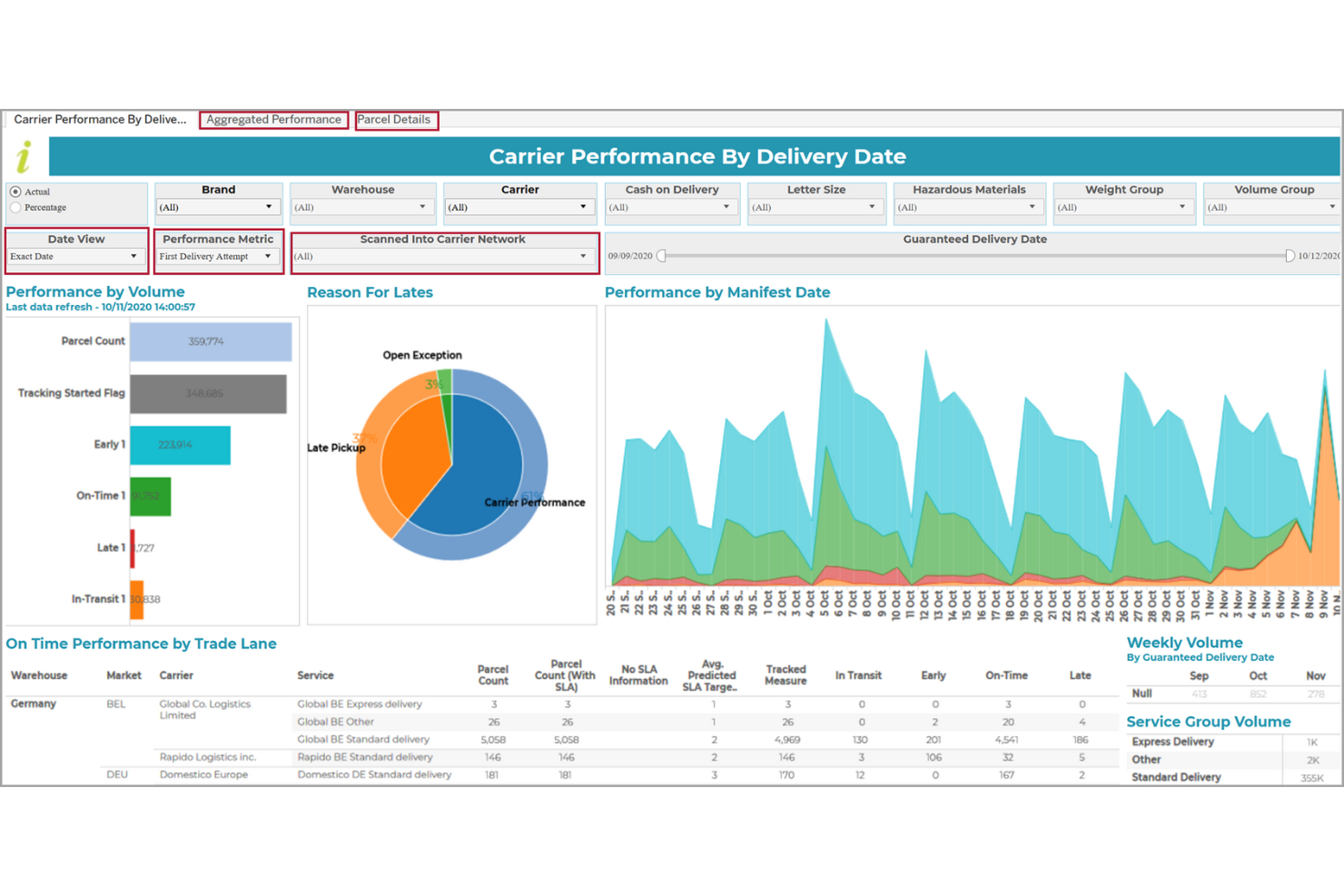
Metapack is a multi-carrier delivery management platform for ecommerce retailers that covers carrier selection, shipment tracking, returns management, and checkout delivery optimization across a global carrier network.
Who Is Metapack Best For?
Metapack is a strong fit for mid-market to enterprise ecommerce retailers that ship across multiple countries and need to manage complex, high-volume carrier operations.
Why I Picked Metapack
I've included Metapack in my top picks because its global carrier network is genuinely unmatched for ecommerce retailers shipping across borders. With 350+ carriers and 4,000+ delivery services, I can configure automated carrier selection rules that factor in destination country, parcel weight, and delivery speed in real time. I also appreciate that cross-border shipments include automated customs documentation, which removes one of the biggest operational headaches when shipping internationally at scale.
Metapack Key Features
- Branded tracking portal: Customers can track shipments in real time through a white-labeled tracking page with automated delivery notifications.
- Self-service returns: Shoppers can generate return labels or QR codes without contacting customer support.
- Checkout delivery promise: Displays validated, carrier-confirmed delivery dates at checkout to set accurate customer expectations.
- Delivery analytics dashboard: Tracks carrier performance, on-time delivery rates, and exception trends across all shipments.
Pros and Cons
Pros:
- Comprehensive analytics tools
- Real-time delivery tracking
- Customizable delivery options
- Supports multiple carrier selection
Cons:
- Can be complex for small businesses
- Requires technical setup
- Pricing not transparent online


Onfleet is a last-mile delivery management platform that combines route optimization, automated dispatch, real-time driver tracking, proof of delivery capture, and customer notifications in one system.
Who Is Onfleet Best For?
Onfleet is a strong fit for mid-market and enterprise retailers managing high-volume, time-sensitive local deliveries with their own driver fleets.
Why I Picked Onfleet
Onfleet earns its spot as one of the best on my shortlist because its delivery tracking goes well beyond a moving dot on a map. I love that it gives customers a live tracking page with predictive ETAs, updated in real time as drivers make stops, so my team fields fewer "where's my order?" calls. The automated SMS notifications trigger at specific delivery milestones, which keeps customers informed without any manual effort on our end.
Onfleet Key Features
- Route optimization: Automatically calculates the most time- and distance-efficient routes across your entire driver fleet before each shift.
- Auto-dispatch: Assigns incoming delivery tasks to the nearest available driver based on location, capacity, and workload in real time.
- Proof of delivery: Drivers capture photos, signatures, barcodes, and timestamps directly in the mobile app to confirm each completed drop.
- Delivery analytics: Tracks driver performance, on-time rates, and task completion data through a built-in reporting dashboard.
Pros and Cons
Pros:
- Offers developer-friendly API
- Provides real-time updates
- Enhances customer satisfaction
- Improves delivery capacity
Cons:
- Can be complex for small teams
- May require technical setup
- Pricing not transparent online

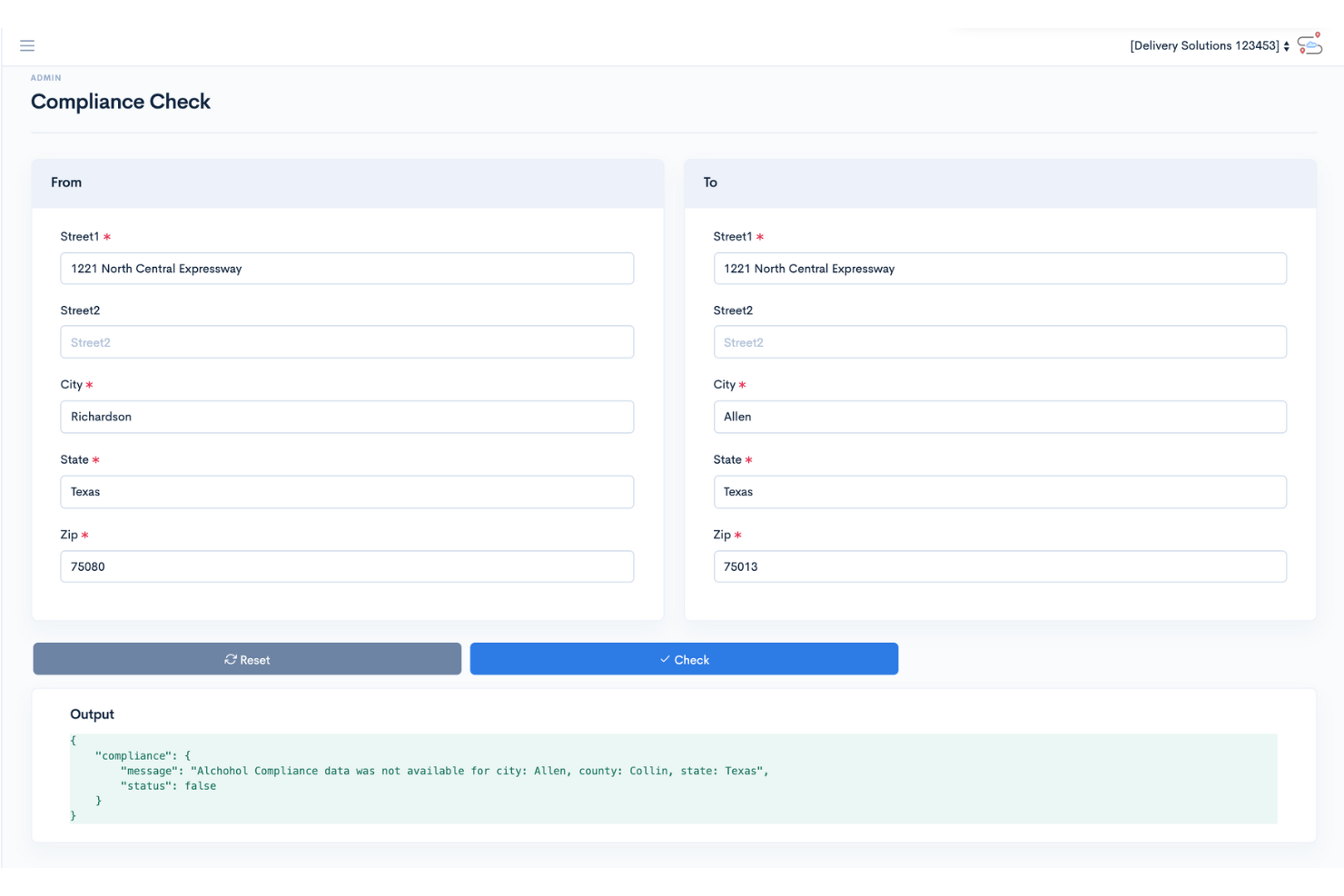
Delivery Solutions is an omnichannel delivery management platform for retailers that covers last-mile orchestration, same-day and scheduled shipping, carrier integrations, and in-house fleet routing and scheduling.
Who Is Delivery Solutions Best For?
Delivery Solutions is a strong fit for mid-market and enterprise retailers managing high-volume, multi-channel fulfillment across both digital and physical storefronts.
Why I Picked Delivery Solutions
I've included Delivery Solutions in my top picks because it's built around same-day delivery orchestration in a way that most platforms simply aren't. What I find compelling is its intelligent provider selection engine, which lets you configure conditions-based rulesets to automatically route orders to the right DSP based on coverage, speed, and cost. I also like that real-time tracking pages are hosted independently of the provider, so your branded experience stays consistent no matter which carrier fulfills the order.
Delivery Solutions Key Features
- Delivery coverage zone builder: Configure custom delivery zones using polygon mapping, zip codes, or blacklisted areas to control where orders are eligible for fulfillment.
- In-house fleet routing: Build optimized delivery routes and schedules for your own drivers directly within the platform.
- Pickup orchestration: Manage BOPIS, curbside, and locker pickup workflows alongside delivery orders from one interface.
- Returns portal: Process reverse logistics and customer return requests without switching to a separate platform.
Pros and Cons
Pros:
- Integrates with multiple delivery partners
- Real-time delivery tracking
- Provides compliance management tools
- Offers flexible delivery options
Cons:
- Limited offline capabilities
- Learning curve for advanced features
- Requires initial setup time
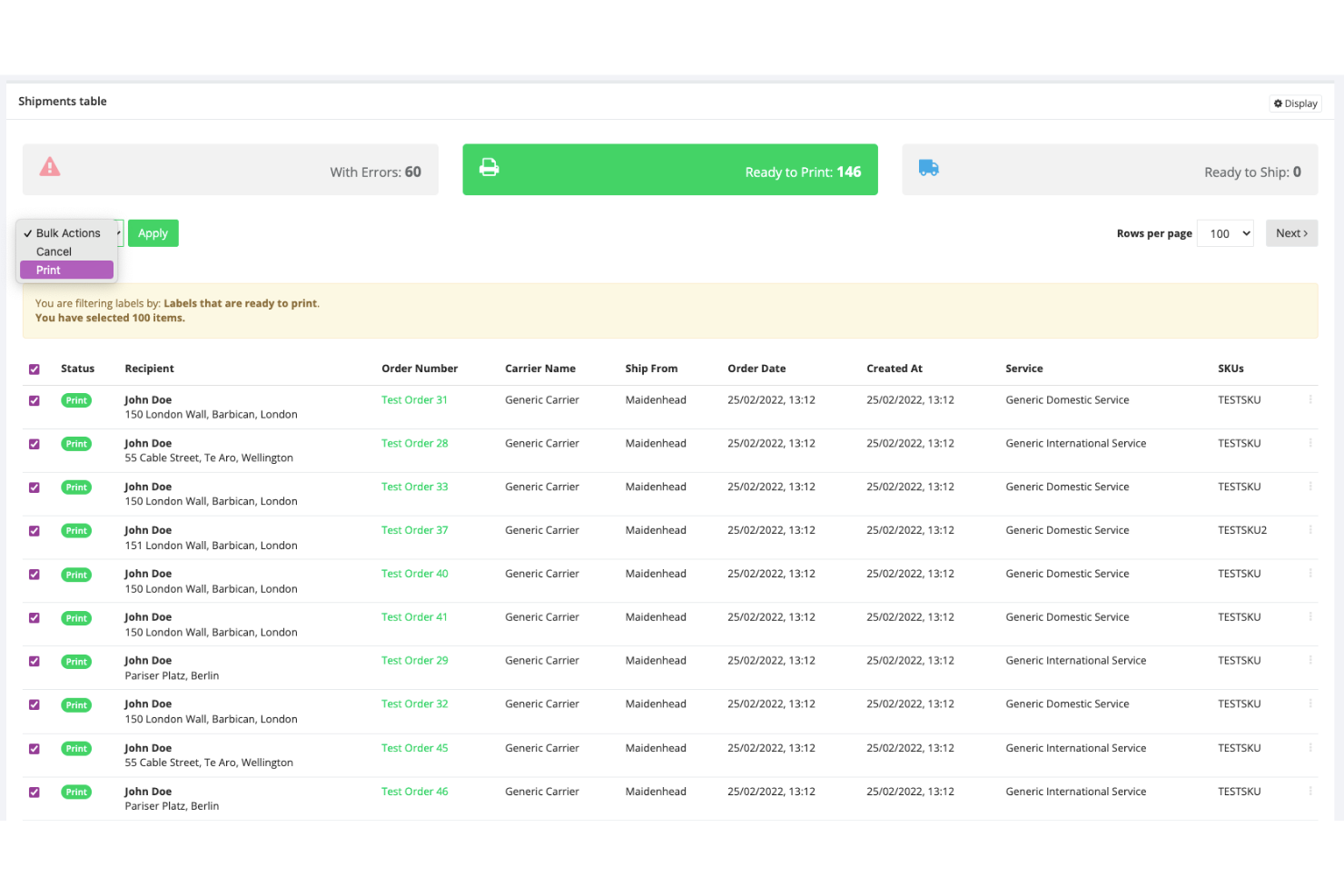
Scurri is a multi-carrier delivery management platform for ecommerce retailers that covers carrier selection, label generation, shipment tracking, post-purchase communications, and AI-powered WISMO resolution.
Who Is Scurri Best For?
Scurri is a strong fit for mid-market to enterprise ecommerce retailers shipping across multiple carriers and regions who need centralized control over carrier allocation and post-purchase experience.
Why I Picked Scurri
Scurri earns its spot on my shortlist because of how it handles carrier integration at scale. Instead of managing a web of direct carrier APIs, I connect to 1,500+ carrier services through a single Scurri API, reducing the overhead of maintaining individual integrations. The rules engine, Scurri Logic, automatically allocates the right carrier based on conditions like cost, destination, or delivery speed. Label generation runs in as little as 150ms with carrier-compatible labels applied automatically, eliminating manual intervention at dispatch.
Scurri Key Features
- Checkout delivery options: Surface carrier-specific delivery choices, including PUDO and locker locations, directly at checkout via API.
- Branded tracking portal: Give customers a white-labeled tracking page with real-time shipment status updates across all carriers.
- Self-serve returns portal: Let customers initiate returns independently through a branded portal, with visibility into return volumes in real time.
- Carrier performance analytics: Track on-time delivery rates, carrier costs, and fulfillment trends through built-in reporting dashboards.
Pros and Cons
Pros:
- Provides shipment tracking
- Flexible shipping solutions
- Customizable shipping labels
- Extensive carrier integration options
Cons:
- Limited offline capabilities
- Learning curve for new users
- Requires initial setup time
Other Ecommerce Delivery Management Software
Here are some additional ecommerce delivery management software options that didn’t make it onto my shortlist, but are still worth checking out:
- FarEye
For predictive visibility
- Carriyo
For returns management
- itshere
For customer notifications
- Track-POD
For paperless delivery
- ShipStation
For order management
- Trakop
For subscription deliveries
- Shippo
For small businesses
- Easyship
For international shipping
- AfterShip
For shipment tracking
- Routific
For route optimization
- ShippyPro
For shipping label creation
- Route4Me
For multi-stop routes
- Shipday
For real-time driver tracking
- Outvio
For post-purchase experience
- LogiNext
For logistics automation
- Circuit For Teams
For driver efficiency
- Dispatch
For field service teams
- Bringg
For delivery orchestration
- nShift
For carrier management
- Elite EXTRA
For last-mile delivery


How I Evaluate Ecommerce Delivery Management Software
I split my evaluation into two layers: the baseline a tool must clear—like carrier connectivity and route optimization—and the differentiators that separate good tools from great ones.
Core Functionality (Table Stakes For This List)
When I'm selecting tools for my list, I rank each one on a scale from 0 (does not offer the functionality) to 5 (excels in this area) for each core functionality listed below. Then, I calculate the tool's total score into a percentage. Each tool needs to achieve a minimum total score of 65% to be considered for inclusion.
- Order & Dispatch Management: I evaluate how each tool ingests orders from sales channels and assigns them to carriers or drivers—whether that's auto-dispatching same-day local orders or batching next-day shipments.
- Multi-Carrier Integration: The number of supported carriers matters, but I also check for rate comparison, label generation, and manifesting so your team can switch carriers mid-season without manual work.
- Route Optimization: I look at whether routing accounts for real-world variables like delivery time windows, vehicle capacity, and traffic—not just point-to-point distance calculations.
- Real-Time Tracking & Notifications: I evaluate whether customers get branded tracking pages and proactive status updates across SMS and email, which directly reduces "where is my order?" support tickets.
- Proof of Delivery & Returns: Each tool should capture digital proof of delivery (photo, signature, geotag) and support reverse logistics workflows for failed deliveries or customer-initiated returns.
- Ecommerce Platform Integrations: I check for native connections with platforms like Shopify, WooCommerce, Magento, and BigCommerce, plus marketplace support so orders flow in without manual imports.
Once I have a list of tools that meet this criteria, I consider what sets each platform apart.
Differentiating Factors (What Sets Vendors Apart)
Here's how I compare and contrast different vendors:
Standout Features
Predictive ETA engines are a big differentiator—I look for tools that use historical delivery data and real-time conditions to give customers accurate arrival windows, not just static estimates. Delivery analytics matter too, especially dashboards that break down cost-per-delivery, on-time rates, and carrier SLA compliance so you can spot underperforming routes or carriers. I also evaluate whether a platform offers a customer self-service portal where shoppers can reschedule deliveries or update instructions, which takes pressure off your support team during peak season.
Beyond Features
Scalability is one of the first things I evaluate—your platform needs to handle holiday surges and flash sale spikes without slowing down dispatch or tracking updates. I also consider time-to-value, specifically how fast you can connect carriers and push your first shipment live. Some platforms offer pre-configured carrier accounts that cut onboarding from weeks to days. Pricing transparency matters just as much. I check whether costs are per-shipment, per-order, or subscription-based, and whether extras like API calls or premium integrations add up in ways that erode your margins.
What is Ecommerce Delivery Management Software?
Ecommerce delivery management software is your logistics command center. It helps you plan, execute, and track deliveries from your warehouse to your customer’s front door—all without the spreadsheet chaos or endless back-and-forth with drivers.
These tools are built for ecommerce teams that want to scale without sacrificing delivery accuracy or customer satisfaction. They handle everything from route optimization and real-time GPS tracking to proof of delivery and automated customer updates.
Whether you're shipping hundreds of orders a day or managing a small local fleet, this software keeps your operations tight, your drivers on track, and your customers in the loop.
How to Choose Ecommerce Delivery Management Software
Picking the right delivery management software isn’t about who has the longest feature list—it’s about finding a platform that fits your business, your team, and your growth goals.
Here's how to cut through the noise and focus on what actually matters:
| Factor | What to consider |
|---|---|
| Scalability | Will this tool keep up when your order volume doubles? Look for flexible pricing tiers, multi-location support, and high-capacity routing capabilities. |
| Integrations | Does it play nice with your existing stack? Prioritize tools that sync with your ecommerce platform, ERP, CRM, and WMS out of the box—or with minimal setup. |
| Customizability | Can you tweak it to fit your workflows? Look for customizable notifications, delivery windows, and branding options that reflect your CX strategy. |
| Ease of use | Is your team going to hate using it? Test the UI. A modern, intuitive interface will save you hours in training (and a few support tickets too). |
| Budget | Can you afford it now and as you grow? Look past the base plan—check for hidden costs like per-driver pricing, API access fees, or setup charges. |
| Security safeguards | How does it protect your data? Confirm it has encryption, GDPR compliance, and solid access controls—especially if you’re handling sensitive delivery info. |
| Customer support | Can you get help when it hits the fan? Look for 24/7 support, fast SLAs, and account managers if you're investing in a premium plan. |
| Real-time tracking | Does it keep you and your customers in the loop? Real-time tracking should be standard—bonus points for live maps, status updates, and tracking links. |
Trends in Ecommerce Delivery Management Software
We’ve tracked dozens of updates, product roadmaps, and industry shifts to surface the trends that actually matter. Here’s what’s shaping the future of ecommerce delivery management:
- AI-driven analytics are leveling up delivery ops. Tools are now using machine learning to predict delays, recommend faster routes, and spot bottlenecks before they impact customers.
- Sustainability features are moving from nice-to-have to must-have. More platforms are baking in eco-routing, emissions tracking, and tools to reduce delivery miles—ideal if you’re building a greener brand.
- Contactless delivery is now table stakes. Customers expect proof of delivery via photo, digital signature, or SMS—and the best software makes this seamless.
- Hyper-local delivery networks are gaining traction. Platforms are partnering with regional couriers to offer faster, zip-code-level same-day delivery at scale.
- Returns management is getting smarter. Tools like Carriyo are leading the charge with self-service return portals, automated label generation, and real-time return tracking—making the post-purchase delivery experience a competitive advantage.
Key Features of Ecommerce Delivery Management Software
Not all delivery tools are created equal. Here are the must-have features we looked for—the ones that move the needle on speed, accuracy, and customer experience:
- Route optimization. Calculates the most efficient delivery paths to save time, fuel, and money.
- Real-time tracking. Lets you and your customers see exactly where each order is, in real time.
- Proof of delivery. Captures digital signatures, photos, or barcodes to confirm successful drop-offs.
- Customer notifications. Send updates via SMS, email, or push so customers aren’t left guessing.
- Returns management. Streamlines reverse logistics with automated return workflows and tracking.
- Scalability. Handles growing order volumes and expanding delivery zones without breaking a sweat.
- Customizable options. Lets you tailor workflows, notifications, and delivery preferences to fit your business.
- Predictive analytics. Uses past performance and real-time inputs to anticipate delays and optimize routes.
- Compliance tools. Helps you stay aligned with local, national, and international delivery regulations.
- Integration capabilities. Connects with your ecommerce, ERP, WMS, and CRM systems to streamline operations.
Benefits of Ecommerce Delivery Management Software
The right software doesn’t just make deliveries faster—it transforms your entire fulfillment experience. Here's what you get:
- Improved efficiency. Smarter routing and automation mean fewer errors, lower costs, and faster deliveries.
- Enhanced customer satisfaction. Transparent tracking and proactive notifications keep customers happy (and reduce support tickets).
- Increased accountability. Proof of delivery ensures you can verify every handoff, reducing disputes and lost packages.
- Scalability. As you grow, the system scales with you—no need to rip and replace.
- Better decision-making. Actionable analytics let you optimize operations based on real delivery data.
- Simplified returns. Self-serve portals and automated workflows make returns a painless experience for customers.
- Regulatory confidence. Built-in compliance tools keep you aligned with shipping laws and industry standards.
Costs & Pricing of Ecommerce Delivery Management Software
Pricing for ecommerce delivery management software can be all over the map.
Some tools charge per driver, others per delivery, and enterprise platforms often keep things “custom.”
Below is a general breakdown of what you can expect by pricing tier—and what you actually get for your money.
| Plan type | Average Price | Common features | Best for |
|---|---|---|---|
| Free Plan | $0 | Basic route planning, limited real-time tracking, manual delivery updates | Startups or solo operators testing the waters |
| Personal Plan | $10–$30/user/month | Route optimization, GPS tracking, proof of delivery, basic customer notifications | Small teams with simple delivery needs |
| Business Plan | $50–$100/user/month | Advanced routing, branded notifications, driver analytics, multi-stop scheduling | Growing ecommerce brands with active fleets |
| Enterprise Plan | $150–$300+/user or flat/month | Full integrations, custom workflows, predictive analytics, dedicated support | High-volume shippers and large operations |
Additional cost considerations
- Per-task or per-delivery fees. Some platforms charge after you exceed a monthly task limit (e.g., $0.08 per additional delivery). Be sure to check usage thresholds.
- Implementation & branding fees. White-labeling, setup assistance, or branded customer portals can trigger one-time or monthly add-ons.
- Hardware/device pricing. Tools that operate on a per-device model (usually for mobile MDM platforms) can add up if your team runs a large fleet.
- APIs & integrations. Some enterprise plans include API access; others charge extra. Confirm whether integrations with your ecommerce stack are included.
Ecommerce Delivery Management Software FAQs
Here are some answers to common questions about ecommerce delivery management software:
What’s the difference between delivery management and shipping software?
Shipping software focuses on printing labels and syncing orders. Delivery management software takes over from there—handling routing, driver tracking, customer notifications, and proof of delivery. If you’re managing your own fleet or coordinating same-day/local delivery, you need both or a platform that does both.
Do I need delivery management software if I use 3PLs or couriers?
It depends. If you’re completely outsourcing fulfillment, your 3PL may already provide delivery visibility. But if you’re managing customer experience in-house or using multiple delivery partners, a delivery management layer gives you control over tracking, notifications, and performance metrics.
How long does it take to fully implement one of these tools?
Lightweight tools can be up and running in a day. Enterprise platforms with integrations, custom workflows, and multiple driver tiers might take a few weeks. Most vendors offer onboarding help to speed this up—take them up on it.
Can I use this software with gig drivers or crowdsourced fleets?
Yes. Many tools support flexible driver types—W2, 1099, gig workers—through driver apps or web portals. Just make sure the platform lets you manage availability, track performance, and communicate easily with non-traditional drivers.
What if my deliveries span multiple countries or regions?
Go with a platform that supports multi-region routing, local compliance (like tax or customs info), and integrations with global carriers. International shipping adds complexity, and not all tools are built for cross-border logistics.
How do I get buy-in from ops or IT before investing?
Focus on the ROI. Fewer missed deliveries, faster routing, and fewer support tickets translate into real cost savings. Bonus: modern tools often come with low-code/no-code setup, which keeps IT lift minimal.