

O software de definição de preços para retalho ajuda a sua equipa a definir, gerir e otimizar os preços dos produtos em vários canais, utilizando automatização, análise de dados e dados em tempo real. Se está à procura do melhor software de definição de preços para retalho, é provável que queira acompanhar as alterações nas condições do mercado, superar os concorrentes e proteger as suas margens — sem acrescentar trabalho manual nem correr o risco de cometer erros de definição de preços. Neste guia, encontrará uma lista selecionada das melhores soluções para 2026, com informações claras sobre aquilo que cada ferramenta faz melhor, para que possa escolher com confiança a opção mais adequada ao seu negócio.
Why Trust Our Software Recommendations
6,700+
Reviews
20
Industry experts
16+
Evaluation factors
14
Years
Our team has been testing and reviewing software since 2012. As retail leaders ourselves, we know how difficult—and important—it is to choose the right software.
For this guide, we evaluated tools using hands-on testing and independent research, scoring tools using our selection criteria.
Our reviews reflect our independent judgment—not a sales pitch.
Tabela comparativa de software de definição de preços para retalho
Esta tabela comparativa resume os detalhes de preços das minhas principais escolhas de software de definição de preços para retalho:
Sorted by: Default
| Tool | Starting Price | Website | |
|---|---|---|---|
Best for advanced price modeling for grocery chains | 4.6 out of 5 | Pricing upon request Free demo available | Website |
Best for real-time omnichannel price adjustments | 4.7 out of 5 | Pricing upon request Not available | Website |
Best for spreadsheet-style pricing with AI | Not rated | €349/month Free plan + free demo | Website |
Best for competitor price tracking for ecommerce | 4.7 out of 5 | $99/month 14-day free trial | Website |
Best for dynamic price automation in omnichannel | 4.4 out of 5 | €399/month Free demo available | Website |
Best for real-time price benchmarking across markets | 4.5 out of 5 | Pricing upon request Free demo available | Website |
Best for in-store and online price intelligence | Not rated | Pricing upon request Free demo available | Website |
Best for configurable pricing analytics for enterprises | Not rated | Pricing upon request Free demo available | Website |
Best for AI-driven price optimization for large retailers | Not rated | Pricing upon request Free demo available | Website |
Best for predictive pricing powered by demand forecasting | Not rated | Pricing upon request Free demo available | Website |


Análises do melhor software de definição de preços para retalho
Apresentamos abaixo os meus resumos detalhados dos melhores softwares de definição de preços para retalho que entraram na minha lista restrita. As minhas análises oferecem uma visão detalhada das funcionalidades, dos preços e das integrações de cada software, para o ajudar a encontrar a melhor opção para si.
 Best for advanced price modeling for grocery chains
- Free demo available
- Pricing upon request
Visit WebsiteCustomer Rating:4.6/5
Yieldigo optimizes retail pricing with demand forecasting analytics. Yieldigo is designed for grocery chains and supermarkets that need advanced price modeling to manage complex assortments. The platform appeals to pricing managers and category teams looking to optimize prices using predictive analytics and demand forecasting. Yieldigo helps you balance margin, volume, and competitiveness in a fast-moving grocery environment.
Why I Picked Yieldigo
Yieldigo stands out for its advanced price modeling capabilities tailored specifically for grocery chains. The platform uses predictive analytics to simulate the impact of price changes across thousands of SKUs, helping you understand how adjustments affect both margin and sales volume. I like that Yieldigo incorporates demand forecasting and elasticity modeling, which are essential for managing the fast-moving and highly competitive grocery sector. This makes it a strong choice for pricing teams that need to balance profitability with customer price perception in a complex retail environment.
Yieldigo Key Features
Some other features that make Yieldigo valuable for grocery pricing teams include:
- Scenario Planning Tools: Model multiple pricing scenarios to compare outcomes before making changes.
- Competitor Price Tracking: Monitor competitor prices to inform your own pricing decisions.
- Automated Price Recommendations: Receive system-generated price suggestions based on your business rules.
- Centralized Price Management Dashboard: Manage and review all pricing activities from a single interface.
Yieldigo Integrations
Integrations include Colruyt, Metro, Makro, SuperPharm, Newpharma, Bonami, Ahold, Erocash, Admenta, Lékárna CZ, Delia, Healthspan, and more.
Pros and Cons
Pros:
- Automated price recommendations based on rules
- Scenario planning for multiple pricing strategies
- Advanced price modeling for grocery assortments
Cons:
- No self-service onboarding documentation available
- Limited retail verticals
Learn more about Yieldigo: Best for real-time omnichannel price adjustments
- Not available
- Pricing upon request
Visit WebsiteCustomer Rating:4.7/5
Quicklizard uses AI to optimize retail pricing with real-time data. Quicklizard is built for retailers and brands that need to adjust prices instantly across online and offline channels. The platform appeals to pricing and ecommerce teams looking to automate real-time price changes based on market data, inventory, and demand. Quicklizard’s omnichannel engine helps you keep pricing consistent and competitive, no matter where your customers shop.
Why I Picked Quicklizard
What sets Quicklizard apart is its ability to deliver real-time price adjustments across both digital and physical retail channels. The platform’s dynamic pricing engine lets you automate pricing decisions based on live market trends, competitor activity, and inventory levels. I appreciate how Quicklizard supports omnichannel consistency, so your customers see aligned prices whether they’re shopping online or in-store. This makes it a strong fit for retailers who need to react quickly to market changes and keep pricing strategies unified across every channel.
Quicklizard Key Features
Some other features that make Quicklizard useful for retail pricing teams include:
- Rule-Based Pricing Engine: Set custom pricing rules to automate decision-making based on your business logic.
- Competitor Price Monitoring: Track competitor prices in real time to inform your own pricing strategies.
- A/B Price Testing: Run experiments with different price points to measure impact on sales and margin.
- Analytics Dashboard: Access visual reports and dashboards to monitor pricing performance and trends.
Quicklizard Integrations
Integrations include SAP, Oracle, Adobe Commerce, Salesforce Commerce Cloud, Shopify, Kafka, Delavo, DataWeave, TGN, and Bright Data.
Pros and Cons
Pros:
- Competitor price monitoring with automated alerts
- Supports A/B testing for pricing strategies
- Real-time price updates across all channels
Cons:
- Integration setup can require vendor assistance
- Fewer retail-specific templates than some competitors
Learn more about Quicklizard: Best for spreadsheet-style pricing with AI
- Free plan + free demo
- From €349/month
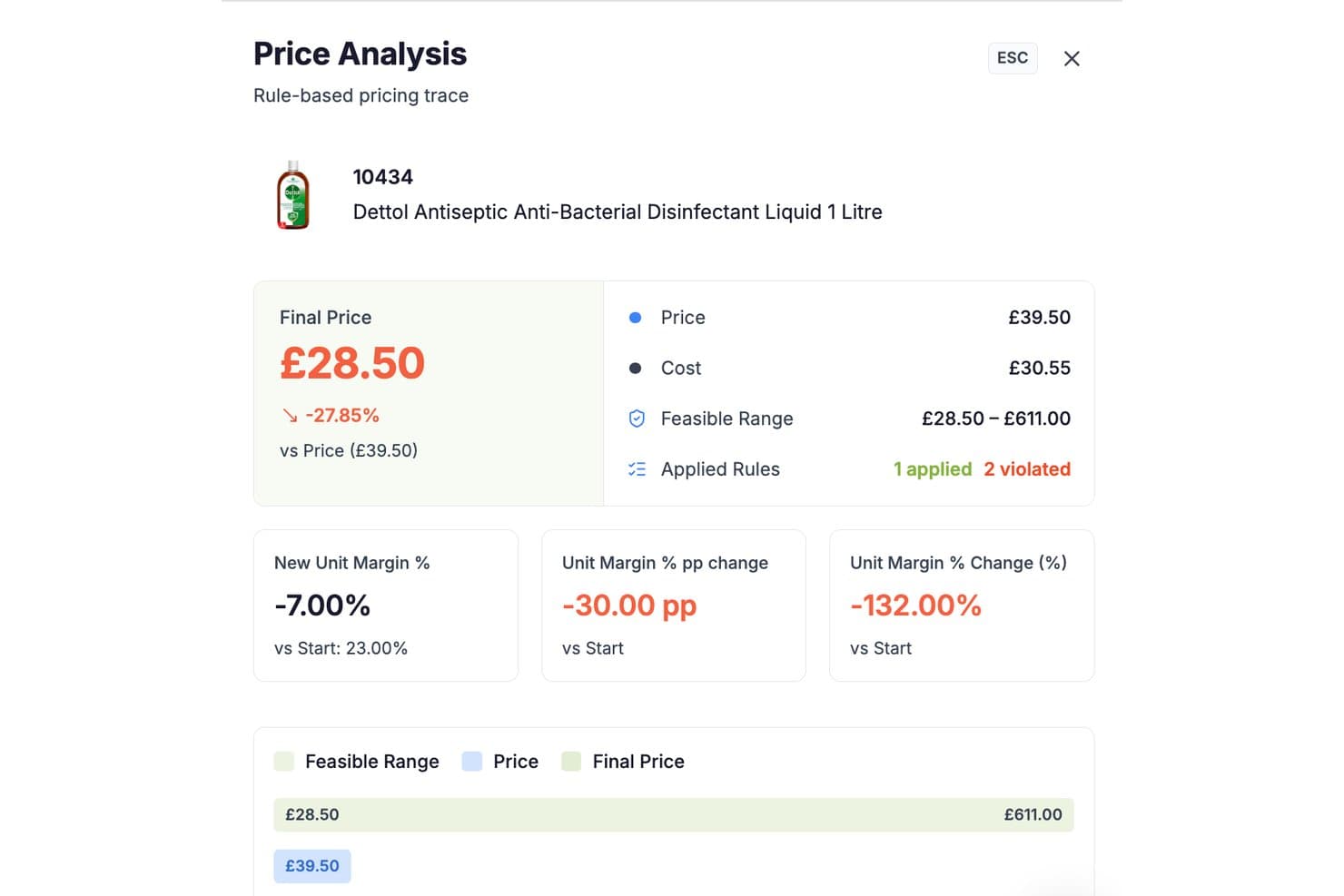
RetailGrid offers a Price Analysis panel that displays final price, feasible range, applied rules, and unit margin metrics for individual retail products. RetailGrid is a retail pricing platform that combines a spreadsheet-style AI workspace with agentic price optimization, competitor monitoring, elasticity analysis, and rules-based pricing across your catalog.
Who Is RetailGrid Best For?
RetailGrid is built for mid-market retailers with catalogs of thousands of SKUs who need pricing intelligence without a months-long enterprise implementation.
Why I Picked RetailGrid
RetailGrid earns its spot on my shortlist because of how it handles AI transparency in a way most pricing tools don't. Every recommendation the AI agents make shows its full reasoning, including which rules fired, which were violated, and the exact margin impact before you apply a change. That per-SKU audit trail means I can walk into a category review with a clear answer for every price move, not just a black-box output.
RetailGrid Key Features
- AI workspace: A spreadsheet-inspired pricing grid with live sales, competitor, and inventory data.
- Rules-based pricing engine: Apply and manage custom pricing rules across your entire product catalog.
- Competitor price monitoring: Automated collection of prices from direct competitors, Google Shopping, and Amazon.
- Elasticity analysis: Quantifies and visualizes each SKU’s price sensitivity using historical sales and market data.
RetailGrid Integrations
RetailGrid offers native integrations with Shopify, Magento, BigCommerce, WooCommerce, Wix, and SAP Commerce Cloud. An API is available for custom integrations.
Pros and Cons
Pros:
- Real-time elasticity and competitor data built in
- Spreadsheet-like interface familiar to retail teams
- Transparent AI decision audit for every SKU
Cons:
- Requires clean product data for full functionality
- Limited support for brick-and-mortar store pricing
Learn more about RetailGrid: Best for competitor price tracking for ecommerce
- 14-day free trial
- From $99/month
Visit WebsiteCustomer Rating:4.7/5
Prisync helps small retailers track competitor prices and adjust pricing. Prisync is built for ecommerce businesses that need to monitor and respond to competitor pricing in real time. The platform appeals to online retailers and brands looking to automate price tracking across multiple competitors and channels. Prisync helps you keep your pricing competitive and data-driven by collecting, comparing, and reporting on market prices automatically.
Why I Picked Prisync
For ecommerce teams focused on staying ahead of competitors, Prisync offers specialized tools for automated price tracking and market analysis. The platform collects competitor pricing data from multiple sources and updates it several times a day, so you always have current information. I appreciate that Prisync includes dynamic pricing rules, letting you set automated price adjustments based on competitor movements. Its detailed price comparison reports make it easier to spot trends and react quickly in fast-changing ecommerce markets.
Prisync Key Features
Some other features in Prisync that are useful for ecommerce teams include:
- Batch Product Import: Upload large product lists using CSV files for quick onboarding and updates.
- MAP Monitoring: Track minimum advertised price violations to protect brand value and compliance.
- Stock Availability Tracking: Monitor competitor stock levels alongside pricing data for a fuller market view.
- Customizable Alerts: Set up notifications for specific price changes or competitor actions that matter to your business.
Prisync Integrations
Integrations include Shopify, Amazon, Google Shopping, and other platforms via API.
Pros and Cons
Pros:
- Custom alerts for important price changes
- Dynamic pricing rules for automated adjustments
- Frequent competitor price updates for accurate tracking
Cons:
- Manual product matching can take time
- Limited analytics for deeper trend insights
Learn more about Prisync: Best for dynamic price automation in omnichannel
- Free demo available
- From €399/month
Visit WebsiteCustomer Rating:4.4/5
Omnia Retail automates dynamic pricing with real-time market data. If your team needs to automate pricing across both online and offline channels, Omnia Retail offers a unified platform built for omnichannel retailers. The software is designed for businesses managing complex assortments and frequent price changes. Omnia Retail helps you keep pricing consistent and competitive by automating updates based on real-time market data and your own pricing rules.
Why I Picked Omnia Retail
I chose Omnia Retail because it specializes in dynamic price automation for retailers managing both online and offline channels. The platform’s rule-based pricing engine lets you set custom strategies that automatically adjust prices in response to market changes, inventory levels, and competitor moves. I like that Omnia Retail streamlines omnichannel consistency, so your pricing stays aligned across every sales channel. Its real-time data feeds and automation tools help retailers react quickly without manual intervention, which is essential for staying competitive in fast-moving markets.
Omnia Retail Key Features
Some other features in Omnia Retail that stand out for retail teams include:
- Assortment Management: Manage and segment your product assortment to apply different pricing strategies to specific categories or brands.
- Competitor Price Monitoring: Track competitor prices in real time to inform your own pricing decisions and stay market-relevant.
- Promotional Pricing Engine: Set up and automate temporary price changes for sales, promotions, or seasonal events.
- Reporting and Analytics Dashboard: Access detailed reports and visualizations to review pricing performance and identify trends.
Omnia Retail Integrations
Integrations include Shopware, Plentymarkets, JTL, Google Shopping, Amazon, eBay, Bol.com, Kaufland, idealo, and Tweakers.
Pros and Cons
Pros:
- Real-time competitor tracking for faster decisions
- Rule-based engine for flexible pricing control
- Dynamic pricing automation across multiple channels
Cons:
- Advanced features may require onboarding support
- Initial setup for pricing rules can be complex
Learn more about Omnia Retail: Best for real-time price benchmarking across markets
- Free demo available
- Pricing upon request
Visit WebsiteCustomer Rating:4.5/5
Intelligence Node delivers real-time retail pricing and market insights. Intelligence Node is a retail analytics and market intelligence platform that includes pricing software capabilities for benchmarking and tracking competitor prices across markets. If you need to monitor and benchmark prices across multiple markets in real time, Intelligence Node is worth a look. This platform is designed for retailers and brands who want granular visibility into competitor pricing and assortment changes as they happen. Intelligence Node stands out for its ability to deliver up-to-the-minute pricing intelligence, helping teams react quickly to market shifts and protect margins.
Why I Picked Intelligence Node
For retailers who need to benchmark prices across multiple markets in real time, Intelligence Node offers a unique advantage. The platform’s AI-driven price monitoring engine tracks millions of SKUs and competitor prices globally, updating data as market conditions change. I like that Intelligence Node provides granular, SKU-level insights and customizable dashboards, so your team can quickly spot pricing gaps and opportunities. Its focus on real-time data makes it a strong fit for businesses that need to react fast to market shifts and maintain a competitive edge.
Intelligence Node Key Features
Some other features that make Intelligence Node useful for pricing teams include:
- MAP Monitoring: Track minimum advertised price violations across channels and markets.
- Automated Alerts: Receive instant notifications about significant competitor price changes.
- Category-Level Analytics: Analyze pricing trends and assortment at the category level.
- Data Export Tools: Export pricing and assortment data for further analysis or reporting.
Intelligence Node Integrations
Native integrations are not currently listed. API access is available for custom integrations.
Pros and Cons
Pros:
- Category-level analytics for assortment insights
- MAP monitoring for brand protection
- Real-time competitor price tracking across markets
Cons:
- No self-serve onboarding or setup tools
- Customization options may require vendor support
Learn more about Intelligence Node: Best for in-store and online price intelligence
- Free demo available
- Pricing upon request

Wiser Solutions provides retail analytics and competitor pricing insights. Wiser Solutions is a retail intelligence and execution platform that offers pricing software features to help teams monitor and optimize prices across in-store and online channels. This platform is especially useful for teams that need to monitor, compare, and optimize pricing across both physical shelves and ecommerce sites. Wiser Solutions stands out for its ability to unify data from multiple channels, helping you spot pricing gaps and align strategies in real time.
Why I Picked Wiser Solutions
What sets Wiser Solutions apart is its ability to deliver price intelligence for both in-store and online channels, which is essential for retailers managing omnichannel pricing strategies. The platform collects and analyzes pricing data from physical stores and ecommerce sites, giving you a unified view of your competitive landscape. I appreciate that Wiser Solutions offers shelf-level data collection and digital shelf analytics, so you can identify pricing discrepancies and optimize across all sales channels. This makes it a strong choice for businesses that need to coordinate pricing decisions between brick-and-mortar and online environments.
Wiser Solutions Key Features
Some other features that make Wiser Solutions valuable for pricing teams include:
- Promotion Tracking: Monitor competitor promotions and discounts across channels.
- Dynamic Pricing Engine: Adjust prices automatically based on real-time market data.
- Price Optimization Recommendations: Receive data-driven suggestions for optimal pricing strategies.
- Customizable Reporting: Build and schedule tailored reports for different teams or stakeholders.
Wiser Solutions Integrations
Native integrations are not currently listed.
Pros and Cons
Pros:
- Promotion tracking across multiple channels
- Shelf-level analytics for physical retail locations
- In-store and online price data collection
Cons:
- Onboarding process may require vendor assistance
- No public list of native integrations
Learn more about Wiser Solutions: Best for configurable pricing analytics for enterprises
- Free demo available
- Pricing upon request

Pricefx delivers cloud-based pricing optimization for enterprise businesses. Pricefx offers a highly configurable pricing analytics platform designed for large enterprises with complex pricing needs. This tool is a strong fit for pricing, finance, and commercial teams that need to model, analyze, and optimize pricing strategies at scale. Pricefx stands out for its flexible analytics engine, which lets you tailor pricing models and dashboards to your business’s unique requirements.
Why I Picked Pricefx
For teams that need deep control over pricing analytics, Pricefx stands out for its high level of configurability. The platform lets you build custom pricing models and dashboards, so you can analyze data in ways that match your business’s unique needs. I like that Pricefx supports advanced scenario modeling, which helps you forecast the impact of pricing changes before you roll them out. This makes it a strong choice for enterprises that want to tailor their pricing analytics and strategies at scale.
Pricefx Key Features
Some other features that make Pricefx appealing for enterprise pricing teams include:
- Rebate and Discount Management: Set up, track, and analyze complex rebate and discount programs.
- Quote Configuration Tools: Generate and manage quotes with configurable pricing rules.
- Price List Management: Create, update, and distribute multiple price lists across regions or channels.
- Automated Price Optimization: Use built-in algorithms to recommend optimal prices based on real-time data.
Pricefx Integrations
Integrations include SAP, Salesforce, Oracle, Microsoft Dynamics 365, PROS, Accenture, Deloitte, PwC, Wipro, and Capgemini.
Pros and Cons
Pros:
- Automated price optimization with built-in algorithms
- Scenario modeling for forecasting pricing impacts
- Highly configurable analytics for complex pricing models
Cons:
- Limited out-of-the-box retail-specific templates
- Implementation projects can require significant resources
Learn more about Pricefx: Best for AI-driven price optimization for large retailers
- Free demo available
- Pricing upon request

Competera provides enterprise retail pricing analytics and optimization tools. Large retailers looking to use AI for smarter pricing decisions may want to consider Competera. This platform uses machine learning to optimize prices across entire product portfolios, factoring in demand, competition, and business goals. Competera is especially useful for teams managing complex assortments who need to balance margin, revenue, and competitiveness at scale.
Why I Picked Competera
What sets Competera apart is its focus on AI-driven price optimization for large, complex retail operations. The platform uses machine learning algorithms to recommend optimal prices based on real-time market data, demand elasticity, and business constraints. I appreciate that Competera can simulate different pricing scenarios, helping teams understand the impact of price changes before making decisions. Its ability to automate pricing for thousands of SKUs makes it a strong fit for retailers who need to manage dynamic pricing at scale.
Competera Key Features
Some other features that make Competera valuable for pricing teams include:
- Competitive Data Collection: Gather real-time competitor pricing and assortment data from multiple sources.
- Rule-Based Pricing Engine: Set custom pricing rules to align with your business strategy.
- Promo Effect Measurement: Analyze the impact of past promotions on sales and margin.
- Role-Based Access Controls: Assign permissions and access levels for different team members.
Competera Integrations
Native integrations are not currently listed. API access is available for custom integrations.
Pros and Cons
Pros:
- Handles large assortments efficiently
- Scenario simulation for better decision planning
- AI-driven pricing recommendations based on demand signals
Cons:
- Limited transparency into pricing logic
- Requires significant data for accurate outputs
Learn more about Competera: 10Best for predictive pricing powered by demand forecasting
Retalon
- Free demo available
- Pricing upon request

Retalon uses predictive analytics to optimize retail pricing and inventory. Retailers looking for predictive pricing that adapts to real-time demand shifts may find Retalon especially relevant. This platform is built for merchandising, pricing, and planning teams that want to use demand forecasting to drive pricing decisions. Retalon helps you anticipate market changes and optimize prices with AI-powered analytics tailored for retail environments.
Why I Picked Retalon
What sets Retalon apart is its focus on predictive pricing powered by demand forecasting, which is especially valuable for retailers managing volatile markets. The platform uses AI-driven analytics to forecast demand at the SKU and store level, allowing you to adjust prices proactively rather than reactively. I appreciate that Retalon combines pricing optimization with inventory and promotion planning, so you can align pricing strategies with broader business goals. This makes it a strong fit for teams that want to use data-driven insights to stay ahead of market trends and maximize profitability.
Retalon Key Features
Some other features that make Retalon useful for retail pricing teams include:
- Automated Promotion Optimization: Set up and manage promotional pricing campaigns with AI-driven recommendations.
- Markdown Management: Plan and execute markdown strategies to clear inventory while protecting margins.
- Exception-Based Alerts: Receive notifications when pricing or inventory anomalies are detected.
- Omnichannel Price Consistency: Maintain synchronized pricing across online and offline sales channels.
Retalon Integrations
Native integrations are not currently listed.
Pros and Cons
Pros:
- Exception-based alerts for pricing anomalies
- Automated promotion and markdown management
- AI-driven demand forecasting for pricing decisions
Cons:
- Pricing details not disclosed on website
- No public list of native integrations
Learn more about Retalon:
Outro software de definição de preços para retalho
Eis algumas opções adicionais de software de definição de preços para retalho que não entraram na minha lista restrita, mas que vale a pena consultar:
- 11Price2SpyBest for multichannel price monitoring at scale
- 12BlackCurveBest for automated pricing rules for SMBs
- 13ZilliantBest for price optimization in B2B industries
- 14VendavoBest for margin management in manufacturing
How I Evaluate Retail Pricing Software
I split my evaluation into baseline criteria—like a functioning repricing engine and competitor monitoring—and differentiators that separate the best tools from the rest.
Core Functionality (Table Stakes For This List)
When I'm selecting tools for my list, I rank each one on a scale from 0 (does not offer the functionality) to 5 (excels in this area) for each core functionality listed below. Then, I calculate the tool's total score into a percentage. Each tool needs to achieve a minimum total score of 65% to be considered for inclusion.
- Price Optimization Engine: I evaluate whether the tool goes beyond basic cost-plus math to offer demand-based or AI-driven price recommendations that factor in elasticity and business goals.
- Competitor Price Monitoring: Tracking competitor prices matters most when it's automated, SKU-matched, and refreshed frequently enough to act on across marketplaces and web sources.
- Repricing Rules & Automation: I look for configurable rule builders that let pricing teams set margin floors, competitor-relative targets, and MAP guardrails that execute at scale.
- Promotion & Markdown Management: Seasonal clearance cycles and flash sales need scheduling, depth planning, and post-event analysis—I check how each tool handles the full promo lifecycle.
- Multi-Channel & Store Pricing: Retailers selling across physical locations, their own webstore, and third-party marketplaces need zone or channel-level price differentiation from one hub.
- Pricing Analytics & Reporting: I look for dashboards that connect price moves to margin and revenue outcomes, giving pricing managers clear visibility into what's working.
Once I have a list of tools that meet the criteria, I consider what sets each platform apart.
Differentiating Factors (What Sets Vendors Apart)
Here's how I compare and contrast different vendors:
Standout Features
Scenario simulation is a big one for me—I want to see how a proposed price change ripples through margin and volume before it goes live. Price image management is equally valuable, especially for retailers tracking KVI perception while quietly optimizing margin on long-tail SKUs. I also evaluate assortment-aware pricing, where the tool accounts for cannibalization between private label and branded alternatives or flags halo effects across related products.
Beyond Features
Integrations matter a lot here. A pricing tool that can't pull live inventory from your ERP or push updated prices to your POS and ecommerce storefront creates manual work that defeats the purpose. I also check whether the platform fits your specific retail vertical—grocery pricing logic is very different from fashion markdown cycles. Finally, implementation timelines deserve attention. Pricing tools with pre-built rule templates and guided onboarding get teams to value faster than platforms requiring months of custom configuration.
Como escolher software de definição de preços para retalho
É fácil ficar preso a listas extensas de funcionalidades e estruturas de preços complexas. Para o ajudar a manter-se concentrado enquanto percorre o seu processo específico de seleção de software, apresentamos uma lista de verificação dos fatores a ter em conta:
| Fator | O que considerar |
| Escalabilidade | O software conseguirá lidar com o volume atual e futuro de produtos, o número de lojas e os canais de vendas? |
| Integrações | Permite uma ligação nativa às suas ferramentas de comércio eletrónico, POS, ERP e análise de dados sem soluções alternativas personalizadas? |
| Possibilidade de personalização | Pode adaptar as regras de preços, os fluxos de trabalho e os relatórios ao seu modelo de negócio e às suas categorias? |
| Facilidade de utilização | As suas equipas de merchandising e de definição de preços conseguirão utilizar a ferramenta diariamente sem formação extensa? |
| Implementação e integração inicial | Quanto tempo demorará a começar a utilizar a solução e de que recursos ou apoio internos necessitará? |
| Custo | Os escalões de preços são claros e estão alinhados com o seu orçamento e com o ROI esperado à medida que o negócio cresce? |
| Medidas de segurança | O fornecedor disponibiliza encriptação de dados, controlos de acesso dos utilizadores e conformidade com as normas relevantes? |
| Disponibilidade do apoio | Pode aceder a apoio em direto durante o horário do seu negócio e existe um processo claro de escalamento para problemas urgentes? |
O que é o software de definição de preços para retalho?
O software de definição de preços para retalho é uma plataforma de preços que ajuda as empresas de retalho a definir, gerir e ajustar os preços dos produtos nos vários canais de vendas. Estas soluções de preços utilizam dados históricos, inteligência artificial e tendências do mercado para apoiar os processos de definição de preços ao longo do ciclo de vida e melhorar a tomada de decisões. Ao utilizar ferramentas avançadas de definição de preços, as equipas podem responder a alterações na procura, proteger a quota de mercado e aplicar estratégias de preços consistentes em diferentes segmentos de clientes.
Funcionalidades do software de definição de preços para retalho
Ao selecionar software de definição de preços para retalho, procure as seguintes funcionalidades essenciais:
- Gestão centralizada de preços: Gira e atualiza os preços dos produtos para todos os canais a partir de um único painel, reduzindo o trabalho manual e os erros.
- Regras de preços automatizadas: Define regras que ajustam automaticamente os preços com base no inventário, na velocidade de vendas ou em acionadores baseados no tempo.
- Agendamento de promoções e reduções de preços: Planeia, agenda e executa antecipadamente preços promocionais ou reduções de preços, garantindo implementações atempadas e consistentes.
- Monitorização dos preços dos concorrentes: Acompanha os preços dos concorrentes para fundamentar as suas próprias estratégias de preços e manter a competitividade no mercado.
- Atualizações de preços em massa: Aplica alterações de preços a vários produtos ou categorias de uma só vez, poupando tempo durante ajustes em grande escala.
- Rastos de auditoria e registos de alterações: Mantém um registo de todas as alterações de preços, incluindo quem as efetuou e quando, para garantir a responsabilização e a conformidade.
- Suporte para várias moedas: Define e gere preços em diferentes moedas para apoiar vendas internacionais e estratégias de preços localizadas.
- Relatórios e análises: Acede a painéis e relatórios que fornecem informações sobre o desempenho dos preços, o impacto nas margens e as tendências de vendas.
- Controlos de acesso dos utilizadores: Atribui permissões e funções aos membros da equipa, garantindo que apenas os utilizadores autorizados podem efetuar alterações de preços.
- Integração com canais de vendas: Liga-se diretamente a plataformas de comércio eletrónico, sistemas de ponto de venda e ERPs para sincronizar os dados de preços em toda a empresa.
Funcionalidades comuns de IA do software de preços de retalho
Para além das funcionalidades padrão do software de preços de retalho listadas acima, muitas destas soluções estão a incorporar IA com funcionalidades como:
- Previsão da procura: A IA analisa vendas históricas, sazonalidade e fatores externos para prever a procura futura, ajudando as equipas a definir preços ideais e a evitar ruturas de stock ou excesso de inventário.
- Otimização dinâmica de preços: A IA ajusta continuamente os preços em tempo real com base nas tendências do mercado, na atividade dos concorrentes e no comportamento dos clientes, para maximizar a receita e a margem.
- Recomendações automatizadas de promoções: A IA sugere o melhor momento, os produtos e os níveis de desconto para as promoções, analisando o desempenho de campanhas anteriores e as condições atuais do mercado.
- Análise da elasticidade dos preços: Os modelos de IA analisam de que forma as alterações de preços afetam o volume de vendas, permitindo às equipas compreender a sensibilidade da procura e definir preços que equilibrem o volume e o lucro.
- Deteção de anomalias: A IA monitoriza os dados de preços e vendas para assinalar padrões ou erros invulgares, como descidas ou subidas repentinas de preços, permitindo às equipas investigar e responder rapidamente.
Vantagens do software de preços de retalho
A implementação de software de preços de retalho proporciona várias vantagens para a sua equipa e para a sua empresa. Eis algumas que pode esperar:
- Preços consistentes em todos os canais: A gestão centralizada de preços garante que os preços dos seus produtos permanecem alinhados na loja, online e nos vários marketplaces.
- Resposta mais rápida às alterações do mercado: As regras de preços automatizadas e os conhecimentos baseados em IA ajudam a sua equipa a ajustar rapidamente os preços à medida que a procura, o inventário ou a atividade dos concorrentes sofrem alterações.
- Melhor controlo das margens: As análises em tempo real e a otimização dinâmica de preços permitem-lhe monitorizar e proteger as margens de lucro de cada produto.
- Redução do trabalho manual: As atualizações em massa, as ferramentas de agendamento e as funcionalidades de automatização minimizam as tarefas repetitivas e libertam tempo da sua equipa.
- Tomada de decisões baseada em dados: Os relatórios, as análises e as previsões baseadas em IA fornecem informações práticas para estratégias de preços mais inteligentes.
- Maior transparência e conformidade dos preços: Os rastos de auditoria e os controlos de acesso dos utilizadores ajudam a acompanhar as alterações e a garantir a responsabilização em toda a organização.
- Maior eficácia das promoções: As recomendações automatizadas de promoções e as ferramentas de agendamento ajudam a planear, executar e medir campanhas com maior precisão.
Custos e preços do software de preços de retalho
A seleção de software de preços de retalho exige uma compreensão dos vários modelos e planos de preços disponíveis. Os custos variam consoante as funcionalidades, a dimensão da equipa, os complementos e outros fatores. A tabela abaixo resume os planos comuns, os respetivos preços médios e as funcionalidades normalmente incluídas nas soluções de software de preços de retalho:
Tabela de comparação de planos de software de preços de retalho
| Tipo de plano | Preço médio | Funcionalidades comuns |
| Plano gratuito | $0 | Gestão básica de preços, listagens de produtos limitadas, acesso para um único utilizador e relatórios básicos. |
| Plano pessoal | $30-$75/utilizador/mês | Gestão centralizada de preços, atualizações em massa, integrações básicas e suporte normal. |
| Plano empresarial | $100-$250/ utilizador/mês | Regras de preços automatizadas, agendamento de promoções, análises avançadas, acesso para vários utilizadores e acesso à API. |
| Plano empresarial de grande dimensão | $400-$1,000+/mês | Integrações personalizadas, funcionalidades baseadas em IA, gestão dedicada de contas, segurança avançada e suporte prioritário. |
Perguntas frequentes sobre software de preços de retalho
Eis algumas respostas a perguntas comuns sobre software de preços de retalho:
Como é que o software de preços de retalho ajuda nos preços omnicanal?
O software de preços de retalho permite-lhe gerir e atualizar os preços em todos os seus canais de vendas a partir de um único local. Isto garante que os clientes veem preços consistentes, quer façam compras online, numa loja física ou através de plataformas de comércio eletrónico, e ajuda a sua equipa a evitar erros ou discrepâncias manuais.
O software de preços de retalho pode integrar-se com os meus sistemas POS e de comércio eletrónico existentes?
Sim, a maioria das soluções de software de preços de retalho oferece integrações com plataformas POS, de comércio eletrónico e ERP populares. Antes de escolher uma ferramenta, verifique se existem integrações nativas ou APIs disponíveis para garantir um fluxo de dados sem problemas e evitar carregamentos manuais.
Que medidas de segurança dos dados devo procurar num software de preços de retalho?
Procure funcionalidades como encriptação de dados, controlos de acesso dos utilizadores e registos de auditoria. Estas salvaguardas ajudam a proteger informações de preços sensíveis e garantem que apenas os membros autorizados da equipa podem efetuar alterações ou consultar dados confidenciais.
Quanto tempo demora a implementar um software de preços de retalho?
Os prazos de implementação variam, mas a maioria das soluções baseadas na nuvem pode ser configurada em alguns dias a algumas semanas. Fatores como a migração de dados, a complexidade da integração e a formação da equipa podem afetar a rapidez com que fica totalmente operacional.
O software de preços de retalho é adequado para pequenas empresas?
Sim, muitas plataformas de software de preços de retalho oferecem planos concebidos para pequenas empresas com menos produtos e utilizadores. Procure soluções com preços flexíveis, integração simples e funcionalidades essenciais que correspondam às suas necessidades atuais.