

Está aqui porque o Magento — sim, o Adobe Commerce; os meus dedos continuam a escrever “Magento” primeiro — não se enquadra totalmente no roteiro do seu negócio de comércio eletrónico.
Este guia apresenta-lhe alternativas credíveis ao Magento, para que possa adaptar a plataforma às necessidades da sua empresa sem ficar com as consequências desagradáveis de uma mudança de plataforma.
Eis aquilo com que as equipas se deparam repetidamente: processos de configuração e atualização pesados, extensões frágeis, integrações com ERP e CRM que consomem sprint após sprint, SLA pouco claros e uma velocidade de carregamento das páginas que prejudica o SEO. A isto acrescente os cálculos do custo total de propriedade, que aumentam depois de adicionar aplicações, gateways de pagamento e extensões para vários canais.
A curva de aprendizagem é real, tal como as lacunas nos modelos, nos construtores de páginas e na facilidade de utilização diária.
O que encontrará aqui: uma análise ordenada e em linguagem simples das principais funcionalidades de cada plataforma de comércio eletrónico, da escalabilidade, das funcionalidades integradas face às extensões, da profundidade da API, das ferramentas de SEO e da realidade dos preços.
Trabalhei em projetos com WooCommerce e Magento numa agência e, posteriormente, numa startup de construtores de páginas para Shopify, por isso sei onde as equipas encontram dificuldades — e quais as afirmações de “facilidade de utilização” que realmente se confirmam.
Consulte a lista de seleção para ver as etiquetas de utilização ideal, aceda à comparação lado a lado para consultar preços e casos de utilização e, quando estiver pronto para escolher uma tecnologia, leia as análises.
Why Trust Our Software Recommendations
6,700+
Reviews
20
Industry experts
16+
Evaluation factors
14
Years
Our team has been testing and reviewing software since 2012. As retail leaders ourselves, we know how difficult—and important—it is to choose the right software.
For this guide, we evaluated tools using hands-on testing and independent research, scoring tools using our selection criteria.
Our reviews reflect our independent judgment—not a sales pitch.
Tabela de comparação das alternativas ao Magento
Esta tabela apresenta, num só lugar, os planos de preços, as necessidades de teste ou configuração e os casos de utilização ideais.
| Tool | Best For | Trial Info | Price | ||
|---|---|---|---|---|---|
| 1 | Best for open-source customization | Free plan + free demo available | Pricing upon request | Website | |
| 2 | Best for optimizing customer engagement | Free plan + free trial available | Pricing upon request | Website | |
| 3 | Best for affordable pricing | Not available | From $41/month | Website | |
| 4 | Best for modular architecture | Free demo available | Pricing upon request | Website | |
| 5 | Best for B2C and B2B flexibility | Free demo available | Pricing upon request | Website | |
| 6 | Best for AI-driven tools | Free demo available | Pricing upon request | Website | |
| 7 | Best for AI-driven search | Free demo available | Pricing upon request | Website | |
| 8 | Best for unifying store and online sales | 60-day free trial + demo available | Pricing upon request | Website | |
| 9 | Best for SAP integration | Free demo available | Pricing upon request | Website | |
| 10 | Best for live ERP data sync | Free demo available | Pricing upon request | Website |


As 10 melhores alternativas ao Magento, analisadas
Cada análise aborda as funcionalidades principais, as características diferenciadoras, as integrações, as vantagens e desvantagens e as etiquetas de utilização ideal. Utilize-a para confirmar a adequação e identificar fatores decisivos antes de se comprometer.
 Best for open-source customization
- Free plan + free demo available
- Pricing upon request
Visit WebsiteCustomer Rating:4.6/5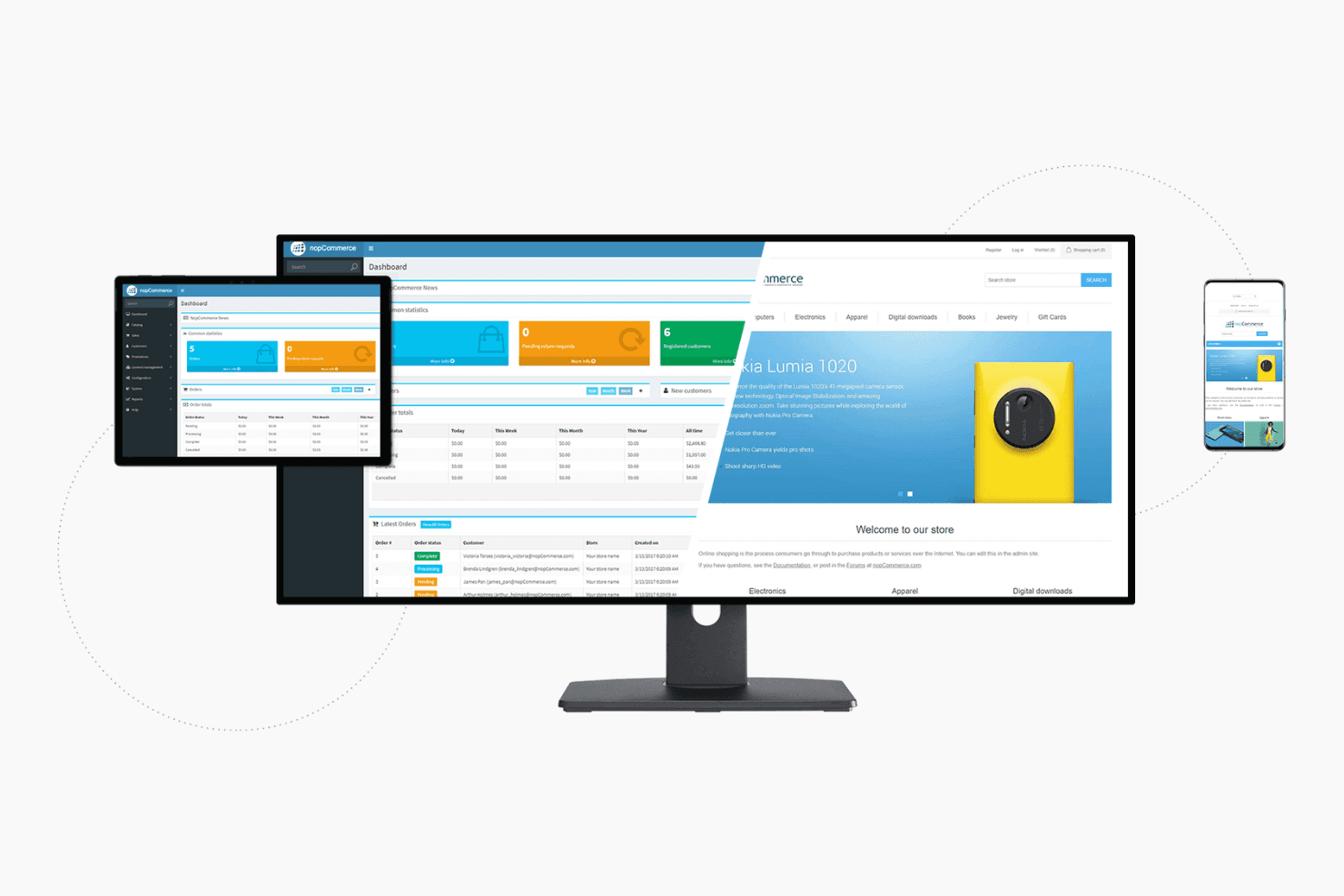
nopCommerce displays its admin dashboard and storefront across devices. nopCommerce is a free, open-source ecommerce platform built on ASP.NET Core that lets developers and technical teams build, customize, and operate online stores without paying licensing or transaction fees.
Who Is nopCommerce Best For?
nopCommerce is a strong fit for technical teams and ecommerce directors who want full control over their store's code and infrastructure without paying platform licensing fees.
Why I Picked nopCommerce
I picked nopCommerce as one of the best Magento alternatives because it gives technical teams full access to the source code on ASP.NET Core, so you're not locked into a proprietary architecture when rebuilding or extending your store. I particularly like that the multi-store feature lets you manage several storefronts from a single admin instance, with shared catalogs and customer credentials across domains. The pluggable architecture also means your developers can build or modify plugins directly, rather than waiting on a vendor to ship a feature.
nopCommerce Key Features
- One-page checkout: Customers complete purchases on a single page, with support for PayPal, Stripe, and Authorize.Net payment gateways.
- Built-in SEO tools: Search-engine-friendly URLs, canonicalization, microdata, breadcrumbs, and an autogenerated sitemap are included out of the box.
- Multi-vendor marketplace: Store owners can run a marketplace with multiple vendors selling through a single storefront from one admin instance.
- AI-generated product descriptions: The catalog settings let you generate product descriptions and SEO meta tags using DeepSeek, Gemini, or ChatGPT.
nopCommerce Integrations
nopCommerce claims 800+ integrations across plugins, themes, and language packs, with marketplace integrations including PayPal Commerce, Microsoft Dynamics 365, Microsoft Power BI, Avalara, Lucene, and Elasticsearch. A REST API supports custom integrations.
Pros and Cons
Pros:
- Built-in order and shipment management
- Multi-store administration consolidates storefront operations
- Open-source code supports tailored storefront workflows
Cons:
- Theme changes and upgrades require technical work
- High-traffic stores need stronger infrastructure
Learn more about nopCommerce: Best for optimizing customer engagement
- Free plan + free trial available
- Pricing upon request
Visit WebsiteCustomer Rating:4.4/5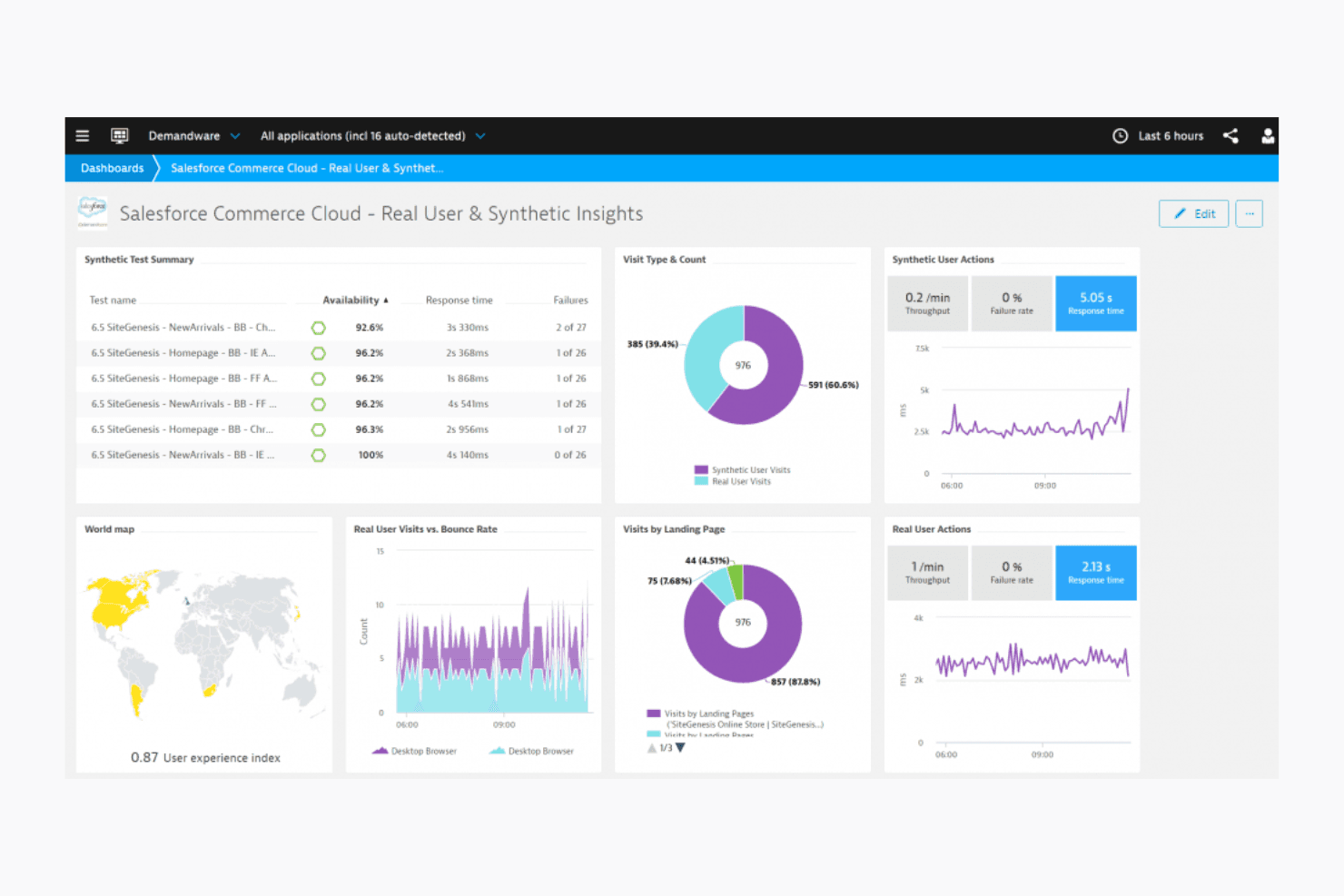
Salesforce Commerce Cloud monitors real user and synthetic site performance. Salesforce Commerce Cloud is an enterprise-grade SaaS commerce platform that unifies B2C and B2B storefronts, order management, and point of sale—making it a strong fit for retailers and brands looking to consolidate online and in-store operations on a single, managed platform.
Who Is Salesforce Commerce Cloud Best For?
Salesforce Commerce Cloud is a strong fit for enterprise retailers and brands that need to unify B2C storefronts, B2B channels, order management, and in-store POS on a single platform.
Why I Picked Salesforce Commerce Cloud
I picked Salesforce Commerce Cloud because it's one of the few platforms that genuinely unifies online and in-store commerce under one roof, which is what makes it so strong for optimizing customer engagement. I love how Agentforce Guided Shopping lets shoppers search by photo or chat, then check out directly in conversation with Apple Pay or Google Pay. Combined with AI-driven product recommendations and Agentforce Merchandising, personalization happens across every touchpoint without requiring a separate tool.
Salesforce Commerce Cloud Key Features
- B2B storefront management: Commerce Cloud B2B Growth Edition supports up to six B2B storefronts with built-in analytics, automation, and segmentation.
- Omnichannel order management: Distributed Order Management provides real-time inventory visibility across up to 50 locations with store-based fulfillment options like BOPIS.
- Composable storefront architecture: REST APIs and headless developer tools let your team build flexible storefront experiences outside the standard template.
- Retail Cloud POS: A mobile-first point-of-sale with clienteling, offline payment support, and Endless Aisle lets associates sell from anywhere in a store.
Salesforce Commerce Cloud Integrations
Salesforce Commerce Cloud has native integrations with Salesforce Commerce, Salesforce Order Management, Salesforce Loyalty, Salesforce Service, Adyen, Verifone Flex, and Elavon. REST APIs support custom integrations, including headless storefront implementations.
Pros and Cons
Pros:
- Reviewers praise complex catalog and promotion control
- AI personalizes shopping and product discovery
- Unifies online, store, and order operations
Cons:
- Magento replatforming means rebuilding storefronts and workflows
- Custom builds often require specialist developers
Learn more about Salesforce Commerce Cloud:
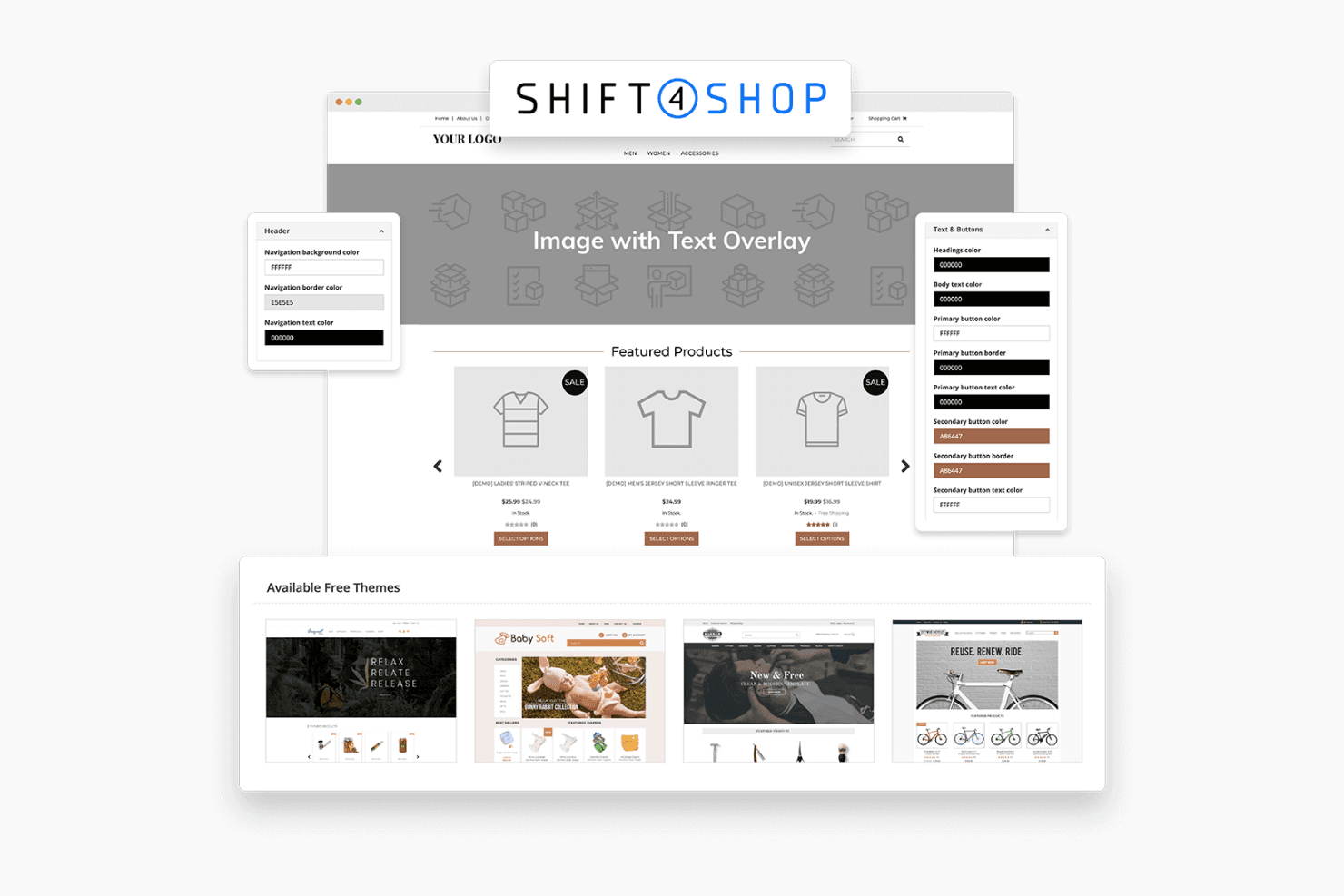
Shift4Shop lets users customize themes, colors, and buttons visually. Shift4Shop is a hosted ecommerce platform that handles storefront management, order processing, and built-in marketing tools—making it a practical option for merchants who want to move off self-hosted infrastructure without taking on developer overhead.
Who Is Shift4Shop Best For?
Shift4Shop suits small to mid-sized merchants moving off self-hosted infrastructure who want a broad feature set at a low monthly cost.
Why I Picked Shift4Shop
I picked Shift4Shop as one of the best Magento alternatives because the pricing is genuinely hard to beat: one flat plan at $41/month covers unlimited products, unlimited staff users, and no transaction fees from Shift4Shop itself. I also appreciate that it actively courts Magento switchers with a free product migration offer and up to 12 extra months of service included. The built-in abandoned cart recovery, promotions scheduler, and email marketing tools mean you're not immediately piecing together a stack of paid add-ons just to run basic campaigns.
Shift4Shop Key Features
- Single-page checkout: Lets customers complete purchases on one page, with a multiple-ship-to option for splitting orders across addresses.
- REST and front-end API access: Provides REST and front-end APIs for retrieving product data, managing cart items, and building custom integrations.
- B2B pricing and payment tools: Supports customer-group pricing, quantity discount tiers, purchase orders, and Net 30/60/90 payment terms for wholesale buyers.
- Kount fraud protection: Uses AI-driven fraud detection powered by Kount to screen transactions before they're processed.
Shift4Shop Integrations
Shift4Shop offers native integrations with PayPal, FedEx, QuickBooks Connector, Mailchimp, AWeber, Facebook Ads, Cloudflare, and Kount. It also lists Amazon and eBay connections, marketplace integrations through its App Store, and REST and front-end APIs for custom integrations.
Pros and Cons
Pros:
- Managed hosting shifts infrastructure upkeep
- Broad catalog tools reduce add-on dependence
- Free product migration targets Magento switchers
Cons:
- Theme edits often require coding
- Reviewers report payment failures after launch
Learn more about Shift4Shop:
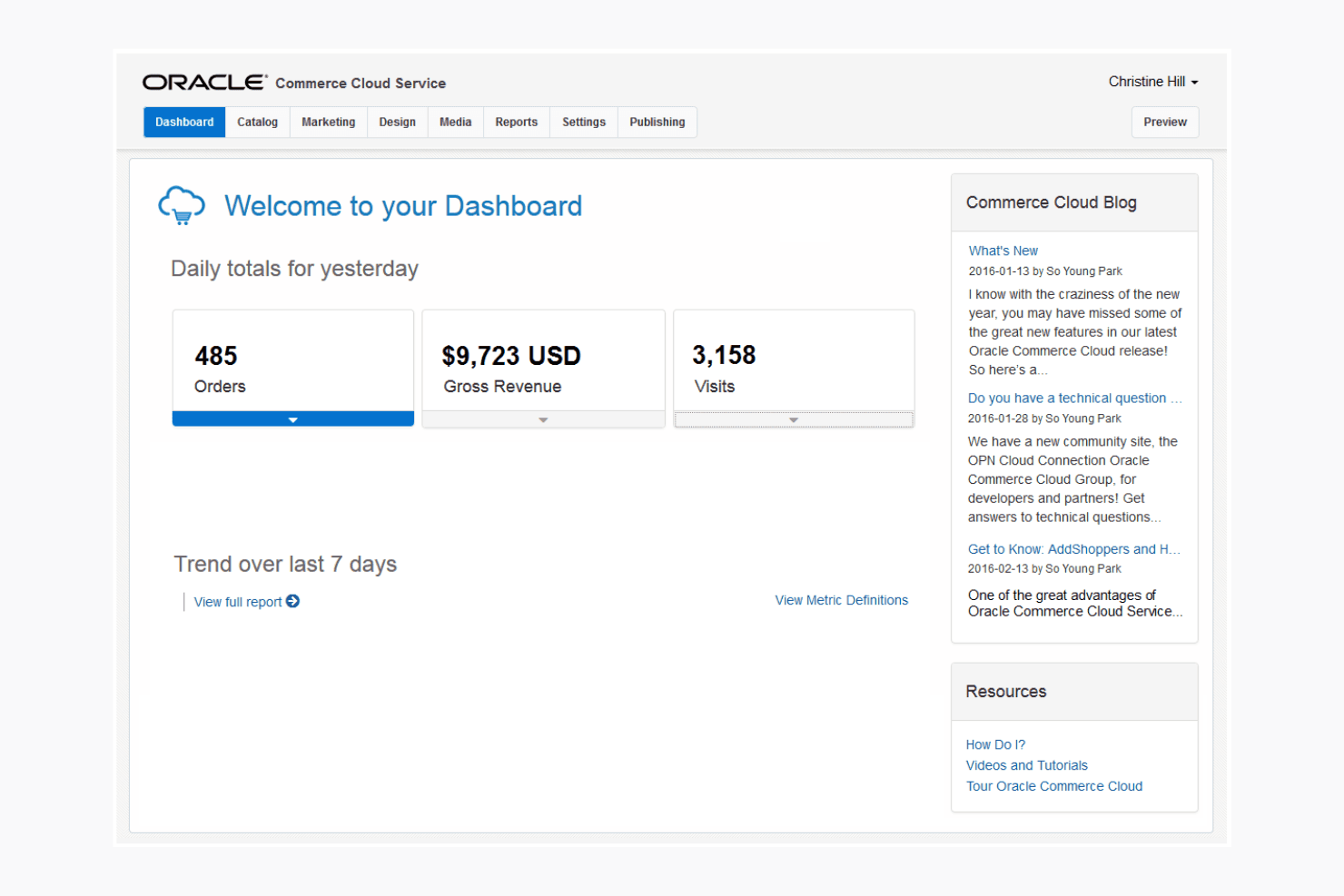
Oracle Commerce displays daily sales totals and 7-day trends at a glance. Oracle Commerce is an enterprise cloud commerce platform built for large B2B and B2C organizations that need account-specific pricing, complex catalog management, and deep integrations with ERP and CX systems.
Who Is Oracle Commerce Best For?
Oracle Commerce is built for large enterprises running complex B2B operations that need account-specific pricing, multi-site management, and deep integration with ERP and CX systems.
Why I Picked Oracle Commerce
I picked Oracle Commerce because its modular architecture gives large B2B operations genuine flexibility in how they build and deploy their storefront. I love that you can run a fully integrated storefront, a headless setup using REST APIs, or a hybrid that keeps commerce features like A/B testing and audience personalization intact. The Open Storefront Framework lets your dev team build in React on Oracle Cloud Infrastructure while business users manage content and merchandising independently through Design Studio.
Oracle Commerce Key Features
- B2B account management: Supports account hierarchies, delegated administration, roles and permissions, contracts, and custom order approvals for business buyers.
- A/B testing with experiments: Lets you test layouts, widgets, cart flows, and checkout flows with traffic allocation controls and built-in reporting.
- Audience-based personalization: Builds audience segments using attributes like geolocation, UTM parameters, and shopper interests to deliver targeted content and promotions.
- Agent Console: Gives customer service reps access to customer profiles and carts so they can create orders, process returns, and assist with cross-channel purchases.
Oracle Commerce Integrations
Oracle Commerce offers native integrations with Oracle Integration Cloud, Oracle CPQ, Oracle Retail Cloud Order Management System, Oracle CX Marketing—Responsys, Oracle CX Content, PayPal, CyberSource, Avalara, and Vertex. REST APIs and webhooks support custom integrations.
Pros and Cons
Pros:
- Offers integrated and headless storefront options
- Supports account-specific B2B purchasing workflows
- Handles large catalogs and high traffic
Cons:
- No dedicated Magento migration workflow
- Requires technical teams for storefront changes
Learn more about Oracle Commerce:
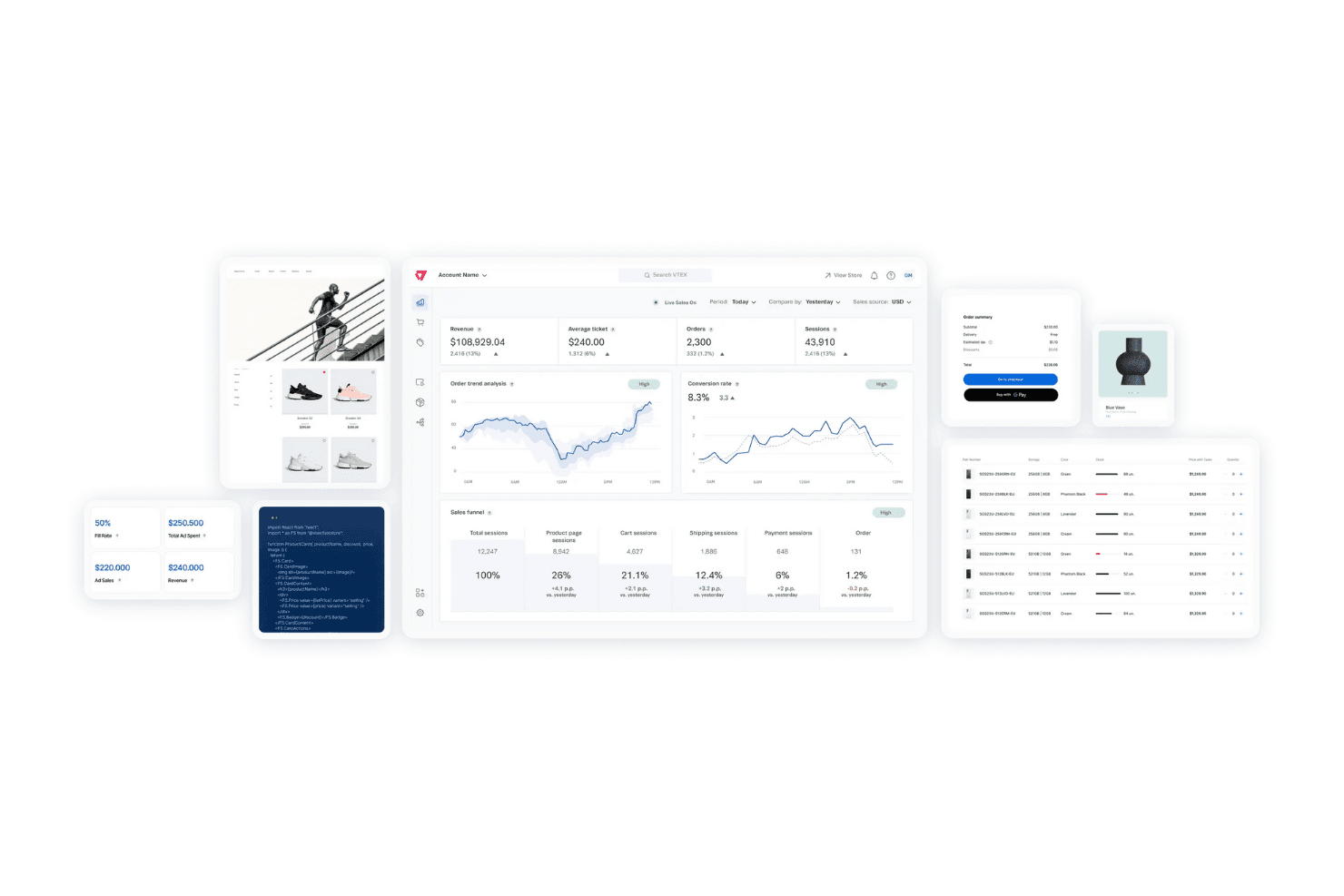
VTEX centralizes store analytics, sales funnels, and order management in one dashboard. VTEX is a SaaS commerce platform built for merchants running B2C, B2B, and marketplace operations who need unified order orchestration, omnichannel inventory, and headless storefront flexibility without managing their own infrastructure.
Who Is VTEX Best For?
VTEX suits mid-market to enterprise merchants running B2C and B2B operations who need a single platform to manage storefronts, marketplaces, and in-store channels without self-hosting infrastructure.
Why I Picked VTEX
I picked VTEX because it's one of the few platforms that handles B2C and B2B commerce from a single backend, without requiring two separate deployments. I appreciate how the platform lets you run buyer organization management, RFQs, and quick reorders alongside your standard D2C storefront. Its no-code headless CMS also means marketing teams can update content and schedule campaigns without pulling in developers every time.
VTEX Key Features
- AI-powered intelligent search: Analyzes shopper behavior patterns and applies your business rules to surface more relevant product results.
- Omnichannel order orchestration: Manages orders across ecommerce, brick-and-mortar, marketplace, and B2B channels from a unified OMS.
- Composable integration ecosystem: Connects to 1,000+ third-party systems, including ERPs, WMS platforms, payment providers, and marketing tools via REST APIs.
- Built-in compliance and security certifications: Covers ISO/IEC 27001, SOC 2 Type 2, PCI-DSS, GDPR, and CCPA across the platform.
VTEX Integrations
VTEX lists 1,000+ system integrations and 3,000+ integrated solutions through its ISV ecosystem, including marketplace integrations with Adyen, Stripe, PayPal, Mercado Pago, Mercado Livre, Google, Meta, and Klarna. Its REST APIs support custom ERP, WMS, fulfillment, and carrier connections.
Pros and Cons
Pros:
- No-code content tools let teams launch campaigns
- Coordinates orders across stores, marketplaces, and ecommerce
- Runs B2B and B2C from one backend
Cons:
- Reviewers report weak reporting and confusing navigation
- Magento migration needs custom data-transfer work
Learn more about VTEX:
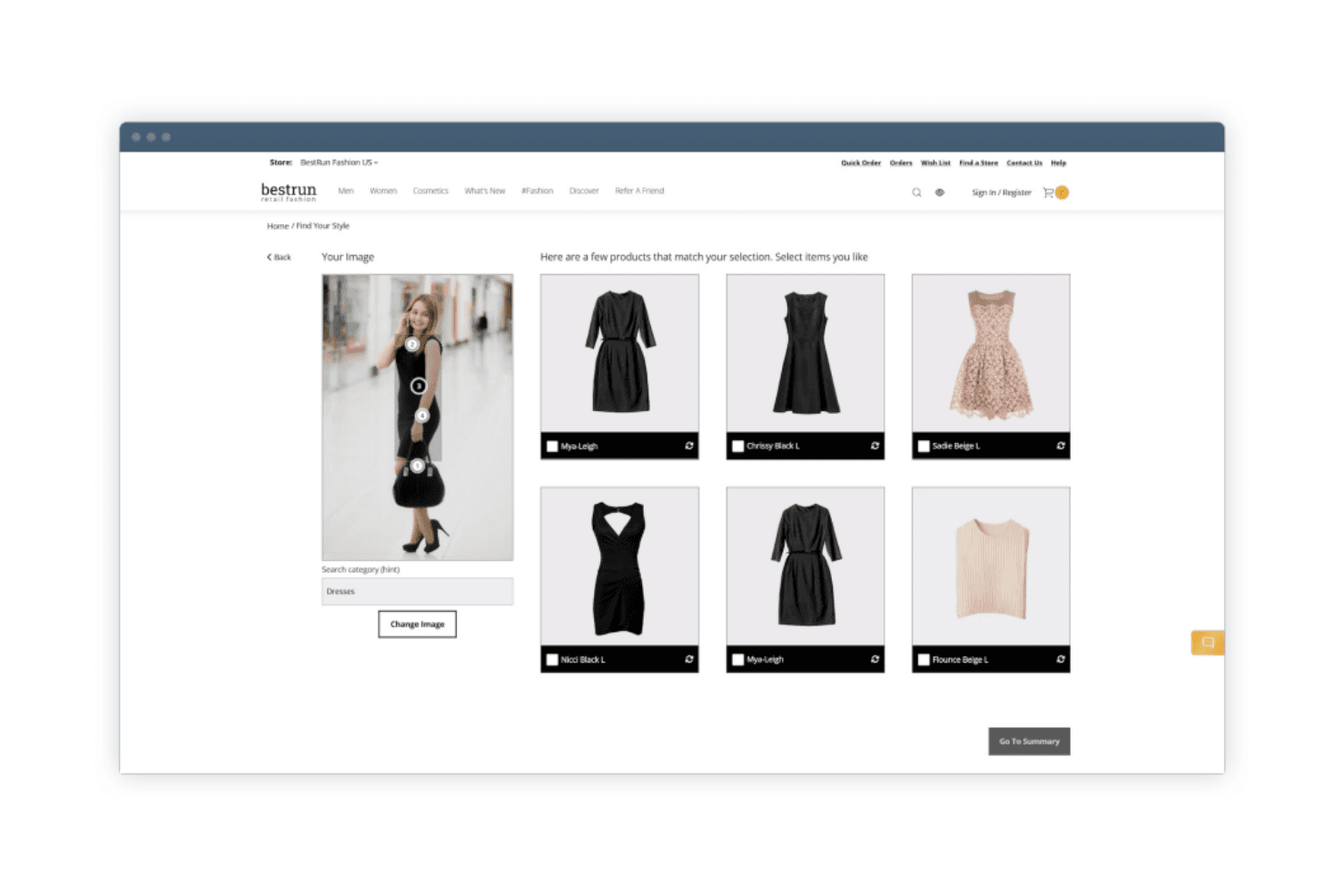
SAP Commerce Cloud lets users find products by uploading a photo. SAP Commerce Cloud is an enterprise-grade commerce platform built for large B2B, B2C, and B2B2C operations that need to manage complex product catalogs, unified pricing and promotions, and consistent buying experiences across multiple channels and storefronts.
Who Is SAP Commerce Cloud Best For?
SAP Commerce Cloud is a strong fit for large enterprises running complex B2B, B2C, or B2B2C operations that need deep SAP ecosystem integration alongside AI-driven selling tools.
Why I Picked SAP Commerce Cloud
I picked SAP Commerce Cloud because its AI-driven selling tools go well beyond basic recommendations. The Catalog Optimization Agent actively helps merchandisers handle product descriptions and catalog translation, while Joule Premium for CX deploys AI agents for personalized shopping and automated catalog updates. For large B2B or B2C teams managing thousands of SKUs across multiple storefronts, that kind of built-in AI muscle is genuinely difficult to replicate on Magento.
SAP Commerce Cloud Key Features
- Composable storefront architecture: Supports headless, API-first storefronts that can be deployed across websites, mobile apps, and other digital channels without modifying the core platform.
- Unified pricing and promotions engine: Manages pricing, discounts, bundles, and coupon programs centrally and applies them consistently across all customer touchpoints.
- SAP Product Content Management: Provides embedded PIM tools for bulk editing, multilingual catalog support, workflow approvals, and content validation across your full product range.
- Configurable checkout flows: Maps checkout steps—including delivery, payment, and pickup—to individual base stores, with the option to modify steps through AddOns.
SAP Commerce Cloud Integrations
SAP Commerce Cloud offers native connectivity to SAP Cloud ERP and prebuilt integration flows through SAP Integration Suite. It also has a marketplace integration with Akeneo PIM and open APIs for custom integrations.
Pros and Cons
Pros:
- Centralizes products, prices, and promotions across channels
- Handles complex catalogs across multiple storefronts
- AI agents automate catalog updates and personalization
Cons:
- SmartEdit restricts editing for some storefront components
- Setup and customization require experienced technical staff
Learn more about SAP Commerce Cloud:
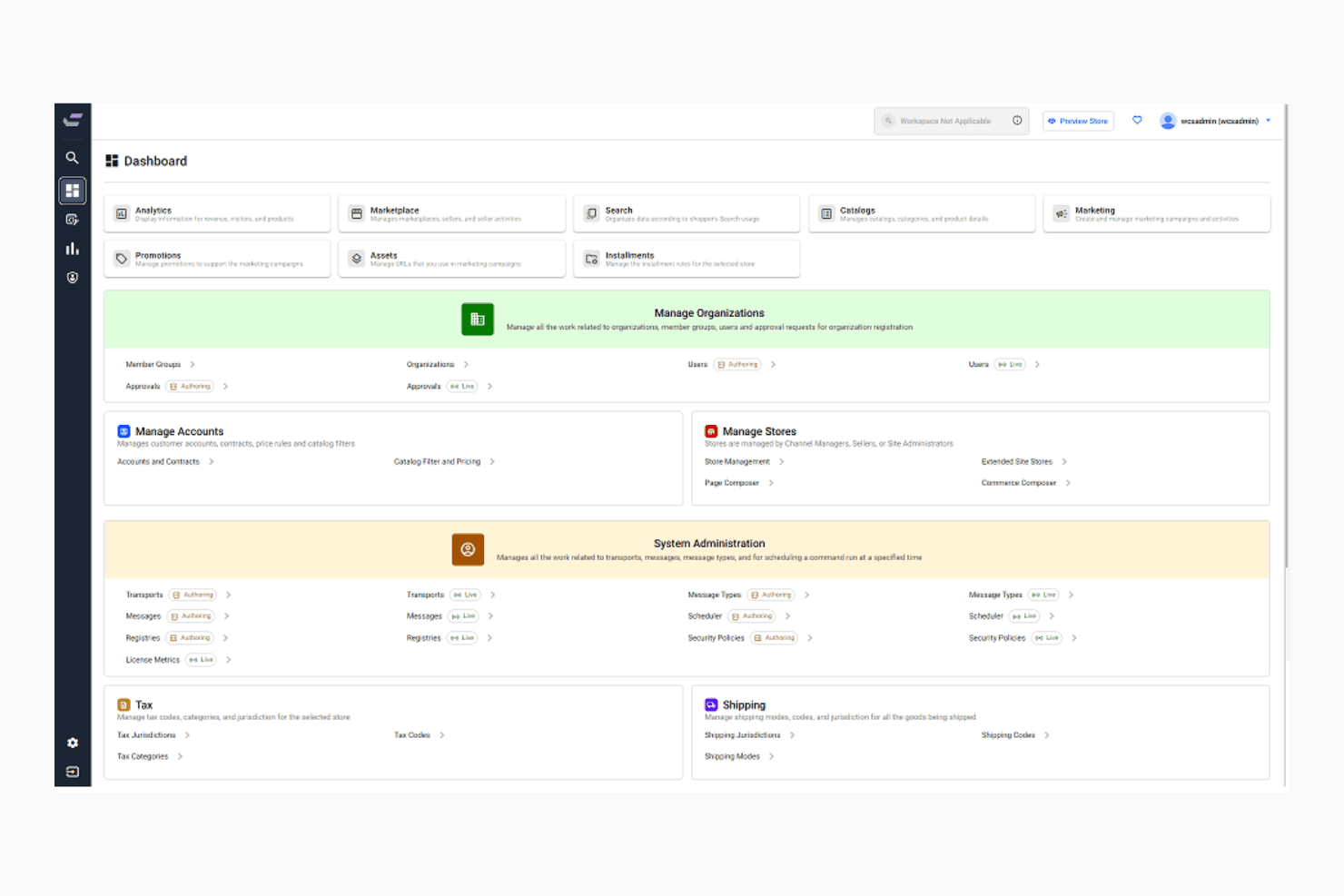
HCL Commerce centralizes store, catalog, and system admin tasks. HCL Commerce+ is an enterprise ecommerce platform built for B2B and B2C organizations that need a composable, AI-enhanced solution with deep catalog management, complex pricing, and flexible deployment across cloud, on-premises, or hybrid environments.
Who Is HCL Commerce+ Best For?
HCL Commerce+ suits enterprise B2B and B2C teams that need deep catalog management, complex pricing, and AI-driven search across global storefronts.
Why I Picked HCL Commerce+
I picked HCL Commerce+ for its AI-driven search, which goes well beyond basic keyword matching. It surfaces intent-based results that reflect real-time prices, contract entitlements, and current inventory, so B2B buyers see only what they're actually allowed to purchase. Business users can also manage search synonyms, boosting rules, and merchandising logic without touching code, which keeps catalog teams moving without waiting on developers.
HCL Commerce+ Key Features
- Composable packaged business capabilities: Modular, API-first commerce functions that can be independently deployed, updated, or replaced without affecting the rest of the platform.
- B2B quoting and RFQ workflows: Automated quote creation supporting multiple products, specifications, and transaction terms, with completed quotes convertible into orders or reusable buyer contracts.
- Omnichannel inventory visibility: Real-time stock tracking across warehouses, physical stores, and third-party fulfillment centers to support buy-anywhere, fulfill-anywhere operations.
- Business-user pricing and promotion management: A promotion and pricing toolset that lets nontechnical teams build campaigns, set contract or volume pricing, and manage promotion stacking without developer involvement.
HCL Commerce Integrations
Native integrations are not clearly documented. HCL Commerce supports REST, GraphQL, webhooks, pub/sub events, and CSV uploads for custom integrations, but no named ERP, CRM, POS, marketplace, or payment integrations are verified.
Pros and Cons
Pros:
- Composable capabilities support hybrid deployments
- RFQs convert into orders or reusable contracts
- AI search reflects contract pricing and inventory
Cons:
- No published catalog or traffic capacity benchmarks
- React storefronts require developer-built pages
Learn more about HCL Commerce: Best for unifying store and online sales
- 60-day free trial + demo available
- Pricing upon request
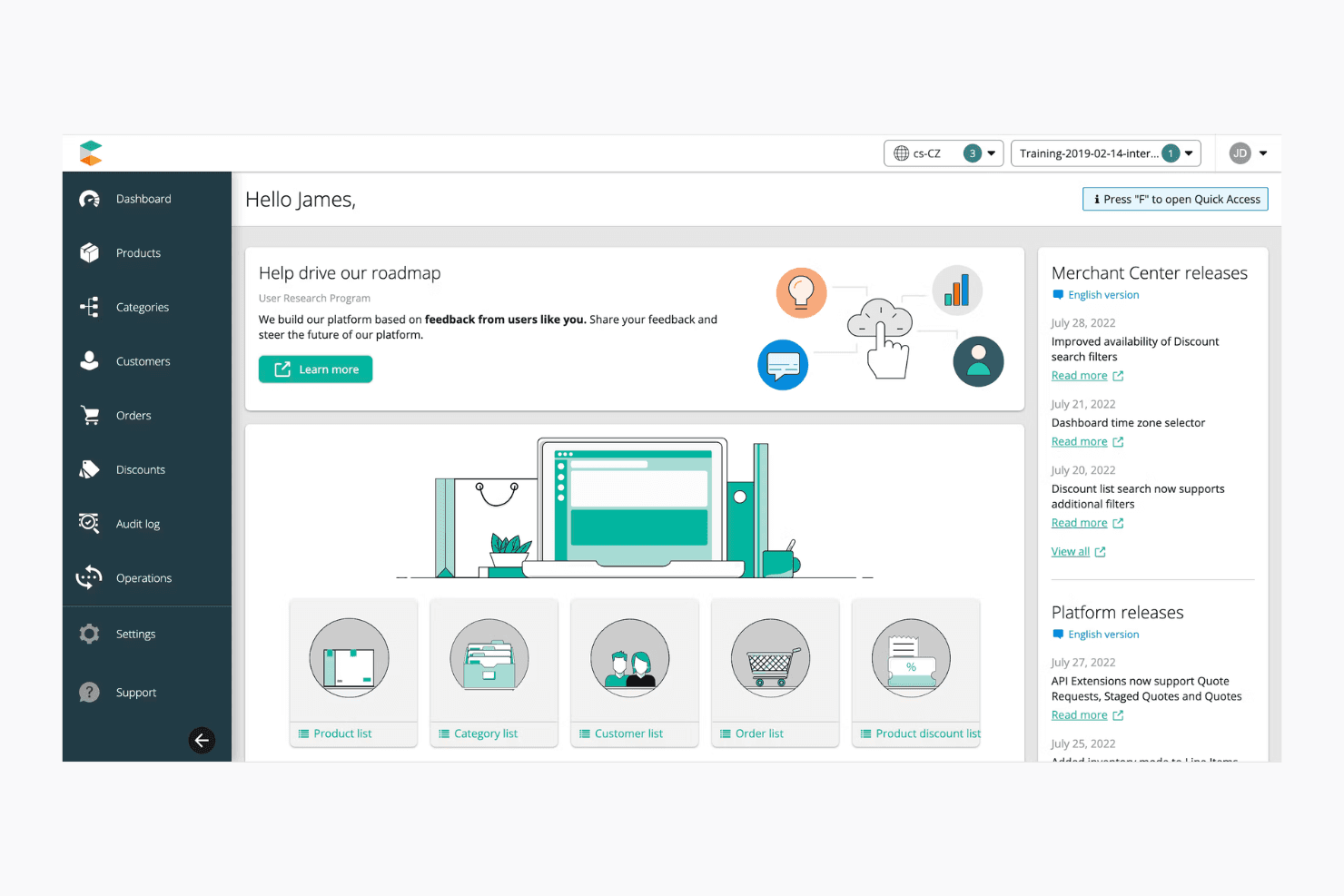
commercetools centralizes product, order, and customer management in one dashboard. commercetools is a headless, API-first commerce platform built for enterprises that need to orchestrate complex, multi-channel selling across web, mobile, in-store, B2B, and emerging AI channels from a single, modular foundation.
Who Is commercetools Best For?
commercetools is a strong fit for enterprise teams running complex, multi-channel operations who need a fully API-driven platform their developers can extend and integrate without limits.
Why I Picked commercetools
I picked commercetools as one of the best Magento alternatives because its API-first architecture gives developer teams genuine control over how commerce logic connects to every channel, from storefronts and mobile apps to in-store POS and AI assistants like ChatGPT and Copilot. I particularly like that REST and GraphQL APIs cover the full commerce stack, including catalog, cart, pricing, and promotions, so teams can compose exactly the experience they need without working around a monolithic platform. The managed Connect runtime is a real advantage too, letting teams deploy custom integrations without owning the underlying infrastructure.
commercetools Key Features
- Omnichannel inventory management: Tracks stock across warehouses, stores, and ecommerce channels simultaneously, with support for up to 100 inventory supply channels per store.
- B2B account hierarchies and quoting: Supports business unit structures, buyer roles and permissions, quote negotiation, and configurable purchasing approval workflows.
- Promotions engine: Targets discounts by customer group, cart total, category, or channel, with configurable stacking order and bulk single-use code generation for affiliate and influencer programs.
- InStore POS: Enables mobile point-of-sale transactions, associate-assisted selling, and cross-channel fulfillment including buy-online-pick-up-in-store and ship-from-store directly from the platform.
commercetools Integrations
commercetools offers marketplace integrations with Adyen, Stripe, PayPal, Worldpay, Acquia Commerce Framework, and 7 Learnings Price Optimization. REST and GraphQL APIs plus the Connect marketplace support custom integrations through a managed runtime.
Pros and Cons
Pros:
- Unified POS connects stores and ecommerce
- Reviewers praise stability and API documentation
- Flexible APIs support complex commerce integrations
Cons:
- No Magento-specific migration workflow documented
- Storefronts require engineering-led implementation
Learn more about commercetools:
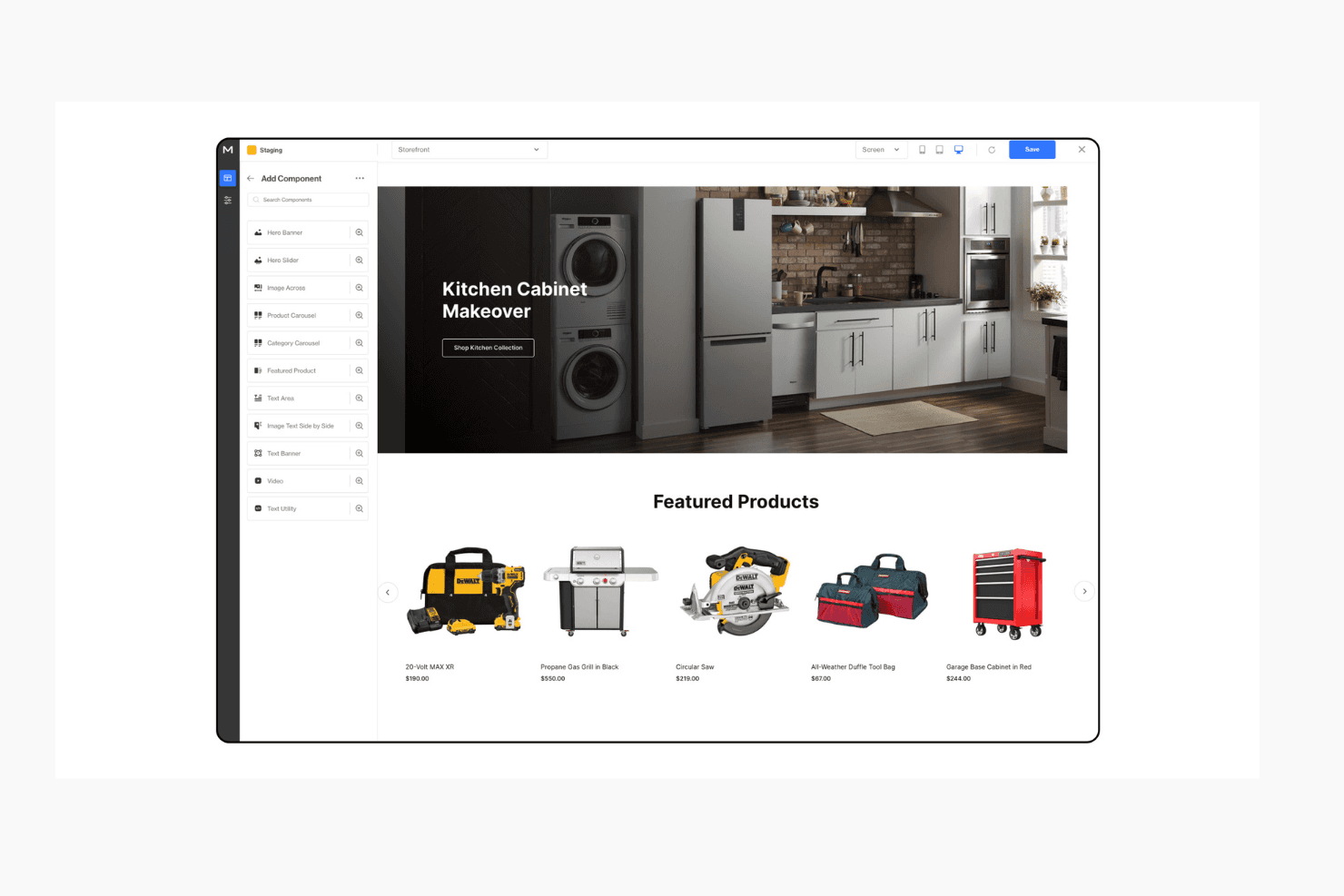
Miva lets users build storefronts by dragging and dropping page components. Miva is a managed SaaS ecommerce platform built for B2B manufacturers, distributors, and wholesalers who need complex catalog management, account-based pricing, and ERP connectivity without maintaining their own infrastructure.
Who Is Miva Best For?
Miva is a strong fit for B2B manufacturers, distributors, and wholesalers that run SAP or other enterprise ERPs and need a managed SaaS platform to replace self-hosted infrastructure.
Why I Picked Miva
I picked Miva because its native SAP connectivity through Miva Connect is genuinely managed, meaning Miva's own team monitors the data flows between your ERP and storefront and handles issues when they arise. That's a meaningful difference from platforms where SAP integration means hiring an agency to build and babysit a custom connector. I also appreciate that B2B-specific logic like account-based pricing, approval workflows, and contract catalogs are built into the platform, so a manufacturer running SAP isn't stitching together multiple tools to replicate what Miva handles natively.
Miva Key Features
- B2B checkout configuration: Set customer-group-specific payment terms, purchase order support, credit limits, and multi-step approval workflows at the account level.
- PageBuilder: Create and update storefront pages, landing pages, and promotional content using drag-and-drop components without writing HTML or CSS.
- Vexture AI search: An on-platform semantic search engine that interprets vague or misspelled queries and surfaces relevant products using vector-based AI.
- CSV and quick-order forms: Let buyers upload bulk orders via CSV or use quick-order forms to place large orders without browsing the catalog.
Miva Integrations
Miva Connect provides managed integrations with SAP, NetSuite, Microsoft Dynamics, Epicor, and Sage. Its partner marketplace lists PayPal, UPS Ready, ShipStation, Avalara, and Searchspring, while the JSON API supports custom integrations.
Pros and Cons
Pros:
- Reviewers praise knowledgeable, responsive support
- Replaces self-hosted infrastructure with managed SaaS
- Handles account-specific wholesale catalogs
Cons:
- No documented native in-store synchronization
- Routine admin tasks involve extra navigation
Learn more about Miva:
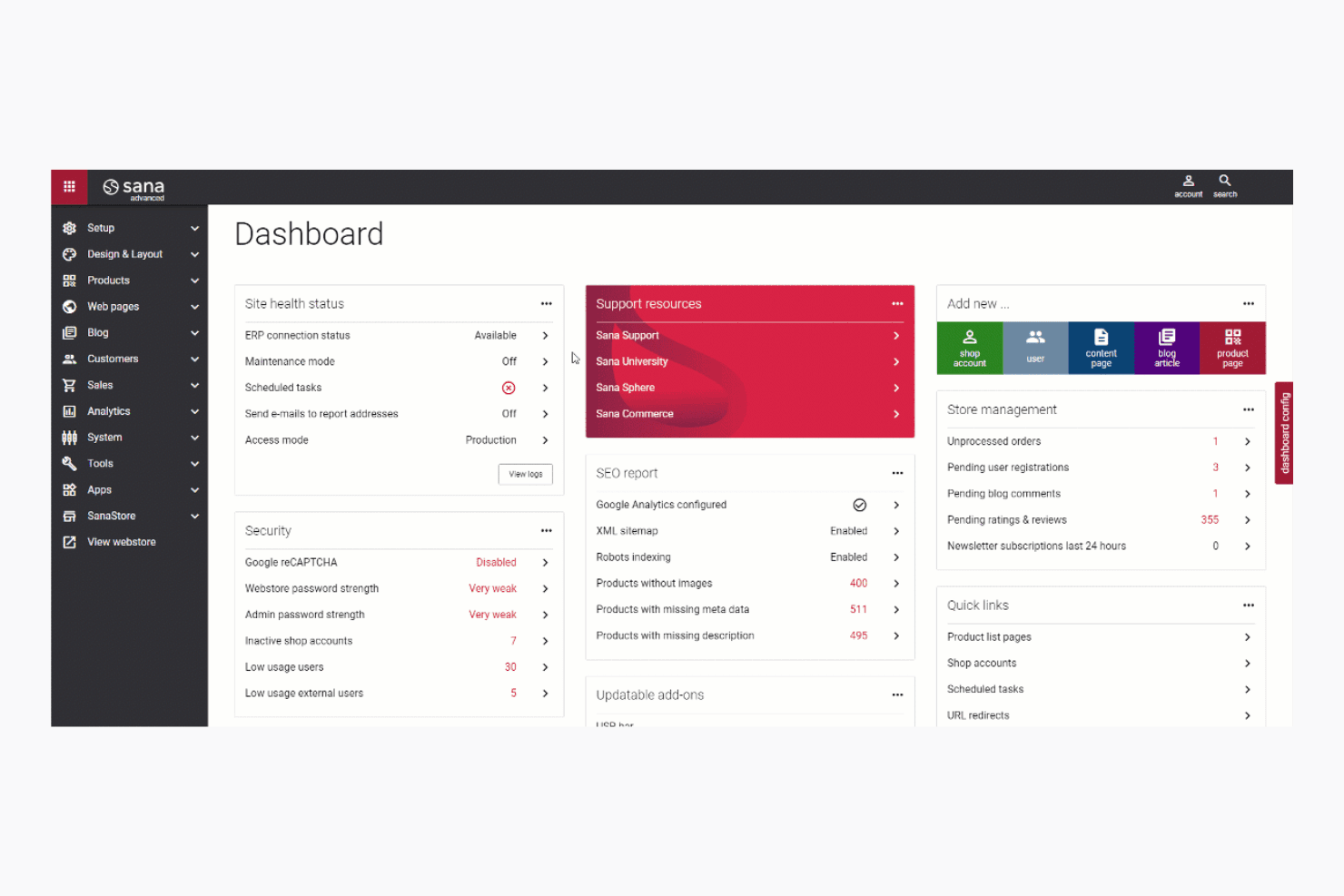
Sana Commerce centralizes store health, SEO, and security in one dashboard. Sana Commerce Cloud is a B2B ecommerce platform built for manufacturers and distributors running SAP or Microsoft Dynamics ERP systems, connecting your ERP data directly to your online storefront to keep pricing, inventory, and customer accounts accurate in real time.
Who Is Sana Commerce Best For?
Sana Commerce Cloud is a strong fit for B2B manufacturers and distributors that run SAP or Microsoft Dynamics and need their ecommerce store to reflect live ERP data without manual syncing.
Why I Picked Sana Commerce
I picked Sana Commerce Cloud because it's one of the few ecommerce platforms that treats your ERP as the actual source of truth, not just a system to sync with. When a customer logs in, they see their real contract pricing, their live warehouse stock, and their full order history pulled directly from SAP or Microsoft Dynamics, with no manual data entry in between. I also appreciate how the ERP-driven catalog automatically creates product pages, controls visibility, and handles unit-of-measure pricing conversions without a separate middleware layer.
Sana Commerce Cloud Key Features
- Self-service buyer portal: Buyers can place orders, view invoices, track shipments, check real-time warehouse stock, and manage returns without contacting a sales rep.
- Multi-storefront management: Run up to 20 storefronts for different regions, brands, or customer segments from a single ERP connection.
- No-code CMS with scheduled content: Build and update storefront pages using a drag-and-drop grid editor with inline editing, content previews, and time-based content targeting by customer group.
- Commerce Console: A unified dashboard that surfaces revenue, average order value, adoption rates, and action signals across your online and offline channels in one view.
Sana Commerce Integrations
Sana Commerce offers native integrations with SAP ECC, SAP S/4HANA, SAP Business One, and Microsoft Dynamics. It also connects with Perfion, inRiver, Tweakwise, Dotdigital, Mailchimp, and Expivi, with an API for custom integrations.
Pros and Cons
Pros:
- Nontechnical teams update storefront content without code
- Buyers self-serve orders, invoices, and shipment status
- ERP data keeps pricing and stock current
Cons:
- Deep storefront changes can require developer work
- Magento migration tooling is undocumented
Learn more about Sana Commerce:
Outras alternativas ao Magento
Eis algumas alternativas adicionais ao Magento que não entraram na minha lista de seleção, mas que vale a pena conhecer:
- 11SprykerBest for quick custom features
- 12Kibo CommerceBest for API-driven integration
- 13ShopifyBest for ease of use
- 14BigCommerceBest for enterprise scalability
- 15OpenCartBest for budget-friendly options
- 16CentraBest for fashion and lifestyle brands
- 17WooCommerceBest for WordPress integration
- 18OroCommerceBest for B2B customization
- 19NetSuite SuiteCommerceBest for ERP integration
- 20Elastic PathBest for headless commerce
- 21SyliusBest for Symfony framework users
- 22Shopware 6Best for innovative design features
- 23IntershopBest for B2B ecommerce
- 24PrestaShopBest for open-source flexibility
- 25SCAYLEBest for high-volume retailers
- 26Broadleaf CommerceBest for customizable commerce
- 27ZnodeBest for multi-store capabilities
- 28FabricBest for modular commerce solutions
- 29Sitecore Order CloudBest for API-first architecture
How I Evaluate Magento Alternatives
I split my evaluation into baseline criteria—catalog management, checkout, and multichannel selling—and differentiators like B2B features, migration tooling, and total cost of ownership.
Core Functionality (Table Stakes For This List)
When I'm selecting tools for my list, I rank each one on a scale from 0 (does not offer the functionality) to 5 (excels in this area) for each core functionality listed below. Then, I calculate the tool's total score into a percentage. Each tool needs to achieve a minimum total score of 75% to be considered for inclusion.
- Storefront Design & Customization: I evaluate theme libraries, visual editing tools, and mobile responsiveness—whether a merchant can build a polished storefront without writing code from scratch.
- Product Catalog Management: Handling complex catalogs matters, so I look at variant support, bulk import/export, category structures, and attribute management for large SKU counts.
- Shopping Cart & Checkout: I check for configurable checkout flows, payment gateway options, tax and shipping rule flexibility, and features like abandoned cart recovery.
- Order & Inventory Management: Real-time inventory syncing across warehouses, fulfillment tracking, and returns processing are what I evaluate—especially for merchants with multiple locations.
- Multichannel Selling: Platforms like Shopify and BigCommerce offer native marketplace and social selling connectors, so I look for similar breadth across Amazon, eBay, and POS channels.
- Extensibility & Integrations: A strong API and app ecosystem determine how well a platform fits into your existing stack—ERP, CRM, shipping, and marketing tools included.
Once I have a list of tools that meet these criteria, I consider what sets each platform apart.
Differentiating Factors (What Sets Vendors Apart)
Here's how I compare and contrast different vendors:
Standout Features
Migration tooling is a big one—I look for platforms that offer native importers or certified partner support to move products, customers, and URL structures from Magento without losing SEO equity. Speaking of SEO, built-in tools for meta tags, sitemaps, and clean URL structures save you from relying on third-party plugins. I also evaluate B2B capabilities like tiered pricing, quote workflows, and customer-group catalogs, since many Magento merchants serve wholesale buyers alongside DTC.
Beyond Features
Total cost of ownership is something I weigh heavily. Magento's self-hosted model carries hidden costs in hosting, patching, and developer hours, so I evaluate whether a platform's pricing stays predictable as your catalog and traffic grow. Hosting and infrastructure matter too—I check for included PCI-compliant hosting, CDN coverage, and uptime guarantees. Scalability rounds out my evaluation: can the platform handle flash sale traffic spikes and support multi-store, multi-currency setups as your business expands internationally?
O que é o Magento?
O Magento — agora Adobe Commerce — é uma plataforma de comércio eletrónico de código aberto e uma solução de comércio empresarial para criar e gerir uma loja online.
Combina uma base de código PHP com temas, módulos e APIs para permitir uma personalização extensiva, desde catálogos de produtos e regras de preços até ao processo de pagamento e aos gateways de pagamento.
As equipas utilizam-no para funcionalidades de várias lojas, várias moedas e B2B, além de ferramentas de SEO e uma gestão robusta de produtos. Pode utilizar a edição de código aberto ou a oferta Adobe Commerce, com funcionalidades mais avançadas, integrações e assistência técnica.
Por que motivo procurar uma alternativa ao Magento?
Poderá querer uma plataforma de comércio eletrónico diferente se a realidade do dia a dia não corresponder às necessidades ou ao orçamento da sua empresa.
- Menor custo total de propriedade. As taxas de subscrição, o alojamento próprio, os complementos e o desenvolvimento contínuo podem acumular-se rapidamente.
- Menor sobrecarga técnica. Nem todas as equipas querem manter PHP, módulos e atualizações — ou contratar profissionais com esse conjunto de competências.
- Obtenção de valor mais rápida. Uma solução de comércio eletrónico SaaS alojada pode reduzir os ciclos de configuração, manutenção e implementação.
- Integrações mais simples. APIs mais limpas e conectores pré-configurados para ERP, CRM e ferramentas de marketing reduzem o risco e o trabalho repetido.
- Melhor usabilidade. Uma interface intuitiva e a criação de páginas por arrastar e largar ajudam os utilizadores não técnicos a implementar alterações rapidamente.
- Melhor desempenho e SEO. Lojas online leves, modelos modernos e funcionalidades integradas mantêm a velocidade e a visibilidade nos motores de pesquisa no caminho certo.
- Venda multicanal integrada. Canais de venda nativos e integrações com redes sociais são melhores do que plugins frágeis de terceiros.
- Escalabilidade adequada. Plataformas baseadas na nuvem que aumentam automaticamente a capacidade, processam o inventário em tempo real e protegem a finalização da compra sob carga.
Principais funcionalidades das alternativas ao Magento
Está a comparar plataformas de comércio eletrónico para implementar mais rapidamente, reduzir o custo total de propriedade e encurtar a curva de aprendizagem. Eis o que as melhores alternativas ao Magento oferecem.
- Arquitetura componível e orientada para API. APIs REST ou GraphQL limpas, webhooks e sincronização em tempo real para que o seu site de comércio eletrónico comunique com ERP, CRM e ferramentas de marketing sem soluções improvisadas.
- Criação de páginas intuitiva. Interface de arrastar e largar, modelos reutilizáveis e um editor visual que não prejudica as Métricas Essenciais da Web nem o SEO.
- Gestão robusta de produtos. Grandes catálogos de produtos, variantes, conjuntos e regras de preços B2B tratados sem tempos limite ou soluções improvisadas.
- Finalização da compra e pagamentos que convertem. Processos conformes com PCI, vários gateways de pagamento, como PayPal e Stripe, e suporte para várias moedas e impostos incluído de origem.
- Precisão do inventário e das encomendas. Stock em várias localizações, encomendas pendentes, devoluções e regras de OMS que mantêm as vendas online e o inventário das lojas perfeitamente sincronizados.
- Ferramentas de pesquisa e SEO integradas. Pesquisa rápida no site, URLs limpos, dados estruturados, mapas do site e controlos que ajudam a sua loja online a obter uma boa classificação sem plugins de terceiros.
- Alcance multicanal e dos mercados online. Canais de venda nativos para a Amazon, redes sociais e POS, além de preços e promoções unificados em todas as lojas online.
- Desempenho e escalabilidade. Alojamento baseado na nuvem, escalabilidade automática, CDNs e SLAs que resistem aos períodos de pico, com atualizações claras à medida que cresce.
- Ecossistema extensível sem caos. Aplicações de terceiros de qualidade, módulos avaliados e mecanismos de controlo que evitam o excesso de plugins comum nas plataformas de código aberto.
- Portabilidade de dados e análise. Exportações fáceis em CSV e JSON, esquemas compatíveis com ferramentas de BI e painéis em que pode confiar para tomar decisões sobre produtos, tráfego e margens.
- Segurança e governação. Certificados SSL, acesso baseado em funções, SSO, registos de auditoria e opções de conformidade para categorias regulamentadas.
- Modelo de preços transparente. Taxas de subscrição, taxas de transação e complementos claros, para poder calcular o custo total de propriedade antes de aderir.