
De beste SAP-alternativene kombinerer omfattende ERP-funksjoner for detaljhandel med lagerbeholdning i sanntid, fleksibel ordrebehandling og støtte for flere salgskanaler. Hvis du leter etter SAP-alternativer, trenger du en løsning som passer til særtrekkene ved moderne detaljhandel – uten den omfattende innsatsen SAP ofte krever.
Denne listen hjelper deg med å sammenligne de beste plattformene og velge systemer som forenkler driften, kobler sammen teamene dine og holder tritt med endringstakten i 2026. Utforsk alternativer som gir virksomheten din pålitelighet og kontroll, enten du driver butikker, har virksomhet på flere steder eller skalerer netthandelen.
Hva er SAP?
SAP er en programvarepakke for virksomhetsressursplanlegging (ERP) som sentraliserer forretningsprosesser som økonomi, lagerbeholdning, innkjøp og salg for store detaljhandelsbedrifter og virksomheter. Den bidrar til å samordne driften på tvers av flere kanaler og lokasjoner, samtidig som den støtter komplekse behov innen forsyningskjede og rapportering. Mange virksomheter vurderer SAP på grunn av bredden, men noen ser etter alternativer for å få større fleksibilitet, spare kostnader eller få funksjoner som er bedre tilpasset kravene i moderne detaljhandel.
Sammenligningstabell over SAP-alternativer
Denne sammenligningstabellen oppsummerer prisopplysningene for mine beste utvalgte SAP-alternativer:
| Tool | Best For | Trial Info | Price | ||
|---|---|---|---|---|---|
| 1 | Best for multi-entity financial consolidation | Free demo available | From £1,200/month | Website | |
| 2 | Best for retail ERP for hardware stores | Free demo available | Pricing upon request | Website | |
| 3 | Best for open-source integrated POS | Free plan available | From $38.90/user/month | Website | |
| 4 | Best for real-time POS and store operations | Free demo available | Pricing upon request | Website | |
| 5 | Best for merchandise distribution | Free demo available | Pricing upon request | Website | |
| 6 | Best for unified commerce and financial management | Free demo available | Pricing upon request | Website | |
| 7 | Best for low-code ERP with Microsoft 365 | 30-day free trial | From $80/user/month (billed annually) | Website | |
| 8 | Best for industry-tailored automation | Free demo available | Pricing upon request | Website | |
| 9 | Best for ecommerce automation and scalability | Free demo available | Pricing upon request | Website | |
| 10 | Best for unlimited-user omnichannel commerce | Free demo available | Pricing upon request | Website |


Why Trust Our Software Recommendations
6,700+
Reviews
20
Industry experts
16+
Evaluation factors
14
Years
Our team has been testing and reviewing software since 2012. As retail leaders ourselves, we know how difficult—and important—it is to choose the right software.
For this guide, we evaluated tools using hands-on testing and independent research, scoring tools using our selection criteria.
Our reviews reflect our independent judgment—not a sales pitch.
Anmeldelser av de beste SAP-alternativene
Nedenfor finner du mine detaljerte sammendrag av de beste SAP-alternativene som kom med på kortlisten min. Anmeldelsene mine gir et detaljert innblikk i funksjonene, integrasjonene og de beste bruksområdene for hver plattform, slik at du kan finne den som passer best for deg.
 Best for multi-entity financial consolidation
- Free demo available
- From £1,200/month
Visit WebsiteCustomer Rating:4.3/5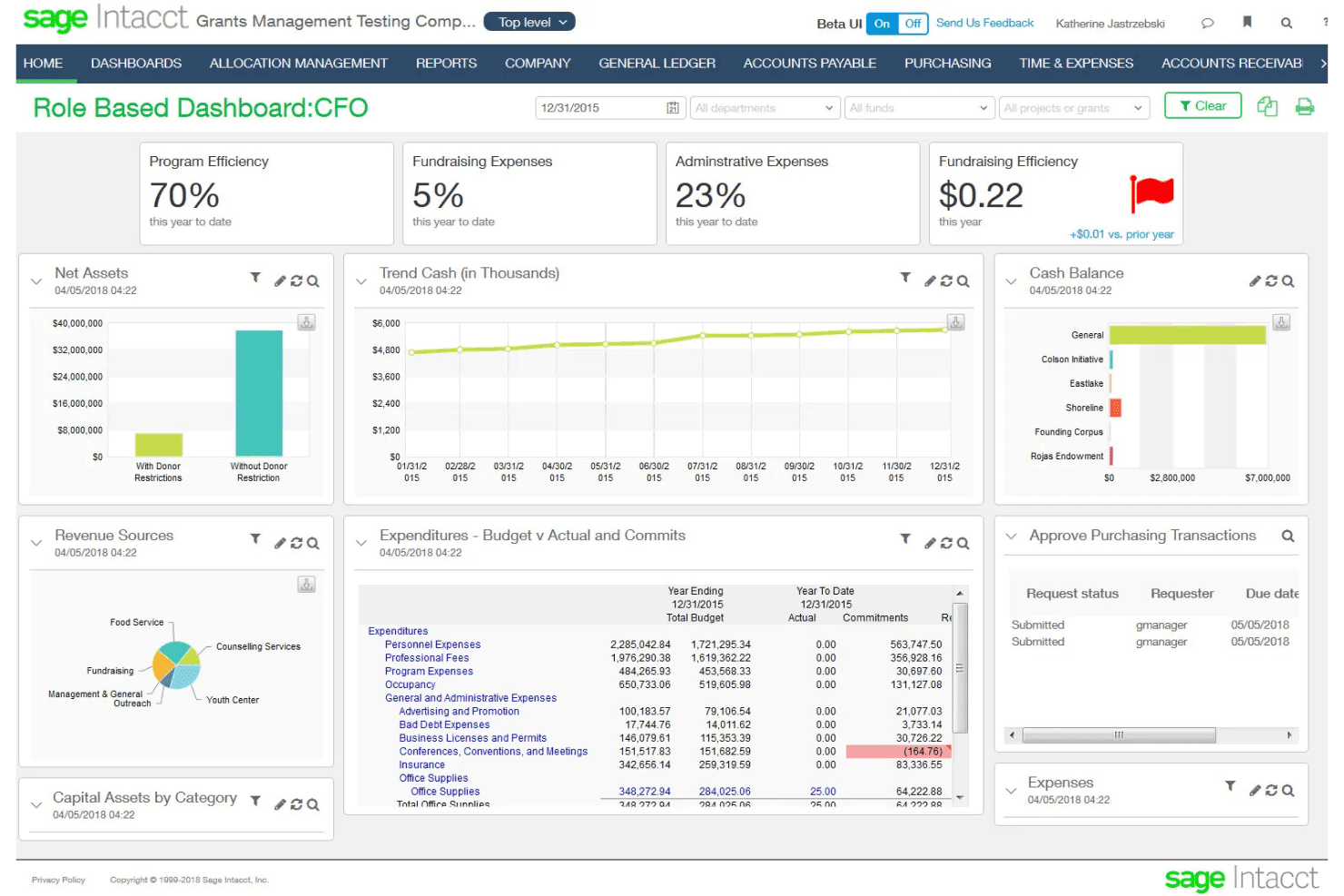
Sage Intacct offers a CFO role-based dashboard displaying program efficiency, fundraising expenses, net assets, cash balance, and budget vs. actual expenditures. Sage Intacct is a cloud-native ERP built for retail CFOs and controllers who need to manage financials, consolidate multi-entity operations, and connect ecommerce channels—without the implementation complexity of enterprise platforms like SAP.
Who Is Sage Intacct Best For?
Sage Intacct is a strong fit for mid-market retail groups managing multiple entities, store locations, or legal structures that have outgrown standard accounting software.
Why Sage Intacct Is a Good SAP Alternative
I've included Sage Intacct in my top picks because its multi-entity consolidation is genuinely class-leading. Inter-company transactions post once and automatically generate mirror entries across entities, with eliminations handled at consolidation time. The 2025 affiliate entity dimension auto-tags inter-company transactions directly in the GL, and multi-book accounting supports GAAP, statutory, and management views simultaneously.
Sage Intacct Key Features
- AI-powered close management tools: Built-in agents help automate month-end close tasks and identify reconciliation issues.
- Retail integration hub: Native connections link directly to Shopify, BigCommerce, WooCommerce, and other ecommerce platforms.
- Multi-dimensional reporting: Flexible structures let users slice and analyze financial and operational data by store, channel, product, or any custom dimension.
- AP automation agent: Automated invoice coding, vendor matching, and duplicate detection reduce manual data entry for payables.
Sage Intacct Integrations
Sage Intacct offers native integrations with Salesforce, Shopify, BigCommerce, WooCommerce, Brightpearl, and ADP Workforce Now, and provides an API for custom integrations.
Pros and Cons
Pros:
- Faster deployment than traditional ERP platforms
- AICPA's preferred financial management system
- Multi-entity consolidation handles hundreds of entities
Cons:
- Advanced inventory management requires add-on modules
- No native CRM or loyalty tools
Learn more about Sage Intacct: Best for retail ERP for hardware stores
- Free demo available
- Pricing upon request
Visit WebsiteCustomer Rating:3.5/5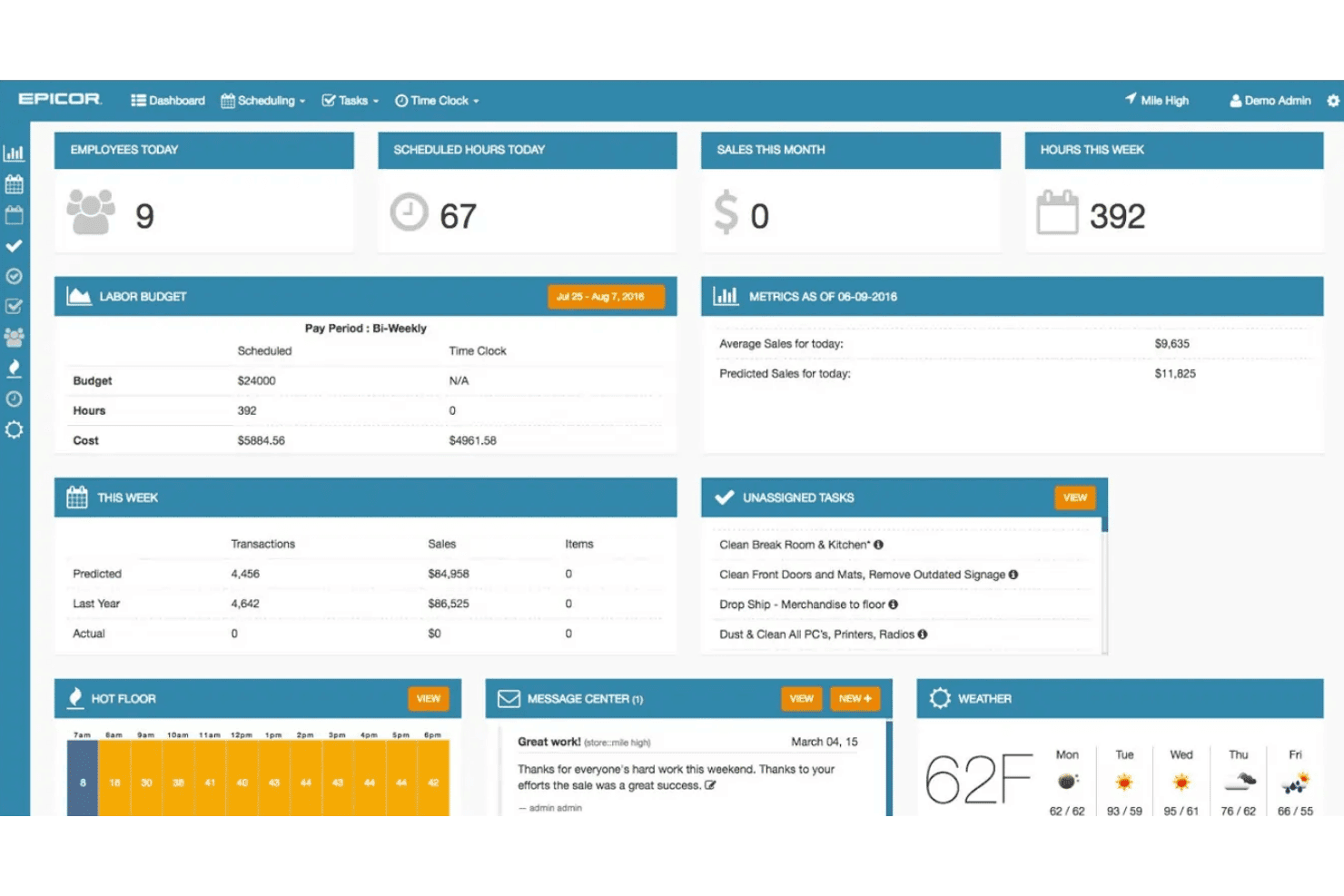
Epicor Eagle offers a centralized retail management dashboard displaying employee scheduling, labor budget, sales metrics, unassigned tasks, and weather forecasts. Epicor Eagle is a retail management platform built specifically for independent hardware, home center, and specialty retailers who need native POS, multi-location inventory, and integrated back-office accounting in a single system.
Who Is Epicor Eagle Best For?
It's a strong fit for multi-store retail operations teams running hardware, farm & home, building supply, or specialty retail businesses that need vertical-specific tools out of the box.
Why Epicor Eagle Is a Good SAP Alternative
I picked Epicor Eagle as one of the best SAP alternatives because it's built around hardware retail in a way SAP isn't. The Pricing Planner pulls in competitor and supplier data to model margin impact before committing to any price change. Market Basket Analysis drives real merchandising decisions, like restructuring product placement based on what customers buy together. Eagle also includes dedicated modules for FFL compliance and service and repair that SAP would need heavy customization to match.
Epicor Eagle Key Features
- Mobile Manager app: Manage inventory, access sales data, and approve purchase orders on the go from any mobile device.
- Integrated e-commerce storefront: Syncs in-store and online inventory for unified product and order management.
- Vendor Report Card: Track supplier performance on metrics like delivery time, accuracy, and cost changes.
- Service & Repair management: Schedule, track, and manage service orders and rental equipment within the same system.
Epicor Eagle Integrations
Epicor Eagle offers native integrations with Epicor Payment Exchange and Epicor PartExpert eCatalog. An API is available for custom integrations.
Pros and Cons
Pros:
- Built-in FFL compliance for firearms retailers
- Native POS syncs stores and ecommerce
- Hardware retail-specific modules out of the box
Cons:
- Dated interface compared to modern ERP alternatives
- Reporting configuration is complex for average users
Learn more about Epicor Eagle:
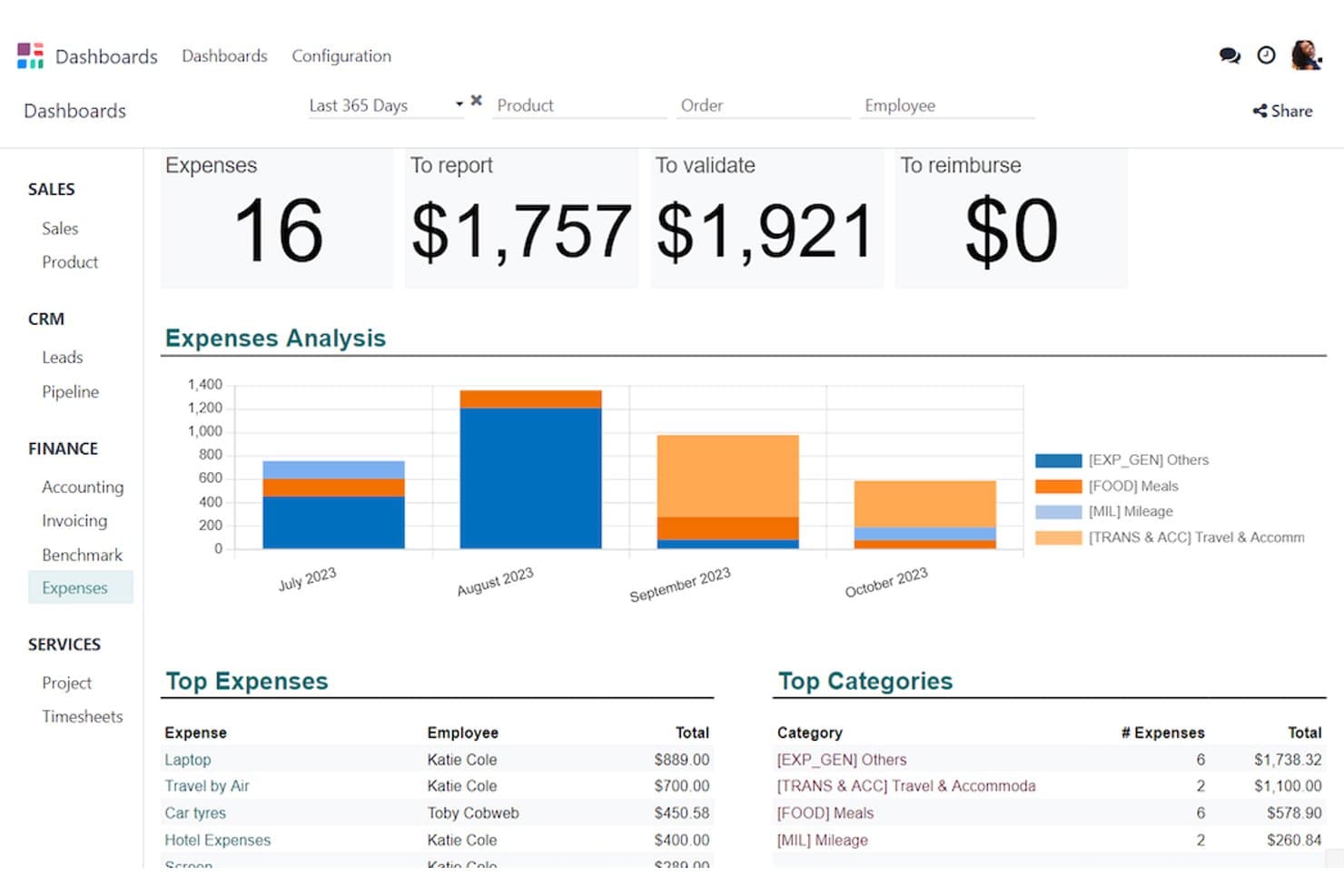
Odoo offers a Finance Expenses dashboard with expense analysis charts, top expenses by employee, and top categories with totals. Odoo is an open-source ERP platform that gives mid-sized retail businesses a single system for managing finance, inventory, supply chain, and POS — without the implementation cost and rigidity that come with SAP.
Who Is Odoo Best For?
Odoo is a strong fit for growing retail businesses that want a modular, customizable ERP they can self-host and adapt without relying on a vendor for every change.
Why Odoo Is a Good SAP Alternative
I've included Odoo in my top picks because its open-source architecture lets retail teams modify POS workflows and self-host on their own infrastructure, something SAP simply doesn't allow without massive consulting fees. I particularly like that the POS runs fully offline and auto-syncs to the central database when connectivity returns. Every POS transaction also updates inventory and accounting entries in real time, since everything shares one database.
Odoo Key Features
- Multi-company accounting: Consolidate financial data and transactions across multiple entities and currencies from one dashboard.
- Merchandise planning: Optimize product assortments and automate replenishment with built-in inventory and purchasing modules.
- Integrated CRM: Store customer profiles, segment data, and manage targeted marketing campaigns within the same platform.
- Procurement automation: Manage vendor relationships, purchase orders, and warehouse operations through a unified workflow.
Odoo Integrations
Odoo offers native integrations with Stripe, PayPal, Adyen, FedEx, UPS, DHL, and all core Odoo apps including CRM, Inventory, Accounting, and eCommerce. An API is available for custom integrations.
Pros and Cons
Pros:
- Modular adoption reduces upfront implementation scope
- Single database unifies POS, finance, and inventory
- Self-hostable with full source code access
Cons:
- Localization support varies widely by country
- Advanced reporting requires significant custom configuration
Learn more about Odoo: Best for real-time POS and store operations
- Free demo available
- Pricing upon request
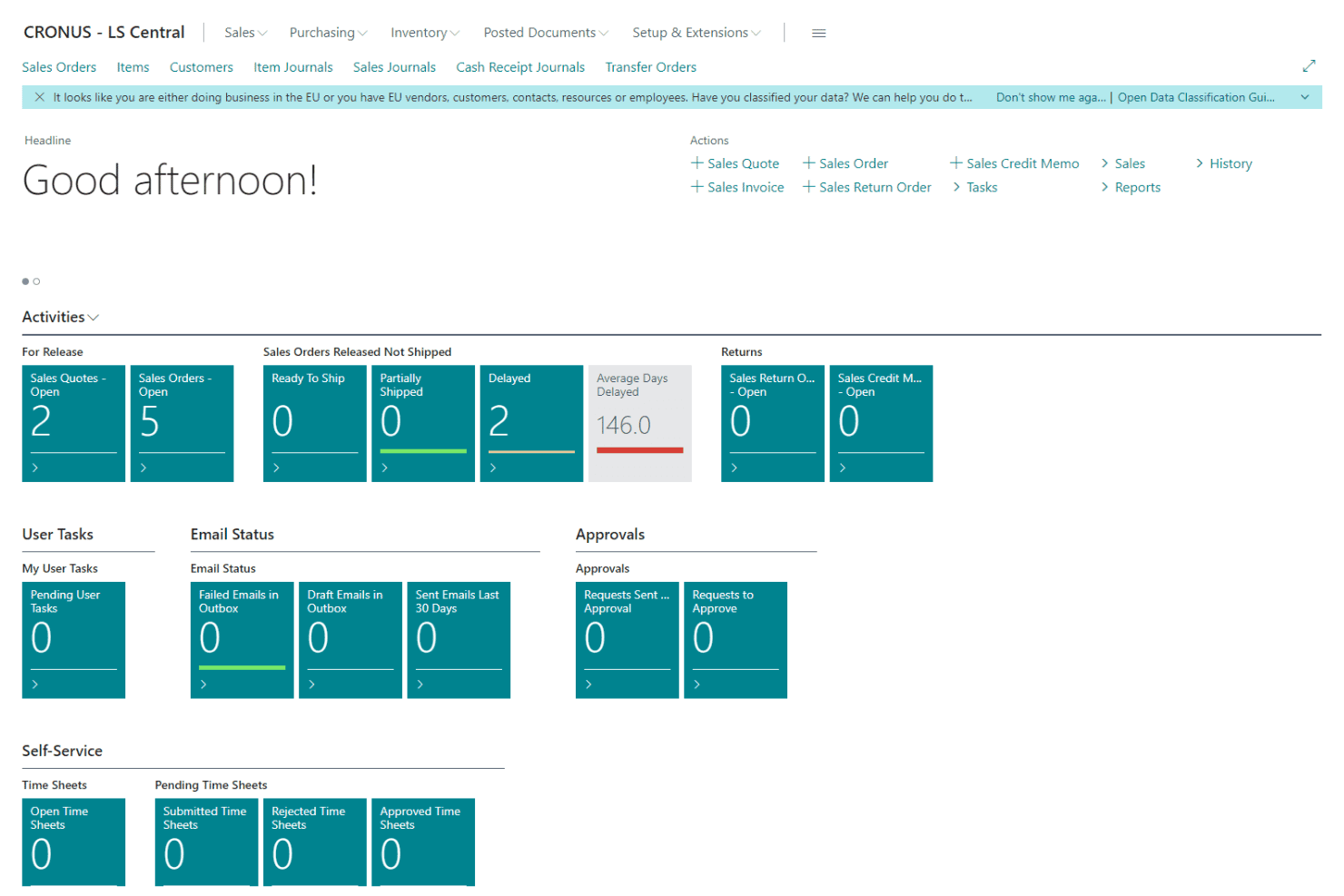
LS Retail offers a sales manager dashboard in LS Central with activity tiles for open quotes, orders, shipments, returns, email status, approvals, and time sheets. LS Central by LS Retail is a unified retail ERP built on Microsoft Dynamics 365 Business Central, designed for multi-store retailers who need POS, inventory, merchandising, and financials running on a single real-time data platform.
Who Is LS Retail Best For?
It's a strong fit for mid-market to enterprise retail and hospitality chains that already use or plan to adopt the Microsoft ecosystem.
Why LS Retail Is a Good SAP Alternative
I've included LS Retail in my top picks because the real-time POS architecture is genuinely unlike what SAP offers out of the box for retail. With LS Central, every transaction at the register syncs instantly to inventory, financials, and loyalty data on the same platform, so there's no lag between what's happening on the floor and what's visible in the back office. I also appreciate the native omnichannel POS layer, which handles mPOS, ePOS, and self-service from a single system rather than patching together separate tools.
LS Retail Key Features
- Unified merchandising management: Handle assortment planning, pricing, promotions, and allocation across every location in one system.
- Embedded financials with retail chart of accounts: Enable general ledger, AR/AP, and retail-specific reporting on a shared data platform.
- Automated replenishment engine: Run demand forecasting and automated purchasing workflows to keep stock at optimal levels.
- Role-based dashboards and retail KPIs: Give users at every level customizable dashboards showing sales, inventory, and financial metrics in real time.
LS Retail Integrations
LS Retail offers native integrations across the Microsoft ecosystem, including Microsoft Dynamics 365 Business Central, and provides connectors to SAP S/4HANA, Oracle, Shopify, and an API for custom integrations.
Pros and Cons
Pros:
- Deep retail-specific merchandising and replenishment tools
- Built on proven Microsoft Business Central ERP
- Real-time POS syncs across all channels
Cons:
- Advanced analytics relies on external Power BI
- Implementation is complex and time-consuming
Learn more about LS Retail:
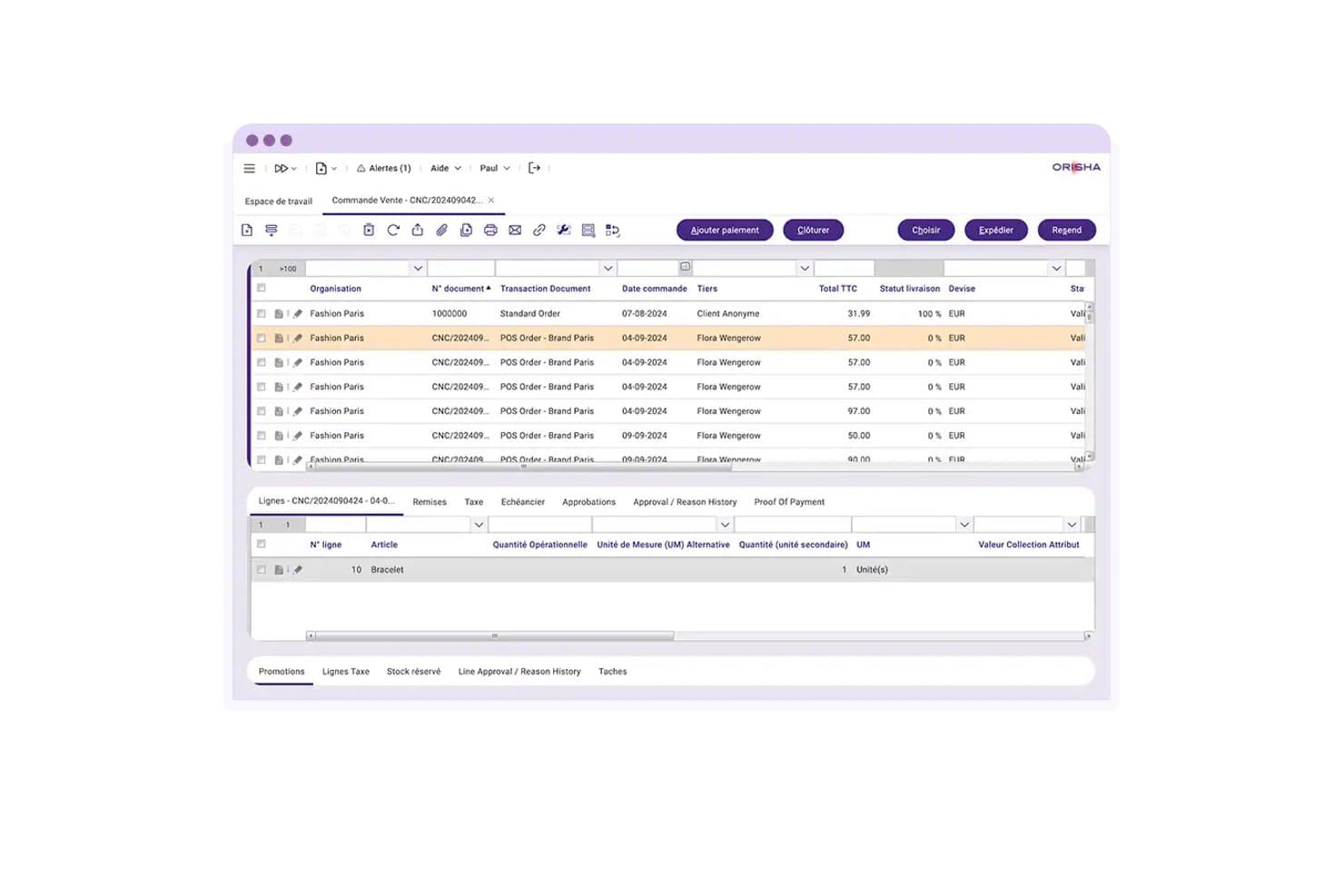
Orisha offers a detailed sales order management window with order lines, delivery status, and payment actions in its Commerce Central module. Orisha Commerce is a cloud-based unified commerce platform built for specialty retail chains that need to replace or extend SAP's retail layer with native POS, real-time inventory, and omnichannel order management across stores and digital channels.
Who Is Orisha Best For?
It's a strong fit for mid-size to large specialty retail chains operating across fashion, sporting goods, home furnishings, or DIY verticals with multiple store locations.
Why Orisha Is a Good SAP Alternative
I've included Orisha in my top picks because it handles merchandise distribution in ways that SAP's retail modules rarely match without heavy customization. I particularly like the agile assortment management combined with real-time stock visibility across every location, which means I can see exactly what's moving, where, and when. The built-in OMS handles supplier replenishments and order orchestration from a single platform, without needing a separate warehouse system bolted on.
Orisha Key Features
- In-store mobile clienteling: Lets associates use mobile devices for personalized customer service and product recommendations in real time.
- Centralized product information management: Offers a single platform to manage SKUs, attributes, and multichannel product data across all store locations.
- Integrated B2C, D2C, and B2B ecommerce: Supports multiple sales channels directly within the same cloud platform for unified operations.
- Real-time API library: Provides an extensive set of APIs for connecting external retail systems, ecommerce platforms, and supply chain partners.
Orisha Integrations
Orisha Commerce offers native integrations with SAP ERP, Adobe Commerce, Adyen, Avalara, EXACT, Frepple, Microsoft Dynamics AX, PrestaShop, VTEX, and authorize.net. An API is also available for custom integrations.
Pros and Cons
Pros:
- No on-premise store server infrastructure required
- Real-time stock visibility across all locations
- Native omnichannel POS across stores and ecommerce
Cons:
- Limited reach beyond specialty retail verticals
- No native general ledger or accounting
Learn more about Orisha: Best for unified commerce and financial management
- Free demo available
- Pricing upon request
Visit WebsiteCustomer Rating:4.2/5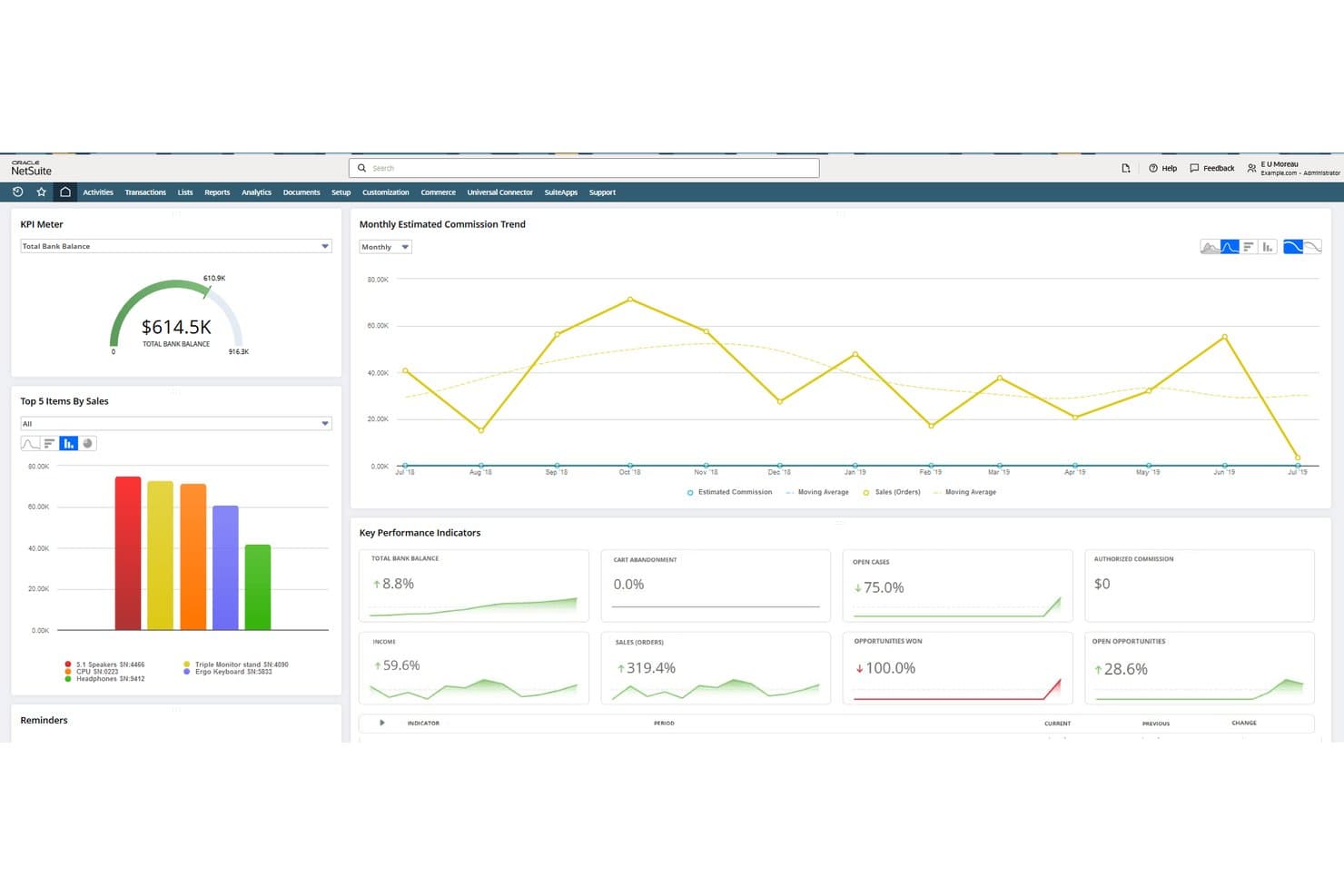
Oracle NetSuite offers a comprehensive dashboard with KPI meters, sales charts, commission trends, and performance indicators as an alternative to SAP. Oracle NetSuite Retail ERP is a cloud-native ERP platform built for omnichannel retailers who need to connect financials, inventory, POS, and ecommerce in a single system — without the implementation complexity and licensing fragmentation that comes with SAP.
Who Is Oracle NetSuite Retail ERP Best For?
NetSuite Retail ERP is a strong fit for mid-market and growing multi-location retailers that have outgrown entry-level accounting tools and need a unified system to manage operations across channels.
Why Oracle NetSuite Retail ERP Is a Good SAP Alternative
I've included NetSuite Retail ERP in my top picks because its single-database architecture genuinely eliminates the data silos that make SAP implementations so painful. Every transaction at the register, every online order, and every supplier invoice hits the same general ledger in real time, so your finance team isn't reconciling feeds from three separate systems. I also appreciate NetSuite's native retail POS, which keeps in-store and ecommerce data in sync without a third-party connector sitting in between.
Oracle NetSuite Retail ERP Key Features
- SuiteApps marketplace: Access industry-specific add-ons and integrations directly from NetSuite’s curated app directory.
- SuiteBuilder customization tools: Users can tailor forms, records, fields, and workflows for unique business processes without code.
- OneWorld global management: Manage multiple subsidiaries, currencies, and tax rules from a single centralized platform.
- Role-based dashboards: Provide every user with customizable, real-time views of relevant KPIs and critical business data.
Oracle NetSuite Retail ERP Integrations
NetSuite Retail ERP offers prebuilt connectors with Salesforce, Shopify, Outlook, and Bill.com, with additional apps available through the SuiteApps marketplace. An API is available for custom integrations.
Pros and Cons
Pros:
- Faster deployment than SAP S/4HANA implementations
- Native POS avoids third-party sync issues
- Real-time data across all retail channels
Cons:
- Customer support quality inconsistent post-implementation
- Add-on modules raise total ownership costs
Learn more about Oracle NetSuite: Best for low-code ERP with Microsoft 365
- 30-day free trial
- From $80/user/month (billed annually)
Visit WebsiteCustomer Rating:4/5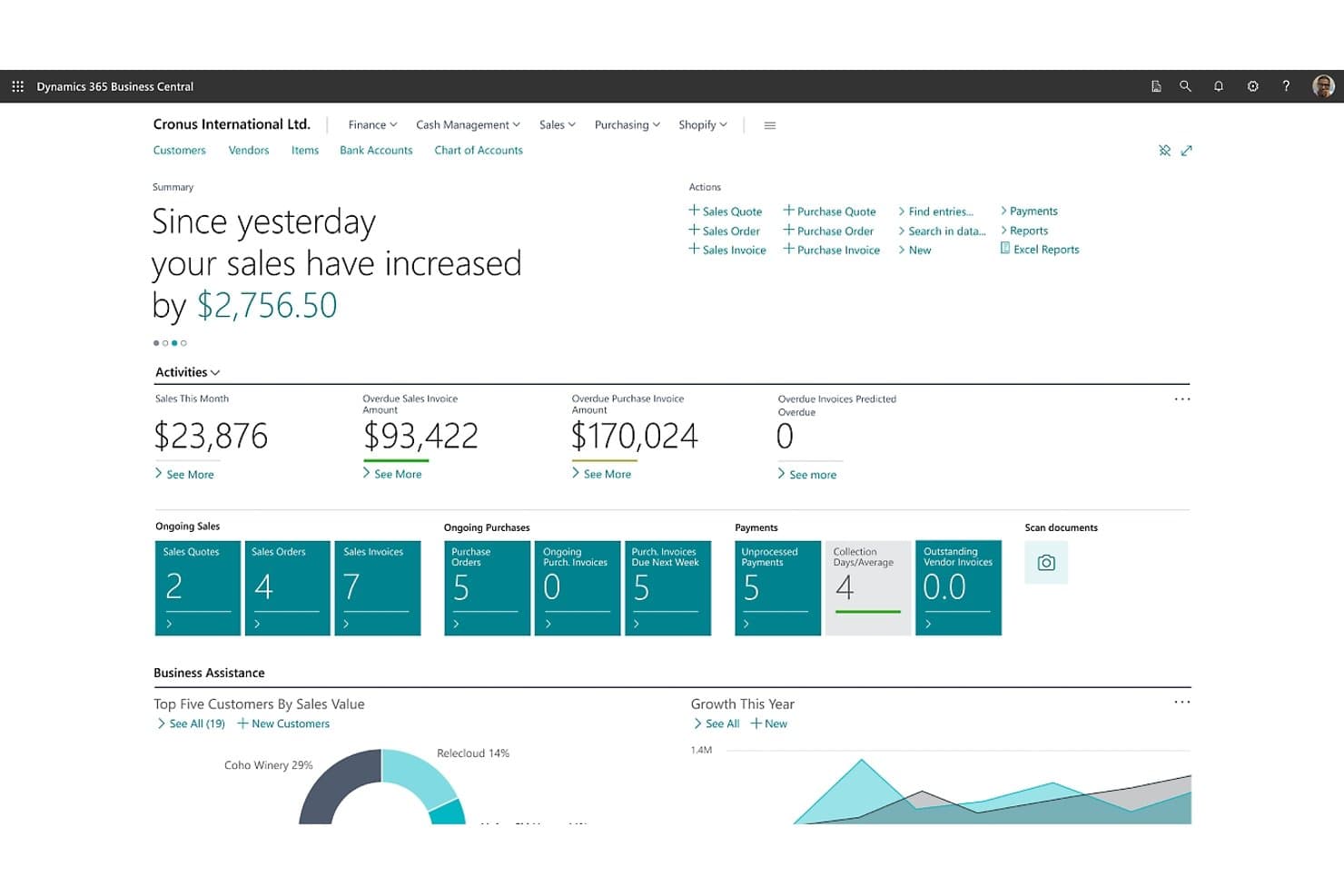
Microsoft Dynamics 365 Business Central offers a comprehensive financial dashboard displaying real-time sales growth, overdue invoices, ongoing purchases, and top customer analytics. Microsoft Dynamics 365 Business Central is a cloud-based ERP for small and mid-sized retailers who need to unify finance, inventory, supply chain, and sales data without the complexity or cost of enterprise platforms like SAP.
Who Is Microsoft Dynamics 365 Business Central Best For?
It's a strong fit for mid-market retail and wholesale businesses that are already running on Microsoft 365 and want ERP that connects directly to those existing tools.
Why Microsoft Dynamics 365 Business Central Is a Good SAP Alternative
I've included Microsoft Dynamics 365 Business Central in my top picks because of how it handles customization through the Power Platform. My team can build custom workflows in Power Automate or create role-specific apps in Power Apps without writing code. I also appreciate that live financial and inventory data surfaces directly inside Excel and Outlook, so retail teams work within tools they already use every day.
Microsoft Dynamics 365 Business Central Key Features
- Multi-location inventory management: Track inventory, SKUs, and purchase orders across multiple warehouses and retail stores in real time.
- Native Shopify integration: Sync inventory, orders, and fulfillment data automatically between Business Central and Shopify ecommerce.
- Advanced warehouse management: Use bar-code scanning, directed picking, and put-away processes to streamline warehouse operations.
- Financial consolidation and multicurrency: Consolidate financials across business entities, handle transactions in multiple currencies, and support global tax compliance.
Microsoft Dynamics 365 Business Central Integrations
Microsoft Dynamics 365 Business Central has native integrations across the Microsoft ecosystem, including Microsoft 365 and Azure, plus a native Shopify integration. Thousands of additional integrations are available through Microsoft AppSource, and an API is provided for custom integrations.
Pros and Cons
Pros:
- Automatic cloud updates require no IT intervention
- AI Copilot automates invoicing and cash forecasting
- Deep native Microsoft 365 and Teams embedding
Cons:
- Full CRM needs separate Dynamics 365 licenses
- Native retail POS requires third-party ISV apps
Learn more about Microsoft Dynamics 365 Business Central: Best for industry-tailored automation
- Free demo available
- Pricing upon request
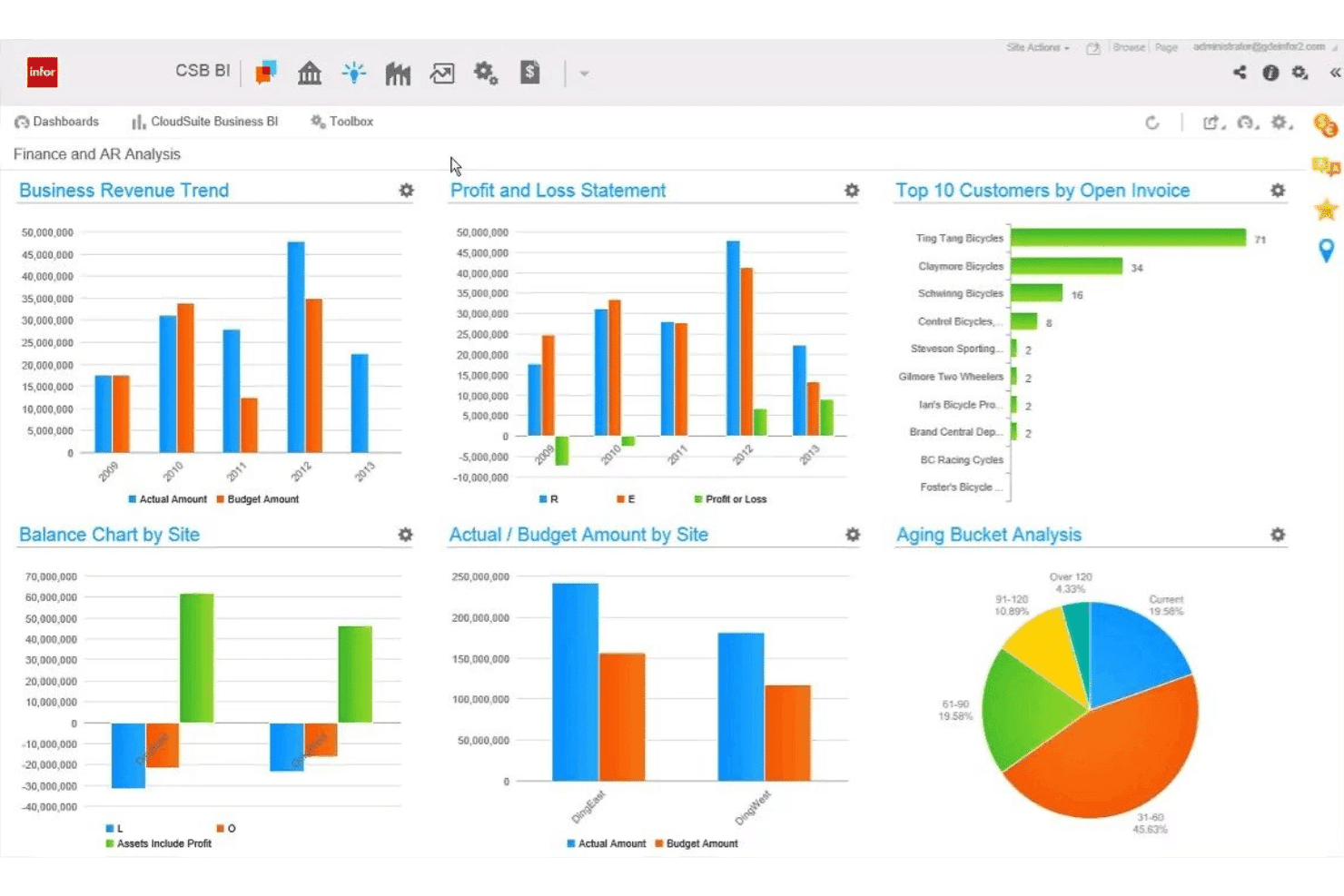
Infor CloudSuite offers a Finance and AR Analysis dashboard featuring revenue trends, profit/loss statements, customer invoices, and aging bucket analysis. Infor CloudSuite is a cloud ERP platform built for retail organizations that need industry-specific financial management, supply chain visibility, and merchandise planning without the implementation overhead of a traditional enterprise ERP like SAP.
Who Is Infor CloudSuite Best For?
It's a strong fit for mid-to-large retail enterprises running multi-location or omnichannel operations that need a pre-configured ERP without heavy custom development.
Why Infor CloudSuite Is a Good SAP Alternative
I've included Infor CloudSuite in my top picks because its industry-tailored automation goes deeper than what SAP offers out of the box. Where SAP requires extensive configuration to fit retail workflows, Infor ships with 60+ pre-configured retail micro-verticals, including apparel color and size matrices and merchandise planning. Coleman AI runs natively within those workflows, triggering demand sensing alerts and anomaly detection without any custom development on your part.
Infor CloudSuite Key Features
- Multi-entity financial consolidation: Consolidates accounting, tax, and reporting across multiple retail entities and jurisdictions.
- Merchandise hierarchy management: Organizes products by categories, styles, colors, and sizes for detailed inventory and planning.
- Warehouse and fulfillment management: Manages inbound, outbound, and internal transfers across multiple distribution centers.
- Role-based analytics dashboards: Offers pre-built, real-time dashboards tailored to retail finance, merchandising, and supply chain roles.
Infor CloudSuite Integrations
Infor offers native integrations with Shopify, DocuSign, Salesforce, ServiceNow, ADP, Twilio, Microsoft Dynamics 365, and more. An API is available for custom integrations.
Pros and Cons
Pros:
- Multi-entity financial consolidation built for retail
- Coleman AI runs natively within ERP workflows
- Pre-configured retail micro-verticals reduce setup time
Cons:
- Steeper learning curve for non-retail ERP teams
- Implementation typically requires specialized Infor partner support
Learn more about Infor CloudSuite: Best for ecommerce automation and scalability
- Free demo available
- Pricing upon request
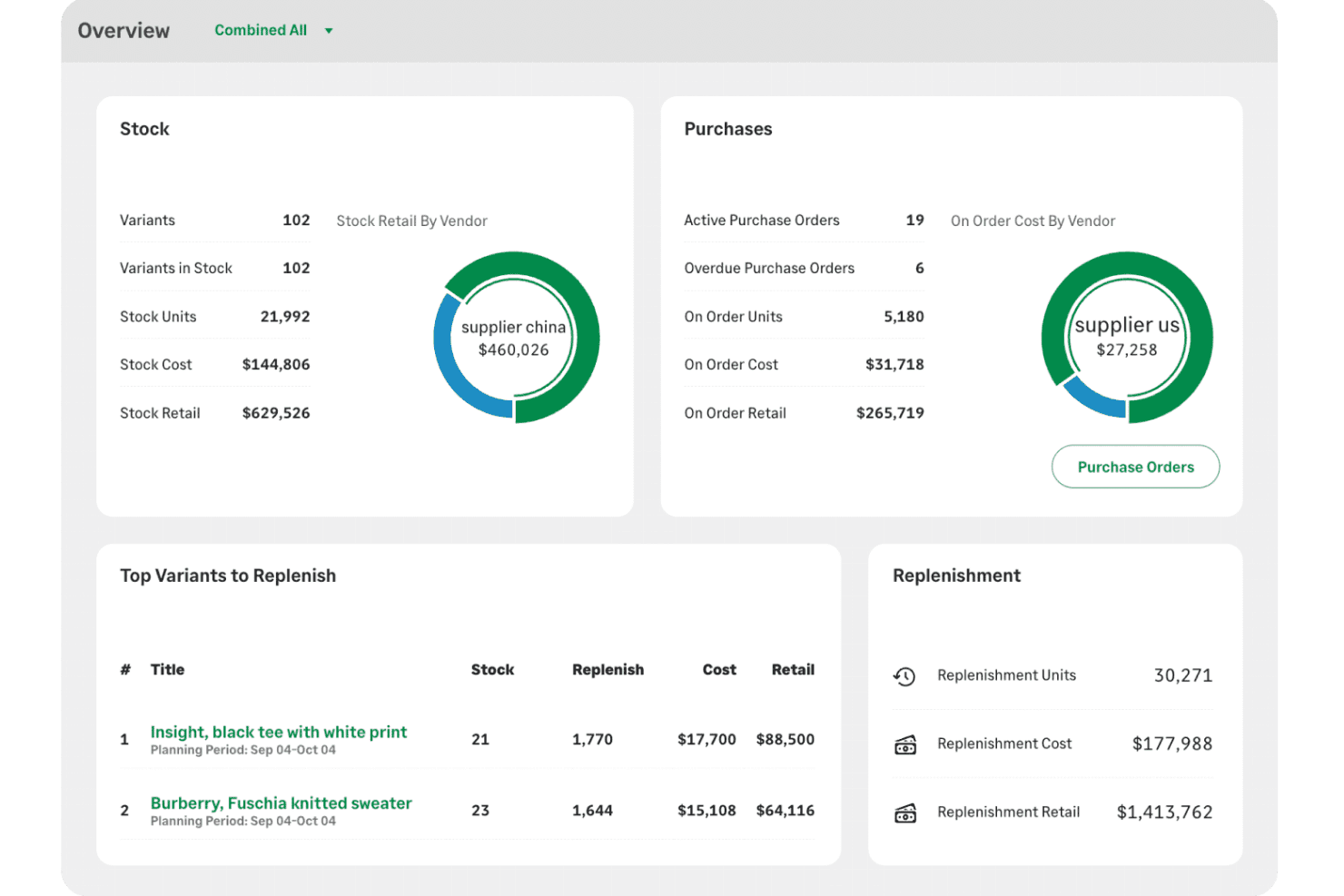
Sage Brightpearl offers an inventory and purchasing overview dashboard with stock levels, purchase orders, replenishment data, and top variants to reorder. Sage Brightpearl is a retail-native ERP platform built for omnichannel retailers who need to unify inventory, order management, and accounting without the complexity or cost of traditional enterprise systems like SAP.
Who Is Sage Brightpearl Best For?
It's a strong fit for mid-market retailers and ecommerce brands scaling across multiple sales channels who've outgrown entry-level tools but don't need full enterprise ERP complexity.
Why Sage Brightpearl Is a Good SAP Alternative
I've included Sage Brightpearl in my top picks because of how well its automation engine handles order routing at scale. When order volumes spike across Shopify, Amazon, and wholesale channels simultaneously, Brightpearl's automation rules process and route each order without manual input, using FIFO cost accounting and real-time inventory sync to keep financials accurate as you grow. I also appreciate that unlimited users are bundled into the pricing, so scaling your team doesn't compound your costs the way it does with SAP licensing.
Sage Brightpearl Key Features
- Integrated retail accounting: Connects sales, inventory, and accounting data for real-time reconciliation and retail-specific financial reporting.
- Multi-location inventory management: Tracks stock, SKUs, and purchase orders across warehouses, stores, and fulfillment centers.
- Native ecommerce and POS integrations: Provides plug-and-play connections to Shopify, Amazon, and leading POS platforms for unified transaction data.
- Demand planning tools: Supports merchandise planning and replenishment with built-in forecasting and inventory optimization features.
Sage Brightpearl Integrations
Sage Brightpearl offers native integrations with Shopify, Amazon, Sage Intacct, Xero, QuickBooks, Bill.com, and leading shipping and 3PL providers. An API is available for custom integrations.
Pros and Cons
Pros:
- Real-time inventory and accounting stay in sync
- Faster go-live than traditional ERP deployments
- Retail-native order automation at scale
Cons:
- Multi-entity consolidation relies on external integrations
- Advanced reporting requires additional BI tools
Learn more about Sage Brightpearl: Best for unlimited-user omnichannel commerce
- Free demo available
- Pricing upon request
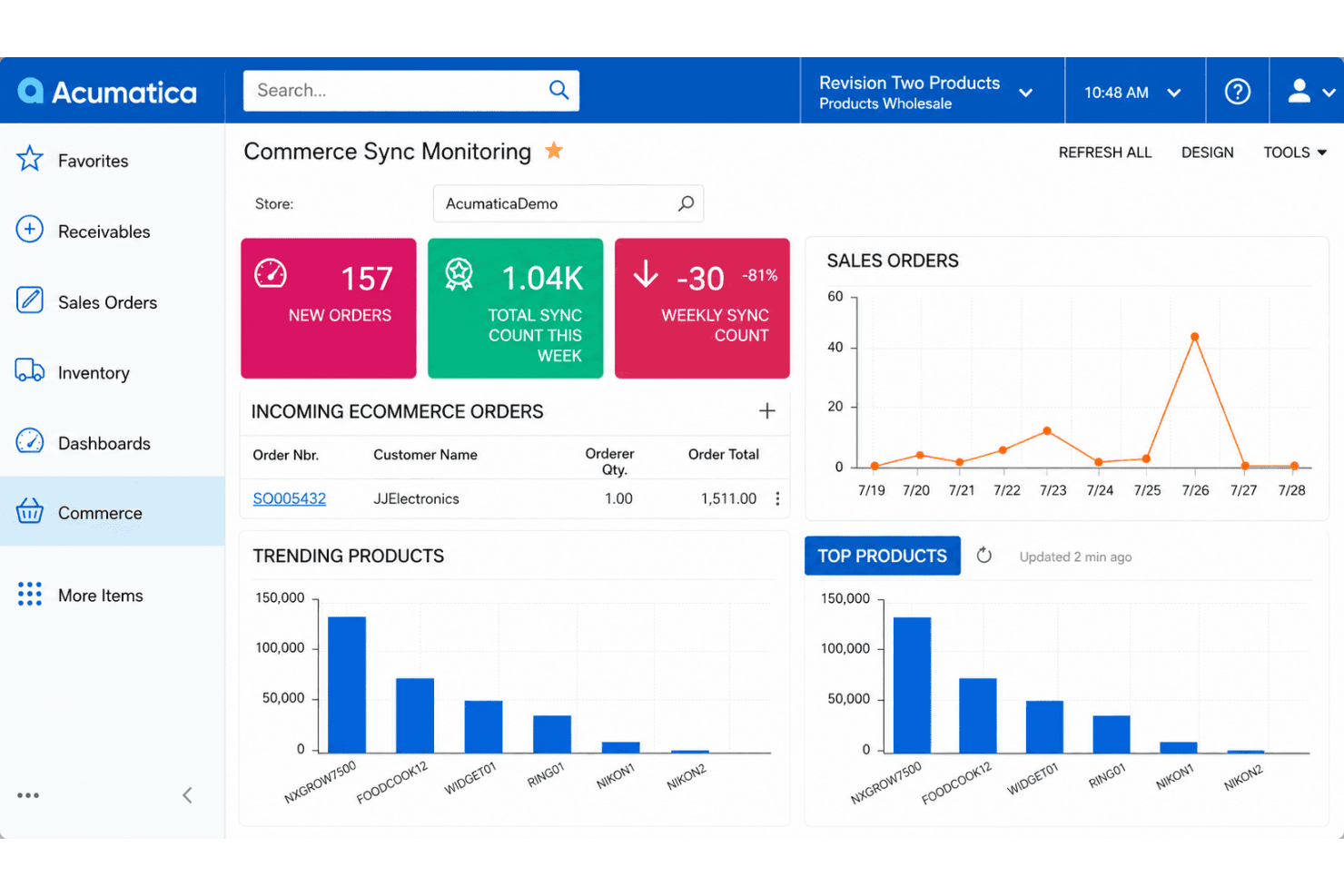
Acumatica Retail Edition offers a Commerce Sync Monitoring dashboard displaying new orders, sync counts, trending products, and sales order trends in one unified view. Acumatica Retail Edition is a cloud ERP built for mid-market retailers who need to connect financials, inventory, POS, and ecommerce channels in one platform without the licensing complexity and cost that comes with enterprise systems like SAP.
Who Is Acumatica Retail Edition Best For?
It's a strong fit for growing mid-market retailers operating across multiple store locations and sales channels who need a scalable ERP without per-user licensing costs.
Why Acumatica Retail Edition Is a Good SAP Alternative
I've included Acumatica Retail Edition in my top picks because its consumption-based licensing means I'm not paying per seat as my team grows. The native POS syncs with Shopify, BigCommerce, and Amazon in real time, keeping inventory and orders accurate across every channel. I also appreciate matrix items for managing size, style, and color variants without any workarounds.
Acumatica Retail Edition Key Features
- Native warehouse management system (WMS): Manage inventory, picking, packing, and shipping inside a unified platform.
- Advanced multi-entity financials: Support for multiple companies, currencies, and intercompany transactions within a single environment.
- Customizable workflow automation: Automate approvals, order routing, and task assignments with tailored, low-code configuration.
- Real-time reporting dashboards: Build and share dashboards featuring live KPIs and drill-down analytics across channels.
Acumatica Retail Edition Integrations
Acumatica Retail Edition offers native connectors with Shopify, BigCommerce, and Shopify POS and offers marketplace integrations with Amazon, Walmart, eBay, Adobe Commerce, WooCommerce, and more. An API is also available for custom integrations.
Pros and Cons
Pros:
- Matrix inventory handles variants across multiple locations
- Native omnichannel POS syncs in real time
- Unlimited-user licensing reduces total cost of ownership
Cons:
- Implementation typically needs a certified VAR partner
- Reporting requires partner support to customize
Learn more about Acumatica Retail Edition:
Andre SAP-alternativer
Her er noen flere SAP-alternativer som ikke kom med på kortlisten min, men som likevel er verdt å se nærmere på:
- 11Cegid Retail OneBest for brand retail management
- 12Oracle RetailBest for advanced merchandising and allocation
- 13EpicorBest for retail supply chain tracking
- 14Cin7Best for inventory and warehouse control
- 15Shopify POSBest for physical and online retail integration
- 16Lightspeed RetailBest for retail POS with advanced analytics
- 17Aptos RetailBest for unified inventory and order management
- 18Gofrugal RetailEasyBest for rapid multi-store deployment
How I Evaluate SAP Alternatives
I first check that each platform covers what SAP delivers at its core—multi-entity financials, inventory across locations, POS sync, and supply chain ops. Then I evaluate the differentiators that separate one alternative from another.
Core Functionality (Table Stakes For This List)
When I'm selecting tools for my list, I rank each one on a scale from 0 (does not offer the functionality) to 5 (excels in this area) for each core functionality listed below. Then, I calculate the tool's total score into a percentage. Each tool needs to achieve a minimum total score of 75% to be considered for inclusion.
- Financial Management: I look for full GL, AP/AR, and multi-entity consolidation so retailers closing books across dozens of stores aren't stuck reconciling in spreadsheets.
- Inventory & Merchandising: Each platform should track SKUs and stock across locations, with purchase orders and merchandise planning that support seasonal allocation cycles.
- Supply Chain Management: I evaluate procurement workflows, warehouse operations, and demand forecasting—especially how well a platform handles vendor coordination at scale.
- Retail POS Integration: Whether it's a native POS or pre-built connectors, I check that transaction data syncs in real time between registers, ecommerce storefronts, and back-office systems.
- Reporting & Analytics: Dashboards need to surface retail KPIs like sell-through rate and margin by category, with drill-down capability that doesn't require a separate BI tool to be useful.
- CRM & Customer Data: I look at how each platform captures purchase history and supports segmentation, since loyalty and repeat-purchase programs depend on clean, unified customer profiles.
Once I have a list of tools that meet the criteria, I consider what sets each platform apart.
Differentiating Factors (What Sets Vendors Apart)
Here's how I compare and contrast different vendors:
Standout Features
Composable ERP architecture is a big differentiator. Modular, API-first platforms let you start with finance and inventory, then add supply chain later—without buying into a monolithic suite. Embedded AI for demand forecasting and automated invoice matching matters too, especially for retailers managing thousands of SKUs across seasons. I also look for pre-built retail accelerators, since templates and data models tuned for merchandise planning can shave months off go-live.
Beyond Features
Licensing transparency matters a lot here. SAP's module-based pricing is notoriously complex, so I evaluate whether alternatives offer clear per-user or consumption-based models with predictable renewals. Integration interoperability is equally important—retailers running Shopify or Salesforce alongside their ERP need pre-built connectors or open APIs, not custom middleware projects. I also check for multi-entity, multi-currency, and local tax compliance support, since retailers expanding into new markets can't afford to outgrow their ERP.
Hvorfor se etter et SAP-alternativ?
Selv om SAP er et godt valg av ERP-programvare for detaljhandel, finnes det flere grunner til at noen brukere ser etter alternative løsninger. Det kan hende du ser etter et SAP-alternativ fordi …
- Høye totale eierkostnader og kompleks lisensiering
- Langvarige tidsplaner for implementering og utrulling
- Begrenset fleksibilitet for krav til detaljhandel i rask utvikling
- Unødvendig komplekst brukergrensesnitt for ikke-tekniske brukere
- Vanskeligheter med å integrere med verktøy for netthandel eller kassasystemer
- Vanskelig å skalere ned for mellomstore eller voksende detaljhandelsbedrifter
Hvis noe av dette høres kjent ut, har du kommet til rett sted. Listen min inneholder flere alternativer for ERP-programvare for detaljhandel som passer bedre for team som møter disse utfordringene med SAP og ser etter alternative løsninger.
Viktige SAP-funksjoner
Her er noen av de viktigste funksjonene i SAP, slik at du kan sammenligne hva alternative løsninger tilbyr:
- Finansstyring: Sentraliserer hovedbok, leverandørgjeld og kundefordringer, budsjettering og støtter finansiell konsolidering på tvers av flere enheter for detaljhandelsbedrifter med komplekse driftsprosesser.
- Lagerstyring og vareutvalg: Sporer lagernivåer, SKU-er og produktsammensetninger på tvers av flere kanaler og lokasjoner, slik at teamene kan unngå utsolgte varer og overfylte lagre.
- Forsyningskjedestyring: Håndterer innkjøp, leverandørforhold, lagerdrift og etterspørselsprognoser for å holde varene i effektiv bevegelse fra leverandører til butikker.
- Integrasjon med kassasystemer: Kobler SAP til fysiske og nettbaserte salgssteder, slik at transaksjons- og lagerdata forblir synkronisert på tvers av butikk- og netthandelsmiljøer.
- Rapportering og analyse: Tilbyr instrumentpaneler og rapporter som dekker salg, økonomi, lager og drift, slik at teamene kan ta beslutninger basert på sanntidsinnsikt som kan settes ut i praksis.
- CRM og kundedata: Lagrer kundeprofiler og kjøpshistorikk og støtter segmentering for å muliggjøre personlig markedsføring, lojalitetsprogrammer og målrettede kampanjer.
- Integrasjon med netthandel: Integreres med netthandelsplattformer, slik at detaljhandelsbedrifter kan administrere digitale butikker, lager og ordreoppfyllelse fra ett samlet system.
- Etterlevelsesstyring: Gir innebygd støtte for skatte-, lov- og regnskapsregler i ulike regioner, slik at detaljhandelsbedrifter kan ekspandere internasjonalt uten krevende etterlevelsesutfordringer.
- Arbeidsflytautomatisering: Automatiserer godkjenninger, varsler og repetitive oppgaver ved hjelp av regelbaserte arbeidsflyter, slik at medarbeiderne kan konsentrere seg om aktiviteter med høyere verdi.
- Flervaluta og lokalisering: Støtter transaksjoner, rapportering og lager i flere valutaer og språk for detaljhandelsbedrifter som opererer på tvers av landegrenser.